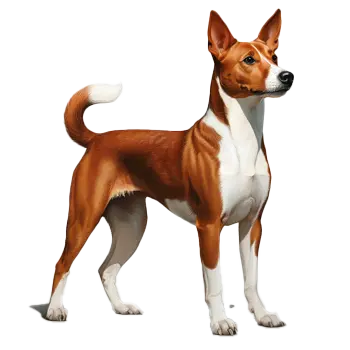
The Zande Dog is a study in elegant efficiency, a small to medium-sized hunting dog whose every physical feature reflects thousands of years of natural selection in the forests and savannas of Central Africa. This is not a breed shaped primarily by human aesthetic preferences in a show ring. It is a dog designed by its environment to be fast, agile, silent, and self-sufficient, and every line of its body tells that story.
Standing approximately 43 centimeters at the shoulder for males and 40 centimeters for females, with weights around 11 and 9.5 kilograms respectively, the Zande Dog presents a square, balanced silhouette that appears taller than it is long. The legs are proportionally long relative to the body, giving the breed a high-stationed appearance that provides excellent visibility in tall grass and allows for the explosive leaping behavior the breed is known for. Basenjis will frequently stand upright on their hind legs, stretching tall to survey their surroundings, a behavior that earned them the local name dog that jumps up and down in some African communities.
The head is one of the breed's most distinctive features. It is finely chiseled with a flat skull, moderately wide between the ears, that tapers gracefully toward the muzzle. The forehead carries fine wrinkles that appear when the ears are pricked forward, giving the dog a perpetually thoughtful or slightly worried expression that is part of the breed's unmistakable character. The eyes are almond-shaped, dark, and set somewhat obliquely, conveying intelligence and alertness. The ears are small, pointed, and carried perfectly erect, set well forward on the top of the skull. The muzzle is shorter than the skull, with a clean, dry profile and a black nose.
The neck is of good length, well crested, and slightly full at the base of the throat, flowing smoothly into well-laid-back shoulders. The body is short and level-backed with a deep chest that reaches approximately to the elbow, providing the lung capacity necessary for sustained pursuit running. The ribs are well sprung and oval rather than barrel-shaped, allowing for efficient movement at speed. The loin is short and the underline rises sharply into a well-defined tuck-up, contributing to the breed's athletic, racy appearance.
The tail is set high on the croup and curls tightly over to one side of the spine, lying closely against the thigh. This distinctive tight curl is one of the breed's signature features and should not be straightened or manipulated, as the tail contains delicate bones that can be injured. The tail set and carriage contribute significantly to the breed's overall silhouette and are considered essential breed type.
The coat is short, sleek, and fine in texture, lying close to the body with a natural sheen that reflects the breed's good health. This minimal coat requires almost no maintenance and produces very little odor, a characteristic that sets the Basenji apart from virtually every other domestic dog breed. The breed is known for grooming itself in a catlike manner, licking and cleaning its coat fastidiously. Accepted colors include rich chestnut red, pure black, tricolor with black and tan markings, and brindle with a red background overlaid with black stripes. All color patterns require white on the feet, chest, and tail tip, with white legs, blaze, and collar being optional.
Movement is one of the defining qualities of the Zande Dog. The breed covers ground with a swift, tireless, swinging stride that appears almost effortless. The legs carry straight forward without paddling or weaving, and the topline remains level and steady even at speed. This efficient gait reflects the breed's heritage as a pursuit hunter capable of covering significant distances through varied terrain without exhausting itself.
Affectionate With Family
★★★☆☆
The Zande Dog bonds intensely with its primary person and extends warmth to the household, but affection is expressed on the dog's terms rather than on demand. Expect proximity and loyalty more than constant cuddling.
Good With Young Children
★★☆☆☆
The breed can coexist with respectful older children but does not tolerate rough handling or teasing. Families with very young kids should carefully evaluate whether this independent breed fits their situation.
Good With Other Dogs
★★★☆☆
The Zande Dog is selective about canine companions and can be quarrelsome, particularly with dogs of the same sex. Early socialization and careful introductions improve the chances of peaceful cohabitation.
Shedding Level
★★☆☆☆
The short, fine coat sheds modestly, with a slightly heavier seasonal shed occurring roughly twice per year. Overall shedding volume is low compared to most breeds.
Coat Grooming Frequency
★☆☆☆☆
This may be the easiest breed to groom in the entire canine world. The Zande Dog cleans itself like a cat, and weekly brushing with a soft brush is all that is typically needed.
Drooling Level
★☆☆☆☆
The Zande Dog is an exceptionally clean breed that produces virtually no drool under any circumstances. This is one of the breed's most appealing characteristics for owners who value household tidiness.
Coat Type
★☆☆☆☆
The coat is short, sleek, fine, and close-lying with a natural sheen. It produces almost no odor, making the Basenji one of the cleanest-smelling dog breeds in existence.
Openness To Strangers
★★☆☆☆
The breed approaches unfamiliar people with calm reserve rather than enthusiastic greeting. It observes and evaluates before deciding whether engagement is warranted, reflecting its ancient, self-reliant heritage.
Playfulness Level
★★★★☆
The Zande Dog is an energetic and curious breed with a playful streak that persists well into adulthood. Its play style tends toward chasing, exploring, and creative mischief rather than traditional fetch games.
Watchdog/Protective Nature
★★★☆☆
While the breed does not bark, it is highly alert and will vocalize with its characteristic yodel or growl when something unusual is detected. It is watchful by nature without being aggressively protective.
Adaptability Level
★★★☆☆
The Zande Dog adapts reasonably well to different living situations including apartments, provided its exercise needs are met. Its sensitivity to cold weather and need for mental stimulation are the primary limiting factors.
Trainability Level
★★☆☆☆
Intelligence is abundant but cooperation is selective. The breed learns quickly and understands commands perfectly well but reserves the right to evaluate each request before deciding whether to comply.