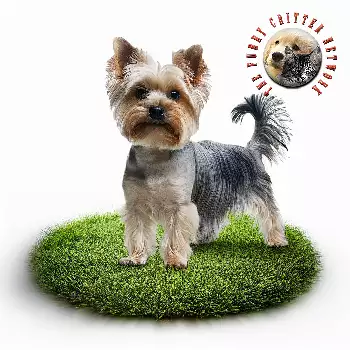
The Yorkshire Terrier is a compact, well-proportioned toy dog that carries itself with the confidence and carriage of a much larger animal. The breed standard's language emphasizes a dog of quality and elegance whose appearance of vigor and self-importance defines its presence in the show ring. That self-importance is not an affectation - it is a genuine expression of the terrier character that persists beneath the glamorous coat.
The skull is flat on top and moderately rounded at the sides. The muzzle is medium in length, proportionate to the skull. The nose is black. The teeth meet in a scissors bite, though a level bite is also acceptable in some registries. The overall head is small and neat, covered in long, flowing tan hair that contributes significantly to the breed's characteristic appearance.
The eyes are one of the breed's most expressive features. Medium-sized and not prominent, set rather forward in the skull, they are dark and bright with a keen and intelligent expression. The sparkling, alert quality of a Yorkie's eyes is one of the first things people notice about the breed. Eye rims are dark. Light, prominent, or round eyes are considered faults in the show standard.
The ears are small, V-shaped, and carried erect. They are set not too far apart and covered with short tan hair. The upright ear carriage contributes to the alert, perky expression that is characteristic of the breed. Puppies may have ears that take weeks or months to come fully erect - this is normal and typically resolves by six months of age.
The neck is medium-length and clean, flowing into well-laid-back shoulders. The body is compact, short-backed, and level. The chest is moderate - neither narrow nor barrel-shaped. The loin is short and the hindquarters well angulated with muscular thighs. Despite the small size, the Yorkshire Terrier's body should convey quality and balance, not frailty.
The tail is traditionally docked in countries where docking is legal, carried slightly higher than the level of the back. In countries where docking is prohibited - which now includes the UK and most of Europe - the natural tail is long and plumed with darker blue hair on the upper surface and tan below. The natural tail, properly carried, is fully acceptable and does not detract from breed type.
Feet are round and compact with black nails and arched toes. The pads are firm. The legs are straight and moderately boned for the breed's size - neither coarse nor appearing spindle-thin.
The coat is the most immediately distinctive feature of the Yorkshire Terrier. In show trim, it is one of the most remarkable coats in the dog world - perfectly straight, brilliantly shining, silky in texture, and falling from a centre part along the spine to floor length on each side. The head hair is gathered in a topknot or parted and falls to each side. The long ear hair blends into the facial fall. The color division is precise: steel blue from the back of the skull to the tail root, with a deeper, darker blue along the spine; rich tan everywhere else, deepest at the chest and paling slightly on the extremities.
Companion or "pet" trims are the practical reality for most Yorkshire Terriers. The puppy cut or teddy bear trim clips the body coat to a manageable length of one to two inches while maintaining a pleasant appearance. This dramatically reduces daily maintenance requirements while making the dog considerably more comfortable in warm weather. Show-quality dogs in show coat are a commitment that most pet owners neither need nor want to sustain.
Male and female Yorkshire Terriers are similar in size and appearance. The standard does not specify different dimensions for the sexes. Both should be under seven pounds, compact, and well-balanced with the characteristic color pattern. In practice, bitches are sometimes slightly more refined in head and expression.
The movement of a Yorkshire Terrier should be free and active, with straight legs driving from behind and reaching well in front. Movement that is stilted, paddling, or crossing indicates structural problems beneath the coat. In the show ring, movement is evaluated after the coat, but for a companion dog living an active life, the structural integrity that produces correct movement matters practically. A Yorkshire Terrier with poorly angulated hindquarters or luxating patellas does not move correctly, and that affects long-term joint health regardless of whether the dog is being shown.
The groomed and finished Yorkshire Terrier in show trim is an arresting visual - the straight parted coat falling to the floor, the perfectly blue and tan color, the bow in the topknot. In companion trim the same dog has a more approachable, teddy-bear quality that many owners prefer. Both presentations reflect the same underlying dog: small, well-built, alert, and unmistakably a Yorkshire Terrier.
Affectionate With Family
★★★★★
Yorkshire Terriers are devoted to their families and thrive on close human companionship. They often select a favorite person and become intensely attached, following them from room to room.
Good With Young Children
★★☆☆☆
Their tiny, fragile frames make them vulnerable to injury from rough handling or falls. They do better with calm older children who understand gentle interaction than with toddlers.
Good With Other Dogs
★★★☆☆
Yorkshire Terriers have a bold attitude toward other dogs that can exceed their actual size advantage. They generally do well with similarly sized dogs but may challenge larger dogs inappropriately.
Shedding Level
★☆☆☆☆
The silky single coat sheds minimally, more like hair than fur. Yorkshire Terriers are a realistic option for households concerned about dog hair, though no dog is truly hypoallergenic.
Coat Grooming Frequency
★★★★★
Show coats require daily brushing and meticulous maintenance. Companion trims need brushing several times a week and professional grooming every six to eight weeks. This is a high-maintenance coat.
Drooling Level
★☆☆☆☆
Clean-mouthed and dry. Drooling is not associated with this breed.
Coat Type
★★★★★
The full show coat is one of the most demanding in dogdom - fine, silky, straight, and floor-length. Even in practical companion trim, the coat requires regular professional attention.
Openness To Strangers
★★★☆☆
Yorkshire Terriers vary from outgoing and curious to reserved with strangers, depending on socialization. Their terrier alertness often shows as watchful reserve before warming up.
Playfulness Level
★★★★☆
Lively and playful, Yorkshire Terriers enjoy games, toys, and interactive activity. Their energy is surprising for their size and they can sustain play with enthusiasm.
Watchdog/Protective Nature
★★★★★
Outstanding watchdogs who notice everything and report everything. Their bold, alert nature and willingness to bark makes them effective alarms despite their small size. Over-barking can be a management challenge.
Adaptability Level
★★★★★
Yorkshire Terriers adapt well to apartment living, city life, and a wide range of owner lifestyles. Their small size and moderate exercise needs make them one of the most versatile small breeds.
Trainability Level
★★★☆☆
Intelligent but with a terrier's independence and strong opinions about what they want to do. Training works well with positive reinforcement and consistency; they respond poorly to heavy-handed methods.