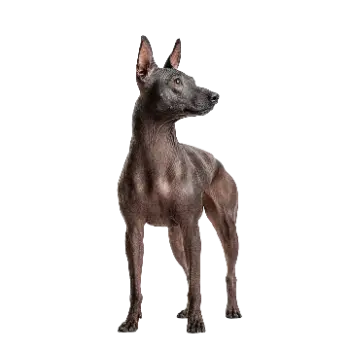
To look at a Xoloitzquintle is to see a dog stripped to its architectural essence. Without a coat to soften or obscure the underlying structure, the hairless variety presents every line of its body with complete transparency. The musculature, the skeletal proportions, the way the skin drapes over the ribcage and tucks along the abdomen are all visible in a way that no coated breed can match. This nakedness is the defining feature of one of the most ancient breeds in the world, a dog whose form has been refined by thousands of years of environmental pressure in Mesoamerica rather than by human selection for fashion or function.
Three size varieties exist within the breed, all sharing the same proportional structure and type. The toy variety stands up to fourteen inches at the withers and weighs ten to fifteen pounds, suitable for lap companionship and apartment living. The miniature measures fourteen to eighteen inches and weighs fifteen to thirty pounds, a versatile middle ground. The standard variety stands eighteen to twenty-three inches and weighs thirty to fifty-five pounds, carrying enough substance to serve as a credible home guardian. All three present a body that is slightly longer than tall, creating a gently rectangular profile. The chest drops to the level of the elbows, and the belly draws upward in a clean tuck that accentuates the lean athleticism of the entire frame.
The head has a strong, wedge-shaped configuration that narrows from a moderately broad skull toward a well-proportioned muzzle. The stop between the forehead and the nasal bridge is present but shallow, creating a smooth topline from crown to nose tip. The ears are perhaps the breed's most visually arresting feature. Set high on the skull, they are large, thin-textured, and held fully erect, giving the dog an expression of perpetual alertness that many observers compare to a bat. The eyes are medium-sized, almond-shaped, and set slightly obliquely in the skull. Their color ranges from pale yellow through amber to deep brown and black, generally harmonizing with the surrounding skin tone. The overall facial expression conveys intelligence, composure, and a watchful awareness of the surroundings.
Skin quality in the hairless variety is central to the breed's identity and its appeal. The skin is smooth, tight over the musculature, resilient to the touch, and noticeably warm against human skin. Minor wrinkling on the forehead is acceptable in younger dogs but the skin should fit cleanly across the body in mature adults. Small patches of coarse hair may appear on the top of the skull, on the toes, and on the final portion of the tail, though extensive coverage beyond these areas is penalized. The color palette is remarkably broad, spanning solid tones of black, gray-black, slate, bronze, red, liver, and fawn, as well as spotted and splashed combinations where multiple pigments share space across the body. The coated variety is covered entirely in a short, flat, close-lying coat that requires no trimming and presents a smooth, sleek appearance.
The tail extends as a natural continuation of the spine, long and tapered to a fine point. At rest it hangs in a relaxed curve, and in motion or alertness it rises to or slightly above the topline without ever curling tightly over the back. The feet are hare-shaped, elongated with well-arched toes and firm pads designed for the varied terrain of their ancestral homeland.
In movement the Xoloitzquintle displays an efficient, ground-covering gait that reflects its functional heritage. The stride is smooth and free, with balanced reach from the forequarters and corresponding drive from the rear. The topline remains steady and level throughout, and the limbs track cleanly without paddling or crossing. There is an effortless quality to the way this breed moves that speaks to thousands of years of natural selection for a body that works rather than one that merely looks impressive standing still.
Affectionate With Family
★★★★★
This breed bonds to its household with an intensity that traces back thousands of years. The Xoloitzquintle craves proximity to its people and thrives on daily physical closeness.
Good With Young Children
★★★☆☆
Older children who understand respectful interaction make the best companions for this breed. Its protective nature may prompt it to manage rough play between younger kids.
Good With Other Dogs
★★★☆☆
Coexistence with familiar dogs is generally harmonious, especially when relationships are established early. New canine introductions require patience and careful management.
Shedding Level
★☆☆☆☆
The hairless variety is essentially shed-free. The coated variety produces only minimal loose hair that is easily managed with occasional brushing.
Coat Grooming Frequency
★☆☆☆☆
Traditional grooming is replaced by a simple skin care routine for the hairless variety. The coated variety needs only a weekly once-over with a soft brush.
Drooling Level
★☆☆☆☆
The Xoloitzquintle is a clean, dry-mouthed breed that produces essentially no drool in normal daily life.
Coat Type
★☆☆☆☆
The hairless variety presents smooth, warm skin with possible sparse tufts on the head, toes, and tail. The coated variety has a short, flat, close-fitting coat.
Openness To Strangers
★★☆☆☆
An inherent wariness toward unfamiliar people reflects this breed's ancient guardian heritage. It assesses newcomers carefully before extending trust.
Playfulness Level
★★★★☆
The breed maintains a spirited, sometimes clownish playfulness that extends well into adulthood, surprising owners who expect its composed appearance to define its personality.
Watchdog/Protective Nature
★★★★★
Thousands of years of guarding human households have produced a breed with deeply embedded protective instincts and reliable alertness to anything unusual.
Adaptability Level
★★★☆☆
The breed adjusts to varied living environments when its core needs for human companionship and climate-appropriate conditions are consistently addressed.
Trainability Level
★★★★☆
Intelligent and capable of rapid learning, the Xoloitzquintle brings an independent mind to training that responds best to positive, collaborative methods.