Xolo

Xoloitzcuintli

Quick Facts

🐕 Breed Group
Non-Sporting Group
📏 Size Category
Small to Large (three sizes)
📏 Height
Males: 10-23 inches, Females: 10-23 inches
⚖️ Weight
Males: 10-55 lbs, Females: 10-55 lbs
⏱️ Life Expectancy
13-18 years
🧣 Coat Type
Hairless or Short, Flat Coat
🎨 Coat Colors
Black, Gray-Black, Slate, Bronze, Red, Liver, Fawn, Spotted
😀 Temperament
Loyal, Calm, Alert, Watchful, Affectionate
🏃 Exercise Needs
Moderate to High
🎓 Training Difficulty
Moderate
👶 Good with Children
Better with older children
🐾 Good with Other Pets
Selective, best with early socialization

Other Names & Breed Recognition

If you have ever heard someone casually mention a Xolo, they were talking about one of the oldest and most fascinating dog breeds on the planet. Xolo, pronounced show-lo, is the universally accepted shorthand for the Xoloitzcuintli, a name so challenging to spell and pronounce that even seasoned dog enthusiasts sometimes stumble over it. The abbreviated form has become the standard way to refer to this breed in casual conversation, on social media, in breed club communications, and increasingly in formal writing as well. The Xoloitzcuintli Club of America itself uses Xolo throughout its publications and website, acknowledging that the shortened name has become the practical default for English speakers who love the breed but prefer not to wrestle with Nahuatl phonetics every time they mention their dog.

The full name Xoloitzcuintli derives from two words in the Nahuatl language spoken by the Aztecs. Xolotl was the god of fire, lightning, and death, a deity depicted with a canine head who was believed to have created this dog from a sliver of the sacred Bone of Life. Itzcuintli simply means dog. Together they form a name that translates roughly to dog of the god Xolotl. The breed also goes by several other names depending on context and region. Xoloitzcuintle and Xoloitzquintle are alternate transliterations of the same Nahuatl source word. Xolito uses the Spanish diminutive suffix to create a more affectionate variation. In English-speaking countries outside of breeding circles, the breed is commonly known as the Mexican Hairless Dog, a descriptive name that emphasizes the most visually distinctive feature of the hairless variety. In Mexico, the hairless version is sometimes called the perro pelon mexicano.

Recognition of this ancient breed spans every major international kennel club. The American Kennel Club places the Xolo in its Non-Sporting Group, having restored full recognition in 2011 after a decades-long absence from its registry. The United Kennel Club has recognized the breed since 1993. The Federation Cynologique Internationale, through Mexico's membership, classifies the breed under Group 5 as a Spitz and Primitive Type. The Kennel Club of Great Britain registers the breed under the name Mexican Hairless. The Canadian Kennel Club also grants full recognition. No matter which name appears on the paperwork, each registry is referring to the same remarkable ancient breed that comes in three sizes and two coat varieties.

Xolo Organizations & Standards

The Xolo holds a unique position in the world of organized dog breeding as a natural, primitive breed that predates the kennel club system by thousands of years. When breed registries began cataloging and standardizing dogs in the nineteenth century, the Xolo was already ancient history. The American Kennel Club was among the first to take notice, registering a Mexican import named Mee Too in 1887 under the name Mexican Hairless Dog. But interest was sparse, registrations were minimal, and the breed's only early AKC champion, a dog called Chinito Junior, earned his title in 1940 during what amounted to a last flicker of attention before the AKC dropped the breed entirely in 1959.

The revival effort centered on the Xoloitzcuintli Club of America, established in October 1986 with the specific mission of restoring AKC recognition. The club compiled a stud book, held annual specialty shows, published a quarterly newsletter called The Xolo News, and maintained an active rescue network. Their persistence paid off when the AKC voted to readmit the breed to its Miscellaneous Class in 2008, effective January 2009, followed by full Non-Sporting Group recognition on January 1, 2011. All three sizes and both coat varieties were accepted from the beginning, and FSS-registered Xolos had been eligible for AKC performance events since January 2007.

The United Kennel Club granted recognition on January 1, 1993, and its standard provides detailed guidance on the breed's structure and presentation. The UKC evaluates both hairless and coated varieties together in conformation, while separating the three size varieties for exhibition. The standard emphasizes a clean, graceful silhouette with medium bone proportionate to overall size, and lists specific disqualifications including blue eyes, cropped ears, docked tails, and albinism that reflect the expectation of a completely natural presentation.

The Federation Cynologique Internationale recognized the breed in 1956, the year after the famous Xolo Expedition recovered ten foundation dogs from remote Mexican villages. As the breed's country of origin, Mexico holds the FCI standard, and the breed is classified under Group 5, Spitz and Primitive Types, Section 6, Primitive Type. The FCI standard is the international reference document and has been translated into the organization's four working languages. The Kennel Club of Great Britain permits the breed to be shown under the name Mexican Hairless, and the Canadian Kennel Club also maintains full recognition. Across all organizations, the standard describes the same dog: a moderate, balanced, naturally developed breed whose form reflects function shaped by evolution rather than human aesthetic preference.

Kennel Club Recognition

  • American Kennel Club (AKC): Recognized in 2011, Non-Sporting Group
  • United Kennel Club (UKC): Recognized, Companion Dog Group
  • Canadian Kennel Club (CKC): Recognized, Group 6 - Non-Sporting
  • FCI: Recognized, Group 5 - Spitz and Primitive Types
  • The Kennel Club (UK): Recognized, Utility

Xolo Physical Description

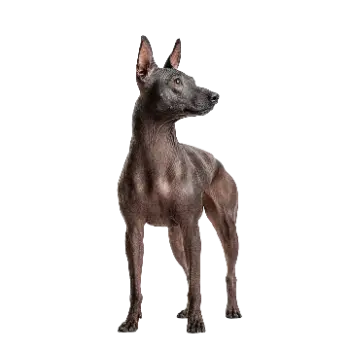
The first thing most people notice about a Xolo is the absence of what they expect to see. There is no coat to admire, no flowing fur to frame the face, no plush undercoat to run your fingers through. In the hairless variety, the dog's architecture is completely exposed, every muscle visible beneath smooth, warm skin that feels nothing like what you might expect from a bare animal. The overall silhouette is lean, athletic, and unmistakably purposeful. This is a dog whose body tells the story of its evolution without any cosmetic overlay, and that raw structural honesty is a large part of what draws people to the breed.

The Xolo comes in three distinct size varieties that share identical proportions and breed type. Toy Xolos stand up to fourteen inches at the withers and weigh between ten and fifteen pounds. Miniature Xolos measure fourteen to eighteen inches and carry fifteen to thirty pounds. Standard Xolos, the largest and most imposing variety, stand eighteen to twenty-three inches and weigh thirty to fifty-five pounds. In all three sizes, the body presents a slightly rectangular profile, longer than tall, with a deep chest that reaches to the elbows and a well-tucked abdomen that creates a clean, athletic underline. The back is level and firm, ending in a gently rounded croup.

The head gives the Xolo much of its character. Viewed from above, it is broad through the skull and tapers toward a moderately long muzzle that is strong without being blunt. The stop is minimal, creating a smooth transition from forehead to nose. The most striking facial features are the ears, which are large, thin-textured, and carried fully erect in a position high on the skull. They give the breed its distinctive alert, attentive expression that many people describe as bat-like. The eyes are medium-sized and almond-shaped, varying from yellow to black depending on the skin color, and they carry an expression of calm intelligence.

The skin of the hairless Xolo is its most defining physical feature and the source of much of the breed's mystique. It is smooth, resilient, and noticeably warm to the touch, fitting snugly over the musculature beneath. Small tufts of coarse hair may appear on the top of the head, the tips of the toes, and the terminal portion of the tail, but these should be sparse rather than abundant. Skin colors range widely across black, gray-black, slate, bronze, red, liver, and fawn, with many dogs displaying spotted or splashed patterns where darker and lighter pigments intermingle across the body. The coated variety wears a short, flat, smooth coat that lies close to the body and covers it completely, presenting a sleek appearance that contrasts with the dramatic nakedness of its hairless littermates.

The tail is long, thin, and tapered to a fine point. It hangs in a natural curve at rest and rises to or slightly above the level of the back when the dog is moving or alert. The feet are distinctly hare-like, with elongated toes, moderate webbing, and well-developed pads that speak to the breed's origins on varied terrain.

Movement reveals the Xolo's athletic nature clearly. The gait is free, easy, and ground-covering, with good reach from the front assembly and strong drive from the hindquarters. There is no choppiness or wasted effort. The topline holds firm and steady during movement, and the legs track cleanly without excessive convergence or divergence. Watching a Xolo move at a trot, you see the functional efficiency of a dog that was never bred to exaggerate any physical feature but simply to move well through the world as nature intended.

Affectionate With Family
The Xolo attaches to its family with an intensity that goes beyond typical canine devotion, seeking constant closeness and involvement in every aspect of household life.
Good With Young Children
Best suited to families with older children who can read canine body language. The breed's protective nature may lead it to intervene in boisterous play.
Good With Other Dogs
Generally accepting of dogs raised alongside it but selective about new canine introductions. Early socialization significantly improves its comfort with unfamiliar dogs.
Shedding Level
The hairless variety produces no shed hair whatsoever. The coated variety sheds at such minimal levels that it barely registers on furniture or clothing.
Coat Grooming Frequency
There is no coat to groom in the hairless variety. Skin care replaces traditional grooming, and the coated variety needs only weekly brushing.
Drooling Level
This is a notably clean-mouthed breed with virtually no drooling tendency under normal conditions.
Coat Type
The hairless variety presents bare, smooth skin with possible sparse tufts on the head and tail. The coated variety has a short, sleek, close-lying coat.
Openness To Strangers
Reserve with unfamiliar people is a consistent breed trait rooted in its ancient watchdog heritage. The Xolo warms up gradually once it assesses a newcomer as safe.
Playfulness Level
Beneath its dignified exterior, the Xolo maintains a genuinely playful and sometimes clownish streak that persists well beyond puppyhood into adult life.
Watchdog/Protective Nature
Home protection is hardwired into the Xolo's temperament through thousands of years of serving as a household guardian. Its vigilance is instinctive and reliable.
Adaptability Level
Adapts well to different living arrangements as long as climate needs and the requirement for close human companionship are consistently met.
Trainability Level
Quick to learn and capable of mastering complex tasks, but brings an independent mind that requires patient, positive, and consistent training methods.

Xolo History & Development

The name Xolo is not just a convenient abbreviation. It is the most widely used term for a breed whose formal name has defeated casual pronunciation attempts for centuries. When someone says Xolo, they are invoking the first half of Xolotl, the Aztec god of fire, lightning, and death who mythology credits with creating this dog from a fragment of the Bone of Life. The shortened form strips away the linguistic complexity while preserving the direct connection to the deity whose name this breed carries. It has become the standard casual reference across North America and increasingly worldwide, used by breeders, owners, veterinarians, and judges who all recognize it immediately.

The breed behind the name is among the oldest documented in the Americas. Archaeological evidence places hairless dogs matching the modern Xolo's description in Mesoamerican civilizations dating back more than three thousand five hundred years. Clay and ceramic figurines recovered from burial sites of the Colima, Maya, Toltec, Zapotec, and Aztec peoples depict dogs that are structurally indistinguishable from the Xolo we know today. These ancient civilizations regarded the breed as sacred. The Aztecs believed that Xolotl created the dog specifically to guard the living and to guide the souls of the dead through the nine perilous levels of Mictlan, the underworld. Dogs were sacrificed and interred alongside their deceased owners to serve as spiritual escorts on that final journey.

The Spanish conquest of the sixteenth century nearly ended the breed's existence. The conquistadors consumed Xolos as a convenient protein source and their imported European dogs crossbred freely with the native population, diluting the gene pool severely. By the nineteenth century, purebred Xolos survived mainly in isolated mountain communities where indigenous peoples had maintained them apart from outside influence. The breed's fortunes shifted during the cultural awakening that followed the Mexican Revolution of 1910, when intellectuals and artists reclaimed indigenous symbols as expressions of national identity. Frida Kahlo and Diego Rivera kept Xolos and featured them prominently in their artwork, helping elevate the breed from obscurity to cultural icon.

The formal preservation effort culminated in the Xolo Expedition of 1954. Breed historian Norman Pelham Wright, with FCI endorsement, led a team into the remote Colima jungle to locate surviving purebred dogs. They recovered ten animals of sound structure, and these became the foundation of a systematic breeding program. The Mexican Kennel Club registered the breed in 1955, the first standard was adopted on May 1, 1956, and the breed was designated the Official Dog of Mexico. That FCI recognition gave the Xolo international status through Mexico's membership in the global organization.

The American chapter of the Xolo's story has its own twists. First registered with the AKC in 1887 as the Mexican Hairless Dog, the breed languished for decades with minimal registrations. Its sole early AKC champion, Chinito Junior, earned his title in 1940. By 1959, the AKC removed the breed from its studbook. The Xoloitzcuintli Club of America, founded in 1986, spent a quarter century rebuilding before the AKC granted full recognition again in 2011.

Xolo Temperament & Personality

The Xolo's temperament is unlike anything you encounter in breeds that were purpose-built during the last few centuries of selective breeding. This is a primitive dog whose behavioral patterns were shaped by thousands of years of coexistence with human civilizations in a role that combined companionship, home protection, and spiritual significance. The result is a personality that feels simultaneously ancient and deeply modern, a dog that reads situations with remarkable perceptiveness and responds with an intelligence that experienced owners describe as almost uncanny.

Loyalty is the foundation of the Xolo's character. These dogs bond intensely with their families and particularly with the individual who provides the most consistent daily care and attention. That bond is not the eager-to-please servility you see in some sporting and herding breeds. It is something deeper and more reciprocal, a genuine attachment that expects presence and engagement in return. The Xolo wants to be wherever you are, doing whatever you are doing. It will follow you from room to room, settle at your feet while you work, and position itself where it can monitor both you and the entrance to whatever space you occupy. This shadow-like devotion is endearing to people who want an intimate canine partnership and overwhelming to those who prefer a more independent pet.

The flip side of that devotion is a well-documented susceptibility to separation anxiety. A Xolo left alone for extended hours without preparation and gradual conditioning may vocalize persistently, destroy household items, or display physiological stress responses that go beyond ordinary boredom. This is not a breed you can leave in a crate for a full workday and expect to find content when you return. The Xolo needs either consistent human presence or careful training to tolerate separations, and ideally a household where someone is home for most of the day.

Wariness toward strangers is a core temperament trait that connects directly to the breed's ancient guardian role. The Xolo does not approach unfamiliar people with immediate friendliness. It watches, evaluates, and takes its cues from the behavior of its owner and the body language of the newcomer. Given time and a non-threatening introduction, most Xolos warm up and accept new people readily. But that initial reserve is consistent and should be respected rather than forced through. Socialization during puppyhood is essential to ensure this natural caution remains measured rather than tipping into fearfulness or reactivity.

The Xolo's relationship with other animals depends heavily on individual temperament and early experience. Dogs raised with other pets from puppyhood generally coexist comfortably, but the breed possesses a moderate prey drive and an independent streak that can complicate introductions to unfamiliar animals later in life. With familiar dogs, many Xolos are playful and socially engaged. With unknown dogs, they tend to be cautious and sometimes assertive about their personal space. The breed's energy level sits in the moderate-to-high range, with a distinctive pattern of intense activity followed by deep, almost meditative calm once physical and mental needs have been met.

Xolo Family Life & Living Requirements

Bringing a Xolo into your family is a commitment to a relationship that operates on a deeper level than many people expect from a pet dog. These are not casual animals that slot quietly into the background of a busy household. They demand involvement, reward attention with fierce loyalty, and make their displeasure known when they feel neglected or excluded. For families who understand and embrace that dynamic, the Xolo becomes one of the most rewarding companions in the canine world. For families looking for a low-maintenance pet that entertains itself, it is emphatically the wrong choice.

The breed does best with older children who have learned how to interact with dogs respectfully. The Xolo's protective instincts are genuine and deeply embedded, which means it may attempt to manage situations where it perceives a family member being handled roughly, even if the rough handling is just children playing. Families with toddlers or very young children should wait until the kids are old enough to understand canine body language before introducing a Xolo into the household. With school-age children and teenagers who treat the dog with consideration, the Xolo forms bonds that are remarkably deep and mutually enriching.

Climate management is a practical reality of Xolo ownership that cannot be overlooked. The breed originated in the tropical environments of Mexico and Central America, and the hairless variety in particular has no built-in insulation against cold. In northern climates, winter outings require protective clothing, and the dog should be considered primarily an indoor companion during colder months. Summer brings a different concern for hairless Xolos with lighter or spotted skin, as sunburn is a real risk during prolonged outdoor exposure. The coated variety handles temperature extremes somewhat better but still lacks the heavy insulation of breeds developed for cold climates.

The Xolo adapts well to various living spaces as long as its emotional and physical needs are met. Apartments work perfectly fine for the toy and miniature sizes, and even the standard can manage in a smaller home if daily exercise is consistent. A fenced yard is helpful but not essential. What matters far more than square footage is the quality and quantity of time the family spends actively engaged with the dog. A Xolo in a mansion whose owners travel constantly will be miserable. A Xolo in a studio apartment with an owner who includes it in daily life will thrive.

Xolo Training & Exercise Needs

The Xolo is a highly intelligent breed that picks up new concepts quickly, but intelligence in this dog does not translate to automatic obedience. There is an independent quality to the Xolo's mind that means it evaluates requests before deciding whether to comply. This is not defiance in the way that a stubborn bulldog might simply refuse to move. It is more like a negotiation, where the dog weighs the value of what you are asking against its own assessment of the situation. Owners who approach training as a collaborative process built on positive reinforcement, consistency, and mutual respect will find the Xolo to be a willing and often enthusiastic student. Those who rely on force or intimidation will find a dog that shuts down emotionally and becomes increasingly difficult to reach.

Socialization during the first sixteen weeks of life is the single most important investment a Xolo owner can make. The breed's natural reserve toward strangers, which is a legitimate and useful temperament trait in a watchdog, needs to be balanced by early positive exposure to a wide range of people, environments, sounds, and situations. A well-socialized Xolo retains its watchful nature but develops the confidence to distinguish between actual threats and normal daily encounters. A poorly socialized Xolo becomes a dog that barks at everything, retreats from unfamiliar situations, and creates stress for everyone in the household.

The adolescent period between six months and roughly two years of age is widely acknowledged by experienced Xolo owners as the most challenging phase of the dog's development. During this stage, the breed's intelligence, energy, and growing physical confidence combine to produce a dog that actively tests the limits of every rule its owner has established. Boundaries that seemed well understood during puppyhood suddenly become suggestions to be challenged. Experienced owners describe this period as the make-or-break phase and consistently advise patience, firmness, and an unwavering commitment to the training foundation laid in early puppyhood.

Daily exercise is essential and should be calibrated to the individual dog's size and energy level. Standard Xolos need genuine physical activity every day, not a leisurely stroll but a brisk walk, a jog, a hike, or an extended session of active play. The breed performs well in agility and other dog sports that combine physical exertion with mental challenge. Toy and miniature varieties need less total exercise volume but still benefit from regular outdoor exploration and interactive play. Mental stimulation matters as much as physical exercise for this breed. Puzzle toys, training sessions, and novel experiences all help satisfy the Xolo's active mind and prevent the boredom-driven destructiveness that under-stimulated dogs of this breed are known for.

Xolo Health Concerns

One of the genuine advantages of owning a Xolo is the breed's overall robust health, a direct benefit of its status as a natural breed shaped by evolution rather than intensive selective breeding. Where many popular breeds carry the accumulated genetic burden of centuries of selection for extreme physical traits, the Xolo's gene pool has remained relatively broad and its structure moderate. The result is a dog with a lifespan of thirteen to eighteen years and a relatively short list of breed-specific health concerns compared to many of its purebred peers.

The breed club recommends standard health screenings including hip evaluation, cardiac examination, patellar luxation assessment, and ophthalmology checks. Hip dysplasia exists in the breed but at rates lower than in many similarly sized breeds. Patellar luxation appears occasionally, more often in the smaller size varieties. Eye conditions are infrequent but monitoring is sensible given the breed's long lifespan. The most common owner-created health issue is obesity. Xolos genuinely love food and will eat well past the point of satiation if allowed. Controlled portions, scheduled meals, and resistance to those expressive eyes begging for extras are the simplest preventive measures an owner can take.

Common Health Issues

  • Skin conditions including sunburn - Acne, and dryness in the hairless variety
  • Incomplete dentition linked to the hairless gene affecting tooth development - Incomplete dentition linked to the hairless gene affecting tooth development
  • Patellar luxation occurring more frequently in toy and miniature sizes - Patellar luxation occurring more frequently in toy and miniature sizes
  • Hip dysplasia present at lower rates than many comparably sized breeds - Hip dysplasia present at lower rates than many comparably sized breeds
  • Obesity resulting from the breed's strong appetite when food intake is uncontrolled - Obesity resulting from the breed's strong appetite when food intake is uncontrolled
  • Occasional eye conditions warranting periodic ophthalmology screening - Occasional eye conditions warranting periodic ophthalmology screening

Preventive Care & Health Monitoring

  • Gentle bathing every two to three weeks with mild cleanser for the hairless variety - Gentle bathing every two to three weeks with mild cleanser for the hairless variety
  • Dog-safe sunscreen on lighter-pigmented skin before prolonged sun exposure - Dog-safe sunscreen on lighter-pigmented skin before prolonged sun exposure
  • Hip, cardiac, patellar - And ophthalmology evaluations per breed club recommendations
  • Controlled, scheduled meals to prevent obesity in a food-motivated breed - Controlled, scheduled meals to prevent obesity in a food-motivated breed
  • Regular dental monitoring especially for hairless individuals with reduced dentition - Regular dental monitoring especially for hairless individuals with reduced dentition
  • Protective clothing during cold weather outings for the hairless variety - Protective clothing during cold weather outings for the hairless variety

Xolo Grooming & Maintenance

The grooming routine for a Xolo bears almost no resemblance to what most dog owners consider normal maintenance. There are no brushes to buy, no detangling sprays, no appointments at the grooming salon, and no fur on your furniture. For the hairless variety, the entire grooming conversation shifts from coat care to skin care, and getting that balance right is simpler than many new owners fear.

The hairless Xolo's skin produces natural oils that protect and condition it without human intervention. The biggest grooming mistake owners make is doing too much rather than too little. Bathing more than once every two to three weeks strips those protective oils and leaves the skin vulnerable to dryness, irritation, and breakouts. When you do bathe, a mild, fragrance-free cleanser is all that is needed. Follow with a light, non-comedogenic moisturizer applied only to areas that look or feel dry. Between baths, a damp cloth to wipe the face and feet after outdoor excursions handles everyday dirt without disrupting the skin's natural balance.

Sun protection requires practical attention rather than constant worry. Xolos with darker, solid-colored skin have considerable natural protection from ultraviolet exposure. Those with lighter pigmentation or spotted patterns are more susceptible to sunburn and benefit from dog-safe sunscreen applied to exposed areas before extended time outdoors. Cold weather demands its own management. The hairless variety has no insulation against winter temperatures, and a well-fitted jacket or sweater is a functional necessity for outdoor walks in cooler climates, not a decorative accessory.

The coated variety simplifies things even further. A weekly pass with a soft brush removes loose hair and keeps the short, flat coat looking clean and smooth. Shedding is minimal, and the coated Xolo does not develop the strong odors that heavier-coated breeds sometimes carry between baths.

Standard maintenance applies equally to both varieties. Nails need regular trimming to maintain proper foot structure and comfortable movement. Ears should be inspected weekly for wax buildup or signs of infection, with gentle cleaning as needed. Dental hygiene deserves consistent attention across the breed, but especially in hairless individuals whose reduced dentition means the remaining teeth carry more functional importance and need to stay healthy throughout what can be an exceptionally long lifespan.