Xolito

Xoloitzcuintli

Quick Facts

🐕 Breed Group
Non-Sporting Group
📏 Size Category
Small to Large (three sizes)
📏 Height
Males: 10-23 inches, Females: 10-23 inches
⚖️ Weight
Males: 10-55 lbs, Females: 10-55 lbs
⏱️ Life Expectancy
13-18 years
🧣 Coat Type
Hairless or Short, Flat Coat
🎨 Coat Colors
Black, Gray-Black, Slate, Bronze, Red, Liver, Fawn, Spotted
😀 Temperament
Loyal, Calm, Alert, Watchful, Affectionate
🏃 Exercise Needs
Moderate to High
🎓 Training Difficulty
Moderate
👶 Good with Children
Better with older children
🐾 Good with Other Pets
Selective, best with early socialization

Other Names & Breed Recognition

The Xolito is one of several shortened and simplified versions of the name Xoloitzcuintli, the ancient Mexican hairless dog that has walked alongside human civilizations for more than three thousand years. Where the full Nahuatl name presents a genuine pronunciation challenge for English speakers, Xolito offers a softer, more approachable alternative that retains the cultural roots of the original word while being far easier to say and spell. The name preserves the essential element of Xolotl, the Aztec god of fire, lightning, and death who was believed to have created this remarkable dog from a sliver of the Bone of Life. By dropping the more complex itzcuintli suffix and replacing it with the diminutive ito ending common in Spanish, Xolito carries an affectionate quality that reflects the intimate bond between these dogs and their people.

The breed carries a remarkable number of alternate names, each reflecting a different cultural or linguistic pathway to the same ancient dog. The most common shortened form is simply Xolo, pronounced show-lo, which has become the standard casual reference in both breeding circles and everyday conversation across North America. The full formal name appears in multiple legitimate spellings, including Xoloitzcuintli, Xoloitzcuintle, and Xoloitzquintle, all of which represent slightly different transliterations of the original Nahuatl word. In English-speaking countries, the breed has long been known as the Mexican Hairless Dog, a straightforward descriptive name that emphasizes the most visually striking characteristic of the hairless variety. In Mexico itself, the hairless version is sometimes called the perro pelon mexicano, which translates directly as Mexican bald dog.

The breed is recognized under various names by different kennel clubs around the world. The American Kennel Club registers the breed as the Xoloitzcuintli and places it in the Non-Sporting Group, having granted full recognition in 2011 after a complicated history that saw the breed first registered in 1887 and then dropped in 1959 due to scarcity. The United Kennel Club recognized the breed in 1993 and uses the same primary spelling. The Federation Cynologique Internationale, which oversees breed standards globally through its member countries, uses the Xoloitzcuintle spelling and classifies the breed under Group 5, Spitz and Primitive Types. The Kennel Club of Great Britain registers and shows the breed under the name Mexican Hairless. Regardless of which name appears on the registration paperwork, every version refers to the same extraordinary ancient breed that comes in three sizes and two coat varieties.

Xolito Organizations & Standards

The breed known affectionately as the Xolito has earned recognition from every major international kennel club, though the registration name varies depending on the organization and its preferred transliteration of the original Nahuatl. The American Kennel Club, which first accepted the breed into its studbook way back in 1887 under the name Mexican Hairless Dog, dropped the breed entirely in 1959 when registrations had dwindled to almost nothing. It took decades of dedicated work by the Xoloitzcuintli Club of America, founded in 1986, to rebuild the breed's presence in the United States and secure readmission. The AKC placed the breed in its Miscellaneous Class in 2009, then granted full Non-Sporting Group recognition effective January 1, 2011, acknowledging all three sizes and both the hairless and coated varieties.

The United Kennel Club recognized the Xoloitzcuintli on January 1, 1993, and maintains a detailed standard that emphasizes the breed's clean, graceful outline and moderate bone structure. The UKC standard specifies that the body should be slightly longer than tall in a ratio of ten to nine, and that females may be marginally longer than males. Both hairless and coated varieties are shown together in UKC conformation events, though the breed is divided by size variety for exhibition purposes. The UKC standard includes specific disqualifications such as blue eyes, cropped ears, docked tails, and albinism, reflecting the breed's natural heritage and the expectation that these dogs should be presented without artificial modification.

The Federation Cynologique Internationale holds particular significance for the Xolito because Mexico, the breed's country of origin, is an FCI member nation. The FCI officially recognized the breed on May 1, 1956, following the famous Xolo Expedition of 1954 in which breed historian Norman Pelham Wright led a team into remote areas of Mexico to locate surviving purebred specimens. The ten dogs recovered during that expedition formed the foundation of the modern breeding program. The FCI classifies the breed under Group 5, Spitz and Primitive Types, Section 6, Primitive Type, and the standard authored by Mexican breed authorities serves as the international reference document.

The Kennel Club of Great Britain registers the breed and permits it to be shown, though it continues to use the name Mexican Hairless rather than any variation of the Nahuatl original. The Canadian Kennel Club also grants full recognition. The breed standard across all organizations emphasizes the same core qualities: a natural, primitive type dog of moderate proportions, with tough protective skin in the hairless variety and a short flat coat in the coated variety, presenting an overall impression of elegance combined with functional strength.

Kennel Club Recognition

  • American Kennel Club (AKC): Recognized in 2011, Non-Sporting Group
  • United Kennel Club (UKC): Recognized, Companion Dog Group
  • Canadian Kennel Club (CKC): Recognized, Group 6 - Non-Sporting
  • FCI: Recognized, Group 5 - Spitz and Primitive Types
  • The Kennel Club (UK): Recognized, Utility

Xolito Physical Description

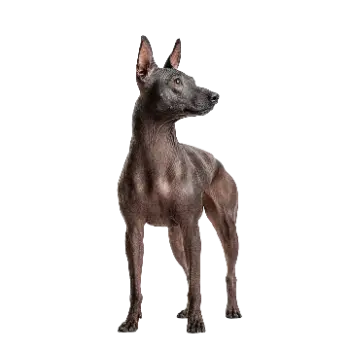
The Xolito is a study in elegant minimalism. Where most dog breeds draw attention through the texture, color, and volume of their coats, this ancient Mexican breed commands the eye with the clean sculptural lines of its body, revealed fully in the hairless variety or lightly draped in the coated version. The overall impression is one of a lean, well-muscled athlete whose form has been shaped not by human fashion but by thousands of years of natural selection in the tropical environments of Mesoamerica. Everything about the physical structure serves a purpose, and that functional integrity gives the breed a timeless quality that connects directly to the clay figurines found in burial sites dating back more than three thousand years.

The breed comes in three recognized sizes, each sharing identical proportions and type. The toy stands up to fourteen inches at the shoulder and weighs between ten and fifteen pounds. The miniature ranges from fourteen to eighteen inches and fifteen to thirty pounds. The standard, the largest and most imposing variety, reaches eighteen to twenty-three inches and carries thirty to fifty-five pounds of solid, athletic weight. Regardless of size, the body is slightly longer than it is tall, presenting a rectangular silhouette that conveys both stability and the capacity for quick, agile movement. The chest is deep, reaching to the elbows, and the abdomen tucks up in a smooth curve that emphasizes the muscular leanness of the torso.

The head is one of the most distinctive features. It is wedge-shaped when viewed from above, with a broad skull that tapers gradually toward a strong, well-defined muzzle. The stop is slight but perceptible. The ears are large, set high on the skull, and carried fully erect with a thin, delicate texture that gives them a striking bat-like appearance. The eyes are almond-shaped and moderately sized, ranging in color from yellow through amber to dark brown or black, always harmonizing with the skin tone. The expression is alert and intelligent, reflecting the breed's watchful nature and keen awareness of its surroundings.

In the hairless variety, the skin is the defining characteristic. It is smooth, tough, and warm to the touch, fitting closely over the underlying musculature without excessive wrinkling except on the head where some folds are permissible in young dogs. The skin may carry small tufts of coarse hair on the crown of the head, the tips of the toes, and the last third of the tail, but extensive hair coverage is a fault. Colors span a wide range including black, gray-black, slate, bronze, red, liver, fawn, and various shades of dark and light tones, with spotted and splashed patterns also occurring. The coated variety carries a short, flat, smooth coat that covers the entire body and requires no trimming or special styling.

Movement is smooth, effortless, and ground-covering. The Xolito moves with a free, easy stride that reflects its athletic build, reaching well forward with the front legs and driving strongly from the rear. There is no wasted motion. The topline remains firm and level during movement, and the tail, which is long, thin, and tapered, is carried in a graceful curve that may rise above the level of the back when the dog is alert or in motion but should never curl tightly over the spine. The feet are hare-shaped with well-arched toes, providing the grip and spring needed for the quick, nimble movement that served these dogs well in the rugged terrain of ancient Mexico.

Affectionate With Family
The Xolito forms profound emotional bonds with its household members, seeking constant proximity and physical contact with the people it considers its own.
Good With Young Children
This breed does best with older children who understand respectful handling. Its protective instincts may lead it to intervene in rough play between younger kids.
Good With Other Dogs
The Xolito can coexist well with dogs it knows, especially those raised alongside it, but it tends to be selective about which canine companions it accepts.
Shedding Level
The hairless variety produces virtually no shed hair at all. The coated variety sheds minimally, making either version a low-maintenance choice for keeping furniture clean.
Coat Grooming Frequency
Traditional coat grooming is essentially unnecessary for the hairless Xolito. Basic skin care and occasional bathing replace the brushing and trimming other breeds require.
Drooling Level
The Xolito is a clean, dry-mouthed breed that produces minimal drool under normal circumstances.
Coat Type
The hairless variety has smooth, tough skin with possible tufts on the head and tail. The coated variety carries a short, flat, close-fitting coat.
Openness To Strangers
Natural wariness toward unfamiliar people is a defining trait. The Xolito observes and assesses newcomers carefully before deciding to extend any warmth.
Playfulness Level
Despite its dignified bearing, the Xolito retains a clownish, puppy-like playfulness well into adulthood that often catches new owners by surprise.
Watchdog/Protective Nature
Guarding the home is woven into this breed's ancient heritage. The Xolito is naturally vigilant and will alert its family to anything unusual in its territory.
Adaptability Level
The Xolito adjusts to different living situations reasonably well provided its need for human companionship and appropriate climate management are met.
Trainability Level
Highly intelligent and capable of learning quickly, the Xolito responds best to consistent, positive methods. Its independent streak requires patience and mutual respect.

Xolito History & Development

The name Xolito represents one of the gentler linguistic adaptations of what is arguably the most challenging breed name in the entire canine world. The full Nahuatl word Xoloitzcuintli combines Xolotl, the Aztec god of fire, lightning, and death, with itzcuintli, meaning dog. For speakers of English and other European languages, this combination of unfamiliar consonant clusters presents a genuine barrier. The shortened form Xolito emerged as a natural solution, borrowing the Spanish diminutive suffix ito to create something that sounds affectionate, approachable, and far less intimidating to pronounce than the full ceremonial name. It is a name that invites familiarity rather than demanding linguistic effort.

The breed itself stretches back at least three thousand five hundred years in the archaeological record. Ceramic and clay figurines depicting hairless dogs nearly identical to the modern Xolito have been recovered from burial sites of the Colima, Maya, Toltec, Zapotec, and Aztec civilizations across Mexico and Central America. These ancient peoples revered the breed for its perceived connection to the spiritual world. According to Aztec belief, Xolotl created the dog from a fragment of the Bone of Life, the same source from which all humanity originated, and tasked it with guiding the souls of the dead through the nine treacherous levels of Mictlan, the underworld. Dogs were frequently sacrificed and buried alongside their owners to fulfill this sacred duty.

The breed's journey through modern history has been turbulent. The arrival of Spanish conquistadors in the sixteenth century brought devastating consequences. European newcomers developed a taste for the dogs as a food source and their imported breeds diluted the native gene pool through uncontrolled crossbreeding. By the early nineteenth century, purebred Xolitos could only be found in remote mountain villages where indigenous communities had maintained them in relative isolation. The Mexican Revolution of 1910 sparked renewed interest in indigenous culture, and artists like Frida Kahlo and Diego Rivera embraced these ancient dogs as symbols of Mexican identity, frequently featuring them in paintings and keeping them as beloved companions.

The formal rescue of the breed came through the famous Xolo Expedition of 1954, when Norman Pelham Wright led a team of Mexican and British dog authorities into the jungles of Colima to locate surviving purebred specimens. They found ten dogs of sound structure, and these animals became the foundation stock for the modern breeding program. The Mexican Kennel Club officially registered the breed in 1955, and the first breed standard was adopted on May 1, 1956, granting the Xolito international recognition through Mexico's membership in the FCI. The breed was subsequently designated the Official Dog of Mexico, cementing its status as a living national treasure.

In the United States, the breed's path to recognition followed its own complicated timeline. A dog named Mee Too became the first AKC-registered specimen in 1887, and Chinito Junior earned the breed's only early AKC championship in 1940. But registrations stagnated, and the AKC dropped the breed in 1959. The Xoloitzcuintli Club of America, founded in 1986, spent twenty-five years rebuilding the breed's presence before full AKC recognition was restored in 2011.

Xolito Temperament & Personality

Living with a Xolito means living with a dog that has spent thousands of years learning to read human beings. This is not a breed that was engineered in the last century to perform a narrow task. The Xolito evolved as a companion, guardian, and spiritual partner to ancient civilizations, and those deeply embedded instincts produce a temperament that is simultaneously devoted and independent, affectionate and watchful, calm and intensely alert. New owners sometimes describe the experience as living with a dog that seems to understand more than it should, and that impression is not entirely fanciful. These are perceptive animals who pay close attention to the emotional states of their people.

The bond between a Xolito and its primary caregiver is remarkably strong. These dogs tend to attach most deeply to the person who provides daily care, feeding, and consistent interaction, though they extend genuine affection to every member of the household. That attachment can become problematic if the dog is left alone for extended periods, as separation anxiety is a well-documented tendency in the breed. A Xolito who feels abandoned does not simply wait patiently. It may vocalize, become destructive, or display stress behaviors that signal genuine emotional distress rather than simple boredom.

With strangers, the Xolito demonstrates a wariness that reflects its ancient role as a home guardian. These dogs do not rush to greet unfamiliar people with wagging tails and immediate trust. Instead, they observe, assess, and gradually warm up once they determine that the newcomer poses no threat to their family. This reserve is not aggression and should never be confused with it. It is a measured, intelligent caution that served the breed well for millennia and continues to make it an effective natural watchdog. Proper socialization from puppyhood helps ensure that this natural wariness does not develop into reactive or fearful behavior.

Among other dogs, the Xolito can be selective. The breed generally coexists well with dogs it has been raised alongside, particularly when introductions happen during the socialization window of early puppyhood. However, the same independent streak that makes these dogs such interesting companions can also produce dogs that prefer to set their own terms for canine friendships. Some Xolitos are gregarious and playful with other dogs throughout their lives. Others develop a preference for human company and tolerate rather than seek out canine interaction.

The energy level of the breed is moderate to high, with a notable distinction between activity and restlessness. A well-exercised Xolito is remarkably calm indoors, settling into a favorite spot with an almost meditative stillness that belies the athletic capacity underneath. But that calm is conditional on adequate physical and mental stimulation. Without it, the breed's intelligence turns to creative problem-solving, which usually means finding ways to entertain itself that its owner would not have chosen. The Xolito retains puppy-like playfulness well into adulthood, bringing a clownish energy to its interactions that can surprise owners who expect the breed's dignified appearance to translate into a permanently serious demeanor.

Xolito Family Life & Living Requirements

The Xolito can be a wonderful family companion, but it is not the right dog for every household, and understanding the distinction matters before bringing one home. This breed thrives in environments where it receives consistent attention, clear boundaries, and genuine inclusion in the daily rhythms of family life. A Xolito that is treated as a peripheral pet, left in the yard or confined to a crate for hours on end, will not flourish. These dogs need to be with their people, participating in whatever is happening, whether that means lying at your feet while you work or riding along on errands.

Families with older children who understand how to interact respectfully with dogs will find the Xolito to be a loyal and engaging companion. The breed is naturally protective, which means it may take it upon itself to intervene in rough play between children, not out of aggression but out of an instinctive drive to maintain order in its environment. For this reason, the breed is generally better suited to homes with children who are past the toddler stage and capable of reading the dog's signals. The Xolito communicates clearly through body language, and children who learn to respect those signals develop a relationship with the dog that deepens over years.

The breed's living requirements are influenced heavily by its tropical origins. The Xolito originated in the warm climates of Mexico and Central America, and its hairless variety in particular has limited tolerance for cold weather. In northern climates, these dogs need protection from winter temperatures and should be considered primarily indoor companions. A warm coat for outdoor excursions during cold months is not a fashion statement but a practical necessity. In summer, the hairless variety needs protection from prolonged sun exposure, particularly on lighter-colored or spotted skin, as sunburn is a genuine concern.

Housing arrangements matter less than the quality of interaction. A Xolito can adapt well to apartment living provided it receives adequate daily exercise and mental stimulation. The toy and miniature sizes are particularly well-suited to smaller living spaces, while the standard size benefits from a home with enough room to stretch out comfortably. A securely fenced yard is a bonus but not a requirement. What is a requirement is an owner who is present, engaged, and willing to invest time in building the kind of relationship that this deeply social breed demands. The Xolito is not a dog you acquire and then manage from a distance. It is a dog that becomes part of the fabric of your household, and the depth of its integration directly determines the quality of the experience for both the dog and the family.

Xolito Training & Exercise Needs

Training a Xolito is an exercise in mutual respect. This breed is highly intelligent and learns quickly, but it brings an independent mind to the training process that can frustrate owners accustomed to breeds that live to please. The Xolito does not perform because it craves your approval in the way a Labrador or Golden Retriever might. It performs because it has decided the task is worth doing, and that distinction shapes everything about how training should be approached. Harsh corrections, raised voices, and punitive methods will backfire dramatically with this sensitive breed. The Xolito responds to fairness, consistency, and positive reinforcement, and it remembers both kindness and unfairness with equal clarity.

Early socialization is not optional with this breed. The Xolito's natural wariness toward strangers, which serves it well as a watchdog, can tip into reactive or fearful behavior if the dog is not systematically exposed to a wide variety of people, places, sounds, and situations during the critical socialization window between eight and sixteen weeks of age. Puppy classes, controlled introductions to new environments, and positive experiences with unfamiliar people all help build the confidence that allows the adult Xolito to distinguish between genuine threats and ordinary visitors. Skipping this step produces a dog that is difficult to manage in public and stressful to live with at home.

The adolescent phase deserves special mention because the Xolito can be genuinely challenging between roughly six months and two years of age. This is the period when the breed's independence, intelligence, and physical energy converge to produce a dog that tests every boundary its owner has established. Experienced Xolito owners describe this stage as a test of patience and consistency, and they strongly advise new owners not to give up during this period. The dog that emerges on the other side of adolescence, with proper handling, is balanced, confident, and deeply bonded to its owner.

Exercise requirements are moderate to high depending on the individual dog and its size variety. The standard Xolito needs daily physical activity that goes beyond a casual walk around the block. Brisk walks, jogging, hiking, and active play sessions all serve the purpose of burning both physical energy and mental restlessness. The breed excels at agility, which combines physical challenge with the mental engagement that these intelligent dogs crave. The toy and miniature varieties can satisfy much of their exercise needs through vigorous indoor play and shorter outdoor excursions, though they still benefit from the stimulation of exploring new environments. A tired Xolito is a calm, content companion. An under-exercised one is a creative demolition expert.

Xolito Health Concerns

The Xolito benefits from being a natural breed that evolved through thousands of years of environmental selection rather than intensive human-directed breeding programs. That evolutionary heritage gives it a significant health advantage over many modern breeds whose gene pools have been narrowed by decades of selection for extreme physical characteristics. The Xolito is generally a robust, healthy dog with a lifespan of thirteen to eighteen years, which is notably long for a breed that includes a standard size reaching fifty-five pounds. That said, no breed is entirely free of health concerns, and responsible ownership means understanding what to watch for.

Beyond these breed-specific considerations, the Xolito is subject to the same general health screenings recommended for most medium-sized dogs. The breed club recommends hip evaluations, cardiac examinations, patellar luxation checks, and ophthalmology screenings. Hip dysplasia occurs in the breed at lower rates than in many comparably sized breeds, but it is not absent. Patellar luxation, a condition where the kneecap slides out of its normal position, is occasionally seen, particularly in the smaller size varieties. Eye conditions are uncommon but worth monitoring. Obesity is a genuine risk because the breed loves to eat and will overindulge if given the opportunity, and excess weight compounds joint stress and shortens the already generous lifespan.

Common Health Issues

  • Skin conditions including acne - Sunburn, and dryness in the hairless variety
  • Incomplete dentition genetically linked to the hairless gene - Incomplete dentition genetically linked to the hairless gene
  • Patellar luxation - Particularly in toy and miniature sizes
  • Hip dysplasia at lower rates than many comparably sized breeds - Hip dysplasia at lower rates than many comparably sized breeds
  • Obesity from overeating if food intake is not monitored - Obesity from overeating if food intake is not monitored
  • Eye conditions including progressive retinal atrophy on rare occasion - Eye conditions including progressive retinal atrophy on rare occasion

Preventive Care & Health Monitoring

  • Regular skin care routine with gentle bathing every two to three weeks for hairless variety - Regular skin care routine with gentle bathing every two to three weeks for hairless variety
  • Dog-safe sunscreen on lighter skin areas before prolonged sun exposure - Dog-safe sunscreen on lighter skin areas before prolonged sun exposure
  • Hip, cardiac, patellar - And ophthalmology evaluations as recommended by the breed club
  • Measured, scheduled meals to prevent obesity in a breed prone to overeating - Measured, scheduled meals to prevent obesity in a breed prone to overeating
  • Dental monitoring and maintenance especially for hairless individuals with incomplete dentition - Dental monitoring and maintenance especially for hairless individuals with incomplete dentition
  • Protective clothing in cold weather for the hairless variety - Protective clothing in cold weather for the hairless variety

Xolito Grooming & Maintenance

Grooming a Xolito looks nothing like grooming most other dog breeds. There is no brushing, no detangling, no trips to the groomer for clips and trims, and no tumbleweeds of shed hair rolling across your floors. For the hairless variety, grooming is really skin care, and understanding the difference between maintaining healthy skin and over-managing it is the key to keeping your Xolito at its best.

The hairless Xolito's skin is naturally tougher and more resilient than it appears. It produces its own protective oils and has evolved over thousands of years to withstand the elements of tropical Mexico without the benefit of a coat. The most common mistake new owners make is assuming that bare skin needs constant intervention. Over-bathing strips the natural oils, leaving the skin dry and vulnerable. Excessive moisturizing clogs pores and can trigger the very acne and irritation it was meant to prevent. The ideal routine is a bath every two to three weeks using a gentle, fragrance-free cleanser, followed by a light application of a non-comedogenic, oil-free moisturizer only on areas that appear dry. Between baths, a warm damp cloth is sufficient for wiping down dirty faces and feet.

Sun protection is a practical consideration, not an aesthetic one. Dark-skinned Xolitos have more natural protection from ultraviolet exposure than those with lighter or spotted coloring, but prolonged direct sun can affect any hairless dog. A dog-safe sunscreen applied to exposed lighter areas before extended outdoor time prevents burns that can damage the skin over time. In colder climates, a well-fitted coat or sweater is essential for outdoor excursions during winter months, as the hairless variety loses body heat rapidly without insulation.

The coated variety requires minimal grooming by comparison. A weekly brushing with a soft bristle brush removes loose hair and distributes the natural oils that keep the short coat healthy and smooth. The coated Xolito sheds very lightly and does not develop the odor issues common in heavier-coated breeds.

Both varieties share the same basic maintenance needs beyond coat or skin care. Nails should be trimmed regularly, as overgrown nails affect gait and cause discomfort. Ears should be checked weekly and cleaned as needed to prevent wax buildup. Dental care carries particular importance in the hairless variety where incomplete dentition means the teeth that are present need careful maintenance to preserve function throughout the dog's long life.