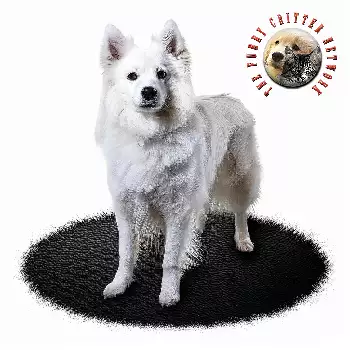
The first thing most people notice about a Volpino Italiano is the coat. It is long, dense, and stands off the body with a stiffness that gives the dog a somewhat puffed, cloud-like appearance, particularly around the neck and chest where the coat forms a pronounced ruff or mane. The overall impression is of a small dog that is somehow larger than its actual dimensions, an optical illusion created entirely by that dramatic coat. Strip the fur away and what you have is a compact, squarely built little dog with clean lines and a surprisingly athletic structure underneath.
The head is one of the breed's most distinctive features and the source of its common name. The skull is moderately rounded but the overall head shape narrows noticeably toward the muzzle, creating a pointed, fox-like profile when viewed from above or in silhouette. The muzzle itself is fairly fine and tapers to a small, always-black nose. The muzzle length should be slightly shorter than the length of the skull, creating the pointed but not exaggerated look characteristic of the breed. The lips are tight and close-fitting. The bite is scissors, and a complete set of well-developed teeth is expected in the standard.
The eyes are round and dark brown, set fairly wide apart and giving a direct, alert expression. The darkness of the eye rim and surrounding skin gives the eyes a framed appearance that accentuates their brightness. The overall expression should read as lively and curious - a Volpino that looks flat or dull in the eye is not showing typical breed character. The ears are set high on the skull, small, triangular, and fully erect. They are mobile and independently operable, one of the things that gives the Volpino its characteristic fox-like, attentive expression. Ears that fold over or hang flat represent a structural fault.
The neck is moderately long and flows smoothly into well-laid-back shoulders. The topline is level and firm from the withers to the base of the tail. The chest is moderately broad and deep, reaching to the elbows, with well-sprung ribs that provide adequate lung room without making the dog appear barrel-chested. The loin is short and strong. The overall body, when viewed from the side, should be essentially square - the distance from shoulder to buttock should approximately match the height at the withers. A dog that reads as long in body is losing the balanced, compact look that defines the breed.
The tail is set high, carried arched over the back, and covered heavily in long hair that gives it a plume-like appearance. In motion the tail is carried up and over, touching or nearly touching the back. A tail carried low or hanging down signals distress or poor temperament presentation rather than a structural fault, but it is nonetheless an important part of reading the dog's overall expression.
The forelegs are straight, fine-boned but not fragile, set well under the body. Feet are small, tight, and cat-like with well-arched toes. The hindquarters are moderately angulated with well-developed thighs and strong, clean hocks. The angulation front and rear should be balanced - a dog that is steep in front and over-angulated behind, or vice versa, moves poorly and loses the smooth, light trotting gait the standard calls for.
Movement in a well-structured Volpino is ground-covering and effortless, with good reach in front and strong drive from behind. The legs should converge toward a central line under the body at the trot, reflecting the compact construction. Movement should look light and energetic rather than labored.
The coat is the breed's defining physical feature and warrants careful attention. It is a true double coat: a dense, soft undercoat beneath a long, coarser outer coat that stands away from the body rather than lying flat. The texture of the outer coat has a slight stiffness - not harsh, but not silky either. It should never wave or curl. The coat forms particularly pronounced furnishings at the neck and chest (the ruff), along the back of the thighs (sometimes called the skirt or trousers), and on the tail. The ears have shorter, finer hair on the inner surface.
Accepted coat colors are solid white and solid red, with white being by far the most common in North American and Italian show lines. The red color ranges from a warm champagne tone to a deeper, richer copper-red. Pale orange shading on the ears of otherwise white dogs is permitted in some standards. Any patterning, parti-color, brindle, or black markings are disqualifying faults. The white coat is naturally resistant to dirt in the way many double coats are - it tends to shed mud once dry rather than absorbing it into the fiber the way a softer coat would.
Size and sexual dimorphism are modest in this breed. Males run from about 11 to 12 inches at the withers and 9 to 14 pounds. Females tend toward the lower end of those ranges at 10 to 11 inches and 8 to 12 pounds. The breed is firmly small, not a miniature version of a larger dog, and should give the overall impression of a compact, balanced, lively little animal with nothing exaggerated or extreme in its structure.
Affectionate With Family
★★★★★
The Volpino is deeply devoted to its people and will follow you from room to room without apology. This is a breed that wants to be in your lap or at minimum in the same room - independent it is not.
Good With Young Children
★★★☆☆
The Volpino genuinely likes children and plays with enthusiasm, but its small frame makes it vulnerable to rough handling. Households with toddlers need to manage interactions carefully to protect the dog.
Good With Other Dogs
★★★☆☆
Most Volpinos get along reasonably well with other dogs when socialized early, though they carry no hesitation about telling a much larger dog exactly what they think of it. Size awareness is not their strong suit.
Shedding Level
★★★☆☆
The Volpino sheds moderately and blows its undercoat seasonally. You will find white fur on dark clothing - plan accordingly - though the volume is manageable with regular brushing.
Coat Grooming Frequency
★★★☆☆
Two to three brushings per week keeps the double coat in good order most of the year. During seasonal coat blows, daily brushing is needed to stay ahead of the loose undercoat.
Drooling Level
★☆☆☆☆
The Volpino is essentially a dry-mouthed breed. Drooling is not something you will encounter with this dog under normal circumstances.
Coat Type
★★★☆☆
The long, stand-off double coat looks impressive but is less demanding than it appears. It has a natural tendency to stay clean and shed dirt, and it does not mat as readily as a softer-coated breed of similar length.
Openness To Strangers
★★☆☆☆
The Volpino is reserved with people it does not know and will announce their arrival loudly. With patient, repeated exposure it warms up, but its instinct to be watchful over its territory and people is always there.
Playfulness Level
★★★★☆
Volpinos are genuinely playful well into adulthood and enjoy games, toys, and anything that gets their mind moving. They have a merry energy that makes them fun companions for people who engage them.
Watchdog/Protective Nature
★★★★★
Alerting to anything out of the ordinary is practically the Volpino's defining job, and it takes that job seriously. Its bark is sharp and persistent - a trained quiet command is not optional, it is necessary.
Adaptability Level
★★★★☆
The Volpino adapts well to apartment or house living as long as it gets daily exercise and plenty of interaction. What it does not adapt well to is being left alone for long stretches - this breed needs company.
Trainability Level
★★★☆☆
The Volpino is intelligent and picks things up quickly when motivated, but it has a stubborn streak that can make consistent training feel like a negotiation. Short, reward-based sessions work far better than repetitive drilling.