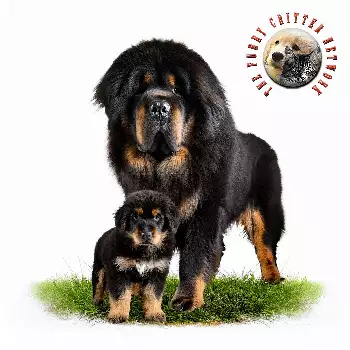
The Tsang-Khyi represents the most imposing physical expression of the Tibetan Mastiff breed, and encountering one for the first time is an experience that tends to recalibrate your sense of how large a dog can actually be. Males of the Tsang-Khyi type regularly stand 26 to 30 inches or more at the withers, with some exceptional individuals exceeding even that range, and weights in Western breeding programs commonly fall between 100 and 160 pounds, though the heaviest specimens can push well beyond those figures. Females are proportionally smaller but still substantial, typically standing 24 to 28 inches and carrying 75 to 120 pounds of dense, heavily boned frame.
The head is where the Tsang-Khyi most dramatically distinguishes itself from the lighter Do-Khyi type. It is broad, heavy, and powerfully constructed, with a pronounced occiput and substantial back skull that gives the dog a noble, almost leonine appearance. The brow ridges are heavy, and the expression is watchful, dignified, and aloof. The eyes are medium sized, deep set, almond shaped, and slightly slanting, coming in various shades of brown. When the Tsang-Khyi is aroused or alert, the deep-set eyes may reveal red haw, a characteristic more pronounced in this type than in the leaner Do-Khyi. The muzzle is broad and well padded, appearing square from any angle, with well-developed lips and moderate flews that cover the underjaw. The upper lip may hang and become increasingly pendulous with age, a trait that is more prominent in the Tsang-Khyi than in its nomadic counterpart.
The ears are medium sized, V-shaped, and pendant, hanging forward close to the head. The neck is muscular and arched, carrying a moderate dewlap that is more pronounced in males. The hallmark mane extends from the head around the neck and over the shoulders, creating a lion-like ruff that contributes enormously to the breed's imposing presence. This mane is typically more developed in males and in dogs living in colder climates.
The body is slightly longer than tall, powerfully built with a level topline, broad straight back, and well-sprung ribs. The chest is deep, reaching at least to the elbows, with a slight tuck-up in the abdomen. The Tsang-Khyi carries heavier bone throughout the body than the Do-Khyi, giving it a more substantial, grounded appearance. The tail is well feathered and carried in a single curl over the back, falling over the loin, serving as a visual counterbalance to the massive head.
The double coat is one of the breed's most practical and visually striking features. The outer coat is harsh in texture, thick, and stands off the body, ranging from medium to long depending on climate. The undercoat is dense and woolly during colder months, becoming sparser in warmer weather. Coat colors include solid black, black and tan, various shades of red ranging from pale gold to deep rich red, and bluish-gray, often with white markings on the chest, feet, and sometimes around the neck. The Tsang-Khyi's coat notably lacks the unpleasant odor common to many large breeds, a practical advantage for a dog that historically lived in close proximity to human habitation.
Movement in the Tsang-Khyi is free and elastic, covering ground efficiently despite the dog's considerable mass. The front legs are straight with good feathering, and the feet are large, strong, and cat-like, sometimes showing feathering between the toes. Despite the monastery type's heavier build, a well-structured Tsang-Khyi retains the agility necessary for its guardian role, able to move quickly and decisively when a perceived threat demands action.
Affectionate With Family
★★★★☆
The Tsang-Khyi forms deep bonds with its immediate family and shows its devotion through quiet, steady companionship rather than exuberant displays of affection.
Good With Young Children
★★★☆☆
Patient and protective with children raised in the household, though the breed's massive size requires careful supervision around smaller kids.
Good With Other Dogs
★★☆☆☆
The Tsang-Khyi can coexist well with dogs it knows but may be territorial toward unfamiliar dogs, particularly those approaching its home turf.
Shedding Level
★★★☆☆
Moderate shedding throughout most of the year gives way to one intense annual coat blow in spring that produces remarkable volumes of undercoat.
Coat Grooming Frequency
★★★☆☆
Weekly brushing handles the coat during most of the year, but the spring shed demands daily grooming sessions for roughly a month.
Drooling Level
★★☆☆☆
The Tsang-Khyi is considered a relatively dry-mouthed breed despite its size, though the monastery type's heavier flews may produce occasional drool.
Coat Type
★★★☆☆
A thick double coat with harsh, stand-off guard hairs over a dense woolly undercoat provides excellent insulation against extreme weather conditions.
Openness To Strangers
★☆☆☆☆
Reserved and naturally suspicious of unfamiliar people, the Tsang-Khyi takes its time assessing newcomers and rarely offers an enthusiastic greeting.
Playfulness Level
★★☆☆☆
The Tsang-Khyi has a dignified demeanor and tends to engage in play on its own terms, preferring purposeful interaction over silly antics.
Watchdog/Protective Nature
★★★★★
Guardian instinct is the defining trait of this breed, honed over centuries of protecting monasteries, estates, and livestock from predators and intruders.
Adaptability Level
★★☆☆☆
The Tsang-Khyi needs space and routine, adapting poorly to apartment life or frequent changes in environment and household composition.
Trainability Level
★★☆☆☆
Highly intelligent but fiercely independent, the Tsang-Khyi learns quickly yet decides for itself when compliance serves its interests.