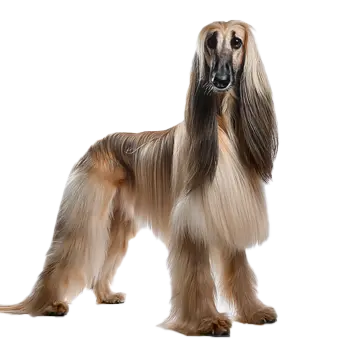
The Tazi is a large sighthound built for speed, endurance, and agility across the mountainous terrain of Afghanistan. Males stand 27 inches at the shoulder and weigh 60 pounds, while females stand 25 inches and weigh 50 pounds. These measurements place the breed among the taller sighthounds without the bulk of guardian breeds, producing a silhouette that communicates athleticism and elegance rather than raw power. The overall impression is of a dog designed to cover rough ground at high speed while maintaining the stamina to pursue game over long distances.
The head is long and refined, with a skull that is neither too broad nor too narrow, and a prominent occiput. The muzzle is long and strong with a slight Roman nose profile that is characteristic of the breed. The jaws are long and punishing, reflecting the breed's history of catching and holding large game. The nose is black in most coat colors, though liver is permitted in lighter-colored dogs. The expression is one of regal detachment, with the dog appearing to gaze into the distance as though contemplating something beyond the immediate surroundings. This faraway look is considered a hallmark of correct breed type and distinguishes the Afghan from more alert-presenting sighthounds.
Eyes are almond-shaped, dark, and nearly triangular in appearance. They are set obliquely and contribute to the exotic Eastern expression that the standard emphasizes. Ears are long, set low, and positioned well back on the skull, carried close to the head and covered with long, silky hair that blends into the coat of the neck. The ear leather itself is long enough to reach the nose when pulled forward.
The neck is long, strong, and arched, carrying the head with characteristic dignity. The topline flows from the neck through a level back to the prominent hipbones, which are a defining breed feature. The hipbones sit notably higher and wider than in most breeds, creating the distinctive silhouette that identifies the Afghan even at a distance. The loin is short and broad with good muscular development. The croup falls away steeply, leading to the tail, which is set low and carried in a ring or curve at the end. The ring curl of the tail is a hallmark feature that distinguishes the Afghan from other sighthounds.
Forequarters are long and straight with strong bone, set well under the body. The shoulders are long and sloping, providing the reach necessary for a ground-covering stride. Hindquarters are powerful with well-bent stifles and long second thighs, creating the exaggerated angulation that gives the breed its distinctive rear silhouette. The feet are large, broad, and covered with thick hair, functioning as natural snowshoes that provided traction and protection on rocky mountain terrain. This foot structure is one of the breed's most practical adaptations to its original working environment.
The coat is the breed's most celebrated feature. Long, thick, and fine in texture with a silky quality, it covers the ribs, forequarters, hindquarters, and legs in profuse growth. Mature dogs develop a shorter, close-fitting saddle along the back, which is a natural pattern rather than a grooming artifact. The topknot of long, silky hair on the head is another breed hallmark. The coat served as insulation against the bitter cold of the Afghan mountains and was never intended as a decorative feature, though modern show grooming has elevated it to an art form. All colors and combinations are acceptable in the breed, including black, cream, red, blue, brindle, and domino patterns.
Movement is the ultimate test of correct Afghan structure. The gait is smooth, springy, and ground-covering, with a distinctive style that shows power and spring in every stride. The dog moves with its head and tail carried high, projecting the proud carriage that is central to breed type. At full speed, the Afghan can reach approximately 40 miles per hour while navigating obstacles with the agility of a much smaller dog.
Affectionate With Family
★★★★☆
The Tazi bonds genuinely with its family but expresses affection on its own terms and schedule. Warmth is offered selectively rather than constantly, making the dog's attention feel earned.
Good With Young Children
★★☆☆☆
The breed's sensitivity to sudden movements and loud sounds makes it a poor match for very young children. Older children who interact calmly and respect the dog's space fare much better.
Good With Other Dogs
★★★☆☆
Generally tolerant of other dogs, especially sighthounds and breeds of similar temperament. The Tazi is not typically dog-aggressive but may not tolerate overbearing or pushy canine companions.
Shedding Level
★★☆☆☆
The single coat does not produce the heavy seasonal shedding of double-coated breeds. Hair loss is minimal, contributing to the breed's reputation as a lower-shedding large dog.
Coat Grooming Frequency
★★★★★
The long, fine, silky coat tangles and mats readily, requiring thorough brushing several times per week and regular bathing every one to two weeks. Show coats demand daily attention.
Drooling Level
★☆☆☆☆
The Tazi is not a drooler. The breed's refined head structure and tight lips produce a clean, dry mouth.
Coat Type
★★★★★
Long, thick, and fine with a silky texture, the single coat covers the body in profuse growth except for the natural shorter saddle on mature dogs. The topknot and ear furnishings are particularly long.
Openness To Strangers
★☆☆☆☆
Aloofness with strangers is a defining breed characteristic. The Tazi may be openly indifferent to unfamiliar people, walking past an outstretched hand without acknowledgment.
Playfulness Level
★★★☆☆
A clownish, playful streak emerges unpredictably, surprising people who expect permanent aristocratic composure. The Tazi can shift from regal dignity to silly exuberance without warning.
Watchdog/Protective Nature
★★☆☆☆
The Tazi is not a guardian breed. It may alert to unusual activity but lacks the protective instinct and territorial drive of breeds developed for guarding.
Adaptability Level
★★★☆☆
Surprisingly calm indoors and adaptable to various living situations if exercise needs are met. The breed requires secure fencing and daily opportunity to run at speed in an enclosed area.
Trainability Level
★☆☆☆☆
The Tazi understands commands but evaluates whether compliance serves its interests before responding. This selective responsiveness is the breed's defining behavioral trait, not a deficiency.