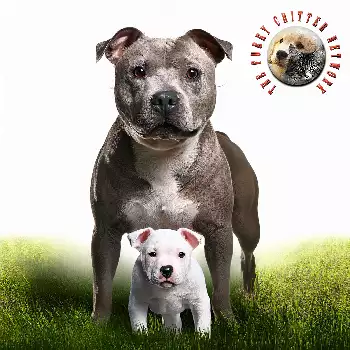
The history of the Staffordshire Bull Terrier is intertwined with the complex and often troubling history of blood sports in England, yet the breed's story is ultimately one of transformation and redemption. From its origins as a dog bred for combat, the Stafford has evolved into one of the most beloved family companions in the world, a journey that speaks to both the breed's adaptability and the dedication of the fanciers who worked to preserve and refine it.
The roots of the Staffordshire Bull Terrier can be traced back to the early nineteenth century in the industrial regions of England, particularly the area known as the Black Country in Staffordshire and the northern parts of Birmingham. During this period, blood sports such as bull-baiting and bear-baiting were legal and widely popular forms of entertainment among all social classes. The Old English Bulldog of that era, a far more athletic and agile dog than the modern Bulldog, was the primary breed used in these activities.
When the Cruelty to Animals Act of 1835 made bull-baiting and bear-baiting illegal in England, enthusiasts of blood sports turned to dog fighting as an alternative. This activity was easier to conduct in secret and required less elaborate staging than the larger baiting sports. To create dogs better suited for pit fighting, breeders began crossing the Bulldog with various terrier breeds, most likely the Black and Tan Terrier or the old White English Terrier, both now extinct. These crosses produced dogs known variously as Bull and Terrier, Half and Half, or Pit Dog, combining the Bulldog's strength and tenacity with the terrier's agility and ferocity.
The resulting dogs varied considerably in appearance, as breeding during this period focused entirely on performance rather than uniformity of type. The only characteristics consistently selected for were gameness, the willingness to fight despite pain or injury, and fighting ability. These dogs were owned primarily by working-class men, including miners, ironworkers, and potters in the Staffordshire region, who bred them for success in the pit without regard for formal breeding principles or record-keeping.
As the nineteenth century progressed, dog shows began to emerge as a popular alternative to blood sports. The Kennel Club was founded in 1873, and breeders began to develop more uniform types suitable for exhibition. James Hinks of Birmingham created the Bull Terrier using Bull and Terrier stock crossed with the English White Terrier and possibly Dalmatian blood, producing the distinctive all-white dogs known as White Cavaliers. These dogs gained rapid acceptance in show circles and recognition from the Kennel Club.
Meanwhile, fanciers of the original Bull and Terrier type in the Staffordshire region remained committed to preserving their dogs without the outcrosses that had created the Bull Terrier. These dogs, the direct ancestors of today's Staffordshire Bull Terrier, continued to be bred in the working-class communities of the Black Country throughout the late nineteenth and early twentieth centuries. Different towns, including Walsall, Darlaston, and Cradley Heath, developed slightly different types, leading to debates about what constituted the ideal specimen.
The movement toward official recognition for the Staffordshire Bull Terrier gained momentum in the 1930s through the efforts of dedicated fanciers, most notably Joseph Dunn and Joe Mallen. These men recognized that without official recognition, the breed they loved would remain marginalized and at risk of disappearing. In June 1935, they organized a meeting at the Cross Guns Hotel in Cradley Heath, where approximately fifty breeders gathered to form the original Staffordshire Bull Terrier Club and draft the first breed standard.
The Kennel Club granted recognition to the Staffordshire Bull Terrier in July 1935, marking a turning point in the breed's history. The name Staffordshire Bull Terrier was chosen to honor the breed's geographic origins while distinguishing it from the Bull Terrier. The dog Jim the Dandy, owned by Shaw and Barnard, served as the model for the original breed standard. The first championships were awarded in 1938 in Birmingham, and in 1939, Lady Eve became the first female champion while Gentleman Jim, bred by Jack Dunn, became the first male champion.
The breed's development continued through World War II and into the post-war period. The standard was revised in 1948 to reflect evolving understanding of ideal breed type, with the most significant change being a reduction in the height range from 15-18 inches to 14-16 inches while maintaining the same weight requirements. This change increased the substance and muscle density expected in the breed.
Staffordshire Bull Terriers began arriving in the United States in significant numbers following World War II, brought by British nationals relocating to America and American servicemen returning home with dogs acquired during their time in England. The breed also arrived through imports from Australia, Canada, and other countries where the Stafford had established a following.
Steve Stone organized the Staffordshire Bull Terrier Club in the United States on January 14, 1967, beginning the formal effort to achieve AKC recognition. The process took nearly a decade, requiring the club to host sanctioned shows and demonstrate consistency in breeding practices before the AKC granted official recognition in 1974. The first Stafford registered in the AKC Stud Book was the English import Ch. Tinkinswood Imperial, and the first American champion was the Australian import Northwark Becky Sharpe.
Today, the Staffordshire Bull Terrier enjoys tremendous popularity, particularly in its homeland of England, where it consistently ranks among the most popular breeds. In Australia, it is one of the top ten most popular breeds, and it holds the distinction of being the most popular terrier in South Africa. While less numerous in the United States than in some other countries, the breed has a devoted following of enthusiasts who appreciate its unique combination of strength, loyalty, and affection.