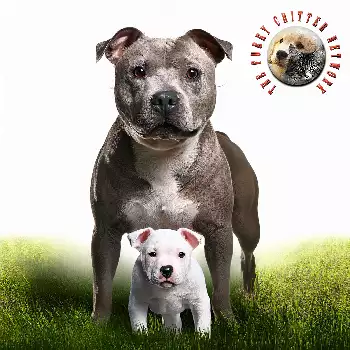
The first thing most people notice about a Staffie is the sheer muscularity packed into a surprisingly compact frame. This is not a large dog. Standing just 14 to 16 inches at the shoulder and weighing between 24 and 38 pounds depending on sex, the Staffordshire Bull Terrier consistently gives the impression of being much bigger than it actually is. That illusion comes entirely from the breed's extraordinary physical density. Every inch of the Staffie is built for power, from the wide chest and strong shoulders to the thick, well-boned legs that anchor a body designed to be low to the ground and difficult to topple.
The head is the breed's most distinctive feature and the one that sets it apart from other terrier breeds at a glance. It is short and deep with a broad skull, and the cheek muscles are so pronounced that they create a visible bulge along the sides of the face. The stop between the forehead and the muzzle is distinct, and the muzzle itself is short but not so compressed as to impair breathing in a healthy specimen. The jaws are strong and clean with tight-fitting lips, and the teeth should meet in a scissors bite. The nose is always black regardless of coat color. The eyes are round, medium-sized, and set to look straight ahead. They are dark in most color varieties, though the shade may relate somewhat to the coat. The ears are either rose-shaped or half-pricked, never fully erect or cropped, giving the Staffie an alert but approachable expression that many owners describe as perpetually cheerful.
The body is compact and close-coupled, meaning there is not much distance between the last rib and the hip. The topline is level, and the chest is deep and broad with well-sprung ribs. Despite the broad front, the Staffie should not appear bowlegged or clumsy. The legs are straight and well-boned, set rather wide apart to accommodate the deep chest. The hindquarters are well-muscled and provide the driving power for a dog that is far more athletic than its stocky build might suggest. The tail is medium length, set low, and tapers to a point. It should not curl over the back and is carried rather like an old-fashioned pump handle.
Movement in the Staffie is described in the breed standard as free, powerful, and agile with economy of effort. When viewed from the front, the legs should move parallel, and the dog should cover ground efficiently without excessive side-to-side roll despite the width of the chest. Good Staffies move with a surprising lightness of foot that belies their muscular build, and the best examples demonstrate both power and grace in motion. A description of movement was notably absent from the breed standard for its first fifty years, not appearing until the 1987 revision in England and the 1989 update in the United States.
The coat is smooth, short, and close-fitting against the body. It has a firm texture without any tendency toward softness or waviness. This is a low-maintenance coat that sheds moderately year-round. Accepted colors include red, fawn, white, black, blue, or any of these combined with white. Brindle in any shade is also accepted, as is brindle with white. The only disqualifications are black-and-tan and liver coloring. The short coat makes the Staffie's muscular definition visible in a way that few other breeds can match, and it is one of the reasons the breed photographs so dramatically despite its modest size. Blue is generally considered one of the rarest and most sought-after Staffie colors, though color should never take priority over structure and temperament when evaluating breeding stock.
Affectionate With Family
★★★★★
The Staffie bonds deeply with every member of its household and wants to be physically close to its people at all times. This breed thrives on affection and will seek out contact constantly throughout the day.
Good With Young Children
★★★★☆
Staffies are famously tolerant and gentle with children, earning them the Nanny Dog nickname in Britain. Their strength and exuberant play style do require adult supervision with younger kids to prevent accidental knocks.
Good With Other Dogs
★★☆☆☆
The breed's fighting ancestry means many Staffies display competitive or aggressive tendencies toward unfamiliar dogs, particularly those of the same sex. Ongoing socialization helps but may not eliminate this trait entirely.
Shedding Level
★★★☆☆
Staffies shed moderately year-round with possible seasonal upticks. The short coat means individual hairs are less noticeable than those of longer-coated breeds, but regular brushing keeps loose fur manageable.
Coat Grooming Frequency
★☆☆☆☆
The smooth, close-fitting coat requires minimal grooming effort. A weekly once-over with a grooming mitt removes dead hair and keeps the coat healthy without any complicated routine.
Drooling Level
★★☆☆☆
Staffies are not heavy droolers under normal conditions, though some individuals may drool when anticipating food or after vigorous exercise. The tight lip structure keeps excessive drool in check.
Coat Type
★☆☆☆☆
The Staffie carries a single-layer smooth coat that lies flat against the body. There is no undercoat, feathering, or curl to manage, making this one of the simplest coat types in the terrier group.
Openness To Strangers
★★★★☆
Most Staffies greet unfamiliar people with tail-wagging enthusiasm rather than suspicion. Their people-loving nature extends well beyond the family circle, making them poor candidates for serious guard work.
Playfulness Level
★★★★★
This breed approaches play with wholehearted intensity. Staffies love tug-of-war, fetch, and rough-and-tumble games, and they retain a puppy-like enthusiasm for play well into their senior years.
Watchdog/Protective Nature
★★★☆☆
Staffies will alert to unusual activity and their muscular appearance alone provides a deterrent, but the breed's general friendliness toward people means they are more likely to welcome an intruder than confront one.
Adaptability Level
★★★☆☆
The Staffie can adjust to apartment living if exercise needs are consistently met, but the breed struggles with long periods of isolation and is sensitive to heat. A predictable routine suits this dog best.
Trainability Level
★★★☆☆
Staffies are smart and capable learners but carry a terrier stubbornness that requires patience and creativity. They respond best to positive reinforcement delivered through short, game-like training sessions.