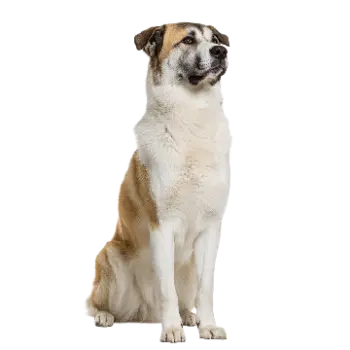
The Sredneaziatskaya Ovtcharka is a massive, powerful guardian breed that communicates its purpose through its physical presence alone. Males stand a minimum of 27 inches at the withers and commonly exceed 30 inches, weighing between 121 and 176 pounds. Females are noticeably smaller but still substantial, standing at least 24 inches and weighing 88 to 143 pounds. Sexual dimorphism is pronounced and considered an essential breed characteristic, with males displaying significantly more mass, a broader head, and heavier bone than their female counterparts.
The head is massive in all dimensions and serves as a defining characteristic of breed type. The skull is flat between the ears with a moderately defined stop, and the muzzle is slightly shorter than the skull, blunt in profile, and well-filled under the eyes. Powerful jaws carry a complete set of teeth meeting in a scissors or level bite. The overall head structure conveys an impression of calm authority rather than aggressive menace, which accurately reflects the breed's approach to its guardian duties. Eyes are medium-sized and oval, set wide apart and relatively deep, carrying an expression of steady confidence. Color ranges from dark brown to lighter shades depending on coat color.
The ears are small and triangular, set at or slightly below the eye line. In many countries of origin and in some breeding programs, the ears are traditionally cropped very short, giving the dog a distinctive look. Where natural ears are maintained, they hang close to the skull and remain relatively inconspicuous given the overall mass of the head. The neck is powerful and moderately short, often featuring a noticeable dewlap that adds to the breed's impression of substance.
The body is slightly longer than tall, with a strong, level back that transmits the power generated by the muscular hindquarters. The loin is short and broad, connecting to a wide, slightly sloping croup. The chest is long, broad, and deep, reaching to the elbows with well-sprung ribs that provide ample capacity for the sustained cardiovascular effort required of a working guardian. The breed carries muscle in a different manner than many other large breeds, with mass distributed evenly rather than concentrated in exaggerated shoulders or hindquarters. A well-conditioned Sredneaziatskaya Ovtcharka looks powerful without appearing inflated or overdone.
The limbs are straight, well-boned, and parallel when viewed from front or rear. Forelegs are set moderately wide to accommodate the broad chest. Hindquarters are well-muscled through the thighs with moderate angulation in the stifles and hocks. The feet are large, oval, and compact, with thick pads suited to traversing the rocky, harsh terrain of Central Asia. Movement is ground-covering and efficient, with a characteristic elastic, unhurried gait that can erupt into surprising speed when the dog perceives a threat. The tail is thick at the base and carried in a sickle curve or loose ring, set moderately high. In some traditions, the tail is docked, though this practice is increasingly restricted in many countries.
The coat is a dense double layer that varies in length across the breed's regional types. Some lines carry a relatively short, harsh coat of three to five centimeters, while others display a longer coat of seven to eight centimeters with more developed feathering on the ears, neck, and legs. Both types feature a dense, woolly undercoat that provides insulation against the extreme temperature swings of Central Asia, where summer heat can exceed 100 degrees and winter cold drops well below zero. The breed sheds its undercoat heavily once per year, typically in spring, and the coat otherwise requires minimal maintenance, being naturally resistant to dirt and debris. Colors span a wide range including white, black, gray, straw, reddish-brown, brindle, parti-color, and ticked patterns. The breed standard permits nearly all colors, reflecting the natural diversity of a landrace that developed across thousands of miles of varied terrain.
Affectionate With Family
★★★★☆
The Sredneaziatskaya Ovtcharka bonds deeply with its household but expresses attachment through steady presence and quiet vigilance rather than overt displays of affection. Its loyalty runs deep beneath a composed exterior.
Good With Young Children
★★★☆☆
Patient and tolerant with children in its own family when properly socialized, though the breed's massive size and guardian instincts require constant supervision. Visiting children should be managed carefully.
Good With Other Dogs
★☆☆☆☆
Same-sex aggression is deeply ingrained and should be considered a breed default. Coexistence with other dogs is possible when established from puppyhood but requires ongoing management and vigilance.
Shedding Level
★★★☆☆
Moderate shedding throughout most of the year with one dramatic annual coat blow in spring when the dense undercoat releases in large clumps over several weeks.
Coat Grooming Frequency
★★☆☆☆
The naturally dirt-resistant double coat requires minimal maintenance for most of the year, with weekly brushing sufficient outside of the annual spring shedding period.
Drooling Level
★★☆☆☆
Some individuals with heavier lip structure may drool around food or water, but excessive drooling is not a widespread breed characteristic. Dogs with tighter lips stay relatively clean.
Coat Type
★★★☆☆
A dense double coat that varies from short to medium length depending on regional type, featuring a harsh outer layer and thick woolly undercoat designed for extreme climate adaptation.
Openness To Strangers
★☆☆☆☆
Deep suspicion of unfamiliar people is a core breed trait bred over millennia of guardian work. The breed does not warm up to strangers quickly and requires careful introductions in controlled settings.
Playfulness Level
★★☆☆☆
Puppies and young dogs show moderate playfulness, but adults settle into a dignified composure that prioritizes observation over play. The breed does not typically seek games or interactive play.
Watchdog/Protective Nature
★★★★★
An unrivaled natural guardian that requires no training to protect its territory, family, and livestock. The breed's protective instincts are hardwired through thousands of years of selection against predators.
Adaptability Level
★☆☆☆☆
This breed requires significant space, a secure perimeter, and a stable routine. It is poorly suited to apartment living, frequent relocation, or environments where its territorial instincts cannot be accommodated.
Trainability Level
★★☆☆☆
Highly intelligent but bred for independent decision-making rather than handler compliance. The breed learns quickly but cooperates on its own terms, requiring patient, relationship-based training methods.