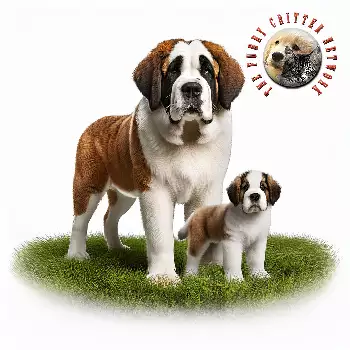
The Saint Bernhardshund is one of the largest and most massive dog breeds in the world, with males standing 28 to 30 inches at the shoulder and weighing between 140 and 180 pounds, while females measure 26 to 28 inches and weigh 120 to 140 pounds. Individual dogs can exceed these ranges considerably, and weights above 200 pounds are not uncommon in well-built males. Despite this enormous size, the breed should never appear clumsy or unbalanced. The standard calls for a powerful, well-muscled body that conveys both strength and dignity, with harmonious proportions that allow the dog to move with surprising efficiency for its bulk.
The head is the breed's most iconic feature. It is massive, broad, and slightly arched across the skull, with strongly developed zygomatic arches that give the head its characteristic width. The forehead features wrinkled skin that becomes more pronounced when the dog is alert, contributing to the thoughtful, intelligent expression that has captivated admirers for centuries. The muzzle is short relative to the skull length, broad, and blunt, with well-developed flews that contribute to the breed's notable drooling tendency. The nose is broad, with well-open nostrils, always black. The eyes are medium-sized, set somewhat frontally with a gentle, knowing expression. Eye color ranges from dark brown to a medium brown, and the lower lids typically show some haw, though excessive looseness is undesirable. The ears are medium-sized, set high, and drop close to the cheeks.
The neck is strong, thick, and moderately long, flowing into a broad, deep chest that reaches at least to the elbows. The back is broad, straight, and firm, with a powerful loin and a gently sloping croup. The tail is long, heavy, and hangs in a gentle curve at rest, rising when the dog is alert or in motion but never carried curled over the back. The limbs are heavily boned and well-muscled, with large, broad feet that provided the traction needed for Alpine work.
The breed exists in two coat varieties. The shorthaired type has a dense, smooth-lying coat with a thick undercoat, particularly heavy around the neck and thighs. This was the original hospice working type, functional in snow without accumulating ice. The longhaired variety, developed through crosses with Newfoundlands in the 1830s, has a medium-length coat that can be straight or slightly wavy but should never be curly. Both types carry substantial undercoat, and both shed heavily, particularly during seasonal coat changes.
Color is predominantly white with red, red with white, or brindle with white. The red can range from a light golden to a deep mahogany. The breed standard requires a white chest, white feet, a white tail tip, a white noseband, and a white collar or partial collar. A dark mask covering the ears and surrounding the eyes is desirable and contributes to the breed's characteristic facial expression. Movement is smooth and purposeful, with good reach in front and strong drive from behind, covering ground with an efficiency that belies the dog's massive size. The gait should remain sound and free at all speeds, and dogs should not display excessive looseness in the joints or a rolling, lumbering motion that would indicate structural deficiency.
It is worth noting that the modern Saint Bernhardshund is substantially larger than the original hospice dogs, which were closer in size to a German Shepherd. The dramatic increase in size occurred through selective breeding during the show era of the late nineteenth and twentieth centuries, when kennel clubs and exhibitions favored ever-larger specimens. The original working dogs needed to navigate deep snow for extended periods, a task that demanded endurance and agility as much as size. Some breed historians and working-dog enthusiasts have noted that the extreme size of some modern specimens has moved the breed away from its functional origins, though the breed's gentle temperament and noble bearing remain firmly intact regardless of individual variation in size.
Affectionate With Family
★★★★★
The Saint Bernhardshund bonds deeply with its entire family and demonstrates its affection through calm, steady companionship and remarkable sensitivity to household emotional states.
Good With Young Children
★★★★★
Famously gentle and patient with children of all ages. The breed's natural nurturing instinct makes it one of the best giant breeds for families, though supervision is needed due to sheer size.
Good With Other Dogs
★★★☆☆
Generally friendly with other dogs when properly socialized. Some individuals may display dominance with same-sex dogs, and the size differential requires management during interactions with small breeds.
Shedding Level
★★★★☆
Both coat varieties shed substantially year-round, with heavy seasonal blowouts that produce impressive volumes of loose undercoat requiring daily management.
Coat Grooming Frequency
★★★☆☆
Two to three brushing sessions weekly maintain the coat outside heavy shedding periods. The longhaired variety requires more thorough attention to prevent matting in feathered areas.
Drooling Level
★★★★★
This breed drools significantly and consistently. Drool increases with heat, food anticipation, and after drinking. Prospective owners must accept this as a permanent feature of daily life.
Coat Type
★★★☆☆
Two varieties exist. The shorthaired type has a dense, smooth-lying double coat. The longhaired type has a medium-length coat that can be straight or slightly wavy, never curly.
Openness To Strangers
★★★★☆
Generally friendly and welcoming toward new people. The breed lacks the suspicion of true guardian breeds and typically greets visitors with calm, good-natured interest.
Playfulness Level
★★★☆☆
Moderately playful, especially during puppyhood and young adulthood. Play tends to be gentle and measured rather than boisterous, reflecting the breed's calm overall disposition.
Watchdog/Protective Nature
★★★☆☆
May bark to announce visitors, and the breed's imposing size provides a natural deterrent. However, the breed is not inherently protective and rarely displays aggressive guarding behavior.
Adaptability Level
★★☆☆☆
Requires ample indoor space, cool living conditions, and acceptance of drool. Not suited to apartments, hot climates, or homes without air conditioning.
Trainability Level
★★★☆☆
Generally cooperative and willing to please, but occasional stubbornness requires patience. Early training is essential because the dog's enormous adult size makes correcting established bad habits extremely difficult.