Russian Wolfhound

Borzoi

Quick Facts

🐕 Breed Group
Hound Group
📏 Size Category
Large to Giant
📏 Height
Males: 28 inches minimum (typically 30-33 inches), Females: 26 inches minimum (typically 27-31 inches)
⚖️ Weight
Males: 75-105 pounds, Females: 60-85 pounds
⏱️ Life Expectancy
9-14 years
🧣 Coat Type
Long, silky, flat to wavy or curly with feathering
🎨 Coat Colors
Any color or combination of colors
😀 Temperament
Dignified, calm, independent, gentle, reserved
🏃 Exercise Needs
Moderate with sprint opportunities
🎓 Training Difficulty
Moderate to difficult - independent thinker
👶 Good with Children
Yes, with older children
🐾 Good with Other Pets
Caution with small animals due to high prey drive

Other Names & Breed Recognition

Russian Wolfhound is the name by which the Borzoi was known throughout the English-speaking world for the better part of two centuries, and it remains one of the most evocative breed names ever coined. It tells you three things immediately: where the dog comes from, what it was built to hunt, and that this is a serious working animal despite its aristocratic appearance. The AKC officially changed the breed's registered name from Russian Wolfhound to Borzoi in 1936, adopting the Russian word derived from "borzyi," meaning swift. But nearly ninety years later, Russian Wolfhound endures in breed literature, in the vocabularies of longtime sighthound enthusiasts, and in the search queries of people encountering this magnificent breed for the first time.

The persistence of the old name is not mere nostalgia. Russian Wolfhound captures something about the breed's identity that Borzoi, elegant as it sounds, does not quite convey. This was a dog bred to course and seize wolves across the frozen Russian steppes, working in coordinated pairs or trios to overtake and pin one of nature's most formidable predators until the mounted huntsman arrived. That heritage is written into every line of the breed's body, from the deep but narrow chest built for sustained speed to the powerful jaws concealed within that impossibly refined head. When someone calls this dog a Russian Wolfhound, they are acknowledging a working history that the modern show ring has softened but never erased.

The breed is registered with the AKC in the Hound Group, with the FCI in Group 10 as a Long-Haired Sighthound, with the UKC in the Sighthound and Pariah Group, and with The Kennel Club in the Hound Group. The parent breed club is the Borzoi Club of America, established in 1903. The breed's full Russian name is Russkaya Psovaya Borzaya, meaning Russian long-haired sighthound. You may also encounter the older term Russian Greyhound in some historical texts, though this is less accurate since the Borzoi and the Greyhound are distinct breeds with separate lineages. Other informal references include Psovoi and simply Borzoi, which has become the universally accepted name across all major registries.

Russian Wolfhound Organizations & Standards

The Borzoi Club of America is one of the oldest breed clubs in the nation, founded in 1903 when the breed was still universally known as the Russian Wolfhound. The BCOA maintains the breed standard, organizes the national specialty, funds health research, and operates rescue and welfare programs for Borzoi in need of rehoming. The club's health committee has earned particular distinction for developing what the OFA has called a gold standard breed health survey, reflecting a community that takes the long-term genetic welfare of its breed seriously rather than treating health testing as a box-checking exercise.

The AKC breed standard paints a picture of the Borzoi as a dog of graceful strength and aristocratic bearing. Males stand at least 28 inches at the shoulder, with many well-bred dogs reaching 30 to 33 inches. Females are slightly smaller at a minimum of 26 inches. Weight ranges from roughly 60 to 105 pounds depending on sex and build. The standard emphasizes the breed's distinctive silhouette: a long, narrow, almost Roman-nosed head, a deep but remarkably narrow chest designed for respiratory efficiency at speed, a pronounced tuck-up at the flank, and the characteristic rising topline created by slightly arched loins. The coat is long, silky, and either flat, wavy, or somewhat curly, with a dense neck frill and generous feathering on the chest, hindquarters, and tail. Any color or color combination is acceptable.

The FCI classifies the Borzoi in Group 10, Section 1 as a Long-Haired or Fringed Sighthound, with Russia holding designation as the country of origin. The UKC places the breed in its Sighthound and Pariah Group, and The Kennel Club registers it in the Hound Group. Recognition across all major international registries has been established for well over a century, reflecting the breed's deep historical roots and global presence.

CHIC certification requirements established by the BCOA include an echocardiogram performed by a board-certified veterinary cardiologist, a thyroid evaluation through an OFA-approved laboratory, an ACVO eye examination by a board-certified ophthalmologist, and DNA testing for degenerative myelopathy through the OFA/University of Missouri protocol. Optional but recommended tests include OFA hip and elbow evaluations. The BCOA also operates a Holter monitor rental program that provides owners access to cardiac arrhythmia screening at reduced cost, an initiative that underscores the breed community's focused attention on heart health as a primary concern.

Kennel Club Recognition

  • American Kennel Club (AKC): Recognized in 1891, Hound Group
  • United Kennel Club (UKC): Recognized, Sighthound and Pariah
  • Canadian Kennel Club (CKC): Recognized, Hound Group
  • FCI: Recognized, Group 10: Sighthounds
  • The Kennel Club (UK): Recognized, Hound

Russian Wolfhound Physical Description

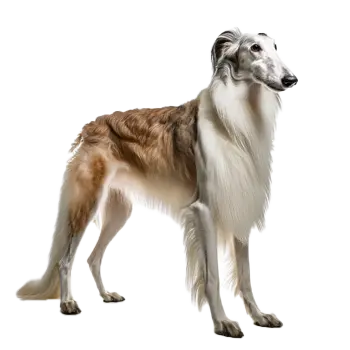
The Russian Wolfhound is one of the most visually arresting dogs in existence. Everything about this breed's structure communicates speed, elegance, and a capacity for explosive athletic performance that belies its serene resting demeanor. Standing 28 to 33 inches at the shoulder and weighing 60 to 105 pounds, the Borzoi occupies a unique space in the canine world: a dog with the height of a giant breed and the lean, aerodynamic build of a coursing athlete.

The head is the breed's most immediately recognizable feature and one of the longest, narrowest skulls in all of dogdom. Viewed from above, the skull and muzzle form a continuous, gently curved line that tapers gradually to the nose without any abrupt transitions. The stop is barely perceptible. This dolichocephalic structure is not ornamental; it served the breed's original function by providing the jaw length and bite strength needed to seize and hold a wolf while minimizing wind resistance during a high-speed pursuit. The jaws are long and deep, with a scissors bite. The eyes are dark, large, almond-shaped, and set obliquely, lending the face an expression that manages to be simultaneously gentle, intelligent, and faintly melancholy. The ears are small, fine in leather, and set well back on the skull, lying flat against the neck when relaxed and lifting slightly at the base when the dog is engaged.

The neck is long, clean, and muscular, carried with a slight arch that flows into moderately laid-back shoulders. The topline presents the breed's characteristic curve: level or slightly rising through the withers, then arching gracefully over the loin before dropping to the croup. This flexible spinal architecture is shared by other coursing breeds and allows for the double-suspension gallop that generates the Borzoi's remarkable speed. The chest is deep, reaching nearly to the elbow, but notably narrow when viewed from the front. This narrow, keel-like chest provides maximum respiratory capacity without the frontal width that would create air resistance. The ribs are long and slightly sprung. The tuck-up is pronounced, creating the distinctive wasp-waisted profile that defines the sighthound silhouette.

The forelegs are straight, clean, and fine-boned relative to the dog's size, with strong, slightly sloping pasterns that absorb impact during the gallop. The hindquarters are long, muscular, and well-angulated, with the broad thighs and low-set hocks that provide the driving power for acceleration and sustained speed. The feet are well-knuckled and hare-shaped, with thick pads suited to rough terrain. When a Borzoi breaks into a gallop, the transformation from languid house companion to coursing predator is startling. The stride is long, low, and effortless, covering ground with an economy of motion that makes high speed look easy.

The coat is long, silky, and either flat, wavy, or somewhat curly, lying close to the body with a denser, shorter texture on the head, ears, and fronts of the legs. A heavy neck frill frames the head in mature dogs, and the hindquarters, tail, and chest carry abundant feathering. The tail is long, set low, and carried in a graceful saber curve. Any color or combination of colors is acceptable, with white, gold, red, brindle, and combinations of these being among the most common. The coat provided essential protection during wolf hunts conducted in Russian winters, insulating the dog against bitter cold while the longer feathering protected the legs and underside from snow and rough terrain.

The overall impression of a well-built Russian Wolfhound is one of restrained power wrapped in extraordinary beauty. This is not a dog that looks like it should be fast. It looks like it should be draped across a velvet chaise in an oil painting. And then it runs, and you understand instantly why the Russian aristocracy built an entire hunting tradition around this breed.

Affectionate With Family
Genuinely affectionate with its household but expresses that bond with quiet restraint rather than exuberant demonstrations. Enjoys physical closeness on its own terms.
Good With Young Children
Gentle and tolerant but best suited to families with older children who understand how to interact calmly with a large, sensitive sighthound. Does not enjoy rough or chaotic handling.
Good With Other Dogs
Generally sociable with other dogs, especially other sighthounds. Does best in pairs or packs with compatible companions of similar temperament and size.
Shedding Level
Sheds moderately year-round with heavier seasonal shedding periods. The long feathering and neck frill produce the most loose hair during coat changes.
Coat Grooming Frequency
Requires thorough brushing two to three times weekly to maintain the silky coat and prevent matting in the feathering. More frequent attention needed during seasonal shedding.
Drooling Level
A clean, dry-mouthed breed with virtually no drooling under normal circumstances.
Coat Type
Long, silky coat that lies relatively close to the body, ranging from flat to wavy to somewhat curly. Dense neck frill and abundant feathering on chest, hindquarters, and tail.
Openness To Strangers
Naturally reserved with unfamiliar people, ranging from polite acknowledgment to quiet indifference. Not aggressive but not effusively welcoming.
Playfulness Level
Capable of explosive bursts of playful energy, particularly when running, but generally calm and measured in its daily interactions. Maintains a dignified bearing even at play.
Watchdog/Protective Nature
Not a natural watchdog or guard dog. The Borzoi may alert to unusual activity but lacks the protective drive to confront perceived threats.
Adaptability Level
Surprisingly adaptable to various living situations given access to safe running space. The breed's calm indoor demeanor makes it more flexible than its size suggests.
Trainability Level
Intelligent but independently minded, responding to training on its own terms. Positive methods with patience and humor produce results; demanding obedience produces resistance.

Russian Wolfhound History & Development

The name Russian Wolfhound is not merely a label. It is a compressed history of one of the most dramatic hunting traditions ever practiced with dogs. For centuries, the Russian aristocracy conducted elaborate wolf hunts across the vast steppes, using packs of these sighthounds to course, overtake, and pin wolves until mounted hunters arrived to dispatch or release the quarry. The name Russian Wolfhound entered English usage as these hunts became famous in Western Europe, and it remained the breed's primary English designation until the AKC's 1936 name change to Borzoi.

The breed's origins are ancient and somewhat disputed. Sighthounds of the Borzoi type appear in Russian records dating to at least the seventeenth century, though the breed's development into its modern form is generally attributed to the Russian nobility of the eighteenth and nineteenth centuries. Grand estates maintained enormous breeding programs, sometimes housing hundreds of Borzoi alongside the horses and hunting hawks that completed the coursing retinue. Each noble family developed its own strain, breeding for the specific combination of speed, endurance, courage, and coat quality suited to their regional terrain and climate. The result was a breed of remarkable athletic ability and striking beauty, valued as both a functional hunting partner and a symbol of aristocratic refinement.

The Russian Wolfhound name gained international currency as the breed was exported to Western Europe and America in the late nineteenth century. Queen Victoria received Borzoi as gifts from the Russian Czar, and the breed became fashionable among European royalty and the wealthy American elite. The first Borzoi registered with the AKC appeared in 1891, under the Russian Wolfhound name. The Borzoi Club of America was founded in 1903 as the Russian Wolfhound Club, and the breed developed a devoted following among those who appreciated both its physical beauty and its coursing heritage.

The 1936 name change from Russian Wolfhound to Borzoi reflected a broader trend in the breed fancy toward using native-language breed names. The shift was not universally welcomed. Many breed enthusiasts felt that Russian Wolfhound better communicated the breed's identity and working heritage, while Borzoi, though authentic, told the English-speaking public nothing about what the dog was or where it came from. This tension between the evocative old name and the linguistically correct new one has never fully resolved, which is why Russian Wolfhound continues to circulate nearly nine decades after the official change.

The breed nearly perished in Russia following the 1917 Revolution. The Borzoi's intimate association with the aristocracy made it a target, and vast numbers were killed along with their noble owners. The breed survived internationally through dogs that had been exported before the revolution, and dedicated breeders in Europe and America preserved the genetic lines that sustain the breed today. The irony is significant: a breed developed over centuries by Russian nobility was saved from extinction by the foreign exports that the aristocracy had made as diplomatic gifts and tokens of prestige.

Russian Wolfhound Temperament & Personality

The Russian Wolfhound's temperament is rooted in its history as an independent coursing dog that was required to make split-second decisions at high speed without human direction. This heritage produces a dog that is intelligent, dignified, and fundamentally self-governing in a way that bewilders people who expect eager-to-please obedience from every breed. The Borzoi does not exist to serve its owner's will. It exists alongside its owner, participating in the relationship on terms that reflect its own assessment of what is worth doing. This is not defiance. It is the temperament of a dog that was bred to think for itself, and understanding this distinction is essential to living happily with the breed.

In the home, the Borzoi is remarkably calm and quiet. Despite its size and athletic capacity, this is a dog that spends a striking amount of its day resting, often draped across furniture in positions that seem anatomically improbable. The breed's nickname among enthusiasts as a "45-mile-per-hour couch potato" captures this duality perfectly. The Borzoi can explode into breathtaking speed when something triggers its prey drive, then return to the sofa and sleep for hours as though nothing happened. This low-key indoor personality makes the breed surprisingly compatible with apartment or suburban living, provided its exercise needs are met through appropriate outdoor activity.

The bond a Borzoi forms with its family is genuine but expressed with restraint. This is an affectionate breed that enjoys physical closeness with its people, often leaning against them or resting its long head on a convenient lap. But it does not demand attention with the insistent neediness of some companion breeds. A Borzoi is content to be in the same room as its owner without requiring constant interaction. Some people interpret this self-sufficiency as aloofness, but it is better understood as the quiet confidence of a dog that is secure in its relationships and does not need constant reassurance.

With strangers, the breed ranges from politely reserved to genuinely indifferent. Borzoi are not aggressive toward unfamiliar people, but they are unlikely to greet visitors with enthusiasm. This reserve is deeply ingrained and should be respected rather than trained away. Socialization ensures that the dog is comfortable in public settings, but it does not transform the breed's fundamental temperament into something more demonstrably friendly. If you want a dog that loves everyone it meets, this is not your breed.

The prey drive in the Borzoi is not a behavioral quirk that can be trained out. It is a core feature of the breed's genetic makeup, selected for over centuries of wolf coursing. A Borzoi will chase small, fast-moving animals with an intensity and commitment that overrides recall training in most circumstances. This has direct practical implications for daily life. The breed cannot be trusted off-leash in unfenced areas, and homes with cats or small dogs require careful management and introductions. Many Borzoi coexist peacefully with household cats they were raised with, but the same dog may pursue an unfamiliar cat encountered outdoors. Understanding and managing this drive, rather than attempting to eliminate it, is a fundamental responsibility of Borzoi ownership.

Russian Wolfhound Family Life & Living Requirements

Living with a Russian Wolfhound requires coming to terms with a paradox: this is simultaneously one of the calmest large dogs you will ever share a home with and one of the most dangerous to leave unsupervised around small animals. The breed's indoor personality is so quiet and unobtrusive that many owners describe their Borzoi as the easiest large dog they have ever lived with. It does not bark excessively, it does not pace or demand attention, and it does not engage in the kind of restless destructiveness that plagues high-energy working breeds left without jobs. What it does is claim every comfortable surface in your home and sleep on it with a graceful sprawl that takes up more space than seems physically possible for a dog of its proportions.

Space considerations are real but nuanced. The Borzoi does not need a vast property to be content, but it does need access to a securely fenced area where it can run at full speed periodically. This is not negotiable. A sighthound that never gets to sprint is a sighthound whose fundamental physical and psychological needs are not being met. The fencing must be at least five to six feet tall, as Borzoi are capable jumpers when motivated. Electronic or invisible fencing is inadequate for this breed because the prey drive will override the deterrent every time.

With children, the Borzoi can be a gentle and tolerant companion, but the breed's size and reserved temperament make it better suited to families with older children who understand how to interact calmly with a large, sensitive dog. The Borzoi does not enjoy rough handling, sudden loud noises, or chaotic energy, and it may simply remove itself from an unpleasant situation rather than endure it. This is a dignified breed that deserves dignified treatment from every member of its household.

The prey drive issue deserves emphasis in the family life context. If your household includes cats, small dogs, rabbits, or other small animals, the introduction process must be careful, supervised, and ongoing. Many Borzoi successfully share homes with cats they were raised alongside, but the owner must remain vigilant and never assume the prey drive has been permanently suppressed. A new cat entering the household, or a familiar cat running suddenly, can trigger a response that no amount of prior coexistence guarantees against. Responsible Borzoi owners maintain management protocols for the life of the dog.

Russian Wolfhound Training & Exercise Needs

Training a Russian Wolfhound requires recalibrating your expectations if you have previously worked with breeds that were developed to follow human direction eagerly. The Borzoi is intelligent, but its intelligence is applied to its own priorities rather than yours. This is a breed that understands perfectly well what you are asking and then makes an independent judgment about whether to comply. Harsh corrections are not only ineffective but actively counterproductive, producing a dog that becomes withdrawn and uncooperative rather than submissive. Positive reinforcement, delivered with patience and a genuine sense of humor about the process, produces the best results.

Basic obedience is achievable and important for safety, but the Borzoi will never perform with the snap-to-attention precision of a herding or working breed. A reliable recall is the most critical and the most difficult command to establish, given the breed's prey drive. Many experienced Borzoi owners are candid that recall is unreliable when the dog's coursing instinct is triggered, which is why secure fencing and leash discipline are non-negotiable management tools rather than training failures. The breed does well in lure coursing, which channels its natural prey drive into a structured activity, and many Borzoi enjoy the sport with genuine enthusiasm.

Exercise needs follow the sighthound pattern: intense bursts of high-speed activity interspersed with long periods of rest. The breed does not need or want hours of sustained exercise in the way that herding or sporting breeds do. What it needs is regular access to a safe, enclosed space where it can run flat out for short periods, supplemented by daily leash walks that provide mental stimulation and environmental engagement. A Borzoi that gets two or three good sprints a week and a daily walk is generally a calm, satisfied household companion. One that is restricted to leash walks only, with no opportunity to run, will develop restless behaviors that reflect its unmet need for speed.

Socialization is important for producing a Borzoi that navigates public spaces with confidence and composure. The breed's natural reserve with strangers means that undersocialized dogs may become genuinely fearful in unfamiliar environments, which in a dog this size creates practical problems. Early exposure to different people, places, sounds, and situations builds the foundation for an adult dog that is calm and self-possessed in public, even if it never becomes effusively friendly with everyone it meets.

Russian Wolfhound Health Concerns

The Borzoi is considered a generally healthy breed for its size, but like all sighthounds it carries specific health vulnerabilities that prospective owners should understand. The breed's deep, narrow chest places it squarely in the high-risk category for gastric dilatation-volvulus, the life-threatening emergency in which the stomach fills with gas and rotates on its axis. GDV can kill a dog within hours if not treated surgically, and every Borzoi owner should know the symptoms, have a veterinary emergency plan in place, and discuss prophylactic gastropexy with their veterinarian. This is not a theoretical concern. Bloat is one of the leading causes of death in large sighthounds.

Degenerative myelopathy is a progressive spinal cord disease caused by a mutation in the SOD1 gene, and DNA testing is required for CHIC certification. The condition causes gradual hind-end weakness and loss of coordination, typically appearing in older dogs. Breeding two carriers together risks producing affected offspring, so testing allows breeders to make informed decisions while maintaining genetic diversity. Hypothyroidism is screened through the OFA thyroid evaluation and is manageable with daily medication when diagnosed. Progressive retinal atrophy and cataracts are monitored through annual ACVO eye examinations. Osteosarcoma, an aggressive bone cancer, occurs in Borzoi at rates consistent with other large and giant breeds, though there is currently no screening test that predicts individual risk. Anesthetic sensitivity is a well-documented concern in sighthounds generally, including the Borzoi, due to their low body fat percentage and unique drug metabolism. Any veterinarian treating a Borzoi should be informed of this sensitivity before administering sedation or anesthesia.

Common Health Issues

  • Gastric dilatation-volvulus (bloat/GDV) - A life-threatening emergency in which the stomach distends with gas and rotates on its axis, cutting off blood supply to abdominal organs. The Borzoi's deep, narrow chest places it among the highest-risk breeds. Prophylactic gastropexy is a preventive measure worth discussing with your veterinarian.
  • Cardiac disease - Conditions including myxomatous mitral valve disease and dilated cardiomyopathy have been documented in the breed. The BCOA requires echocardiography by a board-certified cardiologist for CHIC certification and operates a Holter rental program for arrhythmia screening.
  • Degenerative myelopathy - A progressive spinal cord disease caused by the SOD1 gene mutation, producing gradual hind-end weakness and loss of coordination in older dogs. DNA testing is required for CHIC certification and allows breeders to avoid producing affected offspring.
  • Hypothyroidism - Autoimmune thyroiditis causing insufficient thyroid hormone production, leading to weight gain, lethargy, coat changes, and skin problems. Screened through OFA thyroid evaluation and manageable with daily medication.
  • Progressive retinal atrophy and cataracts - Hereditary ocular conditions monitored through annual ACVO eye examinations. PRA causes progressive vision loss, while cataracts may be surgically correctable depending on severity.
  • Osteosarcoma - An aggressive bone cancer occurring in Borzoi at rates consistent with other large and giant breeds. No predictive screening test currently exists, and early detection of lameness or bone swelling is important.
  • Anesthetic sensitivity - Sighthounds including the Borzoi metabolize certain drugs differently due to low body fat percentage and unique physiology. Any veterinarian treating a Borzoi must be informed of this sensitivity before administering sedation or anesthesia.
  • Geriatric onset laryngeal paralysis polyneuropathy (GOLPP) - A progressive condition affecting older Borzoi, causing changes in bark, breathing difficulty, and hind-end weakness. Management focuses on symptom control and environmental modification.

Preventive Care & Health Monitoring

  • Echocardiogram by a board-certified veterinary cardiologist is required for CHIC certification - Screening for myxomatous mitral valve disease, dilated cardiomyopathy, and other structural cardiac conditions.
  • Thyroid evaluation through an OFA-approved laboratory is required for CHIC certification - Screening for autoimmune thyroiditis that can lead to hypothyroidism.
  • ACVO eye examination by a board-certified veterinary ophthalmologist is required for CHIC certification - Screening for progressive retinal atrophy, cataracts, and other hereditary ocular conditions.
  • DNA testing for degenerative myelopathy through the OFA/University of Missouri protocol is required for CHIC certification - Identifying carriers of the SOD1 mutation to inform breeding decisions.
  • Holter monitoring through the BCOA rental program is recommended for ongoing cardiac arrhythmia surveillance beyond the baseline echocardiogram - Particularly for breeding stock and dogs with equivocal cardiac findings.
  • Discussion of prophylactic gastropexy with your veterinarian is strongly recommended given the breed's extreme susceptibility to gastric dilatation-volvulus. - Discussion of prophylactic gastropexy with your veterinarian is strongly recommended given the breed's extreme susceptibility to gastric dilatation-volvulus.
  • Informing all veterinary personnel of sighthound anesthetic sensitivity before any procedure requiring sedation is a critical safety measure that should be documented in the dog's veterinary records. - Informing all veterinary personnel of sighthound anesthetic sensitivity before any procedure requiring sedation is a critical safety measure that should be documented in the dog's veterinary records.

Russian Wolfhound Grooming & Maintenance

The Russian Wolfhound's long, silky coat is one of the breed's most beautiful features and, compared to many long-coated breeds, surprisingly manageable. The coat texture ranges from flat to wavy to somewhat curly, and it lies relatively close to the body rather than standing off in the voluminous way that breeds like the Rough Collie or Old English Sheepdog display. This means that while the coat is undeniably long and requires regular attention, it does not mat as aggressively as denser, cottony coat types. A thorough brushing two to three times a week with a pin brush and a steel comb keeps the coat in good condition and prevents the tangles that develop in the feathering and behind the ears if maintenance lapses.

The breed does shed, and during seasonal coat changes the shedding can be substantial. The dense neck frill and the leg and tail feathering produce the most loose hair, and daily brushing during heavy shedding periods reduces the amount of hair deposited on furniture and clothing. Bathing should occur as needed, typically every four to six weeks, using a quality shampoo that preserves the coat's natural silky texture. Many Borzoi owners find that a light conditioning spray applied before brushing helps the comb glide through the longer sections without breaking the hair.

The breed's long, narrow head creates some specific grooming considerations. The ears are thin and fine, lying flat against the neck, and should be checked weekly for cleanliness. The long muzzle means food and water can accumulate on the facial hair and beard area, requiring a quick wipe after meals. Nail trimming every two to three weeks is important, particularly for dogs that exercise primarily on soft surfaces and do not wear their nails down naturally. Dental care follows standard large-breed recommendations, with regular brushing and periodic professional cleanings supporting long-term oral health. The breed's hare-shaped feet may grow hair between the pads that should be trimmed periodically to maintain traction and prevent debris accumulation. Overall, the Borzoi's grooming demands are moderate for a long-coated breed and well within the management capacity of any committed owner.