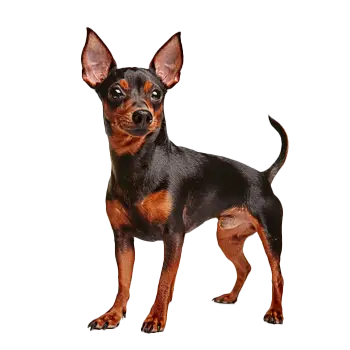

Reh Pinscher

Miniature Pinscher

Quick Facts

🐕 Breed Group
Toy Group
📏 Size Category
Small
📏 Height
Males: 10-12.5 inches, Females: 10-12.5 inches
⚖️ Weight
Males: 8-10 pounds, Females: 8-10 pounds
⏱️ Life Expectancy
12-16 years
🧣 Coat Type
Single coat - short, smooth, tight-fitting, lustrous
🎨 Coat Colors
Solid red, stag red, black with rust points, chocolate with rust points
😀 Temperament
Fearless, spirited, proud, alert, loyal, playful
🏃 Exercise Needs
Moderate to high
🎓 Training Difficulty
Moderate - independent and easily distracted
👶 Good with Children
Better with older children; too fragile for rough play
🐾 Good with Other Pets
Conditional - can be dominant with dogs; high prey drive with small animals

Other Names & Breed Recognition

Reh Pinscher is the original German name for the dog now known internationally as the Miniature Pinscher. The name carries precise meaning: Reh refers to the European roe deer, a small, elegant, reddish-brown cervid native to German forests, and Pinscher is a German term for terrier-type dogs. The name was applied because the breed's early stag-red specimens bore a striking visual resemblance to these delicate forest deer in both color and movement. The comparison was not casual; the Reh Pinscher's light, high-stepping gait and slender, alert bearing genuinely evoked the image of a small deer picking its way through woodland undergrowth.

The name Reh Pinscher appears in German breeding records and show documentation from the late 19th and early 20th centuries, predating the modern designation Miniature Pinscher by decades. The first recorded show entries under this name appeared in Switzerland in 1882, and the German Kennel Club registered the breed as the Reh Pinscher in its stud books during the same period. A landmark specialty show for Reh Pinschers held in Stuttgart, Germany, on September 16, 1900, attracted ninety-three entries, demonstrating that the breed had already achieved substantial recognition and a dedicated following among German dog fanciers.

The breed carries several additional names across different regions and registries. In German-speaking countries, the formal designation is Zwergpinscher, with Zwerg meaning dwarf, identifying the breed as the miniaturized variant of the German Pinscher. The abbreviated nickname Min Pin is universally understood in English-speaking countries. The breed has also earned the affectionate title King of Toys, a reference to its commanding personality and competitive dominance in the show ring among toy breeds. Each name captures a different facet of the breed's identity: Reh Pinscher speaks to its appearance and origins, Zwergpinscher to its relationship within the German Pinscher family, and King of Toys to its oversized personality.

The breed is formally recognized by every major international registry under the name Miniature Pinscher or its equivalent. The AKC first registered the breed in 1925 as the Pinscher (Toy), reclassified it to the Toy Group in 1930, and added "Miniature" to its name in 1972. The FCI recognizes the breed as the Zwergpinscher under Group 2, Pinscher and Schnauzer types. The Kennel Club in the United Kingdom, the CKC, and the UKC all maintain recognition under the Miniature Pinscher designation. If you encounter the name Reh Pinscher in historical texts, breeding records, or among enthusiasts who value the breed's German heritage, you are looking at the Miniature Pinscher and its authentic origin story.

Reh Pinscher Organizations & Standards

The Miniature Pinscher Club of America, founded in 1929, serves as the AKC parent club for the breed in the United States. The MPCA maintains the official breed standard, sponsors national and regional specialty shows, publishes health and breeding resources, and coordinates rescue efforts for Min Pins in need of new homes. Members who agree to the club's Code of Ethics commit to health testing breeding stock, providing lifetime support for dogs they produce, and refraining from selling puppies through pet stores or commercial brokers. The MPCA's website remains the primary resource for prospective owners seeking responsible breeders and accurate breed information.

The MPCA participates in the OFA Canine Health Information Center program. For a Miniature Pinscher to earn a CHIC number, the dog must complete an OFA patellar luxation evaluation and a CAER ophthalmologic examination conducted by a board-certified veterinary ophthalmologist, with results registered in the public database. A cardiac evaluation by a board-certified cardiologist is recommended as an additional screening. The CHIC program does not certify that results are normal; it certifies that the required tests were completed and that the results are publicly available, enabling prospective puppy buyers to make informed decisions based on transparent health data.

The AKC breed standard for the Miniature Pinscher describes a structurally well-balanced, sturdy, compact, smooth-coated toy dog that is naturally well-groomed, proud, vigorous, and alert. The standard places particular emphasis on the breed's distinctive hackney-like gait, a high-stepping front action in which the forelegs reach well forward with strong drive from the rear. This gait is the breed's most recognized and most scrutinized physical feature in conformation competition. The standard calls for clean lines with no excess, a head that is proportionate to the body, and dark, full, oval eyes that convey a sharp, alert expression.

Accepted coat colors under the AKC standard include solid clear red, stag red (red with an intermingling of black hairs), black with sharply defined rust-red markings, and chocolate with rust-red markings. The markings on bicolored dogs must appear in specific locations: above each eye, on the cheeks, on the lips, on the lower jaw, on the throat, as twin spots on the chest, on the lower half of the forelegs, on the inside of the hind legs, below the hocks, and on the lower portion of the feet. The tail is traditionally docked, and ears may be cropped or left natural. Dogs with natural ears can be shown in the AKC ring, though both cropped and uncropped presentations must convey the breed's characteristic alert, erect ear carriage.

The FCI standard for the Zwergpinscher aligns closely with the AKC document in most structural requirements but operates under European conventions that prohibit ear cropping and tail docking in many member countries. The FCI places the breed in Group 2, Pinscher and Schnauzer - Molossoid and Swiss Mountain and Cattledogs, Section 1, Pinscher and Schnauzer type, with breed number 185. This classification reflects the breed's authentic position within the German Pinscher family rather than the Toy designation used by Anglophone registries. The Kennel Club in the United Kingdom classifies the breed under its Toy group, and the UKC places it in the Companion Dog group.

Kennel Club Recognition

  • American Kennel Club (AKC): Recognized in 1925, Toy Group
  • United Kennel Club (UKC): Recognized, Companion Dog
  • Canadian Kennel Club (CKC): Recognized, Toy Dogs
  • FCI: Recognized in 1955, Group 2 - Pinscher and Schnauzer - Molossoid and Swiss Mountain and Cattledogs
  • The Kennel Club (UK): Recognized, Toy

Reh Pinscher Physical Description

The Reh Pinscher is a compact, elegantly proportioned toy dog that projects an image of power and athleticism entirely disproportionate to its small size. Males and females stand between 10 and 12.5 inches at the withers and typically weigh between 8 and 10 pounds. The overall impression is of a miniature athlete: clean-lined, muscular, and perfectly balanced, with no suggestion of coarseness, legginess, or fragility. The body is slightly longer than it is tall, creating a rectangular profile when viewed from the side, with a level topline that slopes gently downward from withers to croup.

The head is proportionate to the body and carried on a slightly arched, graceful neck. The skull is flat with a moderate stop, and the muzzle is strong and proportionate, neither snipey nor blunt. The eyes are dark, full, and slightly oval, set well apart and conveying a bright, alert expression that communicates the breed's perpetual readiness for action. The ears are set high and may be cropped to a pointed, erect configuration or left natural. Natural ears fold forward in a V-shape or stand erect, and both presentations are acceptable in the AKC show ring provided they enhance the breed's alert expression.

The breed's most immediately recognizable physical feature is its distinctive hackney gait, a high-stepping front action that mimics the movement of a Hackney carriage horse. During this gait, the forelegs are lifted high with a pronounced bend at the wrist before extending forward in a smooth, reaching motion. The rear drive is strong and balanced, propelling the dog forward with an effortless, animated quality that commands attention wherever the breed appears. This gait is not simply a stylistic preference; it is a defining breed characteristic that receives considerable weight in conformation judging and distinguishes the Miniature Pinscher from every other toy breed.

The coat is the essence of simplicity: a single layer of short, smooth, hard, lustrous hair that lies flat and tight against the body, following the muscular contours without gap or wrinkle. There is no undercoat, no feathering, and no furnishing of any kind. The coat's sleek surface showcases the breed's well-defined musculature and angular bone structure, creating an appearance of polished elegance. Accepted colors include solid clear red, stag red with an intermingling of black hairs that creates a warm reddish-brown effect, black with precisely placed rust-red markings, and chocolate with rust-red markings. The stag-red coloring is the shade that inspired the original Reh Pinscher name, evoking the coat of the European roe deer.

The tail is set high and traditionally docked to a length that complements the body's proportions, though natural tails are carried upright or in a gentle curve over the back in countries where docking is prohibited. The feet are small, compact, and catlike, with well-arched toes and hard, dark pads. The overall physical impression of the Reh Pinscher is of a small dog engineered for speed, agility, and visual impact, carrying itself with a confidence and bearing that consistently surprises observers who encounter the breed for the first time.

Affectionate With Family
The Reh Pinscher bonds intensely with its household and craves close physical contact with its favorite people. This breed wants to be involved in every family activity and will burrow under blankets, curl into laps, and follow its owner from room to room with tireless devotion. The affection is genuine and deep, though it comes with a possessive edge that can manifest as resource guarding or jealousy when attention is directed elsewhere.
Good With Young Children
The Reh Pinscher's small size and delicate bone structure make it vulnerable to injury from the uncoordinated handling of young children. The breed has a low tolerance for being grabbed, squeezed, or dropped, and will not hesitate to nip in self-defense when it feels threatened. Families with toddlers or very young children should exercise extreme caution, as even well-intentioned play can result in injury to the dog or a defensive reaction toward the child. Older children who understand how to interact gently with a small dog can develop excellent companionships with this breed.
Good With Other Dogs
The Reh Pinscher approaches other dogs with a confidence that vastly exceeds its physical stature, and it will not back down from confrontations with much larger breeds. Early socialization helps moderate this tendency, and many Min Pins coexist well with housemate dogs, particularly when raised together. However, the breed's territorial nature and tendency toward resource guarding can create friction in multi-dog households, and introductions to unfamiliar dogs should always be supervised carefully.
Shedding Level
The Reh Pinscher's short, tight single coat sheds minimally throughout the year. There is no seasonal blowout period because the breed lacks a dense undercoat, and the fine hairs that are released are small enough to be largely unnoticeable on most surfaces. A weekly wipe-down with a grooming mitt captures the majority of loose hair before it reaches furniture or clothing, making this one of the tidiest toy breeds in terms of shedding.
Coat Grooming Frequency
The Reh Pinscher requires the absolute minimum in coat maintenance. A weekly brushing with a soft bristle brush or chamois cloth is sufficient to keep the coat gleaming and remove any loose hair. Bathing is needed only occasionally, typically once a month or less. The coat's smooth, close-lying texture repels dirt effectively and dries quickly after getting wet. This is one of the lowest-maintenance coats in the dog world.
Drooling Level
The Reh Pinscher is an exceptionally clean breed that produces virtually no drool under any circumstances. The tight lip structure and compact jaw mean that saliva stays contained, and owners will never encounter wet spots on clothing, furniture, or floors. This tidiness extends to the breed's overall demeanor, as the Min Pin is fastidious about its personal cleanliness.
Coat Type
The Reh Pinscher's single coat is one of the simplest in the dog world: short, smooth, hard, and lustrous, lying flat and tight against the body with no undercoat, feathering, or furnishings of any kind. The coat follows the contours of the body precisely, showcasing the breed's muscular definition and elegant lines. This sleek covering provides minimal insulation, which means the breed is sensitive to cold weather and benefits from protective clothing during winter outings.
Openness To Strangers
The Reh Pinscher is naturally suspicious of unfamiliar people and will announce the arrival of strangers with vigorous, sustained barking before warming up at its own pace. This wariness is part of the breed's watchdog heritage and should not be confused with shyness or fear. A well-socialized Min Pin may eventually accept a visitor but rarely seeks out attention from people it does not know. Early exposure to a wide variety of people helps moderate this aloofness without eliminating the breed's natural alertness.
Playfulness Level
The Reh Pinscher maintains a puppy-like enthusiasm for play throughout its entire life, approaching games with an intensity that belies its small size. This breed adores toys, particularly those it can chase, shake, and hoard, and it will invent elaborate games of its own when human entertainment is unavailable. The Min Pin's playfulness is boundless and infectious, but it can also be exhausting for owners who are unprepared for a dog that treats every waking moment as an opportunity for action.
Watchdog/Protective Nature
The Reh Pinscher is one of the most alert and vocally responsive watchdogs among all toy breeds. This breed misses nothing in its environment and will sound the alarm at any unusual sound, sight, or movement with a sharp, penetrating bark that carries far beyond what its size would suggest. The Min Pin takes its self-appointed guard duty seriously and will continue barking as long as it perceives a potential threat. While its small size prevents it from providing physical protection, its vigilance and vocal determination make it an effective early warning system.
Adaptability Level
The Reh Pinscher adapts well to various living situations thanks to its compact size and moderate exercise requirements. Apartments, condominiums, and small homes are all suitable environments for this breed, provided that daily exercise and mental stimulation are supplied consistently. The breed does not tolerate cold weather well and requires indoor living with access to warm, soft resting areas. Travel and schedule changes are generally handled without difficulty, though the breed may need time to settle into new environments.
Trainability Level
The Reh Pinscher is intelligent and capable of learning a wide range of commands and tricks, but its independent spirit and short attention span create training challenges that require patience and creativity. This breed responds best to positive reinforcement methods delivered in brief, engaging sessions that feel more like play than work. Harsh corrections produce stubbornness or shutdown behavior. Housetraining is notoriously difficult with the Min Pin and often requires longer than average to accomplish reliably.

Reh Pinscher History & Development

The Reh Pinscher's history reaches back considerably further than most people realize. While definitive documented breeding records begin in the mid-19th century, artwork depicting dogs strongly resembling the modern Miniature Pinscher appears in European paintings and prints dating to the 1600s. These early depictions show small, smooth-coated, red or black-and-tan dogs with erect carriage and alert expressions, suggesting that the type existed as a recognizable variety long before formal breed classification began. The breed's origins lie in Germany, where it developed as a functional barnyard ratter and household companion among farming communities.

The Reh Pinscher belongs to the broader German Pinscher family, which encompasses several related breeds including the German Pinscher, the Affenpinscher, and the various Schnauzer types. The word Pinscher itself derives from a term meaning terrier or biter, reflecting the functional ratting heritage shared by these breeds. Dr. H. G. Reichenbach, a German writer and early breed authority, stated in 1836 that the Reh Pinscher likely resulted from crosses between the Dachshund and the Italian Greyhound, though modern breed historians generally agree that the breed's ancestry includes the smaller German smooth-haired Pinscher as its primary foundation, with Dachshund and Italian Greyhound contributions shaping specific physical and temperamental characteristics.

The Pinscher-Schnauzer Klub, formed in Germany in the 1890s, began formal efforts to standardize and document the various Pinscher types, including the miniature variety. This organization established breeding records, defined ideal characteristics, and promoted systematic breeding programs that refined the breed from a rough working ratter into a consistent, recognizable type. The first Reh Pinschers appeared at shows in Switzerland in 1882, and the German Kennel Club registered the breed in 1883. The first specialty show for Reh Pinschers, held in Stuttgart in 1900, drew ninety-three entries and signaled the breed's transition from farmyard worker to exhibition dog. During this period, black with red markings was the predominant color, and solid red dogs were relatively uncommon.

The breed's popularity expanded rapidly in Germany between 1900 and 1914, establishing it as a fashionable companion and show dog. World War I devastated the German dog fancy, and the Reh Pinscher's population declined sharply during and after the conflict. By 1926, breeding resumed, and the breed began spreading beyond Germany's borders to Denmark, France, Belgium, Switzerland, and England. The first Miniature Pinschers arrived in the United States around 1919, and the AKC registered its first specimen, a black-and-rust female named Asta von Sandreuth, in 1925 under the breed name Pinscher (Toy). The breed was initially placed in the AKC Terrier Group but moved to the Toy Group in 1930.

A persistent and widespread misconception holds that the Miniature Pinscher was developed as a scaled-down version of the Doberman Pinscher. This error arises from the superficial visual resemblance between the two breeds, particularly in their shared black-and-tan coloring. Historical evidence conclusively demonstrates that the Reh Pinscher existed as a recognized breed decades before Louis Dobermann created the first Dobermans in the 1890s. Dobermann himself reportedly described his ambition as creating a giant terrier that would resemble the five-pound Reh Pinscher but be fifteen times heavier. The Miniature Pinscher is not a miniature anything; it is an independent breed with its own distinct lineage, developed long before the Doberman came into existence.

Reh Pinscher Temperament & Personality

The Reh Pinscher possesses a temperament that routinely astonishes people who expect a docile lap dog and instead encounter a fearless, opinionated, perpetually energetic personality compressed into an eight-pound frame. The breed earned its King of Toys nickname not through passive charm but through a commanding presence and absolute conviction that it is the most important individual in any room. The Min Pin carries itself with an aristocratic bearing that communicates authority, and it approaches life with a combination of intelligence, curiosity, and boldness that makes every day an adventure for both the dog and its owner.

The breed's terrier-like temperament is deeply rooted in its history as a working ratter. The drive to hunt, chase, investigate, and conquer that served the Reh Pinscher in barns and stables translates directly into domestic life as an insatiable curiosity about every object, sound, and movement within its environment. Min Pins are perpetual investigators who examine new items thoroughly, test boundaries relentlessly, and approach unfamiliar situations with more bravado than caution. This investigative drive makes the breed endlessly entertaining but also requires vigilant management, as the Min Pin's lack of fear can lead it into situations that exceed its physical capabilities.

Loyalty to family is absolute and often manifests as possessive attachment to a primary person. The Reh Pinscher bonds deeply and demonstratively with its chosen person, seeking physical contact, following throughout the house, and monitoring that person's location and activities with unwavering attention. This devotion can shade into resource guarding behavior directed at the owner, with the Min Pin positioning itself as gatekeeper between its favorite person and other household members, guests, or pets. Early socialization and consistent training help moderate this possessiveness without diminishing the breed's genuine depth of attachment.

The breed's watchdog instincts are exceptional and operate on a hair trigger. The Reh Pinscher is keenly aware of its environment and responds to changes with immediate, vocal alertness. Doorbells, passing pedestrians, delivery trucks, unfamiliar sounds from neighboring units, and even shifts in ambient noise can trigger barking episodes that the breed sustains with considerable determination. This vigilance makes the Min Pin an effective alarm dog, but it also means that owners in apartments or close-quarter living situations must invest in bark management training early to prevent the breed's natural alertness from becoming a neighborhood nuisance.

Despite its serious watchdog demeanor, the Reh Pinscher has a genuine and exuberant playful side that persists well into old age. This breed treats toys as prized possessions, invents elaborate solo games when no human partner is available, and approaches interactive play with infectious enthusiasm. The Min Pin's energy is not nervous or anxious; it is purposeful and directed, flowing naturally between investigation, play, patrol, and affection in a cycle that keeps its owner constantly engaged. The breed's personality is fundamentally incompatible with passive ownership, and it rewards active, involved companions with a relationship of remarkable depth and entertainment value.

Reh Pinscher Family Life & Living Requirements

The Reh Pinscher adapts well to a variety of living environments thanks to its compact size and moderate exercise requirements, but its personality demands an owner who understands that small does not mean simple. This breed is best suited to experienced dog owners or dedicated first-timers who have thoroughly researched its temperamental characteristics before committing. The Min Pin's combination of high energy, strong will, possessive tendencies, and vocal alertness can overwhelm households expecting a quiet, decorative companion. Owners who appreciate the breed's bold character and engage with it actively will find an immensely rewarding companion; those seeking a passive lap dog should look elsewhere.

Apartments, condominiums, and small homes are all suitable environments for the Reh Pinscher, as the breed's exercise needs can be met through a combination of indoor play and moderate outdoor activity. The critical requirement is not space but engagement: a Min Pin in a mansion without human interaction will be more destructive and vocal than a Min Pin in a studio apartment with an attentive, active owner. The breed's sensitivity to cold weather means it must live indoors and requires protective clothing during winter outings. Warm, soft resting areas are essential, and the breed will seek out blankets, pillows, and human laps for warmth throughout the cooler months.

Families with older children can enjoy excellent relationships with the Reh Pinscher, particularly when children are involved in training and structured play. The breed's energy level and enthusiasm for games make it a natural playmate for kids who can handle a small dog with appropriate gentleness. Families with toddlers or very young children should exercise caution, as the breed's small size makes it vulnerable to accidental injury, and its willingness to nip when handled roughly creates a risk cycle in which both dog and child can be harmed. Clear household rules about how the dog is handled, picked up, and approached should be established and enforced consistently.

The Reh Pinscher's escape artistry is legendary among toy breeds and represents a genuine safety concern that owners must address proactively. This breed is capable of squeezing through remarkably small gaps in fences, darting through partially open doors, and wriggling free from improperly fitted harnesses or collars. Its speed and agility make recapture difficult once an escape has occurred. Yard fencing must be inspected for gaps at ground level, gates must close securely and automatically, and door management protocols must become household routine. Many experienced Min Pin owners install baby gates at interior doorways to create buffer zones that prevent direct access to exterior exits.

The breed's tendency toward resource guarding and possessiveness requires ongoing management in multi-pet and multi-person households. The Reh Pinscher may guard food, toys, resting spots, and its preferred person from other animals and family members. These behaviors are best addressed through early training that teaches the dog to associate the approach of others with positive outcomes rather than competition. Feeding in separate areas, providing multiple resting options, and ensuring that the dog receives adequate individual attention help reduce the triggers that activate guarding behavior.

Reh Pinscher Training & Exercise Needs

Training the Reh Pinscher requires a handler who appreciates that this breed's intelligence operates independently of any particular interest in pleasing its owner. The Min Pin learns quickly and retains information effectively, but it applies that knowledge according to its own agenda rather than in eager service to human commands. Successful training approaches treat the dog as a willing partner rather than a subordinate, using positive reinforcement methods that make compliance more appealing than the alternatives. Sessions should be brief, varied, and high-energy, incorporating play elements that keep the dog mentally engaged and enthusiastic about participation.

Housetraining represents the single most common training challenge with the Reh Pinscher and the issue that frustrates more new owners than any other aspect of the breed. Small breeds in general are slower to housetrain than larger dogs, and the Min Pin's independent temperament compounds this challenge. Consistent scheduling, vigilant supervision, immediate reinforcement of correct elimination, and patient tolerance of setbacks are essential. Many successful Min Pin owners use indoor potty options such as pee pads or litter boxes as supplements to outdoor training, particularly during cold weather when the breed's aversion to low temperatures makes outdoor elimination unappealing.

Exercise requirements for the Reh Pinscher are moderate but consistent. The breed needs thirty to sixty minutes of physical activity daily, which can be distributed between walks, indoor play sessions, and structured games. The Min Pin's small size means that much of its exercise can occur indoors through fetch, tug, and interactive toy play, making it manageable for apartment dwellers. Outdoor walks provide important socialization and sensory stimulation but must be conducted on leash at all times, as the breed's prey drive and speed make off-leash exercise dangerous in unenclosed areas. The Min Pin will pursue squirrels, birds, and other small animals with single-minded determination and insufficient regard for traffic or distance from its owner.

Mental stimulation is as important as physical exercise for the Reh Pinscher and should be incorporated into the daily routine as a non-negotiable element. Puzzle feeders, scent games, trick training, and rotating toy selections help satisfy the breed's investigative drive and prevent the boredom that leads to destructive behavior. A Min Pin with nothing to do will create its own entertainment, and its creativity in this regard consistently exceeds its owner's tolerance. Providing appropriate mental challenges channels the breed's intelligence constructively and reduces the likelihood of unauthorized home remodeling projects.

Socialization during the critical developmental period is particularly important for the Reh Pinscher because of the breed's natural wariness toward strangers and tendency toward territorial behavior. Exposure to a wide variety of people, dogs, environments, sounds, and surfaces between eight and sixteen weeks of age helps produce a confident adult that can distinguish between genuine threats and routine social interactions. Without adequate socialization, the Min Pin's watchdog instincts can escalate into excessive barking, suspicion, and reactivity that diminish quality of life for both dog and owner. Puppy classes, controlled social outings, and positive exposure experiences during this window pay dividends throughout the dog's life.

Reh Pinscher Health Concerns

The Reh Pinscher is a generally hardy breed with an impressive lifespan that often reaches 13 to 16 years with appropriate care. This longevity reflects the breed's sound fundamental structure and the absence of the extreme physical exaggerations that compromise the health of some other toy breeds. However, like all purebred dogs, the Miniature Pinscher is predisposed to several hereditary conditions that responsible breeders screen for and that owners should understand. The breed's small size also creates vulnerability to certain injuries and environmental hazards that require proactive management.

Patellar luxation is the most prevalent orthopedic condition in the breed and the primary CHIC screening requirement. The condition occurs when the groove in the femur that normally guides the kneecap is too shallow or improperly aligned, allowing the patella to slip laterally during movement. Affected dogs display an intermittent skipping gait in mild cases or chronic lameness in severe presentations. Weight management plays a critical role in preventing the progression of patellar luxation, as excess body weight increases mechanical stress on already compromised knee joints. Surgical correction is available for dogs with Grade 3 or Grade 4 luxation and produces good functional outcomes in most cases.

Legg-Calve-Perthes disease affects the hip joints of young Min Pins, typically presenting between four and twelve months of age. The condition involves spontaneous degeneration of the femoral head due to disrupted blood supply, causing progressive pain and lameness in the affected rear leg. The hallmark early sign is a young dog that begins favoring one rear leg and shows decreasing willingness to bear weight on it. Surgical removal of the damaged femoral head, known as femoral head ostectomy, is the standard treatment and produces good functional outcomes in the majority of cases, particularly when followed by structured rehabilitation to rebuild muscle strength around the affected joint.

Progressive retinal atrophy is a hereditary eye condition that warrants regular ophthalmologic screening in the breed. The condition causes gradual deterioration of the retinal photoreceptor cells, producing night blindness in the early stages and progressing to complete vision loss over time. Annual CAER examinations by a board-certified veterinary ophthalmologist allow early detection and enable breeders to make informed decisions that reduce the incidence of the condition in future generations. Affected dogs often adapt remarkably well to vision loss in familiar environments, maintaining quality of life through their other heightened senses.

Color dilution alopecia is a condition unique to Min Pins carrying the dilute gene, which produces blue and fawn coat colors. Affected dogs develop progressive hair thinning and loss, particularly along the dorsal surface, beginning between six months and three years of age. The condition has no cure, though secondary bacterial skin infections that arise in affected follicles can be managed with medicated shampoos and antibiotics. Responsible breeders avoid producing blue and fawn puppies to reduce the incidence of this condition, though the dilute colors persist in some breeding programs. Additional health concerns documented in the breed include hypothyroidism, cardiac conditions, epilepsy, and the rare lysosomal storage disease mucopolysaccharidosis type VI, for which a DNA test is available.

Common Health Issues

  • Patellar luxation - A common orthopedic condition in the breed in which the kneecap slips out of its normal groove in the femur, causing intermittent or chronic lameness. Severity is graded from 1 to 4, with higher grades requiring surgical correction. OFA evaluation of breeding stock is the primary screening tool and a CHIC requirement for the breed.
  • Legg-Calve-Perthes disease - Avascular necrosis of the femoral head affecting young dogs typically between four and twelve months of age. The blood supply to the ball of the hip joint is disrupted, causing the bone to deteriorate, collapse, and produce progressive lameness. Surgical removal of the damaged femoral head followed by rehabilitation produces good functional outcomes in most cases.
  • Progressive retinal atrophy - A group of inherited degenerative eye diseases that cause progressive photoreceptor cell death in the retina, leading first to night blindness and eventually to complete vision loss. Annual ophthalmologic examination by an ACVO diplomate allows early detection and informed breeding decisions.
  • Color dilution alopecia - A condition affecting Min Pins carrying two copies of the dilution gene, producing blue or fawn coat colors. The condition causes progressive hair thinning and loss, particularly along the back and flanks, beginning between six months and three years of age. There is no cure, though secondary skin infections can be managed. Health-conscious breeders avoid producing dilute-colored offspring.
  • Hypothyroidism - An endocrine disorder in which the thyroid gland produces insufficient thyroid hormone, leading to symptoms including weight gain, lethargy, hair loss, and skin changes. The condition is manageable with daily oral thyroid hormone replacement therapy and periodic blood testing to ensure proper dosage.
  • Mucopolysaccharidosis type VI (MPS VI) - A rare inherited lysosomal storage disease documented in the breed in which the body cannot properly break down certain complex sugars, leading to progressive organ and skeletal damage. A DNA test is available to identify carriers and prevent affected puppies from being produced.

Preventive Care & Health Monitoring

  • OFA patellar luxation evaluation for all breeding stock - Required CHIC test. Veterinary physical examination with results registered with OFA. Dogs graded higher than Grade 1 should be excluded from breeding programs.
  • CAER ophthalmologic examination by an ACVO diplomate - Required CHIC test. Annual eye examination screens for progressive retinal atrophy, cataracts, and other hereditary eye conditions. Results should be registered with OFA.
  • Cardiac evaluation by a board-certified veterinary cardiologist - Recommended as part of the CHIC health testing protocol. Auscultation and echocardiography screen for congenital and acquired heart conditions documented in the breed.
  • Cold weather protection with appropriate clothing - The breed's single coat and minimal body fat provide poor insulation. A fitted sweater or coat is essential during cold weather outings, and exposure to temperatures below 45 degrees Fahrenheit should be limited.
  • Weight management through measured feeding - The breed's small frame cannot tolerate excess weight, which accelerates joint disease and increases the risk of patellar luxation complications. Maintain a lean body condition score of 4-5 on the 9-point scale.
  • Escape-proof home and yard assessment - The breed's small size, athleticism, and curiosity create escape risks through gaps, under fences, and through partially open doors. Assess living spaces for openings that could allow a determined eight-pound dog to slip through.

Reh Pinscher Grooming & Maintenance

The Reh Pinscher's grooming requirements are among the simplest of any dog breed, a practical advantage that offsets the breed's considerable demands in other areas of ownership. The short, smooth, single coat is essentially self-maintaining, requiring nothing more than a weekly wipe-down with a chamois cloth, soft bristle brush, or rubber grooming mitt to remove loose hair and distribute the skin's natural oils. This brief session takes no more than five minutes and keeps the coat in the gleaming condition that is one of the breed's visual hallmarks. The coat repels dirt effectively and dries almost instantly after getting wet, eliminating the need for blow-drying.

Bathing is needed only when the dog becomes genuinely soiled, typically once every four to six weeks at most. The coat's natural oils provide a degree of self-cleaning that makes frequent bathing unnecessary, and over-bathing strips these oils, leading to dry skin and diminished coat luster. When bathing is required, a mild dog-specific shampoo applied quickly and rinsed thoroughly is sufficient. The breed's lean physique and minimal body fat mean it chills easily when wet, so thorough drying and warm environments after bathing are important to prevent discomfort.

Nail care demands more attention in the Reh Pinscher than in many breeds because its light body weight produces insufficient natural wear on the nails during routine activity. Nails should be trimmed every one to two weeks to prevent overgrowth that alters gait mechanics and can cause discomfort or injury. The breed's small, compact feet and dark nails can make trimming challenging, and many owners find that a rotary grinding tool produces a smoother result with less risk of cutting into the quick than traditional clippers. Desensitizing the puppy to nail care equipment early in life prevents the resistance that makes this routine task unnecessarily difficult in adulthood.

Dental care is a particularly important maintenance priority for the Reh Pinscher, as small breeds are disproportionately affected by periodontal disease due to crowded teeth in compact jaws. Daily tooth brushing with an enzymatic canine toothpaste is the gold standard for prevention, though even two to three brushings per week significantly reduce tartar accumulation and the progression of gum disease. Professional dental cleanings under anesthesia may be recommended annually or biannually depending on the individual dog's dental health. Untreated periodontal disease can lead to tooth loss, chronic pain, and systemic bacterial infections that affect the heart, kidneys, and liver.

Beyond standard grooming, the Reh Pinscher's primary maintenance requirements center on environmental management. The breed's sensitivity to cold demands protective clothing during winter months and monitoring for signs of hypothermia during outdoor activity in low temperatures. The breed's talent for escape requires ongoing assessment of home and yard security. Its tendency to swallow small objects necessitates keeping the living environment free of items small enough to be ingested. And its possessive nature requires thoughtful management of food, toys, and resting areas in multi-pet households. While the Reh Pinscher's coat care is effortless, the total picture of breed maintenance reflects a dog that demands attentive, engaged ownership across every dimension of daily life.