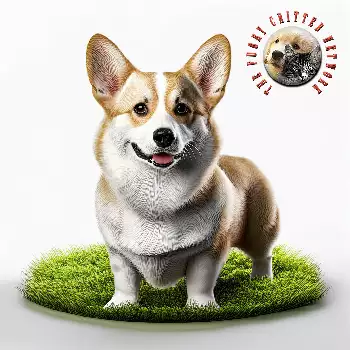
The Pembroke carries itself with an athletic confidence that catches people off guard when they meet one for the first time in person. Photographs and internet videos flatten the breed into a cute, short-legged novelty, but the living dog has a density and muscularity that photographs rarely convey. Pick up a well-conditioned adult Pembroke and you are holding twenty-five to thirty pounds of solid, working-bred dog in a frame that stands barely a foot tall at the shoulder. The structural design is entirely purposeful, engineered over centuries for a specific job that required speed, agility, and toughness in a low-to-the-ground package.
The head establishes breed type immediately. It is broad and flat between the ears, narrowing progressively through the cheeks to a moderate, clean muzzle that avoids both the snippiness of a terrier and the bluntness of a bulldog. The stop is moderate. The nose is fully pigmented and black. The expression is alert, keen, and intelligent, driven primarily by the medium-sized oval eyes set at a slightly oblique angle. Eye color should be dark brown, harmonizing with the coat. The ears are perhaps the breed's single most identifiable feature after its silhouette: firmly erect, medium in size, tapering to a slightly rounded tip, and set wide apart on the skull. They tilt forward when the dog is attentive, giving the face its characteristic sharp, interested look that reflects the breed's constant environmental awareness.
The neck is of fair length, sufficient to provide balance and allow the head to be carried above the topline, transitioning into well-laid-back shoulders. The body is moderately long, with a deep chest that descends to the elbows and well-sprung ribs that are neither barrel-shaped nor slab-sided. The topline is firm and level. The loin is short, and the overall body impression is one of substance without heaviness, a dog that looks ready to work without appearing overdone or coarse. Forelegs are short, straight when viewed from the front, and well-boned. Elbows sit close to the body. The hindquarters carry slightly less weight than the front but provide strong drive through moderate angulation at the stifle and hock. The feet are oval and compact, with strong pads and short nails.
Movement in the Pembroke is smooth, free, and efficient, with good forward reach and strong rear drive. The short legs cover ground with surprising speed and endurance when the structure is correct. Faulty movement, whether paddling, weaving, crossing, or moving with restricted stride, typically points to underlying structural issues that affect both the dog's soundness and its quality of life over time. A correct Pembroke moves with the effortless ground coverage of a dog that could work livestock all day without tiring.
The coat is a functional double coat: medium-length outer hair that lies flat and resists weather, over a short, thick, insulating undercoat. Hair is slightly longer on the chest, britches, and undersides but should never form a pronounced ruff or heavy feathering. Fluffy coats, caused by the FGF5 gene mutation, are considered a serious fault in the show ring though they appear regularly in litters from carrier parents. Color options include red, sable, fawn, and black and tan, all typically accompanied by white markings on the legs, chest, neck, and face. The coat sheds prolifically year-round, with two seasonal blowouts that release the undercoat in spectacular volume requiring daily removal.
Affectionate With Family
★★★★★
The Pembroke distributes its loyalty and affection across the entire household, seeking active involvement in family life and offering steady, cheerful companionship to everyone in the home.
Good With Young Children
★★★☆☆
Sturdy and playful enough for family life, though the breed's innate herding drive produces heel nipping toward running children that demands consistent early training to redirect.
Good With Other Dogs
★★★☆☆
Generally sociable with other dogs when properly introduced, though some individuals display assertiveness with same-sex dogs and the herding instinct can create friction with housemates.
Shedding Level
★★★★★
The thick double coat sheds constantly with two seasonal blowouts of extraordinary volume, making this one of the heaviest-shedding breeds relative to body size.
Coat Grooming Frequency
★★★☆☆
Two to three brushing sessions per week manage normal shedding, escalating to daily during biannual undercoat blowouts that require dedicated removal efforts.
Drooling Level
★☆☆☆☆
The Pembroke produces virtually no excess drool. Its clean muzzle and tight lip line keep saliva contained under all normal circumstances.
Coat Type
★★★☆☆
A weather-resistant double coat with medium-length outer hair over dense undercoat provides functional insulation while producing the heavy shedding characteristic of the breed.
Openness To Strangers
★★★☆☆
Response to unfamiliar people ranges from warmly curious to watchfully reserved, with most well-socialized Pembrokes accepting newcomers after a brief evaluative pause.
Playfulness Level
★★★★☆
Enthusiastic and inventive in play, the Pembroke engages readily with games, toys, and interactive activities, maintaining its playful nature well into adulthood.
Watchdog/Protective Nature
★★★★☆
Keenly alert and vocally assertive, the Pembroke announces environmental changes with a sharp, authoritative bark that belies its compact stature.
Adaptability Level
★★★★☆
Adjusts successfully to apartments, suburbs, and rural settings alike, requiring only that its exercise and mental engagement needs are consistently met regardless of environment.
Trainability Level
★★★★★
Exceptionally quick to learn and eager to work when the handler provides variety and positive reinforcement, ranking among the most trainable of all herding breeds.