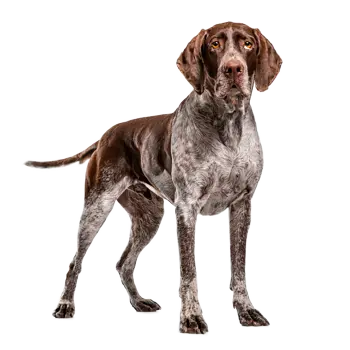

The Old Danish Pointing Dog presents the picture of a substantial, powerfully built continental pointing breed with rectangular body proportions and distinctive piebald coloration. The overall impression should be of a strong, athletic dog built for endurance hunting across varied terrain rather than speed or extreme elegance. Every aspect of the Old Danish Pointing Dog's physical structure serves practical purposes related to its traditional roles as versatile gun dog working birds and other game across Danish forests, fields, and marshlands.
The head demonstrates classic pointing breed type with broad, slightly rounded skull and strong, square muzzle. When viewed from above, the skull shows good width between the ears without appearing coarse or heavy. The occiput is moderately pronounced, contributing to overall head shape without excessive development. In profile, the skull curves gently without appearing domed or flat. The stop between skull and muzzle is well-defined but not abrupt, creating clear distinction while maintaining flowing lines. Muzzle length approximates skull length from stop to occiput, providing proper balance and adequate space for well-developed nasal passages essential for scenting ability.
Facial features convey the breed's calm, intelligent character through careful arrangement and proportion. The eyes are medium-sized and dark brown, shaped slightly oval, and set well apart on the skull under moderately expressive brows. Eye placement and shape create the steady, friendly expression characteristic of the breed, avoiding harsh or suspicious appearance. The nose is large and fleshy with wide, open nostrils colored dark brown to match the brown markings in the coat. Nasal development reflects the breed's exceptional scenting ability, considered among the best of all pointing breeds.
The ears contribute significantly to breed character and expression. Set relatively low on the skull compared to some pointing breeds, they hang close to the head without standing away or folding sharply. The ear leather is medium in length with adequate thickness to protect the ear canal from field debris. The broad, rounded tips complete the characteristic pendant ear shape. Ear mobility indicates attention and emotional state, with ears lifting slightly forward when the dog is alert or interested. Proper ear set and carriage distinguish the Old Danish Pointing Dog from breeds with higher-set ears that create different facial expressions.
The muzzle is strong and square when viewed from front or side, providing adequate space for powerful jaws and well-developed dentition. Lips demonstrate moderate fleshiness with some looseness at the corners, creating subtle flews characteristic of many pointing breeds. This lip structure provides protection during field work while contributing to the breed's tendency toward moderate drooling, particularly around mealtimes. The jaw is strong with teeth meeting in scissors bite where upper incisors closely overlap lower incisors.
The neck demonstrates proper length and substance for a pointing dog, neither too short nor excessively long. Moderately long and muscular, the neck arches slightly from nape to withers, creating elegant line while providing strength for carrying birds and maintaining head position during extended pointing. The skin at the throat is somewhat loose, forming moderate dewlap typical of many continental pointing breeds. This loose skin prevents injury when working through heavy cover and provides flexibility during various working postures.
Body construction reflects the rectangular proportions specified in breed standards, with length from point of shoulder to point of buttock exceeding height at withers in ratio of approximately 9:8. The withers are well-defined and muscular, forming the highest point of the topline when standing naturally. The back is straight, short, and firm, demonstrating strength without excessive length that could compromise endurance. The loin is broad, short, and muscular, providing powerful connection between forequarters and hindquarters. The croup slopes gently to tail set, maintaining flowing topline without abrupt angles.
The chest demonstrates substantial development necessary for heart and lung capacity during sustained work. Depth extends at least to elbow level, providing adequate internal volume. Width between forelegs allows free movement without narrowness that would restrict organs. Ribs spring well from spine, creating adequate barrel shape without becoming round or overly wide. The forechest demonstrates moderate development without excessive protrusion. The underline tucks up slightly from chest to loin, creating athletic appearance without exaggerated waist tuck.
Forequarters show moderate angulation balanced throughout the limb. Shoulder blades are long, flat, and well laid back, forming angle of approximately 110 degrees with upper arm. The upper arm angles back under the body, positioning the legs well beneath the dog rather than too far forward. Forelegs are straight and parallel when viewed from any angle, demonstrating proper alignment. Bone is substantial without being coarse, providing strength for field work. Elbows lie close to chest without being tied in, allowing free movement. Pasterns show slight slope from leg bones to feet, providing necessary flexibility and shock absorption.
Feet are compact and well-arched with thick, tough pads providing protection and traction on varied surfaces. Toes are well-knuckled and close-fitting, preventing splaying during movement. Nails are strong and preferably dark, though lighter nails may occur with white toe markings. Front dewclaws are typically present, while rear dewclaws rarely occur. Proper foot structure provides sure footing on rocks, roots, mud, and other challenging terrain encountered during hunting.
Hindquarters provide the driving power that propels the Old Danish Pointing Dog forward during hunting. The thighs are broad and well-muscled, demonstrating development appropriate to size and function. Stifles show good bend, creating angle that stores and releases energy during movement. Second thighs are well-developed with strong hock joints. Hocks are strong, well let-down, and perpendicular to ground when standing, providing proper leverage. Rear feet match front feet in structure and development, completing balanced construction.
The tail sets moderately high on the croup and extends nearly to the hocks when down. Of medium thickness at base, it tapers gradually to tip. The tail hangs naturally when the dog is relaxed, rising to approximately horizontal during movement and elevated when the dog is excited or alert. The tail should never curl over the back or be carried stiffly perpendicular. Tail carriage indicates temperament and emotional state while contributing to balance during movement.
The coat serves essential protective functions while maintaining the breed's distinctive appearance. Short and dense throughout, the coat lies close to body contours without standing away. Texture is somewhat harsh, providing weather resistance that sheds moisture and prevents burrs from embedding deeply. Undercoat provides insulation without excessive thickness that would cause overheating. Hair length remains relatively uniform across the body without furnishings or fringing. The coat requires minimal grooming while providing adequate protection during work.
Coloration follows the distinctive piebald pattern that has characterized the breed since its development. The base is white with brown markings distributed across the body as large patches and smaller spots or speckling. Brown color ranges from medium liver to dark chocolate, with darker shades preferred by most breeders. Markings typically concentrate on the head, covering ears and creating facial patterns. Body patches vary in size and distribution, with some dogs heavily marked and others predominantly white with scattered spots. Freckling appears on legs and sometimes muzzle and body, adding character to the overall pattern.
The skin fits close to body structure except on head and neck where it is looser, forming moderate wrinkles and dewlap. This loose facial skin prevents injury during field work while contributing to expression. The skin is pigmented where covered by brown hair markings, with pink skin under white areas. Proper skin structure provides protection without excess looseness that would create grooming or health maintenance problems.
Affectionate With Family
★★★★★
The Old Danish Pointing Dog forms deep bonds with family members and thrives on human companionship. These dogs want to be involved in family activities and demonstrate their loyalty through constant desire to please their people. Their affectionate nature makes them devoted family companions who excel when living as integral household members rather than kennel dogs kept separate from their families.
Good With Young Children
★★★★★
Old Danish Pointing Dogs possess naturally patient and gentle dispositions with children, making them excellent family dogs. Their calm temperament combined with tolerance for the sometimes awkward handling children inflict creates wonderful compatibility with young family members. These dogs demonstrate remarkable patience while maintaining appropriate energy for active play with older children who can participate in training and outdoor activities together.
Good With Other Dogs
★★★★☆
When properly socialized from puppyhood, Old Danish Pointing Dogs generally enjoy canine company and can thrive in multi-dog households. Their hunting heritage gives them pack-oriented instincts that facilitate positive relationships with other dogs. Early and consistent social exposure helps them develop appropriate communication skills and play behaviors with other dogs of various sizes and temperaments throughout their lives.
Shedding Level
★★★☆☆
The Old Danish Pointing Dog sheds moderately year-round, with the short dense coat releasing dead hair regularly but not excessively. Weekly brushing helps manage shedding by removing loose hair before it falls naturally around the home. While not among the heaviest shedding breeds, owners should expect some hair on furniture and floors, particularly during seasonal coat changes when shedding temporarily increases from normal levels.
Coat Grooming Frequency
★★☆☆☆
Regular weekly brushing suffices to maintain the Old Danish Pointing Dog coat in good condition throughout most of the year. The short, dense coat requires minimal grooming intervention beyond basic brushing to remove debris and distribute natural oils. Bathing should occur only when genuinely necessary to preserve the coat's natural weather-resistant properties, making grooming maintenance relatively simple compared to breeds requiring professional styling or intensive coat care.
Drooling Level
★★★☆☆
Old Danish Pointing Dogs produce moderate drooling, particularly around mealtimes or when anticipating food. The breed possesses slightly loose flews and dewlap that can lead to some drooling, though not to the excessive extent seen in some Mastiff breeds. Owners should be prepared for occasional slobber, especially during eating, drinking, or periods of excitement, making them less ideal for those who prefer completely drool-free companions.
Coat Type
★★☆☆☆
The Old Danish Pointing Dog sports a short, dense coat that lies close to the body and provides weather protection during hunting. The harsh-textured outer coat combines with adequate undercoat to create weather resistance suitable for working in varied Danish field conditions. This practical coat structure enabled these pointing dogs to work comfortably in rain, cold, and brush without requiring extensive grooming or protection from elements encountered during hunts.
Openness To Strangers
★★★★☆
Old Danish Pointing Dogs typically display friendly curiosity toward strangers once properly introduced, reflecting their generally sociable nature. While initially reserved when meeting unfamiliar people, they warm up relatively quickly compared to more aloof hunting breeds. With proper socialization, they demonstrate appropriate balance between natural wariness that makes them good watchdogs and sufficient friendliness that allows them to accept visitors and new people without excessive suspicion or aggression.
Playfulness Level
★★★★☆
These energetic hunting dogs possess enthusiastic playful nature when outdoors and engaged in activities. Old Danish Pointing Dogs love interactive games, retrieving, and any activity involving their people and satisfying their hunting instincts. Their playful spirit emerges particularly during exercise and training sessions, though they demonstrate remarkable ability to settle calmly indoors after adequate physical and mental stimulation has been provided through outdoor activities.
Watchdog/Protective Nature
★★★★☆
The Old Danish Pointing Dog serves as an effective watchdog with good awareness of surroundings and willingness to alert family to unusual activity. They possess moderate barking tendency to warn of approaching strangers or suspicious sounds around their territory. While protective of home and family, they are not aggressive without cause, making them reliable guardians who can distinguish between genuine threats and normal neighborhood activity with appropriate socialization and training.
Adaptability Level
★★★☆☆
Old Danish Pointing Dogs adapt reasonably well to various living situations provided their substantial exercise needs are met consistently. They can adjust to suburban living if given sufficient daily activity and outdoor access, though they naturally thrive in rural settings with space to run. Their hunting heritage means they struggle in apartments or urban environments without adequate exercise outlets, making them better suited for active households with access to outdoor space for daily vigorous activity.
Trainability Level
★★★★★
Exceptionally intelligent and eager to please, the Old Danish Pointing Dog ranks among the most trainable hunting breeds. They respond enthusiastically to positive reinforcement training methods and genuinely enjoy learning new skills and commands. Their working dog heritage gives them strong desire to perform tasks correctly, making them excellent candidates for pointing work, obedience, tracking, and other canine activities requiring cognitive engagement and reliable performance under field conditions.