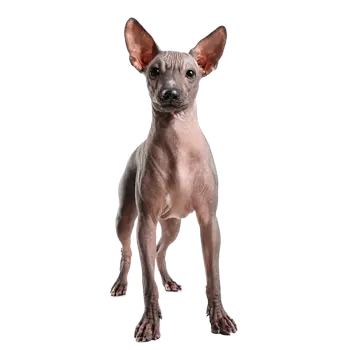
The Peruvian Inca Orchid is an elegant, athletic sighthound whose most striking feature is its near-complete absence of hair in the hairless variety. The breed's overall silhouette conveys speed, balance, and agility without exaggeration or coarseness. The body is approximately square in proportion, with the length from the point of the chest to the point of the rump roughly equal to the height at the withers. Females may be slightly longer in body than males. The chest is moderately deep, reaching to the elbow, and the ribs are well sprung but not barrel-shaped. The underline shows a pronounced tuck-up that contributes to the breed's graceful profile. The topline is straight, though some individuals display a slight dorsal-lumbar convexity that flattens at the croup.
The head is lupoid in structure, broad between the ears and tapering toward the nose. The skull is slightly rounded with no prominent occiput, and the stop is barely perceptible, creating a nearly continuous line from forehead to muzzle. The muzzle is equal in length to the skull and tapers moderately, with tight, clean lips and a straight nasal bridge. Nose pigment matches the skin color. In the hairless variety, ears are erect when alert, resembling a candle flame in shape, medium in length and nearly pointed at the tips. The leathery ear leather may show wisps of hair at the edges. In the coated variety, ears are semi-prick. Eyes are oval to almond-shaped, medium-sized, and range from dark brown to amber depending on skin color, giving the face an alert, intelligent expression.
The hairless variety's skin is the breed's defining physical characteristic. It is smooth, supple, and elastic, warm to the touch, and varies in color from solid black, slate, blue-black, and chocolate to copper, blonde, and various shades of gray. Many individuals display attractive mottling, with pigmented areas interspersed with unpigmented pink or cream patches. Small amounts of short hair may appear on the top of the head, the feet, and the lower portion of the tail, but the body is otherwise bare. Some dogs develop a crew-cut-like tuft of hair on the crown. The skin's texture should be pliable and smooth rather than thick or leathery. The coated variety carries a short to medium-length single coat that may be straight or slightly wavy, with feathering possible on the ears, neck, and tail. All coat colors and combinations are accepted.
Movement in the Moonflower Dog is light, quick, and flexible, reflecting the breed's moderate angulation and sighthound construction. The gait covers ground efficiently without appearing extended or labored, and there is a natural tendency to single-track at speed. The tail is set low, thick at the base, and tapers to a point. When excited, the dog carries it raised in a rounded curve above the backline, but it should never curl into a tight roll. At rest, the tail hangs with a slight upward hook at the tip. The overall impression of a well-bred Peruvian Inca Orchid in motion is one of effortless athleticism, a dog built to move quickly and gracefully through its environment.
Affectionate With Family
★★★★★
The Moonflower Dog forms exceptionally deep bonds with its family members, displaying a level of devotion and attachment that borders on the inseparable. These dogs crave physical closeness with their people and will seek out body contact throughout the day, pressing against their owner's legs, curling up on laps, or draping themselves across a nearby cushion to maintain proximity. The warmth of their bare skin makes physical contact with the hairless variety a uniquely intimate experience among dog breeds, and owners frequently describe the bond as unlike anything they have experienced with coated breeds.
Good With Young Children
★★☆☆☆
The Peruvian Inca Orchid's sensitive skin and reserved temperament make it a poor match for very young children who have not yet learned to handle animals gently. The hairless variety is particularly vulnerable to scratches, pinches, and accidental injuries from clumsy toddler hands, and the breed's natural wariness can escalate into defensive behavior if a child's movements are sudden or unpredictable. Older children who understand how to approach and interact with a sensitive dog can develop a rewarding relationship with this breed, but supervision is always advisable.
Good With Other Dogs
★★★☆☆
With proper socialization beginning in puppyhood, the Moonflower Dog can coexist peacefully with other dogs in the household. Their sighthound heritage gives them a generally non-confrontational disposition with other canines, though they may become territorial if introductions are handled poorly. They tend to gravitate toward calm, gentle play partners rather than rough-and-tumble companions. Multi-dog households work best when each dog has access to its own resting space and resources.
Shedding Level
★☆☆☆☆
The hairless variety of the Peruvian Inca Orchid is among the lowest-shedding dogs in existence, as there is simply no coat to shed. Owners of hairless PIOs will never find hair on furniture, clothing, or floors. The coated variety sheds lightly to moderately depending on coat density and length, but even coated individuals produce far less loose hair than many other breeds. For people who prioritize a clean home or who have mild dog hair sensitivities, the hairless variety is an exceptional choice.
Coat Grooming Frequency
★★★☆☆
While the hairless variety has no coat to brush, its skin requires consistent care that replaces traditional grooming routines. Regular bathing, moisturizing, and sun protection form the core of the hairless PIO's skin care regimen. The skin can develop dryness, acne, and sensitivity without proper attention. The coated variety needs weekly brushing to remove loose hair and prevent tangles, particularly around the neck and ear furnishings. Both varieties require the same routine nail, ear, and dental maintenance as any other breed.
Drooling Level
★☆☆☆☆
The Peruvian Inca Orchid is a notably clean, dry-mouthed breed. Its tight, clean lip structure produces virtually no excess salivation under normal circumstances. The breed's elegant sighthound muzzle contributes to this tidy trait. Owners will not encounter drool spots on furniture or clothing, making the PIO an appealing companion for people who prefer a fastidious housemate.
Coat Type
★☆☆☆☆
The hairless variety, which represents the majority of the breed, has smooth, supple, elastic skin in place of a coat. Small amounts of short hair may appear on the top of the head, the lower portion of the tail, and on the feet, but the body is otherwise bare. The skin feels warm and soft to the touch and can be solid-colored or attractively mottled with pigmented and unpigmented areas. The coated variety carries a short to medium-length single coat that may be straight or slightly wavy, with feathering possible on the ears, neck, and tail.
Openness To Strangers
★★☆☆☆
The Moonflower Dog is characteristically reserved and cautious around unfamiliar people. This breed takes its time evaluating newcomers, studying them carefully before deciding whether to accept their presence. Many PIOs actively dislike being touched by strangers and will withdraw from unwanted hands. This wariness is not aggression but rather a deep-seated breed characteristic that makes them naturally effective watchdogs. Early and extensive socialization helps broaden their comfort zone, but most mature PIOs will always maintain a degree of reserve with people outside their inner circle.
Playfulness Level
★★★☆☆
The Peruvian Inca Orchid possesses a genuine playful streak that surfaces most readily with trusted family members. They enjoy interactive games, toy play, and short bursts of spirited activity, particularly during the cooler hours of the day or in the evening. Their sighthound athleticism makes them surprisingly quick and agile during play sessions. However, their play style tends toward the dignified rather than the boisterous, and they are unlikely to sustain high-energy antics for extended periods. Young PIOs are notably more playful than mature adults, who settle into a calmer demeanor.
Watchdog/Protective Nature
★★★★☆
The breed's natural wariness of strangers, keen alertness, and territorial awareness combine to make it an excellent watchdog. Moonflower Dogs are attentive to their surroundings and will alert their household to unusual sounds, approaching visitors, or anything that disrupts the normal pattern of their environment. Their bark is purposeful rather than constant, carrying genuine authority. While they are not physically imposing guard dogs, their vigilance and vocal alarm capabilities provide effective early warning that most owners find both reliable and reassuring.
Adaptability Level
★★★☆☆
The Peruvian Inca Orchid adapts well to indoor living environments, including apartments, provided it receives adequate exercise and social interaction. However, the breed's specialized care requirements impose practical constraints that affect overall adaptability. The hairless variety must be protected from sun exposure, cold weather, and temperature extremes, which limits spontaneity in outdoor activities and travel. Changes in routine, environment, or household composition can cause stress in this sensitive breed. They adapt best in stable, predictable households where their physical and emotional needs are understood and consistently met.
Trainability Level
★★★☆☆
Peruvian Inca Orchids are intelligent dogs that learn quickly when engaged through positive reinforcement methods. However, their independent sighthound temperament means they evaluate instructions rather than obeying reflexively, and they may decline to perform on command if motivation is insufficient or if they detect no clear purpose in the request. Harsh corrections shut them down entirely, producing avoidance rather than compliance. Short, varied, reward-based training sessions work best, and handlers who approach training as a partnership rather than a hierarchy will achieve the most consistent results with this sensitive breed.