Mexican Hairless Dog

Xoloitzcuintli

Quick Facts

🐕 Breed Group
Non-Sporting Group
📏 Size Category
Toy, Miniature, or Standard
📏 Height
Males: Toy: 10-14 in; Miniature: 14-18 in; Standard: 18-23 in, Females: Toy: 10-14 in; Miniature: 14-18 in; Standard: 18-23 in
⚖️ Weight
Males: Toy: 10-15 lbs; Miniature: 15-30 lbs; Standard: 30-55 lbs, Females: Toy: 10-15 lbs; Miniature: 15-30 lbs; Standard: 30-55 lbs
⏱️ Life Expectancy
13-18 years
🧣 Coat Type
Hairless variety: mostly bare skin; Coated variety: short, flat coat
🎨 Coat Colors
Black, gray, slate, red, liver, bronze; solid or with markings
😀 Temperament
Calm, loyal, alert, intelligent, reserved with strangers
🏃 Exercise Needs
Moderate
🎓 Training Difficulty
Moderate (intelligent but requires consistent socialization)
👶 Good with Children
Good with respectful children, especially when raised together
🐾 Good with Other Pets
Good with household dogs; may chase small animals

Other Names & Breed Recognition

Mexican Hairless Dog is the name that most English speakers reach for when they encounter this ancient breed, and for good reason. The official name, Xoloitzcuintli, is derived from the Nahuatl language of the Aztec people, combining Xolotl, the god of fire, lightning, and the underworld, with itzcuintli, the Aztec word for dog. While that name carries profound cultural weight, its pronunciation presents a genuine barrier for English speakers encountering the breed for the first time. Mexican Hairless Dog strips away the linguistic complexity and offers an immediately understandable description: a hairless dog from Mexico.

The breed also goes by the shortened nickname Xolo, pronounced SHO-lo, which has become the most common informal designation in the dog world. This abbreviation appears in breed club communications, casual conversation among owners, and even in AKC event catalogs where space is limited. The Xoloitzcuintli Club of America uses Xolo routinely, and the name has achieved enough recognition that many people who have never seen the full Nahuatl name will recognize the shorter version.

Recognition of the Mexican Hairless Dog extends across the major international kennel clubs, though its classification varies. The AKC recognized the breed in 2011 and placed it in the Non-Sporting Group, ending a complicated history that saw the breed initially included in AKC records as the Mexican Hairless in 1887, then dropped in 1959 due to insufficient registration numbers. The FCI classifies the breed under Group 5, Spitz and Primitive Types, Section 6, Primitive Type, reflecting the Xoloitzcuintli's status as a naturally evolved breed rather than one shaped through intensive selective breeding. The UKC places it in the Companion Dog Group, The Kennel Club registers it in the Utility Group, and the Canadian Kennel Club recognizes it as well. The breed holds the distinction of being the official dog of Mexico.

The name Mexican Hairless Dog is technically incomplete because it does not account for the coated variety. Every Xoloitzcuintli litter can produce both hairless and coated puppies, and both varieties are recognized as legitimate representatives of the breed. The hairless gene is actually a dominant trait, but it is also a semi-lethal gene, meaning that puppies inheriting two copies of the hairless gene do not survive. Every living hairless Xoloitzcuintli carries one copy of the hairless gene and one copy of the coated gene, guaranteeing that coated puppies will always appear in the breed. Despite this genetic reality, the common name Mexican Hairless Dog has endured because the hairless appearance is the breed's most visually distinctive feature and the characteristic that draws most people to learn about it.

Mexican Hairless Dog Organizations & Standards

The Mexican Hairless Dog's organizational history mirrors the breed's broader journey from near-extinction to international recognition. The Xoloitzcuintli Club of America, founded in 1986, serves as the AKC parent club and has been the primary advocate for the breed's advancement in the United States. The club was instrumental in guiding the breed through the AKC's Foundation Stock Service and Miscellaneous Class before achieving full recognition in the Non-Sporting Group in 2011. The XCA provides educational resources, organizes national specialty shows, coordinates health initiatives, and connects prospective owners with responsible breeders.

The Federacion Canofila Mexicana holds particular historical significance for this breed. When the Xoloitzcuintli faced extinction in the mid-twentieth century, the FCM launched the Xolo Expedition of 1954, led by Norman Pelham Wright, which searched remote areas of Mexico to locate surviving dogs of the ancient type. The dogs recovered during this expedition formed the foundation stock for the breed's modern revival. The breed was first registered in Mexico in 1955, and Wright headed the committee that authored the first official breed standard, adopted on May 1, 1956. Today the Xoloitzcuintli holds the designation of Official Dog of Mexico, a recognition of its deep cultural significance.

The FCI breed standard describes the Xoloitzcuintli as a primitive breed shaped by natural evolution rather than human-directed selective breeding. The standard recognizes three sizes: Toy, measuring 10 to 14 inches; Miniature, measuring 14 to 18 inches; and Standard, measuring 18 to 23 inches. Both hairless and coated varieties are accepted across all three sizes. The standard emphasizes moderation in all aspects of type and conformation, specifying that the breed should never appear extreme or overdone. For the hairless variety, the standard notes that incomplete dentition is expected and acceptable, a direct consequence of the gene responsible for hairlessness also affecting dental development.

Health testing requirements established by the Xoloitzcuintli Club of America through the CHIC program include cardiac evaluation, eye examination by a board-certified ophthalmologist, hip evaluation for Standard and Miniature sizes, and patella evaluation for Toy and Miniature sizes. These screenings reflect the breed's specific areas of potential concern while acknowledging that the Xoloitzcuintli is overall a remarkably healthy breed. The XCA encourages breeders to perform Embark DNA testing in addition to the CHIC-required evaluations, providing genetic health data that supports informed breeding decisions and helps maintain the breed's genetic diversity. Given the Xoloitzcuintli's relatively small global population, maintaining genetic diversity through careful outcrossing and avoiding popular sire syndrome is a priority that the club emphasizes in its breeder education programs.

Kennel Club Recognition

  • American Kennel Club (AKC): Recognized in 2011, Non-Sporting Group
  • United Kennel Club (UKC): Recognized, Companion Dog Group
  • Canadian Kennel Club (CKC): Recognized, Group 6: Non-Sporting Dogs
  • FCI: Recognized, Group 5: Spitz and Primitive Types
  • The Kennel Club (UK): Recognized, Utility Group

Mexican Hairless Dog Physical Description

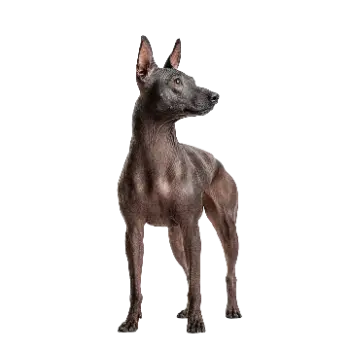
The Mexican Hairless Dog is one of the most visually distinctive breeds in existence, and its appearance tells the story of thousands of years of natural evolution in Mesoamerican environments. This is not a breed sculpted by kennel club aesthetics. It is a primitive type shaped by the pressures of survival, climate, and the companionship of indigenous peoples who valued the dog for its practical and spiritual qualities rather than its adherence to an artificial beauty standard.

The breed comes in three size varieties that share identical proportions and type. Toy Mexican Hairless Dogs stand 10 to 14 inches and weigh 10 to 15 pounds. Miniature individuals measure 14 to 18 inches and weigh 15 to 30 pounds. Standard dogs reach 18 to 23 inches and weigh 30 to 55 pounds. Across all sizes, the body is slightly longer than tall, creating a rectangular profile that conveys athleticism without ranginess. The overall silhouette is clean, elegant, and moderate, with no exaggeration in any structural feature.

The head is distinctive and somewhat similar to the outline of a wedge when viewed from above, tapering from a moderately broad skull to a refined muzzle. The stop is slight but defined. The skull is flat between the ears, which are large, expressive, and carried erect when the dog is alert. These bat-like ears are one of the breed's most recognizable features, contributing to an expression that is simultaneously noble and inquisitive. The eyes are almond-shaped, medium-sized, and range from dark to amber depending on skin or coat color. The expression is calm, watchful, and intelligent.

The most obvious distinguishing feature is the skin of the hairless variety. It is smooth, thick, tough, and protective, significantly more resilient than you might expect from a hairless animal. The skin can range in color from black, gray, and slate to red, liver, and bronze, and may appear solid or carry lighter markings. Some hairless individuals have small tufts of coarse hair on the crown of the head, the tips of the ears, the feet, and the last third of the tail. Adolescent Mexican Hairless Dogs commonly develop acne on their muzzle and lips, a temporary condition that typically resolves with maturity. The coated variety presents a short, flat, close-fitting coat that lies smooth against the body without undercoat or feathering.

The neck is long, graceful, and slightly arched, set smoothly into well-angulated shoulders. The chest reaches to the elbows, and the ribcage is well-sprung without being barrel-shaped. The back is level and firm, the loin is muscular, and the croup slopes gently. The tail is long, reaching to the hock, thin, and tapering. In the hairless variety, the tail may have sparse hair at the tip. At rest, the tail hangs with a slight upward curve at the end. In motion, it rises but should not curl tightly over the back.

Movement is free, effortless, and ground-covering, with the elegant stride of a dog built for moderate sustained activity rather than sprint speed. At a walk and trot, the Mexican Hairless Dog moves with a lightness that belies its sturdy construction. The forelegs reach well forward while the hindquarters provide balanced drive, and the topline remains firm and level throughout. At faster gaits, the legs converge toward the centerline, indicating efficient tracking. The overall impression is of a dog that carries itself with a natural dignity that seems hardwired into the breed rather than trained.

The feet are moderately long, described as hare feet rather than the round cat feet found in many breeds. Toes are well-arched and may have webbing between them. In the hairless variety, the feet may carry sparse coarse hair. Dewclaws are typically removed. The combination of hare feet, moderate bone, and well-angulated joints gives the Mexican Hairless Dog a ground-covering efficiency that served it well across thousands of years of survival in varied Mesoamerican environments.

Affectionate With Family
The Mexican Hairless Dog forms deep, devoted bonds with its family and is happiest when in close physical contact with its people. This breed craves warmth and connection, both literally and emotionally.
Good With Young Children
Does well with children who have learned to handle dogs gently. The toy and miniature sizes are more vulnerable to rough play, while the standard size is sturdier. All sizes benefit from supervised interactions with young children.
Good With Other Dogs
Generally sociable with other dogs in the household, particularly when raised together. Some individuals show prey drive toward very small dogs, and introductions to unfamiliar dogs should be managed gradually.
Shedding Level
The hairless variety produces virtually no shed hair, making it one of the lowest-shedding breeds available. The coated variety sheds minimally due to its short, close-fitting coat.
Coat Grooming Frequency
The hairless variety requires skin care rather than coat care, including regular bathing, moisturizing, and sun protection. The coated variety needs only occasional brushing to maintain its sleek appearance.
Drooling Level
Drooling is essentially nonexistent in this breed. The clean, refined muzzle structure keeps saliva contained under all normal circumstances.
Coat Type
The hairless variety has tough, smooth skin that is thick and protective, sometimes with small tufts of coarse hair on the head, feet, and tail tip. The coated variety has a short, flat, close-fitting coat.
Openness To Strangers
Naturally reserved and watchful around unfamiliar people, the Mexican Hairless Dog does not rush to greet strangers. Thorough socialization during puppyhood broadens the dog's comfort zone, but a degree of caution with new people is characteristic.
Playfulness Level
Moderately playful and willing to engage in interactive games with family members. Less frantic than high-energy breeds, the Mexican Hairless Dog brings a composed enthusiasm to play sessions.
Watchdog/Protective Nature
Alert and attentive to its environment, this breed takes its watchdog responsibilities seriously. It will announce visitors and unusual activity vocally, carrying on an ancient tradition of home guardianship.
Adaptability Level
Adapts well to various living situations from apartments to houses, particularly the toy and miniature sizes. The breed's moderate exercise needs and calm indoor demeanor make it flexible across different home environments.
Trainability Level
Intelligent and capable of learning, though not driven by an overwhelming desire to please. Responds well to positive reinforcement and consistent routines. Requires patient, reward-based methods rather than repetitive drilling.

Mexican Hairless Dog History & Development

The name Mexican Hairless Dog is an English-language descriptor that has been used for centuries, appearing in journals, letters, and records from European explorers who encountered these dogs upon arriving in the Americas. When Christopher Columbus and subsequent Spanish colonizers reached Mesoamerica, they described finding strange, hairless dogs living alongside indigenous peoples. The dogs they documented were the direct ancestors of today's Xoloitzcuintli, and the name Mexican Hairless became the way English speakers identified them long before formal breed registries existed.

The breed's actual history extends far beyond European contact. Archaeological evidence places the Xoloitzcuintli in Mesoamerica for at least 3,000 years, and some researchers suggest the breed's ancestors accompanied the first human migrants who crossed the Bering Strait into the Americas during the last Ice Age. Clay figurines and ceramic representations of hairless dogs have been found in tombs and burial sites across Mexico, dating to the Colima, Maya, Toltec, Zapotec, and Aztec civilizations. These artifacts reveal that the hairless dog held deep spiritual significance for Mesoamerican cultures, serving as a guide for souls traveling through the underworld, a healer whose body warmth was believed to cure illness, and a guardian of the home against both physical and spiritual threats.

The Aztec name Xoloitzcuintli directly encodes this spiritual identity. Xolotl was the god of fire, lightning, deformity, and death, the divine twin who accompanied the dead on their journey to the underworld. Itzcuintli simply meant dog. The Xoloitzcuintli was literally the dog of Xolotl, a companion for the deceased on the passage to the afterlife. This religious significance ensured the breed's preservation across centuries of Mesoamerican civilization, as the dogs were deliberately maintained and valued.

Spanish colonization disrupted but did not destroy the breed. As indigenous cultures were suppressed, the spiritual context that had protected the Xoloitzcuintli eroded, and the breed's numbers declined. By the twentieth century, the Mexican Hairless Dog had become extremely rare. The AKC had initially included the breed in its studbook in 1887 under the name Mexican Hairless, but dropped it in 1959 due to insufficient registrations. The breed's survival pivoted on a single critical intervention: the Xolo Expedition of 1954, organized by the Federacion Canofila Mexicana and led by Norman Pelham Wright. This expedition located surviving Mexican Hairless Dogs in remote Mexican communities and established the foundation breeding stock for the breed's revival.

The breed was registered in Mexico in 1955 and its first formal standard was adopted in 1956. From that point, the recovery was slow but steady. The Xoloitzcuintli Club of America formed in 1986, and the breed worked its way back into AKC recognition in 2011, placed in the Non-Sporting Group. Today the Mexican Hairless Dog is Mexico's official national dog, and its image appears in works by Mexican artists including Diego Rivera and Frida Kahlo, who owned multiple Xolos and featured them in her paintings. The common name Mexican Hairless Dog has persisted through all of this history as the accessible English identifier for a breed whose official name remains one of the most challenging pronunciations in all of cynology.

Mexican Hairless Dog Temperament & Personality

The Mexican Hairless Dog's temperament is the product of thousands of years of living in intimate proximity with human families, first in the homes and communities of Mesoamerican civilizations and later as a cherished companion breed maintained through deliberate cultural preservation. This extended history of close human cohabitation has produced a dog with a remarkably attuned emotional intelligence, a deep capacity for bonding, and a calm, composed presence in the home that distinguishes it from breeds developed primarily for athletic or working pursuits.

The defining characteristic of the Mexican Hairless Dog's personality is its devotion to its family and particularly to one chosen person. The breed typically selects a primary attachment figure and directs its deepest loyalty, attention, and physical affection toward that individual. This bond is not merely preferential. It is intense and consuming. The chosen person will have a constant shadow, a dog that follows from room to room, settles against them whenever possible, and maintains an almost psychic attentiveness to their emotional state. Other household members receive affection and loyalty, but the primary bond is unmistakable and fundamentally shapes the dog's daily behavior.

With strangers, the Mexican Hairless Dog demonstrates the measured reserve that runs through its temperament like a thread. These dogs do not rush to greet unfamiliar visitors. They watch, evaluate, and gradually warm to new people once they determine no threat exists. This wariness is not shyness or fear in a well-socialized individual. It is a composed, deliberate assessment that reflects the breed's ancient role as a home guardian. The Aztecs valued these dogs partly for their vigilance, and that alertness to potential threats has never been bred out. Without adequate socialization during puppyhood, this natural reserve can harden into genuine suspicion or fearfulness, which is why early and thorough exposure to varied people and situations is essential.

Inside the home, the Mexican Hairless Dog is remarkably calm and tranquil once its moderate exercise needs are met. This is not a breed that bounces off the walls or demands constant stimulation. It is content to lie near its people, observe household activity, and enjoy the warmth of a lap or a sunny spot. This composed indoor demeanor makes the breed particularly well-suited to apartment and urban living, especially in the toy and miniature sizes. The contrast between the dog's alert watchfulness and its relaxed home presence is one of the breed's most appealing qualities.

Prey drive deserves honest acknowledgment because the Mexican Hairless Dog does carry a notable chase instinct. Small animals, including cats in some cases, may trigger pursuit behavior, particularly in dogs that have not been raised with smaller pets from puppyhood. This drive connects to the breed's primitive heritage as a dog that survived in semi-wild conditions for portions of its long history. Management and early socialization mitigate the risk, but the instinct is present and should not be ignored.

The breed's emotional sensitivity is a consistent theme across owner experiences. Mexican Hairless Dogs respond strongly to their owner's emotional state, becoming anxious in tense environments and relaxed in calm ones. Harsh training methods are particularly counterproductive with this breed, producing shut-down, avoidant behavior rather than compliance. The dog that responds best to calm, consistent, reward-based handling is the dog that reaches its full potential as a companion.

Mexican Hairless Dog Family Life & Living Requirements

The Mexican Hairless Dog adapts to family life with a flexibility that reflects the breed's long history of living in varied human environments, from the communal homes of ancient Mesoamerican villages to modern apartments in Mexico City. This adaptability makes the breed accessible to a wider range of living situations than many dogs of comparable intelligence and bonding intensity, provided that certain fundamental needs are understood and met.

Housing flexibility is one of the breed's genuine strengths. The toy and miniature sizes are well-suited to apartment and condominium living, as their moderate exercise needs and calm indoor temperament do not create the noise, space, and activity conflicts that higher-energy breeds produce in multi-unit housing. The standard size can thrive in apartments too, though it benefits from somewhat more indoor space and longer daily walks. All three sizes do well in houses with yards, but a yard is not a requirement. What the Mexican Hairless Dog requires is proximity to its people, not proximity to a lawn.

With children, the breed's suitability depends significantly on the size variety and the children's age. Standard Mexican Hairless Dogs are sturdy enough to handle the unpredictable movements of younger children, though interactions should still be supervised. Toy and miniature sizes are more physically vulnerable and do best with children old enough to understand gentle handling. Across all sizes, the breed's calm temperament and affectionate nature create a foundation for good relationships with respectful children. The dog's watchful presence and loyalty make it a quietly protective family member.

Other pets in the household present a mixed picture. The Mexican Hairless Dog generally integrates well with other dogs, particularly when raised alongside them. The breed's social nature and moderate energy level make it an agreeable housemate for canine companions. However, the prey drive that the breed carries means cats and small animals may be at risk, particularly in households where the dog was not socialized with these animals from a young age. Each individual's prey response varies, and careful, supervised introductions are the responsible approach.

The environmental consideration most specific to this breed involves temperature and sun exposure. The hairless variety lacks the coat protection that other breeds take for granted. In cold weather, these dogs need clothing for outdoor excursions and warm sleeping areas indoors. In hot, sunny weather, exposed skin requires dog-safe sunscreen to prevent sunburn. The breed's skin is tougher than it looks and does not require the level of pampering some sources suggest, but reasonable protection from temperature extremes and UV exposure is a genuine responsibility that comes with owning a hairless dog. Families should budget for skincare products, protective clothing, and the extra attention that maintaining healthy exposed skin requires.

Mexican Hairless Dog Training & Exercise Needs

Training a Mexican Hairless Dog requires patience, consistency, and an appreciation for the breed's particular blend of intelligence and independence. This is not a dog that lives to perform on command. It is a thinking animal that evaluates requests, considers whether compliance serves its interests, and cooperates most readily when the handler has established a relationship built on trust and mutual respect rather than dominance. The breed is fully capable of learning complex behaviors, but it learns best through methods that feel collaborative rather than coercive.

Positive reinforcement training produces the best outcomes with the Mexican Hairless Dog. Food rewards, praise, and interactive play serve as effective motivators, and the breed's intelligence means it grasps new concepts quickly when the training context is clear and engaging. Sessions should be kept short and varied to maintain attention, as the breed's primitive temperament includes a low tolerance for repetitive drilling. A Mexican Hairless Dog asked to repeat the same sit-down-sit sequence twenty times in a row will disengage long before the twentieth repetition. Changing exercises frequently, introducing novel challenges, and ending sessions on a positive note keeps the dog mentally invested.

Socialization is arguably the most critical training priority for this breed. The Mexican Hairless Dog's natural reserve with strangers can calcify into genuine fearfulness or reactive behavior if the dog is not exposed to a broad range of people, places, sounds, and experiences during the critical puppyhood window. Socialization should be deliberately more extensive than many breeds require, with particular emphasis on positive encounters with unfamiliar people of varying ages, appearances, and demeanors. The goal is a dog that is watchful but confident in novel situations, not one that retreats, trembles, or becomes defensive when confronted with the unfamiliar.

Exercise requirements for the Mexican Hairless Dog are moderate and manageable compared to working and sporting breeds. A daily walk of 30 to 45 minutes combined with interactive play provides adequate physical activity for most individuals. The breed enjoys brisk walks, backyard play sessions, and participation in dog sports including agility, rally, and scent work. The standard size benefits from somewhat more exercise than the toy and miniature sizes, but no variety requires the hours of vigorous activity demanded by high-drive working breeds. What the Mexican Hairless Dog does need is mental stimulation, which can be provided through puzzle toys, training games, and the kind of environmental enrichment that keeps an intelligent dog engaged without requiring athletic exertion.

One training consideration specific to the hairless variety involves managing the dog's comfort during outdoor activities. Training sessions and exercise in direct sunlight require sunscreen application to prevent burns. Cold weather training sessions need protective clothing. These are not obstacles to training but rather logistics that owners need to incorporate into their routines. The coated variety requires no such accommodations and handles all weather training with standard care.

Mexican Hairless Dog Health Concerns

The Mexican Hairless Dog stands out as one of the healthiest breeds in the dog world, with a lifespan of 13 to 18 years that rivals or exceeds most breeds of comparable size. This robust health is attributed to the breed's natural evolutionary development over thousands of years, during which the forces of natural selection rather than human-directed breeding programs shaped its genetic makeup. The absence of the extreme physical features that cause health problems in more heavily modified breeds contributes to the Xoloitzcuintli's general soundness.

The breed's overall health profile is one of its greatest assets. Responsible breeders who follow the XCA's testing recommendations and maintain genetic diversity through thoughtful pairings produce dogs that typically live long, healthy lives with minimal veterinary intervention beyond routine wellness care. The ancient, naturally evolved foundation of the breed has spared it many of the genetic burdens that more recently developed or heavily modified breeds carry.

Common Health Issues

  • Skin sensitivity in the hairless variety includes susceptibility to sunburn - Dryness, and contact irritation due to direct environmental exposure. Dog-safe sunscreen, moisturizer, and protective clothing mitigate these concerns effectively.
  • Adolescent acne on the muzzle and lips is common in young hairless Mexican Hairless Dogs - Presenting as red bumps, pimples, or blackheads. The condition is temporary and typically resolves with maturity, though scarring can occur if the dog scratches affected areas.
  • Incomplete dentition is a normal consequence of the hairless gene and is expected in the hairless variety according to breed standard. Missing premolars are most common - And diligent dental hygiene protects the teeth that are present.
  • Hip dysplasia can occur in the Standard and Miniature sizes - Involving abnormal hip joint development that leads to instability and progressive arthritis. Radiographic screening through OFA helps identify affected individuals before breeding.
  • Patellar luxation affects primarily the Toy and Miniature sizes - Involving displacement of the kneecap from its normal femoral groove. Severity ranges from occasional slipping to permanent displacement requiring surgical correction.
  • Cardiac conditions - While not highly prevalent, are included in CHIC screening requirements established by the Xoloitzcuintli Club of America. Regular cardiac evaluation helps identify congenital or developing heart abnormalities.

Preventive Care & Health Monitoring

  • Cardiac evaluation is a CHIC requirement for the breed - Screening for congenital and acquired heart conditions. The Xoloitzcuintli Club of America includes this in its recommended testing protocol for all breeding stock.
  • Eye examination by a board-certified veterinary ophthalmologist is a CHIC requirement - Screening for hereditary eye conditions across all three size varieties.
  • Hip evaluation through OFA or PennHIP is recommended for Standard and Miniature sizes to screen for dysplasia and support sound breeding decisions. - Hip evaluation through OFA or PennHIP is recommended for Standard and Miniature sizes to screen for dysplasia and support sound breeding decisions.
  • Patella evaluation is recommended for Toy and Miniature sizes to identify patellar luxation before breeding - Helping reduce the condition's incidence in smaller size varieties.
  • Regular skin care for the hairless variety - Including appropriate bathing, moisturizing, and sun protection, prevents the chronic skin problems that result from neglecting exposed skin.
  • Dental care is particularly important given the hairless variety's predisposition to incomplete dentition - Regular brushing with canine toothpaste and periodic professional cleanings protect existing teeth from periodontal disease.

Mexican Hairless Dog Grooming & Maintenance

Grooming a Mexican Hairless Dog is unlike grooming virtually any other breed because the primary concern for the hairless variety is skin care rather than coat care. The absence of hair eliminates brushing, deshedding, and the tangles and mats that occupy owners of coated breeds, but it introduces a different set of maintenance requirements centered on protecting and nourishing exposed skin. The coated variety, which carries a short, flat, close-fitting coat, requires minimal traditional grooming and serves as a lower-maintenance alternative within the breed.

For the hairless variety, regular bathing is the foundation of skin care. Unlike coated dogs that can go weeks between baths, hairless Mexican Hairless Dogs benefit from bathing every one to two weeks to remove the oils, dirt, and environmental debris that accumulate directly on exposed skin. A gentle, dog-specific cleanser preserves the skin's natural pH balance without causing dryness or irritation. Between full baths, wiping the dog down with a damp washcloth keeps the skin clean and comfortable. Over-bathing can dry out the skin just as effectively as neglecting it, so finding the right frequency for each individual dog requires observation and adjustment.

Moisturizing is an important component of hairless Mexican Hairless Dog skin care. After bathing and between baths, applying a dog-safe moisturizer or lotion helps maintain skin suppleness and prevents the cracking and flaking that dry skin produces. The skin should look and feel smooth and healthy, not greasy, ashy, or tight. Some owners use coconut oil or other natural products, while others prefer commercial canine skincare lines formulated specifically for hairless breeds. Experimentation may be needed to find the product that works best for an individual dog's skin type.

Sun protection is non-negotiable for the hairless variety during outdoor activities. Dog-safe sunscreen should be applied to exposed skin before any extended time in direct sunlight. Human sunscreen should never be used on dogs, as certain ingredients common in human formulations are toxic to canines. Protective clothing, including lightweight shirts and coverups designed for dogs, provides an additional layer of UV defense and can be more practical than sunscreen for longer outdoor sessions.

The coated variety sidesteps nearly all of these skin-specific requirements. Its short, flat coat requires only occasional brushing to remove loose hair and maintain a sleek appearance. Bathing can follow a normal schedule of every few weeks or as needed. The coated variety does not require moisturizer, sunscreen, or protective clothing under normal circumstances, making it the significantly lower-maintenance option within the breed.

Across both varieties, nail trimming every two to three weeks, weekly ear cleaning, and regular dental care complete the maintenance routine. Dental hygiene is particularly important for hairless individuals given the breed's predisposition to incomplete dentition, as protecting existing teeth from periodontal disease is essential. Starting all handling and grooming routines during puppyhood builds the cooperative behavior that makes lifelong maintenance smooth and stress-free.