Louisiana Catahoula

Catahoula Leopard Dog

Quick Facts

🐕 Breed Group
Herding Group
📏 Size Category
Medium to Large
📏 Height
Males: 22-26 inches, Females: 20-24 inches
⚖️ Weight
Males: 65-90 lbs, Females: 50-65 lbs
⏱️ Life Expectancy
10-14 years
🧣 Coat Type
Single coat, short to medium length
🎨 Coat Colors
Blue merle, red merle, brindle, solid black, red, yellow, patched, spotted
😀 Temperament
Independent, loyal, protective, energetic, territorial
🏃 Exercise Needs
High
🎓 Training Difficulty
Moderate to High
👶 Good with Children
Good with older children when raised together
🐾 Good with Other Pets
Can be aggressive with same-sex dogs; high prey drive with small animals

Other Names & Breed Recognition

The Louisiana Catahoula is one of several names used to describe a versatile working dog that holds the distinction of being the only breed to have originated in the state of Louisiana. When people refer to a Louisiana Catahoula, they are speaking about the same dog registered by the United Kennel Club as the Louisiana Catahoula Leopard Dog and listed in the American Kennel Club's Foundation Stock Service as the Catahoula Leopard Dog. The inclusion of "Louisiana" in this particular name serves to emphasize the breed's deep roots in the culture, geography, and working traditions of that Gulf Coast state, setting it apart from dog breeds whose names reference distant European or Asian origins.

The word "Catahoula" itself carries historical weight. It is widely believed to derive from a Choctaw word meaning "sacred lake," referring to Catahoula Parish in northern Louisiana where the breed was developed and refined by generations of farmers, hunters, and ranchers. The breed goes by a remarkably long list of alternate names reflecting different aspects of its identity and working history. Catahoula Cur, Catahoula Hog Dog, Catahoula Hound, and Catahoula Leopard Cur all appear in regional usage, each emphasizing a different facet of the dog's capabilities or appearance. The "leopard" designation references the breed's distinctive merle coat pattern, though not all individuals carry this marking.

The United Kennel Club granted full recognition to the breed on January 1, 1995, placing it in the Herding Group and using the full designation Louisiana Catahoula Leopard Dog. The UKC became the first major national registry to formally recognize the breed, a milestone that validated decades of breeding efforts by dedicated enthusiasts in the American South. The American Kennel Club took a more cautious approach, entering the breed into its Foundation Stock Service in 1996. The FSS designation allows Catahoulas to participate in certain AKC companion and performance events such as rally, obedience, and agility, but does not grant eligibility for conformation championships. The breed has not advanced beyond FSS status, partly because a significant portion of the Catahoula community actively opposes full AKC recognition out of concern that show ring emphasis would compromise working ability.

Neither the Federation Cynologique Internationale nor The Kennel Club of the United Kingdom recognizes the breed. Several breed-specific organizations maintain registries and promote the Louisiana Catahoula independently of the major kennel clubs. The National Association of Louisiana Catahoulas, formed in 1977, promotes breed preservation with an emphasis on working instincts. The Louisiana Catahoula Cur Association, the Catahoula Cur Breeders Association, and the American Catahoula Association all contribute to maintaining breeding records, organizing working trials, and promoting responsible ownership. The political recognition came in 1979 when Governor Edwin Edwards signed legislation making the Louisiana Catahoula Leopard Dog the official state dog of Louisiana, cementing the breed's place in the cultural identity of the state.

Louisiana Catahoula Organizations & Standards

The organizational landscape supporting the Louisiana Catahoula reflects the breed's grassroots origins and the working dog community's independent spirit. Unlike breeds that developed within the framework of a single national kennel club, the Louisiana Catahoula grew out of practical necessity in rural Louisiana, and its registries and breed clubs emerged from that same practical tradition. The National Association of Louisiana Catahoulas, established in 1977, operates as one of the oldest and most respected breed organizations. NALC maintains a detailed breed standard, registers dogs, and organizes events that showcase working ability through treeing competitions, hog bay trials, cow bay events, and cow trials that test whether a dog can actually do the work it was bred for.

The UKC breed standard provides the most widely referenced written description of the ideal Louisiana Catahoula. It describes a medium to medium-large, short-coated dog with a broad head, small to medium drop ears, and an undocked tail carried as a natural extension of the topline. The standard emphasizes that the breed should appear well-muscled and powerful without being bulky, projecting agility and endurance rather than mass. Body proportions should be slightly longer than tall, with the distance from elbow to ground measuring 50 to 60 percent of the dog's total height at the withers. The standard explicitly states that the Catahoula should not resemble either a sighthound or a bulldog in type, establishing a middle ground that reflects the breed's need for both speed and strength in demanding fieldwork.

Size specifications within the UKC standard allow for considerable variation, acknowledging that different working roles and regional breeding traditions have produced dogs of varying sizes. Males ideally stand around 24 inches at the shoulder, while females are preferred at approximately 22 inches, but the standard accommodates a range that reflects the breed's utilitarian focus. Weight is not rigidly specified because the emphasis falls on functional structure rather than arbitrary numbers. The standard penalizes dogs that are either excessively undersized or oversized, as both extremes would compromise working efficiency.

Health testing requirements for responsible Louisiana Catahoula breeders center on three primary evaluations. OFA hip evaluations screen for hip dysplasia, a condition that affects the breed at meaningful rates given its size and athletic demands. BAER testing, which stands for Brainstem Auditory Evoked Response, screens for congenital deafness that is closely linked to the merle gene responsible for the breed's distinctive coat patterns. Dogs that carry predominantly white coats face the highest risk, and ethical breeders absolutely avoid merle-to-merle pairings that produce double merle offspring with dramatically increased rates of deafness and vision impairment. CERF eye examinations check for inherited eye conditions including microphthalmia and colobomas. The American Catahoula Association works alongside these registries to promote responsible breeding and maintain the breed's working heritage through shows, clinics, trials, and certified testing programs.

Kennel Club Recognition

  • United Kennel Club (UKC): Recognized, Herding Group

Louisiana Catahoula Physical Description

The first thing most people notice about a Louisiana Catahoula is the eyes. This breed produces some of the most visually arresting eye colors in the entire canine world, ranging from ice-blue "glass" eyes that appear nearly white to rich amber, deep brown, and vivid green. Heterochromia is common and considered perfectly normal within the breed, so a single dog may have one blue eye and one brown eye, or even display two distinct colors within the same eye. These striking eyes sit beneath a broad, slightly rounded skull that tapers to a well-defined stop before meeting a strong, deep muzzle capable of generating the jaw pressure needed for catching and holding livestock.

The head of the Louisiana Catahoula conveys power and intelligence in equal measure. The muzzle is broad and well-filled beneath the eyes, neither snippy nor excessively heavy. Drop ears are set moderately high and fold forward, lying close to the cheeks. The standard penalizes ears that are cropped, reflecting the breed community's commitment to preserving the dog's natural working appearance. The nose can be any color or combination of colors, as the merle genetics that produce the breed's coat patterns can also affect pigmentation on the nose leather.

The body of the Louisiana Catahoula communicates athletic purpose from every angle. The neck is muscular and of sufficient length to allow the dog to track scent at ground level and reach up to bay livestock simultaneously. The chest is deep, extending below the elbow, and moderately broad with well-sprung ribs that provide ample lung capacity for sustained physical effort. The topline is level and strong, supported by well-muscled loins that connect the ribcage to powerful hindquarters. The underline shows moderate tuck-up through the loin area, creating a profile that suggests readiness for explosive movement.

The forequarters feature well-laid-back shoulders and forelegs of moderate length with strong, straight bone. One distinctive physical trait of the Louisiana Catahoula is prominent webbing between the toes, an adaptation believed to have developed from generations of working in the swampy terrain of Louisiana's bayou country. This webbing provides better traction on soft, muddy ground and may aid in swimming across the waterways that crisscross the breed's native landscape. The hindquarters are broad and muscular with well-angulated stifles and hocks set low to the ground.

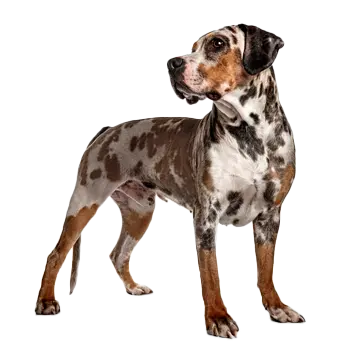
The coat of the Louisiana Catahoula ranges from short and sleek to medium in length with a texture that can vary from smooth to slightly coarse. Some dogs carry light feathering on the hindquarters, belly, and tail, but the coat always lies close to the body and serves a functional purpose rather than an ornamental one. The breed's most famous visual feature is the merle coat pattern, sometimes called the "leopard" pattern, which produces a base color overlaid with contrasting patches and spots in one or more additional colors. However, Louisiana Catahoulas also come in solid colors, brindle patterns, and patched configurations. Coat colors include blue merle, red merle, black, red, yellow, brindle, and chocolate, often with trim points on the chest, cheeks, legs, and beneath the tail.

Movement in the Louisiana Catahoula should appear smooth, effortless, and ground-covering, reflecting a dog built for all-day endurance rather than brief bursts of speed. The gait demonstrates agility and coordination, with feet tending to converge toward the center line of balance as speed increases. The UKC standard specifically notes that poor movement should be penalized in proportion to how much it reduces the dog's ability to perform the work it was bred to do, reinforcing the principle that every aspect of the Louisiana Catahoula's physical structure exists to serve a working purpose. The tail is carried as a natural extension of the topline, neither excessively high nor tucked, and should never be docked or naturally bobbed.

Affectionate With Family
The Louisiana Catahoula forms deep, devoted bonds with its family unit and can be intensely loyal to those it considers part of its inner circle. This affection tends to be selective rather than indiscriminate, given freely to trusted family members while remaining reserved toward outsiders.
Good With Young Children
This breed does best with older children who understand how to interact respectfully with a large, assertive dog. Supervision around small children is essential due to the breed's size, energy level, and tendency toward boisterous play.
Good With Other Dogs
Louisiana Catahoulas often display same-sex aggression and strong territorial instincts that can make coexistence with other dogs challenging. Early and thorough socialization helps, but many owners find that opposite-sex pairings work best in multi-dog households.
Shedding Level
The single coat sheds at a moderate and steady rate throughout the year without dramatic seasonal blowouts. Weekly brushing keeps loose hair manageable and maintains the coat's natural sheen.
Coat Grooming Frequency
Grooming needs are minimal thanks to the short, naturally dirt-resistant coat. A weekly brushing session and occasional bath are sufficient to keep a Louisiana Catahoula looking clean and well maintained.
Drooling Level
Most Louisiana Catahoulas produce only moderate drool, typically limited to situations involving food anticipation or heavy exertion. They are not considered a heavily drooling breed under normal circumstances.
Coat Type
The coat ranges from short and smooth to medium length with a slightly coarse texture. Some individuals carry light feathering along the legs, belly, and tail, but the coat remains close-lying and functional for outdoor work.
Openness To Strangers
The breed is naturally wary and aloof around unfamiliar people, a trait rooted in its protective territorial instincts. Louisiana Catahoulas typically need time to assess strangers before warming up, and they rarely seek attention from people they do not know.
Playfulness Level
At home with its family, the Louisiana Catahoula often reveals a clownish, playful side that contrasts sharply with its serious working demeanor. These dogs enjoy interactive games and rough-and-tumble play sessions that channel their physical energy.
Watchdog/Protective Nature
Few breeds match the Louisiana Catahoula's natural protective instincts and territorial awareness. They are highly alert to changes in their environment and will not hesitate to sound the alarm or physically position themselves between a perceived threat and their family.
Adaptability Level
This breed was developed for rugged outdoor work across Louisiana's diverse terrain and does not adapt easily to confined living spaces or sedentary routines. Louisiana Catahoulas require ample space, consistent activity, and a clear leadership structure to thrive.
Trainability Level
The Louisiana Catahoula is intelligent and capable of learning complex tasks but possesses a strong independent streak that can frustrate inexperienced trainers. They respond best to firm, fair, and consistent handling from someone who earns their respect rather than demands it.

Louisiana Catahoula History & Development

The name "Louisiana Catahoula" tells you exactly where this breed belongs. While the full registered name is Louisiana Catahoula Leopard Dog, the shortened form Louisiana Catahoula serves as both a geographic marker and a declaration of cultural identity. The inclusion of the state name is not merely ornamental. It distinguishes this breed as the only one to have originated within Louisiana's borders, and that connection to place runs through every chapter of the breed's development.

The origins of the Louisiana Catahoula reach back centuries to the earliest interactions between European explorers and the Native American populations of what is now Louisiana. Early Spanish expeditions under Narvaez and Cortez documented that indigenous peoples of the region kept dogs that were smaller than wolves but similar in appearance. These Native American dogs, likely ancestors of the modern Carolina Dog, served as hunting companions on the swamps, forests, and prairies of the Gulf Coast. When French settlers arrived in the region, they brought their own working dogs, believed to include the Beauceron and possibly other herding and guardian breeds. The crossing of these European imports with the existing Native American dogs over multiple generations produced the foundation stock from which the Louisiana Catahoula eventually emerged.

The breed developed its working identity in the wild, unforgiving landscape of Louisiana's interior. Feral hogs roamed the forests and swamplands in enormous numbers, and the settlers needed dogs capable of tracking, baying, and holding these dangerous animals until hunters could dispatch them. The Louisiana Catahoula proved extraordinarily effective at this work, using a unique herding technique in which multiple dogs would create a "canine fence" around a group of hogs or cattle, circling and baying to contain the livestock within a perimeter that the handler could then manage. This working style required intelligence, physical courage, and the ability to read livestock behavior, traits that became deeply embedded in the breed through generations of selective pressure.

The formal naming and recognition of the breed came relatively late compared to many European and British breeds. The Louisiana Catahoula Cur Association was formed in 1976, followed by the National Association of Louisiana Catahoulas in 1977, providing the first organized frameworks for registering dogs and maintaining breeding records. The pivotal political milestone arrived on July 9, 1979, when Governor Edwin Edwards signed legislation designating the Louisiana Catahoula Leopard Dog as the official state dog. This recognition was more than symbolic. It acknowledged the breed's deep historical significance to Louisiana's agricultural economy, its role in the cultural identity of rural communities across the state, and its unique status as an indigenous American breed rather than a European import.

The journey toward kennel club recognition followed a different timeline. The UKC granted full recognition in 1995, validating the breed's identity and providing a national platform for showing and trialing Louisiana Catahoulas. The AKC added the breed to its Foundation Stock Service the following year, but progress toward full AKC recognition has stalled, largely because many traditional breeders actively resist it. Their concern is grounded in observable history with other breeds: once a working breed achieves full AKC recognition, the emphasis often shifts from function to appearance, and the working qualities that define the breed begin to erode. The Louisiana Catahoula community, by and large, would rather preserve the breed's working integrity than gain access to the AKC conformation ring.

Louisiana Catahoula Temperament & Personality

The temperament of the Louisiana Catahoula is shaped entirely by its history as a working dog bred to handle dangerous, unpredictable livestock in challenging terrain. This is not a breed that was refined in a drawing room or developed to sit quietly at someone's feet. The Louisiana Catahoula was built to think independently, make split-second decisions in high-pressure situations, and assert physical control over animals that outweigh it several times over. Every behavioral trait the breed exhibits in a home environment traces directly back to these working origins.

The Louisiana Catahoula's intelligence is practical and problem-solving in nature rather than the eager-to-please responsiveness seen in breeds like retrievers or herding collies. A Catahoula observes, evaluates, and then decides how to respond, and that evaluation includes whether it agrees with what you are asking it to do. This independent thinking made the breed invaluable in the field, where a dog working feral hogs at a distance from its handler needed to read livestock behavior and adjust its strategy without waiting for human instruction. In a home setting, this same independence can manifest as stubbornness or selective listening if the owner has not established a clear leadership dynamic.

Bonding patterns in the Louisiana Catahoula tend to be intensely focused. These dogs typically attach most strongly to one person or a small family unit and can be deeply devoted to their chosen people. The UKC standard notes that Catahoula temperament ranges from serious and business-like when working to clownish at home, and many owners describe a dog that seems almost like two different animals depending on the context. The playful, goofy behavior that emerges during relaxed family time gives way to intense focus and controlled aggression when the dog perceives a working or protective situation.

Stranger wariness is deeply embedded in the breed and should not be mistaken for shyness or poor socialization. The Louisiana Catahoula is naturally aloof with unfamiliar people, assessing them carefully before deciding whether they represent a welcome visitor or a potential threat. This aloofness often makes them appear unresponsive or disengaged in show ring environments where animation and tail-wagging are expected. Some individuals may draw away from judges during examination, a behavior the UKC standard acknowledges as breed-typical rather than a fault in temperament.

Same-sex aggression is a well-documented behavioral pattern in the Louisiana Catahoula and one that prospective owners must take seriously. The territorial instincts that make these dogs effective guardians of livestock and property can create significant conflict when two dogs of the same sex share a household. Many experienced Catahoula owners recommend keeping only opposite-sex pairs and emphasize that introductions to new dogs must be handled carefully and gradually. The breed's prey drive is similarly strong, reflecting generations of hunting instinct. Small animals, including cats and small dogs, may trigger chase and catch behaviors that can result in injury, particularly if the Louisiana Catahoula was not raised with these animals from puppyhood. Even dogs that coexist peacefully with household cats should be supervised, as the drive to pursue fast-moving small animals remains deeply wired into the breed's behavioral repertoire.

Louisiana Catahoula Family Life & Living Requirements

Integrating a Louisiana Catahoula into family life requires an honest assessment of whether your household can provide what this breed genuinely needs. These are not dogs that will quietly adapt to whatever lifestyle you offer them. They require space, activity, structure, and a clear hierarchy within the home, and they will let you know through destructive behavior, excessive vocalization, or territorial aggression if those needs are not being met.

The ideal living situation for a Louisiana Catahoula includes a securely fenced yard with ample room for running and exploration. This breed was developed to work across vast tracts of Louisiana woodland and swamp, and its energy levels reflect that heritage. Apartment living is strongly discouraged for this breed. Even homes with small yards can prove insufficient if the dog does not receive enough structured physical and mental exercise to compensate for limited space. The fence itself needs to be substantial, as Louisiana Catahoulas are athletic enough to scale inadequate barriers and motivated enough to try when they detect interesting stimuli beyond the property line.

Families with children can find the Louisiana Catahoula to be a loyal and protective companion, but the pairing works best when children are old enough to understand and respect the dog's boundaries. This is a large, powerful breed with a play style that can be rough, and young children who run, scream, or make sudden movements may inadvertently trigger the dog's herding or prey-chasing instincts. Supervision during interactions between the dog and children of any age is non-negotiable. When raised together from puppyhood, many Louisiana Catahoulas become devoted guardians of the children in their household, positioning themselves between the child and any perceived threat with a seriousness that reflects their protective nature.

Multi-pet households require careful management with this breed. The same-sex aggression and prey drive discussed in the temperament section have direct implications for daily family life. Introducing a Louisiana Catahoula to a home that already contains cats, small dogs, or other small animals requires a slow, supervised process and a realistic acceptance that some individual dogs may never be fully trustworthy around smaller animals. Owners should always have a management plan that includes physical separation when direct supervision is not possible.

The Louisiana Catahoula is not a dog for passive or absentee ownership. These dogs need daily engagement with their people, meaningful work or structured activity, and consistent leadership. When these requirements are met, the Louisiana Catahoula rewards its family with fierce loyalty, entertaining personality, and the kind of companionship that comes from a dog bred to work shoulder-to-shoulder with humans in difficult conditions.

Louisiana Catahoula Training & Exercise Needs

Training a Louisiana Catahoula demands a handler who understands the difference between dominance and leadership. This breed does not respond to harsh, punishment-based methods, which tend to provoke defiance or shutdown rather than cooperation. Equally, purely permissive approaches will be exploited by a dog that is always evaluating whether the person giving instructions is actually worth listening to. The effective approach falls in the middle: firm, fair, and consistent guidance from someone who has earned the dog's respect through calm authority and reliable follow-through.

Early socialization is not optional for this breed. Louisiana Catahoula puppies need extensive exposure to different people, dogs, environments, sounds, and situations during their critical developmental window before twelve weeks of age. Without this foundation, the breed's natural wariness of strangers and territorial instincts can develop into reactive or fearful-aggressive behavior that becomes increasingly difficult to manage as the dog matures. Socialization should continue throughout adolescence and into adulthood, as the Louisiana Catahoula's temperament continues to develop and solidify well past the puppy stage.

The breed's exercise requirements are substantial and non-negotiable. A minimum of one hour of vigorous daily activity is needed to maintain physical health and mental equilibrium, and most Louisiana Catahoulas thrive with significantly more than that. Simply turning the dog out into a yard does not constitute adequate exercise. These dogs need structured activities that engage both body and mind. Long hikes through varied terrain, swimming, retrieving games, and scent work all provide the kind of physical and cognitive challenge that this breed craves. For owners with access to livestock, actual herding or stock work provides the most natural and satisfying outlet for the Louisiana Catahoula's working drives.

Canine sports offer excellent alternatives for owners without livestock access. The breed's athleticism, intelligence, and competitive drive make it a strong candidate for agility, rally, obedience, and tracking events. The AKC's FSS designation allows Louisiana Catahoulas to participate in rally, obedience, and agility competitions, providing both structured training goals and competitive outlets. Some breed organizations also host specialized working events including treeing trials, hog bay competitions, and cow trials that test the dog's natural working instincts.

The consequences of inadequate exercise and mental stimulation in this breed are severe and predictable. A bored, under-exercised Louisiana Catahoula will create its own entertainment, and that entertainment typically involves destructive chewing, digging, fence-testing, excessive barking, and redirected aggression. These behaviors are not evidence of a bad dog but rather symptoms of an intelligent, high-energy working breed whose fundamental needs are not being met. Prospective owners who cannot commit to providing the physical and mental outlet this breed requires should seriously consider a less demanding breed.

Louisiana Catahoula Health Concerns

The Louisiana Catahoula is generally a robust and hardy breed, reflecting the rigorous natural selection pressures of its working heritage. Dogs that could not withstand the physical demands of hunting feral hogs in Louisiana's swamps and forests simply did not contribute to the breeding pool, and that functional winnowing produced a breed with fewer inherited health problems than many purebred dogs. However, several specific conditions deserve attention from current and prospective owners.

Responsible breeding practices offer the most effective defense against these health concerns. Ethical Louisiana Catahoula breeders perform BAER hearing tests on all puppies before placement, obtain OFA hip evaluations on breeding stock, maintain current CERF eye certifications, and most critically, never breed two merle-coated dogs together. The merle-to-merle prohibition is the single most important health decision in Louisiana Catahoula breeding, as it eliminates the double merle offspring that suffer the highest rates of deafness and vision impairment.

Common Health Issues

  • Congenital deafness is the most breed-specific health concern in the Louisiana Catahoula - Linked directly to the merle gene that produces the breed's signature coat patterns. Dogs with predominantly white coats face the highest risk, and double merle offspring from merle-to-merle pairings are especially vulnerable to severe bilateral deafness.
  • Hip dysplasia involves abnormal development of the hip joint socket - Causing progressive arthritis and mobility limitations. The condition occurs at meaningful rates in this medium-to-large breed and is screened through OFA radiographic evaluation of breeding stock.
  • Microphthalmia is a developmental eye condition in which one or both eyes are abnormally small and poorly formed - Occurring with increased frequency in double merle Louisiana Catahoulas. Affected dogs may experience partial or complete vision loss depending on severity.
  • Colobomas are structural gaps in the eye tissue that can affect the iris - Retina, or other ocular structures. This condition appears most commonly in dogs carrying two copies of the merle gene and may cause light sensitivity or compromised vision.
  • Obesity poses a significant health risk for Louisiana Catahoulas that do not receive adequate exercise - Placing additional stress on joints and contributing to accelerated development of hip dysplasia and other musculoskeletal conditions.

Preventive Care & Health Monitoring

  • BAER testing should be performed on all Louisiana Catahoula puppies before placement to definitively assess hearing status - This brainstem auditory evoked response evaluation detects both unilateral and bilateral deafness caused by the merle gene complex.
  • OFA hip evaluations on breeding stock screen for hip dysplasia and should be verified before purchasing a puppy - Both parents should have documented OFA hip scores available for review.
  • CERF eye examinations performed by a board-certified veterinary ophthalmologist screen for inherited eye conditions including microphthalmia - Colobomas, and other structural abnormalities associated with the merle gene.
  • Merle gene testing confirms carrier status and is essential for breeding decisions. Responsible breeders never pair two merle-coated dogs together - As the resulting double merle offspring face dramatically elevated risks of deafness and blindness.
  • Regular veterinary wellness examinations every twelve months allow early detection of developing conditions - Weight management through appropriate diet and consistent exercise helps prevent obesity-related joint stress in this active breed.

Louisiana Catahoula Grooming & Maintenance

The Louisiana Catahoula's grooming needs reflect its no-nonsense working heritage. This is a wash-and-wear breed whose short to medium single coat was designed by generations of practical selection to shed dirt, resist moisture, and require minimal human intervention. Owners accustomed to high-maintenance coated breeds will find the Louisiana Catahoula refreshingly easy to keep clean and presentable.

Weekly brushing with a firm bristle brush or rubber grooming mitt removes loose hair, distributes natural skin oils, and keeps the coat looking healthy. The single coat sheds at a steady, moderate rate throughout the year rather than producing the dramatic seasonal blowouts associated with double-coated breeds. During periods of slightly heavier shedding, increasing brushing frequency to two or three sessions per week helps control loose hair in the home. Bathing is needed only occasionally, perhaps once or twice a year under normal conditions, or when the dog has gotten into something particularly muddy or odorous. Over-bathing strips the coat of its natural protective oils and can lead to dry, irritated skin.

Nail maintenance is particularly important for this active breed. Louisiana Catahoulas that work on soft ground may not wear their nails down naturally and require regular trimming every two to three weeks. Overgrown nails can alter gait mechanics, cause discomfort, and contribute to foot and leg injuries during vigorous physical activity. The breed's characteristic webbed feet should be inspected regularly for debris, cuts, or irritation, especially after working or hiking in rough terrain.

Ear care deserves consistent attention because the drop ear structure creates a warm, enclosed environment that can promote bacterial and yeast infections if moisture becomes trapped. Weekly inspection and gentle cleaning with a veterinarian-recommended ear solution helps prevent infections before they develop. Owners should check ears after swimming or bathing and dry them thoroughly to remove excess moisture. Dental care follows standard recommendations for all breeds: regular brushing with a veterinary-approved toothpaste helps prevent periodontal disease, which remains one of the most common health issues across all dog breeds regardless of size or type. Providing appropriate dental chews and scheduling professional cleanings as recommended by your veterinarian further supports long-term oral health. The Louisiana Catahoula's overall low-maintenance grooming profile is one of the breed's most practical advantages for active owners who prefer to spend their time working or exercising with their dog rather than fussing over coat care.