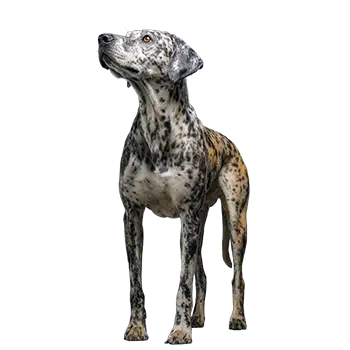
The Leopard Cur is built for endurance and agility in rough country, and every element of its physical structure reflects that purpose. This is a medium-to-large dog with a lean, athletic frame that carries no unnecessary bulk. The body is just slightly longer than it is tall, creating a rectangular silhouette that provides both stability on uneven ground and the reach needed to cover miles of terrain without tiring. When you see a Leopard Cur in working condition, the word that comes to mind is efficient. There is nothing decorative about this dog's build. Every line serves a function.
The head is broad and well-proportioned to the body, featuring a moderate stop and a heavy muzzle of moderate length. The jaw is strong enough to manage game but not exaggerated in any direction. Nose pigment is typically dark, usually black, though red merle-colored dogs may carry brown or liver-colored noses. The eyes are nearly round and set wide apart, giving the dog excellent peripheral vision, which is a genuine asset when tracking game through dense brush. Eye color ranges through shades of yellow and brown, but leopard-spotted dogs may carry one or both blue eyes or wall eyes, a feature that adds to the breed's striking appearance without affecting function.
The ears are drop style, short to medium in length, and set high on the head. During a hunt, these pendulous ears serve a practical purpose by helping to stir up scent particles near the ground as the dog works a trail. The neck is muscular and of moderate length, flowing into well-laid-back shoulders that allow for efficient forward reach during movement. The upper arm is long and wide, forming an approximately 90-degree angle with the shoulder blade. This construction is essential for the smooth, ground-covering gait the breed is known for.
The body of the Leopard Cur presents a level topline from withers to croup, supported by a deep chest that provides ample lung capacity for sustained effort. The ribs are well-sprung but not barrel-shaped, allowing for both respiratory efficiency and agility through tight spaces in the field. The loin is short, broad, and muscular, providing the power needed for explosive bursts of speed when closing on game. Hindquarters are strong and well-muscled, with hocks that fully extend during movement. The overall gait is smooth and effortless, with good reach in front and strong driving power from behind. As speed increases, the feet converge toward the center line of balance.
The feet are rounded and compact, similar in shape to a cat's paw, with tough pads that can handle rocky ground, thorny underbrush, and the varied terrain of the Southern wilderness. The breed is known for having unusually durable feet that resist soreness even after long days in the field. The tail is straight, set low, and may be any length. Some working dogs have had their tails docked, though this practice is controversial and not required by the breed standard.
The coat is one of the Leopard Cur's most distinctive features. A dense double coat consists of a stiff, straight outer layer and a fine, woolly undercoat that provides insulation against both cold and heat. The coat lies close to the body and is uniform in length. Colors are remarkably varied. Roughly 60 percent of Leopard Curs are solid-colored, appearing in shades of yellow, red, black, blue, or brindle. The remaining dogs display the leopard or spotted pattern that gives the breed its name, with merle markings creating mottled patches of color. White points and a white collar are acceptable, but no more than one-third of the coat may be white. This diversity in appearance means that two Leopard Curs standing side by side may look dramatically different while sharing every essential structural trait.
Affectionate With Family
★★★★★
The Leopard Cur bonds tightly with its household and craves involvement in daily life. This is not a dog content to observe from across the room; it wants to be wherever its people are.
Good With Young Children
★★★★★
Remarkably gentle and watchful around kids, the Leopard Cur has a well-documented reputation for being especially protective of young children in the home.
Good With Other Dogs
★★★★☆
Having been bred to work cooperatively in packs during hunts, the Leopard Cur generally gets along well with other dogs, particularly when socialized early.
Shedding Level
★★★☆☆
The dense double coat sheds moderately throughout the year with seasonal increases. Weekly brushing keeps loose hair manageable without much effort.
Coat Grooming Frequency
★★☆☆☆
Grooming needs are minimal for the Leopard Cur. The short, close-fitting coat stays relatively clean and requires only weekly brushing and occasional baths.
Drooling Level
★☆☆☆☆
The Leopard Cur is not a drooler. Its tighter lip structure means you will rarely deal with slobber around the house or on your clothing.
Coat Type
★★★☆☆
A stiff, straight outer coat sits over a fine, woolly undercoat that provides insulation in both hot and cold conditions, reflecting the breed's all-weather working heritage.
Openness To Strangers
★★★☆☆
The Leopard Cur tends to be cautious but not aggressive with unfamiliar people. It will typically assess newcomers before warming up, guided by its protective instincts.
Playfulness Level
★★★★☆
Energetic and game-oriented, the Leopard Cur enjoys interactive play and will happily engage in fetch, tug, or chase games with family members of any age.
Watchdog/Protective Nature
★★★★★
Alert and naturally territorial, the Leopard Cur takes guarding its family seriously. Its vocal nature and keen awareness of its surroundings make it an outstanding watchdog.
Adaptability Level
★★☆☆☆
Bred for open land and active work, the Leopard Cur does not adapt well to apartment living or sedentary households. It needs space, a job, and daily physical outlets.
Trainability Level
★★★★☆
Highly intelligent and genuinely eager to please, the Leopard Cur responds well to consistent, positive training methods. Its desire to work with its handler makes training rewarding.