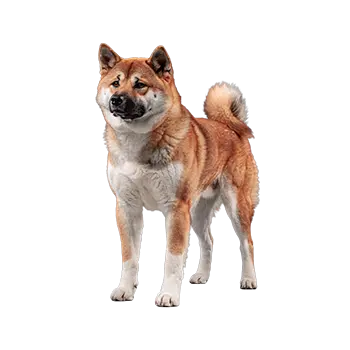
The Japanese Akitainu presents as a large, substantial spitz-type dog of notable dignity and balance. Unlike the American Akita, whose breeding moved toward a heavier, bear-like impression, the Japanese type retains a distinctly fox-like elegance - the head is refined rather than massive, the structure athletic rather than ponderous, and the overall silhouette clean and purposeful. The first thing most people notice is the face: those angled, triangular eyes give the Japanese Akitainu an expression of focused intelligence that is unlike any other large breed.
The head is broad and flat on top, with a well-defined stop and a muzzle that is deep and full through the cheeks but shorter than the skull in length. The muzzle is straight in profile and tapers slightly toward the nose. The nose is black except in white dogs, where flesh coloring is permissible. The jaws are strong with a scissors bite and full dentition. The skull is broad between the ears with minimal wrinkle or loose skin.
The eyes are distinctly small relative to the size of the head - this is an intentional standard requirement, not a fault. They are triangular in shape, deep-set, set at an oblique angle with the outer corners higher than the inner, and dark brown in color. The expression they produce is characteristically intense, evaluating, and alert. Light eyes are a serious fault.
The ears are relatively small, thick, and strongly erect, carried with a slight forward lean that brings them in line with the neck. They are triangular, rounded only slightly at the tips, and set wide on the skull. Ears that are large relative to the head, drop, or are otherwise soft are significant faults in this breed.
The neck is thick, muscular, and of moderate length with no loose skin or dewlap. It flows into well-laid-back shoulders and a deep, moderately broad chest. The chest reaches to the elbow, with well-sprung ribs and a firm, muscular loin with a slight tuck-up. The back is level and short-coupled. The overall proportion is slightly longer than tall (10:11 height-to-length ratio per FCI standard), giving the body a powerful, grounded appearance without the squareness that some working breeds carry.
The tail is one of the Japanese Akitainu's most recognizable features - it is full, thick, and carried in a tight curl over the back. When unrolled, the tail reaches to the hock. The curl can be a full loop or a three-quarter curl falling to either side. The hair on the tail is longer than on the body and fans outward, giving the characteristic plume effect. A tail that does not curl, or that is carried hanging, is a disqualifying fault.
Forequarters are well-muscled with moderately laid-back shoulders and straight front legs with heavy bone and tight, cat-like feet. The pasterns are slightly sloped for shock absorption. Hindquarters are broad, muscular, and moderately angulated with well-developed second thighs and low hocks. Movement is powerful and efficient - the gait at a trot is flexible and elastic with good reach and drive, and the back remains level and strong through the stride.
The double coat consists of a dense, soft, plush undercoat and a slightly harder, straight outer coat of medium length - longer on the tail and thighs than on the body. The coat is not silky or flowing; it is meant to be weather-resistant and functional. The accepted colors are red fawn, sesame (red fawn with black-tipped hairs), brindle, and white. All colors except white display urajiro - pale cream to white shading on the sides of the muzzle, cheeks, under the jaw, neck, chest, belly, inside the limbs, and under the tail. This patterning is a breed requirement, not a cosmetic preference. Black masks and pinto markings are associated with American Akita influence and are disqualifying faults under Japanese and FCI standards.
The Japanese Akitainu is sexually dimorphic - males are noticeably larger and more powerful through the head and body than females, which are more refined in overall appearance while remaining substantial dogs. A well-bred female Japanese Akitainu should not look like a small male; she should look distinctly feminine while carrying the breed's characteristic structure and expression.
Size in this breed is meaningful to its type. The Japanese Akitainu that approaches the upper end of the standard - tall, substantial, and well-built - is a striking animal that commands attention without effort. The combination of the erect ears, curling tail, deep chest, and characteristic fox-like face is immediately recognizable and unlike any other large breed. When the breed's proportions are correct and the coat is in full condition, the Japanese Akitainu presents one of the most visually distinctive profiles in the dog world.
Affectionate With Family
★★★★☆
Within their household, Japanese Akitainu are deeply devoted and warm, but they direct that affection inward rather than broadcasting it broadly. This is a dog that loves its family with intensity and discretion - you will know you are loved, but it will not perform for an audience.
Good With Young Children
★★★☆☆
With children they have been raised alongside, Japanese Akitainu can be patient and gentle. Their size, strength, and low tolerance for rough or disrespectful handling makes supervision essential, and very young children require extra care around any Akitainu.
Good With Other Dogs
★★☆☆☆
Same-sex aggression is well-documented in the breed and dog-dog tension with unfamiliar dogs is common. Most Japanese Akitainu do best as the only dog in the household or with a carefully matched companion of the opposite sex.
Shedding Level
★★★★☆
Heavy seasonal shedding twice a year - the dense double coat blows out in quantities that require daily brushing during those periods. Moderate shedding continues year-round. This breed leaves its mark on furniture, clothing, and floor surfaces.
Coat Grooming Frequency
★★★☆☆
Weekly brushing during low-shed periods keeps the coat in good shape, but during the two annual coat blows, daily brushing becomes necessary. No professional trimming is required, but the seasonal maintenance commitment is real.
Drooling Level
★☆☆☆☆
Clean-mouthed and dry. The Japanese Akitainu is not a drooler.
Coat Type
★★★☆☆
The double coat is plush, dense, and weather-resistant with a soft, thick undercoat and slightly coarser outer layer. It is not unusually demanding to maintain outside of shedding season, but the volume during coat blows is substantial.
Openness To Strangers
★★☆☆☆
Reserved and naturally suspicious of people outside the household is an accurate description of most Japanese Akitainu. This is a guard dog in its heritage and present-day character - strangers are assessed before accepted, and acceptance is not guaranteed.
Playfulness Level
★★★☆☆
Playful in private with people they know, but dignified and restrained in public. The Japanese Akitainu has a well-developed sense of when silliness is appropriate and when it is not - a characteristic that is either charming or puzzling depending on what you expected.
Watchdog/Protective Nature
★★★★★
Among the most naturally protective of all large breeds. The Japanese Akitainu takes territorial responsibility seriously, and its physical presence combined with genuine courage makes it an effective deterrent. This is a dog that will not hesitate if it believes its family is threatened.
Adaptability Level
★★☆☆☆
The Japanese Akitainu is not well-suited to small living spaces, hot climates, or homes with significant dog traffic nearby. They adapt to their household routine readily but do not generalize well to novel or chaotic environments without solid early socialization.
Trainability Level
★★★☆☆
Intelligent and capable of learning complex tasks, but independent-minded and unimpressed by repetitive drills. Training this breed requires patience, creativity, and a handler who earns rather than demands respect.