Jack Russell

Russell Terrier

Quick Facts

🐕 Breed Group
Terrier Group
📏 Size Category
Small
📏 Height
Males: 10-12 inches, Females: 10-12 inches
⚖️ Weight
Males: 9-15 lbs, Females: 9-15 lbs
⏱️ Life Expectancy
12-14 years
🧣 Coat Type
Smooth, broken, or rough
🎨 Coat Colors
White with tan, black, or brown markings
😀 Temperament
Alert, lively, inquisitive, fearless
🏃 Exercise Needs
High
🎓 Training Difficulty
Moderate to High
👶 Good with Children
Yes, with older children
🐾 Good with Other Pets
Caution advised

Other Names & Breed Recognition

If you ask most people what a Jack Russell is, they will point at any small, mostly white terrier with brown or black markings and a personality ten times its size. The name Jack Russell has been the default label for this type of dog for well over a century, and it remains the name that most of the public uses regardless of what the kennel clubs have decided to call it. When you search for a Jack Russell, you are most likely looking at the dog the AKC officially recognizes as the Russell Terrier, a compact, rectangular terrier standing ten to twelve inches at the shoulder that was granted AKC recognition in 2012.

The naming situation around these dogs is genuinely complicated, and understanding it matters if you are shopping for a puppy or trying to figure out what you already own. Three related but distinct breeds share the Russell family tree. The Parson Russell Terrier is the taller version, standing thirteen to fifteen inches, and has been AKC-recognized since 1997 under the original Jack Russell Terrier name before being renamed in 2004. The Russell Terrier is the shorter, more rectangular version that most of the world outside the United States calls the Jack Russell Terrier. And then there is the Jack Russell Terrier as maintained by the Jack Russell Terrier Club of America, which is not AKC-recognized and encompasses dogs from ten to fifteen inches with a broader range of physical variation.

The reason the AKC uses Russell Terrier instead of Jack Russell Terrier comes down to a naming dispute. The JRTCA opposed AKC recognition from the beginning, fearing it would shift breeding priorities from working ability to show ring appearance. When a splinter group pushed for AKC recognition anyway, the JRTCA retained legal rights to the Jack Russell Terrier name. The AKC could not use it, so the shorter dogs entered the registry as Russell Terriers. Most of the rest of the world, including the FCI and its ninety-eight member countries, calls this same dog the Jack Russell Terrier.

Regardless of the official paperwork, Jack Russell is the name that stuck in everyday language. It is what your neighbor calls their dog, what the vet writes on the intake form, and what you typed into the search bar to end up here. All of these names describe dogs descended from the same working terrier lineage, and the Russell Terrier is the AKC's answer to giving the shorter, more compact version of that lineage its own breed standard and recognition.

Jack Russell Organizations & Standards

The organizational landscape for Jack Russell type dogs in the United States is more fractured than almost any other breed, and understanding who oversees what will save you confusion when looking for a puppy or entering competitions. The American Russell Terrier Club serves as the AKC parent club for the Russell Terrier and maintains the breed standard, health testing recommendations, and educational resources for the AKC-recognized version of the breed. Their CHIC program requirements include BAER testing for hearing, CERF or OFA eye examination, and patellar evaluation, with primary lens luxation DNA testing and late-onset ataxia DNA testing under consideration for formal inclusion.

The Jack Russell Terrier Club of America operates entirely outside the AKC system and maintains its own registry, breed standard, and trial circuit. The JRTCA standard is intentionally broader, accepting balanced terriers anywhere from ten to fifteen inches at the shoulder with various coat types and markings. Their emphasis is on working ability and functional conformation rather than the uniformity that show rings demand. The JRTCA also maintains a health registry and recommends BAER, CERF, patella, primary lens luxation, and cardiac evaluations.

Internationally, the FCI recognizes the Jack Russell Terrier as a distinct breed in Group 3, Section 2, with a standard that closely matches what the AKC calls the Russell Terrier. The breed's FCI standard was developed primarily from Australian breeding programs, where the shorter-legged type was refined and standardized after being exported from England. The Kennel Club in the UK recognized the Jack Russell Terrier as recently as 2016, making it one of the last major kennel clubs to formally accept the breed.

The AKC breed standard for the Russell Terrier describes a strong, active, lithe working terrier with a flexible chest small enough to be spanned by average-sized hands. Height is ten to twelve inches with a body that is slightly longer than it is tall, giving the breed its characteristic rectangular outline. The coat may be smooth, broken, or rough, and must be predominantly white with tan, black, or brown markings. The standard emphasizes that this is a working terrier first, and every aspect of the dog's structure should reflect its original purpose of going to ground after quarry. The spannable chest is a non-negotiable requirement in the standard, not a preference, because a dog that cannot fit into a fox's den has lost the fundamental characteristic that defines the breed. Judges and breeders who lose sight of this working requirement are moving the breed away from its purpose, which is a concern that both the AKC parent club and the JRTCA share despite their differences on almost everything else.

Kennel Club Recognition

  • American Kennel Club (AKC): Recognized in 2012, Terrier Group
  • United Kennel Club (UKC): Recognized, Terrier
  • Canadian Kennel Club (CKC): Recognized, Terrier
  • FCI: Recognized, Group 3: Terriers
  • The Kennel Club (UK): Recognized, Terrier

Jack Russell Physical Description

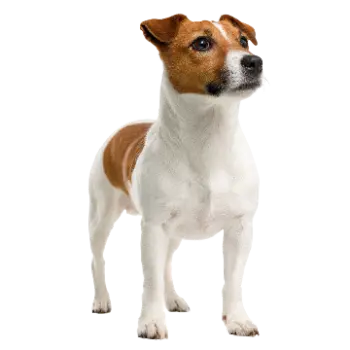
The Jack Russell is a small dog that does not know it is small, and its body reflects that attitude. Everything about the physical structure of this breed is built for function. The chest is the defining structural feature, and it is specifically designed to be narrow and flexible enough that the dog can compress itself to fit into underground dens and burrows. A properly built Jack Russell's chest can be spanned by placing both hands around the ribcage just behind the elbows, with the fingers nearly meeting underneath. If the chest is too wide or too deep, the dog cannot do the job it was bred for.

The body is slightly longer than it is tall, giving the breed a rectangular outline rather than the square proportions seen in the taller Parson Russell Terrier. Height ranges from ten to twelve inches at the withers, and weight typically falls between nine and fifteen pounds depending on build and bone density. The legs are straight, strong, and well-boned relative to body size, with enough length to give the dog surprising speed and agility for its compact frame. The feet are round, compact, and hard-padded, built for digging and covering rough ground.

The head is moderately broad with a flat skull that narrows gradually toward the eyes. The stop is defined but not overly pronounced. The muzzle is strong and slightly shorter than the skull, with powerful jaws that reflect the breed's original work. The nose is black. The eyes are dark, almond-shaped, and carry an expression that most people describe as keen, alert, or mischievous depending on what the dog is contemplating at that moment. The ears are small, V-shaped, and fold forward close to the skull, dropping at or just above the top of the skull.

The tail is set high and traditionally docked to a length that provides a convenient handhold for pulling the dog out of a hole, which was its original purpose. Where docking is not practiced, the natural tail is carried upright and may curve slightly but should not curl over the back.

Three coat types exist within the breed. The smooth coat is flat, hard, and dense with no visible feathering. The broken coat has some longer hair, particularly around the face and on the legs, creating a slightly scruffier appearance without being fully rough. The rough coat is longer and wiry throughout, requiring hand-stripping to maintain its proper texture. All three types are weatherproof and shed more than most people expect from a small dog. The predominant color is white, which must make up at least fifty-one percent of the body, with markings in tan, black, or brown that are usually concentrated on the head and at the base of the tail.

In motion, the Jack Russell moves with a ground-covering stride that looks effortless and purposeful. The gait is free and springy, with good reach in front and strong drive from the rear. There is no wasted movement. Everything about the way this dog carries itself communicates readiness and confidence, whether it is trotting beside you on a walk or launching itself after a ball at full speed across the yard. The overall impression should be of a tough, athletic, working terrier that is capable of a full day in the field despite its compact size. A well-built Jack Russell looks balanced and fit, never heavy, never fragile, and always like it is about three seconds from doing something that will either impress you or make you shake your head.

Affectionate With Family
These dogs bond tightly with their household and genuinely enjoy being part of daily life. Their affection tends to come in bursts between adventures rather than as constant cuddling.
Good With Young Children
They can do well with children who understand how to respect a small dog's boundaries. Very young children who grab or startle them may get a correction the dog considers fair warning.
Good With Other Dogs
Same-sex aggression is well documented in this breed, and many Jack Russells will challenge dogs much larger than themselves without hesitation. Careful introductions and ongoing management are essential.
Shedding Level
All three coat types shed more than their small size would suggest. The smooth coat in particular drops hair steadily year-round despite its short length.
Coat Grooming Frequency
Grooming needs are minimal. Weekly brushing handles the smooth coat, while broken and rough coats benefit from occasional hand-stripping to maintain texture.
Drooling Level
Drooling is essentially nonexistent in this breed. You will not need towels near the water bowl.
Coat Type
The coat comes in three varieties. Smooth is flat and hard, broken has some longer hair especially on the face and legs, and rough is longer and wiry throughout.
Openness To Strangers
Most are confident around new people without being overly suspicious, though they will announce arrivals with enthusiasm. They warm up quickly once they decide someone is worth their time.
Playfulness Level
Play is a fundamental need for this breed, not a bonus. They approach games with the same intensity they bring to everything else, and their energy during play can surprise people who underestimate their size.
Watchdog/Protective Nature
They are alert and vocal about anything unusual in their environment. Their bark is much bigger than their body, and they take the job of notifying you about visitors and wildlife very seriously.
Adaptability Level
They can adapt to various living situations if their substantial exercise and mental stimulation needs are met. The challenge is not the space but the commitment to keeping their minds and bodies busy.
Trainability Level
Intelligence is not the issue. These dogs learn fast and understand perfectly well what you are asking. Whether they choose to comply depends on whether your request competes with something more interesting.

Jack Russell History & Development

The name Jack Russell is arguably the most famous name in the terrier world, and its origin story starts with a real person. Reverend John Russell, known to his friends as Jack, was a nineteenth-century English parson with a consuming passion for foxhunting. In 1819, while studying at Oxford, he encountered a milkman's terrier named Trump, a small white-and-tan female that fit his vision of the perfect working terrier. He purchased her on the spot, and she became the foundation of his breeding program. Russell spent the next several decades developing a line of working terriers specifically suited to running alongside foxhounds and bolting foxes from their dens at the end of a hunt.

Russell's dogs were bred strictly for function. He never showed them in conformation events, and he was proud to note that his terriers had never tasted blood. The goal was a dog bold enough to enter a fox's den and bark until the quarry bolted, not a dog that would kill underground. This distinction shaped the temperament of the breed and remains relevant today. Russell wanted courage and persistence tempered by enough sense not to get killed in a hole. After his death in 1883, the dogs he created continued under various names and in various forms across the English countryside.

The name Jack Russell became the informal label for any small, mostly white working terrier in the decades that followed. There was no single standard, no official registry, and tremendous variation in size, leg length, coat type, and build. Different regions and different hunting communities maintained their own lines, and the name Jack Russell was applied to all of them. This is the root of the naming confusion that persists today.

The shorter-legged type that became the Russell Terrier was refined primarily in Australia, where the dogs had been exported from England in the mid-twentieth century. Australian breeders standardized the smaller, more rectangular version and sought formal kennel club recognition. The FCI accepted this type as the Jack Russell Terrier in 2001, using the Australian standard as its basis. When the AKC moved to recognize the same type in 2012, it could not use the Jack Russell name due to the JRTCA's legal claim, so it registered the breed as the Russell Terrier.

The irony is that Jack Russell remains the name everyone uses in casual conversation. Whether someone owns a JRTCA-registered working terrier, an AKC Russell Terrier, or a dog of unknown registry that fits the general description, they almost universally call it a Jack Russell. The name has transcended breed registries and become a cultural shorthand for a specific type of dog, which is exactly the kind of stubborn persistence that the Reverend would have appreciated.

Jack Russell Temperament & Personality

Living with a Jack Russell means living with a dog that has more personality per pound than just about any breed on earth. These are not background dogs. They do not blend into the furniture. They have opinions about everything, energy that outlasts most owners, and a level of boldness that regularly puts them in situations their body size would suggest they should avoid. If you are looking for a calm, easygoing companion that requires minimal engagement, this is the wrong breed in the most spectacular way possible.

The defining behavioral trait is drive. Jack Russells were bred to pursue quarry underground, which required courage, tenacity, and a willingness to work independently in dark, confined spaces against an animal that could bite back. That drive does not disappear when the dog moves into a house. It redirects. Without appropriate outlets, a Jack Russell will find its own projects, and those projects typically involve digging, disassembling, escaping, or harassing whatever small creatures share the property. They are world-class escape artists who will dig under fences, climb over obstacles, and find gaps in perimeters that you would not have believed a dog could fit through.

With their people, Jack Russells are loyal, entertaining, and genuinely affectionate on their own terms. They enjoy physical closeness and play, and many develop a particularly strong bond with one household member. Their intelligence is sharp and fast, and they pick up on routines, cues, and patterns quickly. This intelligence is a double-edged sword in a home setting because the same brain that learns tricks in minutes also figures out how to open cabinets, manipulate latches, and time its escapes to your bathroom breaks.

Dog-to-dog interactions require honest attention. Same-sex aggression is well documented in this breed, and many Jack Russells will escalate a confrontation with dogs much larger than themselves without a moment's hesitation. This is not a breed you can trust at an off-leash dog park without knowing exactly how your individual dog behaves. Socialization from puppyhood helps, but it does not override the genetic wiring that tells this dog to stand its ground. Multi-dog households can work, but they require careful management and realistic expectations.

With strangers, most Jack Russells are confident and bold rather than shy or suspicious. They will bark to announce visitors and may take a moment to assess before deciding how they feel about someone, but outright fearfulness is uncommon. Their alert nature makes them excellent watchdogs despite their size. They hear everything, notice everything, and have absolutely no hesitation about letting you know when something in their environment has changed.

Jack Russell Family Life & Living Requirements

The Jack Russell can be a wonderful family dog for the right household, but the right household needs to understand what it is signing up for before that puppy comes home. This is not a dog that adjusts itself to your lifestyle. You adjust your lifestyle to the dog, or you both end up miserable. The families that do best with this breed are active, engaged, and genuinely enjoy spending time outdoors with their dog. Couch potato households and Jack Russells are a recipe for frustration on both sides.

With children, the fit depends heavily on the age of the kids and their ability to respect boundaries. Jack Russells generally do well with older children who can participate in active play, throw balls, run around the yard, and understand that a small dog is not a toy to be picked up and carried constantly. Very young children who grab, pull, or accidentally corner the dog may receive a correction, because Jack Russells have a low tolerance for being manhandled. They are not aggressive toward children in the way that suggests a dangerous temperament. They simply have clear boundaries and enforce them with terrier directness.

Housing considerations revolve around containment and stimulation more than space. A Jack Russell can live in an apartment if its exercise and mental needs are fully met, but a house with a securely fenced yard makes life considerably easier. The fence needs to be serious. These dogs dig, climb, and squeeze through gaps. A standard four-foot fence is an invitation, not a barrier. Underground digging barriers and six-foot solid fencing are not excessive precautions for a determined Jack Russell.

Other pets in the household require honest evaluation. Cats can coexist with a Jack Russell if the dog is raised with them from puppyhood, but the prey drive in this breed is strong and some individuals will never be trustworthy around small animals regardless of socialization. Small pets like rabbits, hamsters, guinea pigs, and birds should be considered incompatible unless you maintain absolute physical separation at all times. A Jack Russell's instinct to pursue small, fast-moving creatures is deeply embedded and will surface without warning.

The time commitment is the factor that most surprises new owners. This is not a set-it-and-forget-it dog. Jack Russells need daily physical exercise, daily mental challenges, and daily interaction with their people. When those needs are met, they are cheerful, manageable, and genuinely fun to live with. When those needs are neglected, the behavior problems that follow are entirely predictable and entirely the owner's responsibility to address.

Jack Russell Training & Exercise Needs

Training a Jack Russell is an exercise in creative problem-solving, because these dogs are too smart for repetitive drills and too independent for blind obedience. They learn commands quickly, often within a handful of repetitions, but whether they choose to follow those commands depends entirely on what else is competing for their attention at that moment. A squirrel, an interesting smell, or a perceived escape route will win over your recall command almost every time unless you have built a genuinely strong working relationship with the dog.

The most effective approach is to make training feel like a game rather than a chore. Short sessions of five to ten minutes with high-value rewards keep the dog engaged and wanting more. Vary the exercises constantly. Jack Russells get bored with repetition faster than almost any other breed, and a bored Jack Russell becomes a creatively noncompliant Jack Russell. Positive reinforcement is essential. These dogs do not respond well to harsh physical corrections or intimidation. They will shut down, redirect their frustration into other behaviors, or simply decide you are not worth listening to.

Recall is the most critical command to establish and the most difficult to make reliable. Because of their prey drive and independent nature, a Jack Russell that spots something worth chasing will override its training in a heartbeat. Work on recall relentlessly, in increasingly distracting environments, with the highest value rewards you can offer. Even with excellent training, many experienced Jack Russell owners never fully trust off-leash recall outside of enclosed areas, and that honesty is not a training failure. It is realistic management of a breed with deeply ingrained chase instincts.

Exercise needs are substantial for a dog this size. An hour or more of physical activity daily is the baseline, not the goal. This can include brisk walks, fetch sessions, hiking, agility training, or any activity that lets the dog run and use its body at full capacity. Mental exercise is equally important and can be provided through puzzle toys, nose work, hide-and-seek games, and training sessions. A physically tired Jack Russell that is mentally bored will still find trouble.

Agility and earthdog trials are natural fits for this breed and provide structured outlets for their energy, intelligence, and prey drive. Barn hunt is another activity that channels their working instincts into a controlled setting. These activities do more than tire the dog out. They build the cooperative bond between dog and handler that makes everyday training more effective.

Jack Russell Health Concerns

Jack Russells are generally hardy little dogs with a lifespan that commonly reaches twelve to fourteen years, and many individuals sail past that range with proper care. Their working heritage and the emphasis that breeding communities have placed on functional soundness have produced a breed with fewer structural health issues than many purebred dogs. That said, several breed-specific conditions deserve your awareness and your veterinarian's attention.

Congenital deafness occurs in this breed and is linked to the white pigmentation genetics that define its coat color. BAER testing identifies unilateral or bilateral hearing loss and is recommended for all breeding dogs. Legg-Calve-Perthes disease involves degeneration of the femoral head in the hip joint and typically presents in young dogs as rear leg lameness. Surgical removal of the damaged bone is the standard treatment, and most dogs recover well with physical rehabilitation.

Common Health Issues

  • Primary lens luxation is caused by a mutation in the ADAMTS17 gene that weakens the fibers holding the eye's lens in place. Dislocation leads to pain - Glaucoma, and potential blindness, typically presenting between three and eight years of age.
  • Patellar luxation involves the kneecap sliding out of its normal groove - Causing intermittent lameness and skipping gait. It ranges from mild occasional episodes to severe chronic instability requiring surgical correction.
  • Late-onset ataxia is caused by a CAPN1 gene mutation and presents between six and twelve months of age with progressive coordination loss and balance problems. It is fatal - With most affected dogs euthanized within two years of symptom onset.
  • Spinocerebellar ataxia is caused by a KCNJ10 gene mutation presenting between two and six months of age with coordination loss - Muscle twitching, and seizures. It is progressive and ultimately fatal.
  • Congenital deafness is linked to the breed's white pigmentation genetics and may be unilateral or bilateral - BAER testing identifies hearing loss in puppies and breeding stock.
  • Legg-Calve-Perthes disease involves degeneration of the femoral head in the hip joint - Typically presenting in young dogs as rear leg lameness. Surgical removal of the damaged bone followed by rehabilitation is the standard treatment.

Preventive Care & Health Monitoring

  • BAER hearing testing is required for CHIC certification through the American Russell Terrier Club and should be performed on all breeding dogs to identify congenital deafness linked to white coat pigmentation. - BAER hearing testing is required for CHIC certification through the American Russell Terrier Club and should be performed on all breeding dogs to identify congenital deafness linked to white coat pigmentation.
  • Eye examination by a board-certified ACVO ophthalmologist is required for CHIC certification to screen for primary lens luxation and other inherited ocular conditions. - Eye examination by a board-certified ACVO ophthalmologist is required for CHIC certification to screen for primary lens luxation and other inherited ocular conditions.
  • Patellar evaluation by a veterinarian is required for CHIC certification to assess kneecap stability and grade any luxation present before breeding decisions are made. - Patellar evaluation by a veterinarian is required for CHIC certification to assess kneecap stability and grade any luxation present before breeding decisions are made.
  • Primary lens luxation DNA testing for the ADAMTS17 mutation identifies clear - Carrier, and affected dogs. Responsible breeders screen all breeding stock and manage carrier pairings to avoid producing affected puppies.
  • Late-onset ataxia DNA testing for the CAPN1 mutation and spinocerebellar ataxia DNA testing for the KCNJ10 mutation are available and recommended to identify carriers of these fatal neurological conditions. - Late-onset ataxia DNA testing for the CAPN1 mutation and spinocerebellar ataxia DNA testing for the KCNJ10 mutation are available and recommended to identify carriers of these fatal neurological conditions.
  • Maintaining lean body condition through portion-controlled feeding and adequate exercise protects against the joint stress that accelerates patellar luxation and other orthopedic conditions in small breeds. - Maintaining lean body condition through portion-controlled feeding and adequate exercise protects against the joint stress that accelerates patellar luxation and other orthopedic conditions in small breeds.

Jack Russell Grooming & Maintenance

Grooming a Jack Russell is straightforward compared to most breeds, but the amount of hair that comes off these small dogs surprises everyone who assumed a short-coated terrier would be a low-shedding choice. All three coat types shed, and the smooth coat is arguably the worst offender because those short, stiff hairs embed themselves in furniture, clothing, and car upholstery with impressive persistence. Regular brushing helps manage the situation but does not eliminate it.

For smooth-coated Jack Russells, weekly brushing with a firm bristle brush or rubber curry comb removes loose hair and distributes skin oils. Bathing is only necessary when the dog has rolled in something unpleasant, which with this breed happens more often than you might expect. These dogs are drawn to the most pungent things they can find in the yard, and a quick rinse becomes part of the routine.

Broken and rough coats require the same weekly brushing plus periodic hand-stripping to remove dead outer coat and maintain the proper wiry texture. Stripping involves pulling out spent hair by hand or with a stripping knife, and your breeder can demonstrate the technique. Clipping is an option for pet dogs who will not be shown, but it softens the coat over time and changes its weather-resistant properties. For a working terrier that spends time in brush and rough terrain, maintaining the natural coat texture through stripping is worth the effort.

Ear care matters because the folded ear flap can trap moisture and debris, creating conditions for infection. Check ears weekly and clean with a veterinarian-approved solution as needed, paying particular attention after swimming or bathing. Dental care is important in this breed because their relatively small jaws can lead to crowding, which accelerates tartar buildup and periodontal disease. Regular brushing and appropriate dental chews help maintain oral health between professional cleanings.

Nail trimming follows the standard schedule of every two to three weeks, though very active dogs that run on hard surfaces may wear their nails down naturally. These dogs stay lean naturally when properly exercised, but their enthusiasm for food means weight management requires portion control. A fat Jack Russell is a Jack Russell headed for joint problems, and their small frame amplifies the impact of even a few extra pounds.