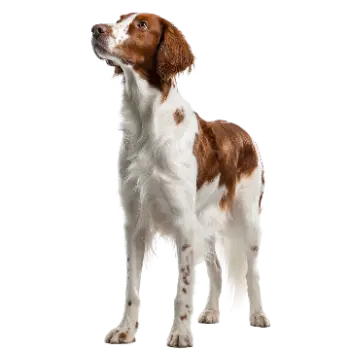
The IRWS is a well-built, athletic sporting dog that gives an impression of power and purpose without coarseness. Compared to the Irish Setter, the IRWS is generally broader, more substantial, and slightly less refined in outline, reflecting a build that was optimized for sustained field work in the rough Irish terrain where the breed spent centuries finding game. Males stand 24 to 26 inches at the shoulder and typically weigh 50 to 70 pounds, while females are slightly smaller at 22.5 to 24 inches.
The head is broad and clean with a well-defined stop and a square, moderately deep muzzle. The skull is domed when viewed from the front, wider than the Irish Setter's more oval skull shape. The nose is dark, either black or dark brown, with well-opened nostrils suited to the breed's exceptional scenting ability. Eyes are round to slightly oval, dark hazel to dark brown, and carry an expression that combines kindness with keen intelligence. The ears are set level with the eyes and lie close to the head, moderate in size and covered with fine feathering that blends with the head coat.
The neck is moderately long and muscular, flowing smoothly into well-laid-back shoulders that allow for the reaching front stride needed in a working setter. The body is strong and muscular with a deep chest that provides heart and lung capacity for sustained exertion. The ribs are well-sprung, and the topline is firm and level, sloping slightly from the withers toward the croup. The loin is muscular, and the underline shows a slight tuck-up that contributes to an athletic profile without appearing racy or tucked-up like a sighthound.
Legs are well-boned and straight, with powerful hindquarters featuring good angulation at the stifle and well-let-down hocks. The feet are close-knit with plenty of feathering between the toes that historically provided protection when working through rough cover. The tail is set on level with the topline and carried in line with or slightly below the back, well-feathered and tapering to a fine point.
The coat is the feature that immediately identifies this breed. The base color is white, with solid red patches distributed across the body. The red patches should be clearly defined rather than ticked or mottled, though some flecking on the face and lower legs is permitted. The coat lies flat and close to the body, with fine, silky feathering on the ears, the backs of the front and rear legs, the chest, the belly, and the tail. A slight wave is acceptable in the body coat but heavy curling is not desired. The texture is finer and silkier than what you might expect from a field dog, but it serves the practical purpose of shedding water and debris while providing enough coverage to protect against brush and cold weather.
In motion, the IRWS moves with a smooth, ground-covering stride that shows good reach in front and strong drive behind. The breed's natural working gait is a sustained gallop that covers large stretches of ground efficiently, and the white coat with red patches was historically valued because it made the dog easy to spot against the green and brown Irish landscape, a practical advantage when your setter was working at considerable distance.
The overall physical impression of the IRWS is one of power balanced with refinement. This is not a heavy, lumbering dog, but neither is it as racy and angular as the Irish Setter. The IRWS occupies a middle ground that reflects its heritage as a practical working dog bred for function over appearance. The broad chest, strong hindquarters, and well-boned legs give it the substance needed for all-day work in the field, while the clean head, moderate feathering, and balanced proportions give it the elegance that makes it an attractive companion in any setting. The parti-colored coat pattern ensures that no two dogs look exactly alike, and that individuality is part of the breed's charm.
Affectionate With Family
★★★★★
The IRWS forms deep, devoted bonds with its household and seeks close physical contact with family members throughout the day.
Good With Young Children
★★★★☆
This breed is patient and gentle with children, showing a reliable good nature that makes it a trustworthy family companion, though its size requires supervision with very young kids.
Good With Other Dogs
★★★★☆
The IRWS is generally sociable with other dogs and enjoys canine company, rarely showing aggression or territorial behavior toward other dogs when properly introduced.
Shedding Level
★★★☆☆
Shedding is moderate year-round with seasonal increases, requiring regular brushing to manage loose hair and keep the coat in good condition.
Coat Grooming Frequency
★★★☆☆
The flat coat with feathering needs regular brushing several times per week and attention to the longer hair on the ears, chest, legs, and tail to prevent tangles.
Drooling Level
★☆☆☆☆
The IRWS is not a drooler and keeps its surroundings clean under normal circumstances.
Coat Type
★★★☆☆
The coat lies flat and close to the body with a fine, silky texture and moderate feathering on the ears, backs of legs, chest, and tail.
Openness To Strangers
★★★★☆
Most IRWS dogs welcome new people with friendly enthusiasm, approaching strangers with curiosity and warmth rather than suspicion.
Playfulness Level
★★★★☆
The breed maintains a lively, playful attitude throughout its life and eagerly participates in games and outdoor activities with its family.
Watchdog/Protective Nature
★★☆☆☆
While the IRWS will alert to unusual activity with a bark, its friendly disposition means it is unlikely to serve as an effective deterrent against intruders.
Adaptability Level
★★★☆☆
The breed adapts to different environments when its exercise needs are met, but its size and energy level make it best suited to homes with access to outdoor space.
Trainability Level
★★★★☆
The IRWS is intelligent and willing to work with its handler, responding well to patient, positive training methods, though it can take longer to mature than some sporting breeds.