Irish R&W

Irish Red and White Setter

Quick Facts

🐕 Breed Group
Sporting Group
📏 Size Category
Large
📏 Height
Males: 24-26 inches, Females: 22.5-24 inches
⚖️ Weight
Males: 50-75 lbs, Females: 50-75 lbs
⏱️ Life Expectancy
11-15 years
🧣 Coat Type
Flat, silky with feathering
🎨 Coat Colors
White base with solid red patches; flecking and mottling permitted
😀 Temperament
Spirited, determined, friendly, courageous, biddable
🏃 Exercise Needs
High
🎓 Training Difficulty
Moderate - eager to please but energetic
👶 Good with Children
Excellent
🐾 Good with Other Pets
Good with proper introduction

Other Names & Breed Recognition

Irish R&W is the abbreviation that field trial enthusiasts, breeders, and breed club members use in everyday conversation when the full name Irish Red and White Setter feels like too many words for the pace of the discussion. You will see it in trial catalogs, online breed forums, veterinary intake forms, and the casual shorthand of people who work with these dogs daily. The related abbreviation IRWS appears in written breed communication as well, particularly in club publications and health registry databases.

The shorthand emerged naturally from the breed community's need to distinguish this dog from its more famous relative, the solid red Irish Setter, without using the full eight-syllable name every time. In conversation among sporting dog people, saying Irish R&W or simply R&W immediately identifies the breed without ambiguity. The abbreviation carries no particular regional or historical significance beyond practical convenience, but it has become so universally understood within the breed community that many newcomers encounter it before they encounter the full formal name.

The Irish Red and White Setter holds a unique position in the setter family as the older of the two Irish setter breeds. The breed predates the solid red Irish Setter by a considerable margin, with documentation of red and white setters in Ireland stretching back to the seventeenth century. For much of the nineteenth and twentieth centuries, however, the solid red setter dominated in popularity and show ring success, pushing the red and white variety into near obscurity. The breed's survival and revival is one of the more remarkable conservation stories in purebred dogs.

The AKC granted full recognition to the Irish Red and White Setter in 2009, making it one of the newer additions to the Sporting Group despite being one of the older sporting breeds in existence. The Kennel Club in the UK recognized the breed earlier, and the FCI classifies it in Group 7 among pointing dogs. The Irish Red and White Setter Club of America serves as the AKC parent club and maintains health testing protocols, breeder referral services, and breed education programs.

Irish R&W Organizations & Standards

The Irish Red and White Setter Club of America (IRWSCA) serves as the AKC parent club and has been instrumental in establishing the breed in the United States, advocating for health testing standards, and supporting breed rescue. Given the breed's relatively small population, the club places particular emphasis on maintaining genetic diversity while screening for known health concerns. The club participates in the CHIC program and maintains breeder referral services for people seeking responsibly bred puppies.

The breed standard describes an athletic, powerful dog built for endurance in the field. Males stand 24 to 26 inches at the shoulder, females 22.5 to 24 inches, with weight typically falling between 50 and 75 pounds. The overall impression should be of a strong, well-balanced dog showing power without coarseness. The head is broad in proportion to the body, with a well-defined stop and a clean, square muzzle. The eyes are dark hazel to dark brown, round, and carry a kind, alert expression. The ears are set level with the eyes, lying close to the head.

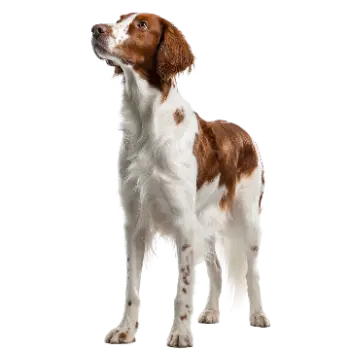
The coat is the breed's most visually distinctive feature. The base color is white with solid red patches, which should be clearly defined rather than blended or roaned. Flecking and mottling on the face and legs is permitted, but roaning through the body is not desirable. The coat lies flat and has a fine silky texture with feathering on the backs of the forelegs and upper arms, the thighs, the chest, the ears, and the tail. The standard calls for minimal trimming that maintains a neat natural appearance rather than the sculpted grooming seen in some other sporting breeds.

CHIC certification for the breed requires an OFA or PennHIP hip evaluation, an OFA thyroid evaluation, a CERF or CAER eye clearance, an Optigen PRA DNA test registered with OFA, and an Optigen CLAD DNA test registered with OFA. This is one of the more comprehensive CHIC protocols among sporting breeds, reflecting the breed community's serious commitment to managing the health conditions that a small gene pool makes particularly important to track. Any breeder who dismisses these tests as unnecessary or excessive does not understand the genetic realities of working with a numerically limited breed.\n\nIn Ireland, the Irish Red and White Setter Club works closely with the Irish Kennel Club to maintain breed health programs and promote the breed's working heritage. The breed retains a strong following among field trial enthusiasts in the UK and Ireland, where dogs are regularly worked on game and evaluated in competitive trials that test natural hunting ability alongside trained obedience.

Kennel Club Recognition

  • American Kennel Club (AKC): Recognized in 2009, Sporting Group
  • United Kennel Club (UKC): Recognized, Gun Dog
  • Canadian Kennel Club (CKC): Recognized, Sporting Dogs
  • FCI: Recognized, Group 7: Pointing Dogs
  • The Kennel Club (UK): Recognized, Gundog

Irish R&W Physical Description

The Irish R&W is a handsome, athletic setter built along lines that prioritize field function over show ring refinement. This is a dog designed to cover ground efficiently over long days of hunting, and every aspect of the structure serves that purpose. The overall impression is of power and stamina without heaviness, a dog that looks like it could run all morning and still have energy to spare by afternoon.

The head is broad and proportionate to the body, domed without being coarse, with a well-defined stop between the skull and muzzle. The muzzle is clean and square when viewed from the front, with a good depth that provides room for the scenting apparatus that is central to the breed's working function. The nose is dark, the nostrils wide. The eyes are dark hazel to dark brown, round, and set just enough to give a slight impression of kindness even in a dog at full alertness. The ears are set level with the eyes, moderately sized, and lie close to the head with fine feathering along the edges.

The neck is moderately long, muscular, and slightly arched, flowing into well-angled shoulders that provide the reach necessary for efficient ground-covering movement. The chest is deep, extending to approximately the elbow, with well-sprung ribs that flatten slightly to allow free movement of the front legs. The topline is strong and level, the loin muscular and slightly arched, and the croup falls away gently toward the tail. The hindquarters are broad and powerful with good angulation through the stifle and hock, providing the driving force that keeps the dog moving steadily across rough terrain.

The coat pattern is what catches every eye. A white base color carries solid patches of deep red that should be clearly defined and well distributed. The red patches can appear anywhere on the body and head, and no two dogs are marked exactly alike. Flecking and mottling on the face and lower legs is permitted and adds to the breed's characteristic appearance. The coat itself lies flat against the body with a fine, silky texture. Feathering develops along the backs of the forelegs, on the thighs, the chest and throat, the underside of the tail, and the ears. The feathering should be straight and flat, not wavy or curly.

The tail is strong at the root, tapering to a fine point, carried level with or just below the back. In the field, the tail serves as a flag that allows the handler to track the dog's location and movement at a distance, and the white base color of the coat enhances this visibility. Movement should be free, effortless, and ground-covering, with the smooth action of a dog that can maintain a steady working pace for hours. The Irish R&W in motion is a genuinely beautiful sight, the red and white coat flashing through field cover as the dog quarters back and forth searching for game.\n\nThe legs deserve attention because they are central to both the breed's function and its visual appeal. The forelegs are straight, well-boned, and set well under the body, with the feathering along the back of the forearm adding visual weight without compromising clean movement. The hindquarters carry substantial muscling through the thighs, with moderate angulation through the stifle and strong hocks set low to the ground. The feet are close-knit with plenty of feathering between the toes that historically protected the pads during fieldwork over rough ground. The overall picture from nose to tail is of a dog built to run, search, and point across varied terrain for hours at a stretch, looking striking while doing it.\n\nSize falls in the medium-large range for sporting breeds. Males typically stand between 24 and 26 inches at the shoulder and weigh 50 to 75 pounds, with females a few inches shorter. There is genuine substance to a well-built Irish R&W, with good bone density and muscular development that gives the breed more physical presence than its relatively moderate weight might suggest.

Affectionate With Family
The Irish R&W is a deeply people-oriented dog that thrives on close contact with its family. Expect a dog that wants to be wherever you are, whether that is in the field or on the couch.
Good With Young Children
This breed is known for its patience and gentleness with children of all ages. Their playful, tolerant nature makes them excellent family dogs, though their size and energy level warrant supervision with very small children.
Good With Other Dogs
Most Irish R&Ws get along well with other dogs, particularly when socialized early. Their sporting background means they are accustomed to working cooperatively alongside other dogs in the field.
Shedding Level
The silky coat sheds moderately throughout the year with heavier shedding during seasonal changes. Regular brushing keeps loose hair manageable.
Coat Grooming Frequency
The feathered coat needs brushing two to three times per week to prevent tangles, particularly in the ear, chest, and leg feathering. Minimal trimming keeps the natural outline neat.
Drooling Level
The Irish R&W is not a drooling breed. Their clean, dry mouths produce virtually no excess saliva under normal conditions.
Coat Type
The coat lies flat against the body with a fine silky texture. Feathering develops on the backs of the forelegs, thighs, chest, and ears, adding elegance to the breed's athletic frame.
Openness To Strangers
Generally friendly and approachable with new people, the Irish R&W lacks the aloofness common to some sporting breeds. They tend to greet visitors with enthusiasm once a quick assessment confirms no threat.
Playfulness Level
These are cheerful, spirited dogs that maintain their playfulness well into adulthood. They enjoy games, interactive play, and any activity that involves running and exploring.
Watchdog/Protective Nature
The Irish R&W will alert you to arrivals and unusual sounds, but this is a sporting breed at heart, not a guardian breed. The bark is an announcement, not a challenge.
Adaptability Level
With sufficient daily exercise the breed can adapt to various living situations, but they are happiest with access to open space for running. Without adequate physical outlets, their energy becomes difficult to manage indoors.
Trainability Level
Eager to please and intelligent, the Irish R&W takes well to training when positive methods are used. They respond best to handlers who keep sessions engaging and maintain a patient, consistent approach.

Irish R&W History & Development

The abbreviation Irish R&W is modern shorthand, but the breed it describes has roots reaching deep into Irish sporting history. Red and white setters were documented in Ireland as early as the seventeenth century, and evidence suggests that the parti-colored setter was the original Irish type, predating the solid red variety that would eventually overshadow it. Paintings from the 1700s depict Irish sporting scenes featuring setters with the distinctive red and white patterning, working alongside hunters in a manner that would be immediately recognizable to anyone who has watched the breed in the field today.

The breed's story is one of near-extinction and determined recovery. During the nineteenth century, the solid red Irish Setter gained enormous popularity in the show ring and among sportsmen, gradually eclipsing the red and white variety. Breeders increasingly favored the striking all-red coloring, and the red and white dogs were allowed to decline in numbers. By the early twentieth century, the Irish Red and White Setter was perilously rare, and the upheavals of World War I in Ireland further reduced the population. By the 1920s, the breed was widely considered to be extinct or nearly so.

The recovery effort began in the 1920s when a small number of dedicated Irish breeders located surviving red and white setters in the countryside and began a deliberate breeding program to rebuild the population. This work continued slowly through the middle decades of the twentieth century, with a small but committed group of breeders maintaining the breed through careful selection and occasional outcrossing. The gene pool remained extremely limited, which made health screening and genetic diversity management critical priorities from the earliest stages of the recovery.

International recognition came gradually. The Kennel Club in the UK recognized the breed, and the FCI provided international standing. In the United States, the Irish Red and White Setter was admitted to the AKC Miscellaneous Class before receiving full recognition in the Sporting Group in 2009. The relatively late AKC recognition reflected not reluctance about the breed's quality but the practical reality of building a sufficient population base in North America to support a sustainable registry.

The abbreviation Irish R&W emerged from the practical needs of breed communication as the dog gained footing in North American field trial and show communities. With a full name of eight syllables that takes time to say and space to write, shortened forms were inevitable. Today the breed remains numerically small compared to its red cousin, and that limited population makes the breed community's emphasis on health testing, genetic diversity, and responsible breeding practices not just admirable but existentially important for the breed's continued survival. Every litter matters in a breed this size, and every breeding decision carries weight that extends beyond the individual dogs involved to the viability of the population as a whole. The Irish R&W community understands this responsibility intimately, and it is reflected in the comprehensive health testing protocols and the careful attention to genetic diversity that characterize the most dedicated breeding programs.

Irish R&W Temperament & Personality

The Irish R&W is a spirited, cheerful dog that approaches life with the enthusiasm of a breed that genuinely enjoys both working and companionship. These are not high-strung dogs despite their considerable energy. They carry their intensity with a good-natured stability that makes them considerably easier to live with than their activity level might suggest. The breed's temperament reflects its dual heritage as both a serious field dog and a family companion, and most individuals transition smoothly between those roles without the behavioral whiplash that sometimes accompanies high-drive sporting breeds.

With their own family, Irish R&Ws are deeply affectionate and remarkably patient. They form strong bonds with all household members and are particularly noted for their gentleness with children. This is one of those breeds that seems to understand instinctively that small humans require a different energy level than adults, and many R&W owners describe their dogs moderating their behavior around young children without ever being taught to do so. That natural sensitivity extends to the household's emotional climate as well. These dogs pick up on tension and stress, and they cooperate best in homes where the atmosphere is calm and consistent.

In the field, the Irish R&W becomes a focused, determined working partner. The breed was developed to quarter ground methodically, locate game birds through scent, and hold a steady point until the hunter is in position. That combination of drive, discipline, and cooperation with the handler transfers directly into household life. An Irish R&W that understands what is expected and has a cooperative relationship with its owner is typically a willing and responsive companion.

With strangers, the breed is generally friendly and approachable. They lack the suspicion of unfamiliar people that characterizes many guardian and herding breeds, instead greeting visitors with curiosity and a wagging tail once they have taken a moment to assess the situation. This friendliness makes them poor choices as guard dogs but excellent choices for families that have frequent visitors or an active social life.

With other dogs, the Irish R&W typically gets along well, particularly when socialized from puppyhood. Their field trial heritage means they are accustomed to working in the presence of other dogs, and most individuals maintain a cooperative attitude toward canine housemates. Prey drive is present given the breed's hunting background, so introductions to cats and small animals should be managed carefully, but many R&Ws coexist peacefully with household cats when raised together.

Irish R&W Family Life & Living Requirements

The Irish R&W thrives in active households that can provide the daily exercise and mental engagement this breed needs to be its best. These are not apartment dogs under most circumstances. While they can be calm and settled indoors when their exercise needs are met, the amount of daily physical activity required to reach that settled state is more than most apartment dwellers can easily provide. A house with a securely fenced yard gives the dog room to move between structured exercise sessions, and access to open land for off-leash running is a genuine asset.

Families with children will find the Irish R&W to be one of the more naturally compatible sporting breeds. Their combination of patience, playfulness, and sturdy build makes them genuinely good family dogs rather than dogs that merely tolerate children. They enjoy active play with kids, they are gentle enough to be trusted with younger children under supervision, and they form bonds with family members of all ages. The breed's eagerness to please and cooperative temperament also make it relatively straightforward to teach children and dogs appropriate boundaries with each other.

The breed's exercise requirements are high and non-negotiable. An Irish R&W needs at minimum one solid hour of vigorous physical activity daily, and more is better for young healthy adults. Long walks, running in open fields, swimming, and retrieving games all satisfy the physical drive. Dogs that participate in field work, hunt tests, or other canine sports tend to show the most balanced temperaments at home because the combination of physical exertion and purposeful activity fulfills the breed's need to work. An under-exercised R&W becomes restless, vocal, and creative about finding its own entertainment, none of which typically aligns with household harmony.

Mental stimulation matters as much as physical exercise. Training sessions, puzzle toys, scent work activities, and novel experiences keep the breed's active mind engaged and prevent the boredom that leads to destructive behavior. The Irish R&W is intelligent enough to need regular mental challenges and cooperative enough to enjoy them, making training a genuinely pleasant activity for both dog and handler rather than a chore to endure.\n\nOne practical consideration for family life is the breed's coat and its interaction with the household. While the Irish R&W is not a heavy shedder compared to double-coated breeds, the silky feathering does collect outdoor debris and track moisture into the house after wet-weather outings. Keeping a towel by the door for post-walk wipe-downs and brushing out burrs before they work deeper into the feathering quickly becomes second nature for most owners.

Irish R&W Training & Exercise Needs

Training an Irish R&W is a genuinely rewarding experience for anyone who appreciates working with an intelligent, cooperative sporting breed. These dogs want to please their handlers and they learn quickly when the training approach matches their temperament. Positive reinforcement methods work exceptionally well because the breed responds to encouragement and engagement far better than to correction or compulsion. Food rewards, toy rewards, and genuine enthusiasm from the handler all serve as effective motivators.

Early socialization sets the foundation for everything that follows. Exposing the puppy to a wide range of people, dogs, environments, and situations during the critical first months builds the confidence and social flexibility that makes an Irish R&W easy to live with as an adult. Puppy classes provide structured socialization alongside basic obedience, and the breed typically shines in these group settings because of its natural friendliness and desire to engage.

Basic obedience should begin early and build progressively. The breed's intelligence means it picks up commands quickly, but that same intelligence means it also notices when training becomes repetitive and loses interest accordingly. Keeping sessions short, varied, and upbeat produces far better results than lengthy drill sessions. The Irish R&W is not a stubborn or defiant breed, but it can become disengaged if the work feels pointless. Give the dog a reason to stay invested and it will impress you with how fast it learns.

Exercise needs are substantial and should be taken seriously from the start. Daily vigorous activity is essential, not optional. Long walks, jogging, off-leash running in secure areas, swimming, and retrieving games all contribute to the physical outlet this breed requires. Field work and hunt tests provide ideal channels for the breed's natural abilities, combining physical exertion with the mental engagement of scent work and bird finding. Agility, rally obedience, and dock diving are additional activities where the Irish R&W's athleticism and cooperative nature produce excellent results. The key principle is that this is a sporting breed built for sustained physical effort, and expecting it to be satisfied with a fifteen-minute walk around the block is setting everyone up for frustration.\n\nRecall training deserves particular emphasis because the breed's hunting instinct means an Irish R&W that catches an interesting scent may temporarily forget that you exist. Building a reliable recall through consistent positive reinforcement, starting in low-distraction environments and gradually increasing the challenge, is one of the most important investments you can make in your dog's safety and your own peace of mind.

Irish R&W Health Concerns

Canine leukocyte adhesion deficiency, known as CLAD, is the breed-specific health condition that the Irish R&W community has worked most diligently to manage. CLAD is an inherited immune system disorder that prevents white blood cells from functioning properly, leaving affected dogs unable to fight infections effectively. Most affected dogs die young from recurrent infections. A DNA test identifies carriers and affected dogs, and responsible breeders have dramatically reduced the incidence of CLAD through consistent testing and informed breeding decisions. The carrier rate in the breed was approximately 12 percent when testing first became available and has been reduced through careful breeding since then.

Hip dysplasia occurs in the Irish R&W as it does in many medium to large sporting breeds. The hip joint develops improperly, leading to looseness, inflammation, and progressive arthritis. Hypothyroidism, an underactive thyroid condition, has also been documented and is screened through the OFA thyroid evaluation that is part of the CHIC protocol. The breed's relatively small gene pool makes comprehensive health testing particularly important because genetic conditions can become concentrated in a limited population more quickly than in numerically larger breeds.

Common Health Issues

  • Canine leukocyte adhesion deficiency (CLAD) - An inherited immune system disorder that prevents white blood cells from functioning properly. Most affected dogs die young from recurrent infections. DNA testing has significantly reduced incidence through informed breeding decisions.
  • Von Willebrand's disease - A blood clotting disorder causing insufficient levels of clotting factor, leading to excessive bleeding from injuries or during surgical procedures. DNA testing identifies carriers and affected dogs.
  • Posterior polar cataract (PPC) - An eye condition where cataracts form at the back of the lens. Typically a milder form of cataract that does not usually progress to blindness but requires monitoring through regular ophthalmological examination.
  • Progressive retinal atrophy (PRA) - An inherited eye disease causing gradual photoreceptor degeneration and progressive vision loss. DNA testing through Optigen identifies carriers and affected dogs.
  • Hip dysplasia - Abnormal development of the hip joint causing looseness, inflammation, and progressive arthritis. Screened through OFA or PennHIP radiographic evaluation.
  • Hypothyroidism - Underactive thyroid function causing weight gain, lethargy, and coat changes. Screened through OFA thyroid evaluation and managed with daily medication.

Preventive Care & Health Monitoring

  • OFA or PennHIP hip evaluation for breeding stock to screen for hip dysplasia - Part of the CHIC certification protocol for the breed.
  • OFA thyroid evaluation to screen for hypothyroidism - Recommended as part of the comprehensive CHIC testing protocol.
  • CERF or CAER ophthalmologist evaluation to screen for posterior polar cataracts - Progressive retinal atrophy, and other heritable eye conditions.
  • Optigen DNA test for CLAD registered with OFA to identify carriers and affected dogs before breeding - This test is critical given the breed's limited gene pool.
  • Optigen DNA test for progressive retinal atrophy registered with OFA to identify genetic status and prevent producing affected puppies. - Optigen DNA test for progressive retinal atrophy registered with OFA to identify genetic status and prevent producing affected puppies.
  • Knowledge of von Willebrand's disease status through DNA testing - Especially important before any planned surgical procedure to ensure appropriate bleeding precautions.
  • Regular ear inspection and cleaning to prevent infections in the breed's folded ear leathers - Which create warm moist environments favorable to bacterial and yeast growth.
  • Consistent coat maintenance through brushing two to three times weekly and post-field checks to remove burrs and debris that can cause skin irritation if left embedded in the feathering. - Consistent coat maintenance through brushing two to three times weekly and post-field checks to remove burrs and debris that can cause skin irritation if left embedded in the feathering.

Irish R&W Grooming & Maintenance

The Irish R&W's coat is moderate in its grooming demands compared to some of the more heavily coated sporting breeds. The flat, silky body coat and the feathering on the ears, legs, chest, and tail need regular brushing two to three times per week to prevent tangles and remove loose hair. The feathering is particularly prone to collecting burrs, seeds, and debris during outdoor activity, so a post-outing check and brush-through becomes routine for anyone who takes their R&W into the field or on walks through brushy areas.

Trimming should be minimal and aimed at maintaining a neat natural appearance rather than sculpting the dog into a manicured show outline. The breed standard specifically calls for a natural look, and excessive trimming is penalized in the show ring. Light work with thinning shears to tidy the areas under the ears, around the feet, along the pasterns, and under the tail is all that is needed. The whiskers should remain intact. This minimal trimming approach is a genuine advantage for owners who prefer a lower-maintenance grooming routine compared to breeds that require extensive scissoring or hand-stripping.

Bathing follows a moderate schedule, roughly every four to six weeks or as needed after particularly dirty outdoor adventures. The silky coat texture responds well to a quality dog shampoo and conditioner, and the flat lie of the coat means it dries relatively quickly compared to thicker double-coated breeds. The long ear leathers deserve particular attention during grooming because the fold creates a warm, moist environment that can promote bacterial or yeast growth if not kept clean. Weekly ear checks and gentle cleaning with a veterinarian-approved ear solution help prevent infections before they start.

Nail care follows the standard schedule of every two to three weeks, adjusted based on how much natural wear the dog's activity provides. Dental care through regular brushing supports long-term oral health. The overall grooming commitment for an Irish R&W is moderate and manageable, sitting comfortably between the minimal needs of short-coated breeds and the intensive demands of heavily coated or non-shedding breeds. The reward for consistent grooming is a dog that looks as handsome at home as it does in the field.