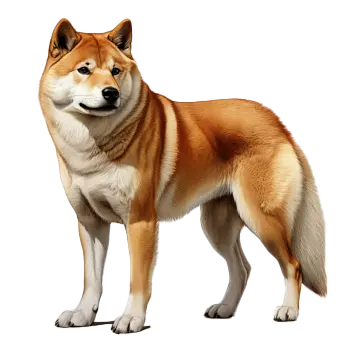
The Hokkaido-Ken is a medium-sized spitz that looks exactly like what it is - a dog built for mountain hunting in harsh winter conditions. The body is compact and muscular without being heavy, with proportions that favor agility and endurance over raw power. Males typically measure 19.5 to 20.5 inches at the shoulder and weigh 44 to 66 pounds. Females are slightly smaller in both dimensions but share the same robust, athletic build. Everything about the Hokkaido-Ken's physical structure serves a functional purpose, and the breed has avoided the cosmetic exaggerations that compromise structure in many modern show breeds.
The head is distinctive and immediately recognizable within the Japanese spitz family. The skull is broad and slightly flat between the ears, with a well-defined stop and a strong, tapered muzzle. The most striking feature is the eyes - small, triangular, and angled slightly upward at the outer corners, giving the face an intense, almost piercing expression that differs noticeably from the rounder, softer eyes of breeds like the Shiba Inu. Eye color is dark brown in most coat varieties. The ears are small relative to the head, triangular, thick, and firmly pricked forward. Together, the eyes and ears create a face that communicates constant alertness and sharp intelligence.
The neck is thick and powerful, set cleanly into well-laid-back shoulders with good angulation. The chest is deep, reaching to the elbow, and the ribs are well-sprung to provide the lung capacity needed for sustained effort at altitude. The topline is straight and level, the loin is broad with strong musculature, and the croup has a gentle slope. The breed standard calls for a body that is slightly longer than tall, giving the dog a rectangular outline when viewed from the side. This proportion provides stability and efficiency of movement across uneven terrain.
The tail is a defining spitz characteristic - set high, thickly furred, and carried in a tight curl or bold sickle curve over the back. The curl pattern varies between individuals, with some dogs carrying a single tight ring and others showing a looser sickle shape that arcs to one side. The tail's dense fur served as insulation during cold-weather sleeping, covering the nose and face when the dog curled up in snow.
The coat is the breed's most functional feature. The outer layer consists of harsh, straight guard hairs that stand slightly off the body, creating a weatherproof barrier against rain, snow, and cold. Beneath that protective layer sits a dense, soft undercoat that provides insulation in freezing temperatures. The combination is remarkably effective - these dogs can work comfortably in deep snow and bitter cold that would sideline most other breeds. Coat colors include red, white, black, brindle, sesame (mixed black and red hairs), and black and tan, with red and white being the most commonly seen.
The breed moves with a light, agile gait that reflects its mountain hunting heritage. Reach and drive are balanced and efficient, and the dog covers ground quickly without wasted motion. On rough terrain, the Hokkaido-Ken moves with a confidence and surefootedness that immediately tells you this is a dog operating in its natural element.
Some Hokkaido-Ken display blue-black tongue spots, a trait that appears frequently enough in the breed to be considered a recognized characteristic, though it is not required by the standard. The feet are tight and compact with thick pads that handle rocky ground and frozen surfaces equally well, and dewclaws are typically present on the front legs. Overall, the Hokkaido-Ken's physical profile is that of a dog designed by centuries of practical necessity rather than aesthetic preference - every feature earns its place through function.
Affectionate With Family
★★★★★
The Hokkaido-Ken forms a powerful, almost exclusive attachment to its family. This is a dog that needs to be with its people and does not handle separation gracefully.
Good With Young Children
★★★☆☆
Older kids who know how to be calm and respectful around dogs are the best match. Very young children may push the Hokkaido-Ken past its comfort zone with grabbing or rough play.
Good With Other Dogs
★★☆☆☆
Dog-to-dog relations can be tense, especially with same-sex pairings or unfamiliar dogs. The breed's strong territorial and prey instincts make careful management around other dogs essential.
Shedding Level
★★★★★
Heavy shedding is a fact of life with the Hokkaido-Ken. The biannual coat blow produces remarkable quantities of fur, and year-round shedding keeps things interesting in between.
Coat Grooming Frequency
★★★☆☆
Outside of shedding season, weekly brushing is enough. During the coat blow, plan on daily sessions to keep the loose undercoat from matting against the skin.
Drooling Level
★☆☆☆☆
Drooling is not a concern with this breed. The Hokkaido-Ken keeps a dry, clean mouth.
Coat Type
★★★★☆
The harsh outer coat and plush undercoat work together to provide outstanding cold-weather protection. The coat's natural oils contribute to a self-cleaning quality that reduces grooming demands.
Openness To Strangers
★★☆☆☆
Reserved and cautious around new people, the Hokkaido-Ken does not warm up quickly. Socialization broadens its tolerance but does not eliminate the breed's fundamental watchfulness.
Playfulness Level
★★★★☆
A lively and spirited companion during play, the Hokkaido-Ken brings real energy to games and outdoor adventures. It loves to chase, explore, and engage with its family.
Watchdog/Protective Nature
★★★★★
Vigilant and vocal, the Hokkaido-Ken misses nothing in its environment. The breed takes territorial awareness seriously and will announce anything it considers out of place.
Adaptability Level
★★☆☆☆
Not well suited for apartment living, hot climates, or households where the dog will spend long hours alone. This breed needs room, cool weather, and regular human contact.
Trainability Level
★★★☆☆
Smart and capable of learning complex tasks, but the Hokkaido-Ken approaches training on its own terms. Handlers who work with the breed's independence rather than against it get the best results.