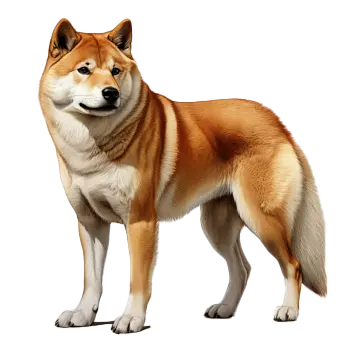
The Hokkaido is a medium-sized, powerfully built spitz that communicates its ancient hunting heritage through every aspect of its structure. Standing 18 to 20 inches at the shoulder and weighing 44 to 66 pounds, it is the most robustly built of the six native Japanese breeds - heavier in bone and more muscular in overall impression than the similarly sized Shikoku or the more refined Kishu. The body is slightly longer than tall, with a compact, dense structure that reads as powerful rather than elegant. This is a dog that looks like it could do the job it was bred for, and in Japan some still do.
The head is medium-sized with a broad, slightly domed skull and a well-defined stop that leads to a pointed but moderately long muzzle. The muzzle tapers toward the nose but is never fine or snipy - there is substance here appropriate to a dog built to grip game. The jaws are strong, and the dentition is a complete scissors bite. One distinctive feature occasionally seen in the breed is a bluish-black or spotted tongue, reminiscent of the Chow Chow and Shar Pei, which is thought to reflect ancient genetic connections among these Eastern breeds. A spotted or blue-black tongue is neither penalized nor required under the standard.
The eyes are small, triangular in shape, and set with the outer corner slightly higher than the inner corner - a characteristic feature that gives the Hokkaido its keen, alert, slightly oblique expression. Eye color is dark brown. The eyes give the dog a watchful, intelligent quality that reflects its original function as a hunting and guarding dog in difficult terrain. The expression is focused and serious rather than soft or inviting.
The ears are small, triangular, strongly erect, and carried forward and slightly outward, giving the dog a constant air of alertness. The ear size is notably smaller relative to the head than in many Western breeds - an adaptation that reduces heat loss and vulnerability to frostbite in the arctic conditions the breed's ancestors worked. The ears have some capacity to rotate toward sound but do not fold or drop under any normal circumstance.
The neck is powerful and muscular, moderately long, arched slightly at the crest. It flows into well-laid shoulders that allow for efficient forward reach. The chest is deep and broad with well-sprung ribs providing substantial lung capacity - necessary for a dog working hard over extended periods at elevation and in cold. The topline is level and firm. The loin is well-muscled and the overall body gives an impression of coiled energy.
The tail is the Hokkaido's most visually distinctive feature: set high and carried curled tightly over the back in a classic spitz curl, or carried in a sickle shape. The tail is thickly furred with hair longer than the body coat, and the curl or sickle carriage is maintained even at rest, though it may relax slightly when the dog is asleep. The tail curl serves a thermal function in cold conditions by allowing the dog to cover its face while curled up in snow.
The forequarters are straight with moderate angulation, strong pasterns, and compact, round feet with thick, hard pads suited for traction in snow and on rocky terrain. The hindquarters are muscular with well-developed thighs providing the drive for sustained movement. The Hokkaido moves with an efficient, elastic trot that can be maintained for long periods - the movement of a working dog, not a show ring specialist. The gait is sure-footed and ground-covering.
The coat is the breed's thermal armor. The outer coat is harsh, straight, and stands off from the body rather than lying flat, which creates an air pocket against the skin for additional insulation. The undercoat is extremely dense and soft, providing the primary warmth layer. The coat is shorter on the face and ears, medium on the body, and longer on the tail. During the seasonal coat change, the volume of undercoat released is impressive by any standard - the dog's overall appearance changes noticeably as the old undercoat comes out and the new coat establishes.
Sexual dimorphism is clear in the Hokkaido - males are noticeably more substantial than females, with greater bone, wider head, and more muscle mass. The standard acknowledges different height ranges for each sex. Both exhibit the same coat type, tail carriage, and overall structural proportions, but a male Hokkaido standing at 20 inches and 60 pounds has a presence that a 45-pound female does not. This dimorphism is appropriate to the breed's history as a large-game hunting dog where physical capability mattered. The overall impression, in both sexes, is of an ancient, functional dog that has been shaped by thousands of years of real work rather than aesthetic selection.
Affectionate With Family
★★★★☆
The Hokkaido is deeply devoted to its own family and shows genuine warmth with the people it considers its pack. This affection is not exuberant or demonstrative - it is the quiet, steady loyalty of a dog bred to work and live alongside people in severe conditions.
Good With Young Children
★★★☆☆
Generally patient with children in its own household when raised with them, but the Hokkaido's independence and occasional protective instincts make supervision important with very young children. Older kids who respect the dog's space are better suited to this breed.
Good With Other Dogs
★★★☆☆
Dog compatibility varies considerably by individual. Some Hokkaido coexist comfortably with other dogs, particularly when raised together, but same-sex aggression is not uncommon in this primitive breed. Careful introduction and ongoing management are required.
Shedding Level
★★★★☆
The Hokkaido blows its dense undercoat seasonally - usually twice a year - and the volume of loose hair during these coat changes is significant. Between blowouts, shedding is moderate but present year-round.
Coat Grooming Frequency
★★★☆☆
Weekly brushing is sufficient outside of shedding season. During coat blowout, daily brushing for several weeks is needed to manage the undercoat release and keep the process from becoming overwhelming.
Drooling Level
★☆☆☆☆
The Hokkaido is a clean, dry-mouthed breed with no tendency toward drooling. Not a practical concern for owners.
Coat Type
★★★☆☆
Dense double coat with a harsh, straight outer layer built for cold and wet conditions. Not a high-maintenance coat in terms of daily care, but the seasonal blowout is substantial.
Openness To Strangers
★★☆☆☆
The Hokkaido is characteristically reserved with unfamiliar people - this is a primitive trait rooted in the breed's guardian and hunting background. Reserve can shade into suspicion without proper socialization from an early age.
Playfulness Level
★★★☆☆
The Hokkaido has a serious, dignified quality that distinguishes it from more perpetually playful breeds. It enjoys activity and work, but play for its own sake is less central to its personality than purposeful engagement.
Watchdog/Protective Nature
★★★★★
An exceptional watchdog with strong territorial instincts and the physical courage to back it up. The Hokkaido does not bark idly - when it alerts, something has genuinely triggered its attention.
Adaptability Level
★★☆☆☆
This is a working breed with specific needs for exercise, mental stimulation, and an experienced owner. It does not adapt easily to sedentary households, apartment living, or owners without experience managing a primitive, independent dog.
Trainability Level
★★★☆☆
Intelligent and capable but independent in the way all primitive breeds are - the Hokkaido evaluates requests and decides whether compliance makes sense. Training works best with consistency, positive reinforcement, and an owner the dog genuinely respects.