Griff

Brussels Griffon

Quick Facts

🐕 Breed Group
Toy Group
📏 Size Category
Small
📏 Height
Males: 7-10 inches, Females: 7-10 inches
⚖️ Weight
Males: 8-10 lbs, Females: 8-10 lbs
⏱️ Life Expectancy
12-15 years
🧣 Coat Type
Rough (wiry) or Smooth
🎨 Coat Colors
Red, belge, black and tan, black
😀 Temperament
Alert, Curious, Loyal
🏃 Exercise Needs
Low to moderate
🎓 Training Difficulty
Moderate - sensitive but willing
👶 Good with Children
Better with older, gentle children
🐾 Good with Other Pets
Generally good with other pets

Other Names & Breed Recognition

Griff is the kind of nickname that only people who actually live with these dogs tend to use, and once you hear it in conversation at a dog show or a breed meetup, you know you are talking to someone who has spent real time with a Brussels Griffon rather than just admiring one from across the room. The name is a natural abbreviation, easy to say, and it carries a warmth that mirrors the breed's personality. It is not a formal designation assigned by any kennel club. It is a term of endearment that has become so embedded in breed culture that breeders use it in kennel names, online communities, and everyday conversation without any need for explanation.

The full breed name, Brussels Griffon, places the dog squarely in its Belgian origins. In Belgium and across Europe, three closely related varieties are sometimes recognized as distinct breeds: the Griffon Bruxellois (rough-coated, red), the Griffon Belge (rough-coated, other colors), and the Petit Brabancon (smooth-coated). In the United States, the AKC groups all three varieties under the single Brussels Griffon designation, recognizing both rough and smooth coats across the accepted color range as a single breed. This consolidation means that when American owners say Griff, they could be referring to any coat type or color within the breed.

The AKC recognized the Brussels Griffon in 1910, placing it in the Toy Group. The breed had a presence in America before that, with imports arriving from Belgium and England during the late nineteenth century. The FCI classifies the breed under Group 9 (Companion and Toy Dogs), Section 3 (Small Belgian Dogs), maintaining the three-variety distinction that the AKC does not observe. The Kennel Club in the United Kingdom recognizes the breed under its Toy Group, and the UKC places it in the Companion Dog Group.

The American Brussels Griffon Association serves as the AKC parent club, overseeing breed standards, health initiatives, and breeder education in the United States. You may also hear the breed called Griffon, Brussels, or simply BG in online shorthand, but Griff remains the most affectionate and widely used informal name among people who know and love the breed.

Griff Organizations & Standards

The American Brussels Griffon Association has been the breed's primary advocate in the United States, maintaining the AKC breed standard and coordinating health research and breeder education. The standard describes a toy dog of strong, thickset build with an almost square body proportion, intelligent expression, and an air of self-importance that anyone who has spent time around the breed will recognize immediately. The ideal weight range falls between eight and ten pounds, with dogs at the upper end of that range preferred for their sturdiness and substance. There is no height specification in the AKC standard, but most adults stand seven to ten inches at the shoulder.

The breed standard addresses two coat varieties in equal terms. The rough coat should be dense and wiry, with longer hair on the cheeks, chin, and around the eyes forming the distinctive facial furnishings that give the breed its characteristically expressive face. The smooth coat, corresponding to the Petit Brabancon in European classification, lies flat against the body with a glossy sheen and lacks the beard and facial furnishings of the rough variety. Both coat types are shown in the same classes and judged against the same structural and temperament criteria.

Accepted colors under the AKC standard include red (ranging from reddish-brown to a clear red), belge (a mix of reddish-brown and black, usually with a black mask and whiskers), black and tan, and solid black. The FCI standard, which separates the three varieties, assigns specific colors to each: red for the Griffon Bruxellois, other colors including belge and black for the Griffon Belge, and all accepted colors for the smooth Petit Brabancon.

Health testing through the CHIC program requires two evaluations for Brussels Griffons: a patella evaluation by OFA and an eye examination by a board-certified ACVO ophthalmologist. Optional but recommended screenings include OFA hip and thyroid evaluations, an electroretinogram (ERG) test for progressive retinal atrophy, and MRI screening for syringomyelia. The ABGA's Champions for Health program awards recognition to breeders based on the breadth of health certifications they pursue, encouraging testing beyond the minimum CHIC requirements. The program uses a tiered system from Copper through Diamond levels, rewarding breeders who invest in additional screenings such as hip evaluation, thyroid panels, and neurological screening. This approach acknowledges that the two required CHIC tests represent a baseline, not a ceiling, and that comprehensive health screening serves both individual litters and the breed's long-term genetic health. The ABGA also maintains a code of ethics that sets expectations for breeder conduct regarding health testing transparency, puppy placement practices, and lifetime responsibility for dogs produced under a breeder's program.

Kennel Club Recognition

  • American Kennel Club (AKC): Recognized in 1910, Toy Group
  • United Kennel Club (UKC): Recognized, Companion Dog Group
  • Canadian Kennel Club (CKC): Recognized, Toy Group
  • FCI: Recognized, Group 9 (Companion and Toy Dogs)
  • The Kennel Club (UK): Recognized, Toy Group

Griff Physical Description

The Griff is a small dog that refuses to look small. Everything about its build and carriage communicates substance and self-assurance that you do not normally associate with a dog under ten pounds. The body is thickset and compact, nearly square in proportion when measured from point of shoulder to point of buttocks compared to height at the withers. There is no fragility here. The chest is broad and deep for the breed's size, the ribs are well sprung, and the overall impression is of a sturdy little dog that feels heavier than it looks when you pick it up.

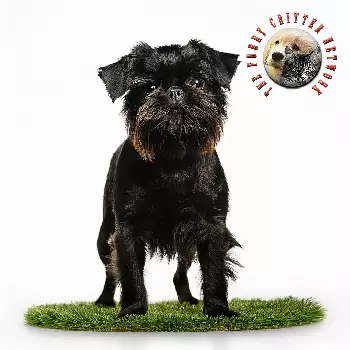
The head is where the Griff's personality lives, and it is the feature that most people remember long after their first encounter with the breed. The skull is large and round with a prominent forehead that domes over wide-set, large dark eyes. Those eyes are the breed's most arresting feature. They are black, round, and set well apart, giving the face an expression that people consistently describe as almost human. The combination of the domed skull, large eyes, and very short, turned-up nose creates a face that communicates curiosity, intelligence, and a certain theatrical seriousness that is entirely the Griff's own.

The muzzle is extremely short with an undershot bite, meaning the lower jaw extends slightly beyond the upper jaw. The jaw is broad and prominent, contributing to the distinctive profile. In rough-coated individuals, the beard and mustache frame the face with wiry hair that adds visual weight and emphasizes the already substantial jaw structure. Smooth-coated Griffs lack these furnishings, giving the face a cleaner, more streamlined appearance while retaining the same underlying structure.

Ears may be cropped or natural. Cropped ears are pointed and stand erect, while natural ears are small, set high, and fold forward in a semi-erect position. The trend in most countries has moved firmly toward natural ears, and many breeders no longer crop. The neck is medium length and arched slightly, flowing into well-laid shoulders that support surprisingly free and purposeful movement for a dog this size.

The tail is set high and carried upward. When docked, it is shortened to about one-third its natural length. When left natural, it curves upward and over the back without forming a tight curl. Legs are straight, medium-boned, and set well under the body, supporting a gait that is free and purposeful with good reach and drive. The Griff moves with more authority than most toy breeds, covering ground efficiently rather than mincing or prancing.

Coat texture differs substantially between the two varieties and affects the dog's overall visual impression. The rough coat is dense, wiry, and stands somewhat off the body, requiring hand-stripping for show presentation and giving the dog a charmingly disheveled look between grooming sessions. The smooth coat lies flat, is short and glossy, and gives the dog a sleeker, more refined silhouette. Both varieties come in the same color palette, though the visual impact of the colors differs somewhat between the two coat textures. Red is perhaps the most iconic color, ranging from a warm reddish-brown to a brighter, clearer red that catches the light beautifully. Belge is a distinctive mix of reddish-brown and black hairs, typically accompanied by a black mask and darker facial furnishings in rough-coated dogs. Black and tan features a solid black body with rich tan markings on the legs, chest, and face. Solid black rounds out the accepted palette and gives the breed a particularly striking appearance in the rough coat variety where the dark wiry texture and beard create a look of serious intensity.

Despite their small size, Griffs carry themselves with a posture and confidence that draws attention. The head is carried high, the gait is purposeful, and the overall bearing communicates a dog that is completely unaware of how small it actually is. This combination of compact build, expressive face, and self-assured carriage is what makes the Griff so memorable on first meeting and so addictive to the people who choose to live with one.

Affectionate With Family
The Griff attaches to its people with a fierce devotion that belies its small size. These dogs want physical closeness constantly and will seek out laps, shoulders, and any available warm spot near their favorite person.
Good With Young Children
Their small size and sensitive temperament make Griffs a poor match for households with very young children. Rough handling or sudden movements can injure these little dogs or trigger defensive snapping.
Good With Other Dogs
Most Griffs get along well with other dogs, particularly those of similar size and energy level. They can be surprisingly bold around larger dogs, sometimes to their own detriment.
Shedding Level
Rough-coated Griffs shed very little thanks to their wiry texture. Smooth-coated individuals shed moderately but still less than many toy breeds with softer coats.
Coat Grooming Frequency
Rough coats need regular brushing and periodic hand-stripping to maintain proper texture. Smooth coats are lower maintenance but still benefit from weekly brushing to manage shedding.
Drooling Level
Not a drooler. The breed's brachycephalic face structure occasionally leads to some moisture around the mouth, but actual drooling is not a characteristic of the Griff.
Coat Type
Two distinct coat varieties exist. The rough coat is dense and wiry with a distinctive beard and longer facial furnishings. The smooth coat lies flat against the body with a glossy texture.
Openness To Strangers
Griffs often take a moment to assess new people before warming up. Some are immediately friendly while others maintain a dignified reserve until they decide the newcomer is acceptable.
Playfulness Level
Playful and spirited in short bursts, the Griff enjoys interactive games with its people. They have a mischievous streak and will invent games on their own if you do not provide them.
Watchdog/Protective Nature
Alert and vocal about unusual activity, the Griff takes its watchdog duties seriously. They will announce visitors and unfamiliar sounds with a bark that carries more authority than their size suggests.
Adaptability Level
Their small size and moderate exercise needs make Griffs adaptable to apartments, condos, and smaller living spaces. They travel well and adjust to new environments as long as their person is present.
Trainability Level
Intelligent but sensitive, the Griff learns well with patient, positive methods. They can be stubborn when they feel pressured and will shut down if training becomes harsh or repetitive.

Griff History & Development

The Griff nickname is a modern creation, born from the practical habit of shortening a breed name that is both long and sometimes confusing to spell. But the breed behind the nickname has a history that stretches back several centuries in the streets and stables of Brussels, Belgium, where these little dogs earned their keep as ratters long before anyone thought of putting them on a silk pillow.

The Brussels Griffon's ancestors were small, rough-coated dogs kept by Belgian coachmen and stable workers to control the rat population in horse-drawn cab stables during the seventeenth and eighteenth centuries. These working terrier types, generally called Griffons d'Ecurie (stable griffons), were valued purely for their ratting ability and their willingness to work in tight spaces. They were not bred for looks or companionship. They were bred to kill rats, and they were apparently very good at it.

The transformation from working ratter to parlor companion began in the nineteenth century when Belgian breeders started crossing the stable griffons with imported toy breeds. The Pug played a significant role in this transformation, contributing the short face, domed skull, and smooth coat variety that became the Petit Brabancon. The English Toy Spaniel (King Charles Spaniel) is also believed to have influenced the breed, particularly the red coloring and the large, expressive eyes. The Yorkshire Terrier may have contributed to the rough coat texture. Through these crosses, the breed gradually shifted from a functional vermin hunter to an ornamental companion while retaining enough of its original terrier spirit to remain a dog with genuine personality rather than just a decorative accessory.

The breed gained aristocratic patronage in the late 1800s when Queen Marie Henriette of Belgium took a keen interest in Brussels Griffons and began breeding them at the royal kennels. Her involvement elevated the breed's profile dramatically, attracting attention from wealthy Europeans and eventually from the international dog show circuit. The first Brussels Griffons arrived in England and America around this time, and the breed was recognized by the AKC in 1910.

World Wars I and II devastated the breed in its home country. Belgium's geographic position at the center of both conflicts meant that dog breeding was a low priority during wartime, and the Brussels Griffon population declined sharply. Post-war recovery relied heavily on breeding stock that had been exported to England before the wars, and the breed's survival is often credited to English breeders who maintained quality dogs through both conflicts. The Griff nickname emerged most strongly in American and English-speaking breed communities during the post-war recovery period, as the breed rebuilt its numbers and its devoted following among toy dog enthusiasts who appreciated its combination of personality, portability, and unmistakable face.

Griff Temperament & Personality

The Griff is a dog that thinks it is the most important creature in any room it enters, and honestly, it is hard to argue when you see how completely it commands the attention of everyone around it. This breed has a presence that has nothing to do with size and everything to do with personality. They are alert, opinionated, emotionally expressive, and absolutely convinced that their human exists primarily to serve their needs. It sounds exhausting, and sometimes it is, but the flip side of all that self-importance is a dog that pours affection and loyalty into its primary relationship with an intensity that larger, more reserved breeds rarely match.

The bonding pattern in Griffs tends to be intense and focused. Most will pick a favorite person and orient their entire emotional world around that individual. They want to be in the same room, preferably in the same chair, and ideally in physical contact at all times. This is not a breed that does well being left alone for long stretches. Separation can produce genuine anxiety that manifests as barking, destructive chewing, or refusal to eat. Owners who work long hours away from home need to plan for companionship, whether through a second pet, a pet sitter, or a schedule that limits the dog's time alone.

The breed's terrier heritage shows up in ways that surprise people who expect a passive lapdog. Griffs are curious, investigative, and surprisingly bold for their size. They will bark at unfamiliar sounds with genuine conviction, investigate new objects with determination, and stand their ground with dogs many times their size if they feel the situation demands it. This boldness is part of their charm, but it also means they need owners who understand that a ten-pound dog standing up to a seventy-pound dog is not brave. It is a safety hazard that requires management.

Sensitivity is a defining feature of the breed's emotional landscape. Griffs read their owners with remarkable accuracy and respond visibly to shifts in mood, tone of voice, and household tension. A harsh correction that might roll off the back of a terrier or working breed can devastate a Griff for hours. They do not sulk passively either. They communicate their displeasure through body language, facial expression, and sometimes vocal commentary that leaves no doubt about how they feel. Training and daily interactions work best when you respect this sensitivity and work with it rather than against it.

With other pets, the Griff generally coexists well, particularly with dogs of similar size and energy level. They can live happily with cats and are not typically prey-driven toward small animals. The main social concern is their tendency to throw their weight around with larger dogs, which requires supervision until you are confident that the dynamic is safe for everyone involved.

Griff Family Life & Living Requirements

The Griff fits into a specific kind of household better than others, and being honest about that match saves both the dog and the family a lot of frustration. The ideal Griff home is calm, attentive, and willing to accommodate a dog that needs more emotional engagement than its small size might suggest. These dogs do not just want a place to sleep and a bowl of food. They want to be woven into the fabric of daily life, present for meals, included in evenings on the couch, and acknowledged as a full participant in whatever the household is doing.

With children, the Griff requires careful consideration. These are not durable dogs physically. At eight to ten pounds, they can be seriously injured by accidental rough handling, and their sensitive temperament means they do not tolerate the unpredictable behavior of very young children well. Households with older children who understand how to interact gently with a small dog can work beautifully. The Griff will often develop a special bond with a child who treats it with respect, becoming a loyal shadow and confidant. But toddlers and preschoolers who grab, squeeze, or fall on dogs are a genuine risk to a Griff's physical safety and emotional well-being.

One of the breed's genuine advantages for modern households is its adaptability to smaller living spaces. The Griff does not need a large yard or a house in the suburbs. These dogs thrive in apartments and condos provided they get their daily walks and have indoor space to play and explore. They travel well in carriers, adapt to new environments relatively quickly as long as their person is present, and their exercise needs are manageable for people whose lifestyles do not include daily five-mile runs.

The breed does best in homes where someone is present for most of the day. Whether that means a work-from-home situation, a retired owner, or a household where schedules overlap so the dog is rarely alone for more than a few hours, the key is minimizing isolation. Griffs that spend their days alone frequently develop behavioral problems rooted in anxiety, and those problems are much easier to prevent than to fix. A second pet can help, particularly another small dog that the Griff bonds with, but it does not fully replace human companionship for a breed that craves it this strongly.

Griff Training & Exercise Needs

Training a Griff requires patience, a light touch, and the willingness to accept that this breed will cooperate enthusiastically when it sees the point and politely ignore you when it does not. They are intelligent dogs that learn quickly, but their sensitivity means the training approach matters as much as the content. Positive reinforcement, delivered with warm verbal praise, small treats, and genuine enthusiasm, is the currency that works. Harsh corrections, raised voices, or physical handling produce a dog that shuts down, hides, or refuses to engage at all. Once a Griff decides that training is stressful, rebuilding its confidence takes considerably more effort than getting it right the first time.

Short training sessions of five to ten minutes work best. The Griff's attention span for structured learning is real but limited, and pushing past the point where the dog is engaged turns productive training into frustrating repetition for both of you. End every session with something the dog does well so the experience closes on a positive note. Come back to challenging exercises later with fresh energy rather than drilling them in a single marathon session.

Housetraining can be a particular challenge with Griffs and with toy breeds in general. Their small bladders mean more frequent trips outside, and their sensitivity to weather means some individuals will flatly refuse to go out in rain, cold, or wind. Consistency, patience, and a designated indoor option like pee pads can bridge the gap while the dog builds reliability. Expect the process to take longer than it might with a larger breed and plan accordingly.

Exercise needs are modest and manageable. A daily walk of twenty to thirty minutes combined with some indoor play satisfies most Griffs. They enjoy exploring on walks and are more engaged by variety in their route than by distance. Short play sessions with toys, gentle tug games, and interactive puzzles provide mental stimulation that keeps the breed's active mind occupied. Despite their small size, they have enough stamina for longer outings if you want to bring them along on moderate hikes or extended walks, though they should not be expected to keep pace with athletic breeds over long distances.

Socialization during puppyhood is particularly important for the Griff because the breed's natural sensitivity can tip into fearfulness if it does not encounter a wide range of people, environments, and situations during the critical development period. Puppy classes, visits to friend's homes, exposure to different surfaces and sounds, and positive interactions with calm, friendly dogs all build the confidence that produces a well-adjusted adult.

Griff Health Concerns

The Griff's health profile reflects its brachycephalic structure and small-breed status, with a few conditions that deserve particular attention from owners and breeders. Understanding what to watch for helps you partner effectively with your veterinarian rather than relying on generic small-dog advice that may not address breed-specific risks.

Brachycephalic airway syndrome is an inherent concern for any short-muzzled breed. The compressed facial structure can lead to narrowed nostrils, an elongated soft palate, and other structural changes that compromise breathing efficiency. Symptoms range from mild snoring and noisy breathing to exercise intolerance and heat sensitivity. Avoiding strenuous exercise in hot or humid conditions, maintaining a healthy weight, and working with a veterinarian experienced with brachycephalic breeds helps manage the condition effectively. Dental crowding is also common due to the shortened jaw, making regular dental care particularly important.

Common Health Issues

  • Patellar luxation - The kneecap slips out of its normal position in the groove of the femur, causing intermittent or persistent lameness. This is one of the most prevalent orthopedic conditions in the Brussels Griffon and ranges from mild (self-correcting) to severe (requiring surgical correction).
  • Syringomyelia - Fluid-filled cavities develop within the spinal cord, often associated with Chiari-like malformation. Symptoms include phantom scratching, neck pain, and in severe cases neurological deficits. MRI is the definitive diagnostic tool.
  • Progressive retinal atrophy - A group of inherited conditions causing gradual retinal degeneration and progressive vision loss. Dogs typically show difficulty in low light before more obvious visual impairment develops.
  • Cataracts - Cloudiness of the eye lens that can impair vision, documented in Brussels Griffons in both congenital and adult-onset forms. Surgical removal is successful in the majority of cases when retinal health is confirmed.
  • Brachycephalic airway syndrome - Structural compromise of the airways due to the breed's shortened muzzle, potentially including narrowed nostrils and elongated soft palate. Severity ranges from mild snoring to exercise intolerance and heat sensitivity.

Preventive Care & Health Monitoring

  • OFA patella evaluation is a required CHIC test for Brussels Griffons and screens for patellar luxation - One of the most common orthopedic conditions in the breed. Evaluation should be performed at minimum one year of age.
  • Eye examination by a board-certified ACVO veterinary ophthalmologist is the second required CHIC test and screens for progressive retinal atrophy - Cataracts, and other heritable ocular conditions.
  • ERG (electroretinogram) testing specifically for progressive retinal atrophy is recommended as optional screening beyond the standard eye examination to detect retinal changes before clinical signs become apparent. - ERG (electroretinogram) testing specifically for progressive retinal atrophy is recommended as optional screening beyond the standard eye examination to detect retinal changes before clinical signs become apparent.
  • MRI screening for syringomyelia and Chiari-like malformation is listed as an optional CHIC test and is particularly recommended for breeding stock given the condition's prevalence and its impact on quality of life. - MRI screening for syringomyelia and Chiari-like malformation is listed as an optional CHIC test and is particularly recommended for breeding stock given the condition's prevalence and its impact on quality of life.
  • Regular dental evaluations and professional cleanings are essential due to the breed's dental crowding from its shortened jaw - Which accelerates tartar buildup and increases susceptibility to periodontal disease.

Griff Grooming & Maintenance

Grooming a Griff depends heavily on which coat variety you have, because the two types require genuinely different approaches. The rough coat is the higher-maintenance option and the one that gives the breed its signature look. That wiry, tousled texture with the distinctive beard and facial furnishings needs regular brushing two to three times per week to prevent matting, particularly around the face, behind the ears, and under the legs where friction tangles the hair. For show dogs, hand-stripping (pulling out dead outer coat by hand or with a stripping knife) maintains proper coat texture and color. Pet owners who are not showing their Griff often opt for clipping instead, which is faster and more comfortable for the dog but changes the coat texture over time, making it softer and less wiry than the breed standard describes.

Smooth-coated Griffs are considerably easier to maintain. A weekly brushing with a soft bristle brush or rubber grooming mitt removes loose hair and keeps the coat's glossy appearance. They shed more than their rough-coated counterparts, but the volume is modest by any standard. Bathing either coat variety every four to six weeks is generally sufficient, using a mild dog shampoo and thorough rinsing to prevent skin irritation.

Facial care is a daily commitment regardless of coat type. The Griff's prominent eyes and compressed facial structure create skin folds that trap moisture and debris. Wiping the face daily with a soft damp cloth, paying particular attention to the folds beneath the eyes, prevents the buildup that can lead to irritation or infection. The eyes themselves should be monitored for excessive tearing, discharge, or redness that could indicate an emerging problem, given the breed's susceptibility to several ocular conditions.

Dental care deserves extra attention in this breed. The shortened jaw creates crowding that makes Griffs more susceptible to tartar accumulation, gum disease, and tooth decay than breeds with longer muzzles. Regular brushing with a dog-appropriate toothbrush and enzymatic toothpaste is the best preventive measure, supplemented by annual professional dental cleanings. Many Griff owners find that dental health becomes one of the most important ongoing maintenance tasks as the dog ages.

Nail trimming should happen every two to three weeks, as these small dogs typically do not wear down their nails naturally through activity alone. Ear cleaning on a weekly basis keeps the ear canals healthy, and checking for any signs of infection or unusual odor should be part of your routine.