Eurasian Dog

Eurasier

Quick Facts

🐕 Breed Group
Non-Sporting Group
📏 Size Category
Medium
📏 Height
Males: 20-24 inches, Females: 19-22 inches
⚖️ Weight
Males: 51-71 pounds, Females: 40-57 pounds
⏱️ Life Expectancy
12-16 years
🧣 Coat Type
Dense double coat, medium-long guard hair, thick undercoat
🎨 Coat Colors
Fawn, red, wolf-grey, black, black and tan; white patches and pure white are not permitted
😀 Temperament
Calm, devoted, reserved with strangers, family-oriented
🏃 Exercise Needs
Moderate
🎓 Training Difficulty
Moderate
👶 Good with Children
Yes, especially with family children
🐾 Good with Other Pets
Generally good

Other Names & Breed Recognition

Eurasian Dog is the descriptive long form of the breed name used in contexts where the one-word form Eurasian might be ambiguous or where writers and translators have added the word "dog" for clarity. You will encounter this form in older breed encyclopedias, international dog guides, some translated German and Swiss breed literature, and in online searches by people who know the breed exists but are not yet certain of its formal name. It is a name that makes immediate sense once you understand the breed's origin: the Eurasian Dog is literally a dog bred from a deliberate combination of European and Asian spitz breeds, and the name announces exactly that.

The formal registered name is Eurasier under the FCI, which recognized the breed in 1973. The United Kennel Club uses the spelling Eurasian as its official registered name since the breed's UKC recognition in 1996. The American Kennel Club carries the breed in its Foundation Stock Service under the name Eurasier. The Canadian Kennel Club and The Kennel Club in Britain also use Eurasier as their registered spelling. Across these variations, Eurasian Dog sits as the informal but recognizable descriptive name that searchers and readers encounter most often in general reference contexts rather than registry-specific ones.

Other names that appear in breed history include Wolf-Chow, the working name used during the breed's early development phase between 1960 and approximately 1972, before the Samoyed was incorporated and the breed was formally renamed. That name reflected the initial Chow Chow and Wolfspitz cross that Julius Wipfel began with. Once the Samoyed contribution was established and the breed's tripartite heritage was settled, the Wolf-Chow name was retired and the geographically descriptive Eurasier name was adopted for FCI recognition.

In the United States the breed remains rare. The United States Eurasier Club reports approximately 450 Eurasian Dogs on the entire North American continent, a number that reflects both the breed's recency in America and the deliberate selectivity of its breeding community. The breed's rarity makes careful buyer research especially important - with few breeders available, distinguishing responsible health-testing breeders from those who are not is critical for anyone seriously pursuing this dog.

Eurasian Dog Organizations & Standards

The Eurasian Dog's governance traces back to Germany, where the Verein fur Deutsche Spitze oversees the German spitz breeds including the Eurasier under the FCI framework. The FCI standard is the foundational document that defines the breed internationally, covering physical structure, temperament description, color requirements, size ranges, and disqualifying faults. The standard has been stable since the breed's FCI recognition in 1973 and is the reference point for breed judges and breeders across all FCI-member countries.

In the United States, the United States Eurasier Club is the national breed organization. The USEC has established a health testing protocol that is among the more comprehensive required by any breed club for a dog of this size and type. Before breeding, a Eurasian Dog must have OFA hip evaluation or PennHIP completed, OFA elbow evaluation, OFA patellar evaluation from one year of age or older, a full thyroid panel with TgAA antibody measurement within one year of breeding, and CAER eye certification from a board-certified ACVO ophthalmologist. All five of these tests address conditions that are specifically documented in the breed rather than being generic requirements applied without breed-specific rationale.

The FCI standard specifies that the Eurasian Dog should be medium-sized, balanced, and well-constructed, with a wedge-shaped head, prick ears, a dense double coat, and a tail that curls over the back. Males stand 52 to 60 centimeters and weigh 23 to 32 kilograms; females stand 48 to 56 centimeters and weigh 18 to 26 kilograms. All coat colors are acceptable except pure white, white patches on an otherwise pigmented coat, and liver coloring, which are disqualifying faults. The temperament description in the FCI standard is unusually specific for a breed document - it calls for the dog to be watchful and alert toward strangers without aggression or timidity, and strongly bonded to its family with the need for constant family contact to develop properly.

The Eurasier Society UK and the Eurasier Club of Canada serve their respective national communities with similar health-focused frameworks. The Kennel Club in Britain places the breed in the Utility Group and coordinates health scheme participation for UK-based Eurasian Dog breeders. The broad international structure means that a buyer in North America can research breeding lines from Germany, Switzerland, the Netherlands, and other established European programs when evaluating the health history and pedigree of a potential puppy.

When verifying a breeder's health testing claims, the OFA database at ofa.org allows any member of the public to search by breed or by individual dog name. A responsible Eurasian Dog breeder will be able to give you their dogs' registered names and direct you to their OFA records without hesitation. Current thyroid, hip, elbow, patellar, and eye results visible in that database confirm that a breeder is operating in line with the standards the breed community has established.

Kennel Club Recognition

  • United Kennel Club (UKC): Recognized, Northern Breeds
  • Canadian Kennel Club (CKC): Recognized, Non-Sporting Group
  • FCI: Recognized, Group 5 - Spitz and Primitive Types
  • The Kennel Club (UK): Recognized, Utility Group

Eurasian Dog Physical Description

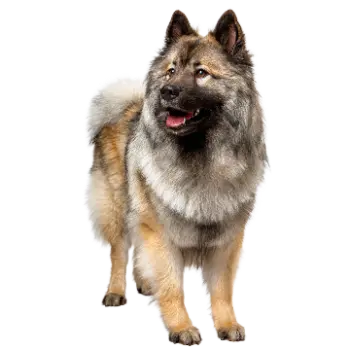
The Eurasian Dog presents as a naturally balanced, medium-sized spitz - substantial enough to have physical presence in a household without being a large breed, and proportioned in a way that reflects sensible construction rather than any exaggerated feature. Its three founding breeds left visible but harmonized contributions. The Chow Chow's substance and coat density, the Wolfspitz's clean wedge head and prick ears, and the Samoyed's slightly lighter build and open expression combine into a dog that does not closely resemble any one of its ancestors.

The head is the first thing most people notice. It is clearly spitz in type - a moderately broad, clean-planed skull that tapers to a moderately pointed muzzle, with a stop that is defined but not abrupt. The muzzle is of medium length, the lips tight and dry. The nose is black in most color varieties, or self-colored in some lighter-coated dogs. The eyes are medium-sized, oval to almond in shape, dark brown, and set to look forward. The expression they carry is the breed's most characteristic feature: calm, attentive, and intelligent, with none of the hard or suspicious quality you sometimes see in spitz types that have been bred heavily for guarding function. The ears are medium-sized triangles, erect, covered with short close hair, and carried slightly forward - the posture that gives the dog its alert, interested aspect.

The neck is moderately long and muscular, connecting cleanly to well-laid-back shoulders. The back is level and firm. The chest is moderately broad and reaches to the elbow. The body is compact - slightly longer than tall but not noticeably so - with a defined tuck-up at the flank that keeps the outline from looking heavy. The tail is set high, covered in dense bushy hair, and curled over the back in the classic spitz position. Both the curl and the way the tail is carried are breed hallmarks.

The legs are straight and well-boned, the feet round, compact, and tight-toed. The overall structure should convey moderate angulation - enough to produce effortless, ground-covering movement, but not the extreme angles that create structural problems over time. When the Eurasian Dog moves, it should track straight with a level topline, reach forward cleanly with the front, and drive from the hindquarters without any rocking, rolling, or paddling.

Coat texture and distribution follow the typical double-coated northern breed pattern, with regional variation across the body. The face, ears, and fronts of the legs carry short, smooth hair. The neck, back of the legs, and tail carry the longer, loosely lying guard coat. The overall effect is a dog that looks plush and well-coated without looking overly groomed or artificially presented. Color may be fawn, red, wolf-grey, solid black, or black and tan. Some Eurasian Dogs inherit the blue-black or spotted tongue from their Chow Chow ancestry, which is an expected breed feature.

Body condition is worth assessing with hands rather than eyes in any heavily coated dog. The dense coat of the Eurasian Dog conceals weight changes more effectively than most people expect. A dog at ideal weight will have ribs that are easily felt without pressing through fat, and a visible waist when viewed from above. Maintaining appropriate weight reduces stress on joints that are already subject to documented orthopedic concerns in the breed.

The overall size and moderate construction of the Eurasian Dog make it a practical household companion in a way that very large breeds or heavily built breeds are not. It does not require special furniture, reinforced leashes, or an oversize vehicle. Its physical profile is that of a well-made medium dog that lives sensibly in the spaces and routines of an ordinary household.

Affectionate With Family
The Eurasian Dog wraps its full affection around the household it belongs to, showing that bond through steadfast proximity and quiet attentiveness. It does not love at a distance.
Good With Young Children
Patient and gentle with children in the family, the Eurasian Dog is a calm presence that tolerates the energy of kids without becoming reactive. Its medium size is a practical fit for family life.
Good With Other Dogs
The Eurasian Dog is not dog-aggressive and lives comfortably alongside other dogs in the household. Its low prey drive extends to peaceful coexistence with cats and smaller animals as well.
Shedding Level
Year-round shedding is part of life with a Eurasian Dog, with two heavy seasonal coat blows added on top. Regular brushing is the practical answer.
Coat Grooming Frequency
Weekly brushing handles the Eurasian Dog coat well between seasonal sheds. The coat is relatively self-maintaining outside of those twice-yearly blows.
Drooling Level
The Eurasian Dog does not drool. Its tight spitz lips and dry mouth are a clean-living bonus for owners who find drooling unpleasant.
Coat Type
A dense, weather-resistant double coat with medium-long guard hair and a thick soft undercoat. Longer at the neck and rear of the legs, giving the dog a plush and balanced silhouette.
Openness To Strangers
The Eurasian Dog takes its time with unfamiliar people. It is not hostile, but it reserves its warmth and trust for those it has chosen to accept. Early socialization shapes how smoothly this goes.
Playfulness Level
Outdoors, the Eurasian Dog is lively and engaged. Indoors, it is calm and settled. The contrast is consistent and one of the qualities owners find most appealing about the breed.
Watchdog/Protective Nature
Alert and observant, the Eurasian Dog will notify its family of unusual activity or arrivals. It is not aggressive or reactive - it is watchful in a composed, confident way.
Adaptability Level
The Eurasian Dog fits varied living situations when its companionship needs are met. Isolation is the one condition it cannot adapt to - this dog needs its people present.
Trainability Level
Smart and willing but independently minded, the Eurasian Dog trains best through patience and positive reinforcement. It responds to a handler who earns its cooperation rather than demands it.

Eurasian Dog History & Development

The Eurasian Dog is one of the few breeds whose creation can be traced to a specific person, a specific place, and a specific year. Julius Wipfel began his breeding program in Germany in 1960, working with a small group of collaborators including Charlotte Baldamus. His stated goal was to create a new companion breed that combined the best qualities of the Chow Chow and the Wolfspitz - the German name for the Keeshond - while producing a dog that was more consistently people-oriented than either founding breed on its own.

The Chow Chow contributed substance, a dense and weather-resistant coat, and a dignified independence. The Wolfspitz contributed the clean spitz structure, the wedge-shaped head, the prick ears, and somewhat more responsiveness to its owners than the Chow. The initial crosses produced dogs that showed promise in both conformation and temperament, and this first generation was called the Wolf-Chow. Wipfel found the Wolf-Chow type compelling but felt the temperament still lacked the reliably gentle, family-oriented quality he was working toward.

In 1972, a Samoyed male was introduced to the breeding program. The Samoyed's lighter build, his open and friendly expression with family members, and his history as a close human companion in Siberian communities addressed the temperament gap in the Wolf-Chow and added a lightness of spirit that the heavier founding breeds had not fully provided. With the Samoyed contribution incorporated and the breed able to reproduce itself consistently, the name was changed. The new name honored the breed's dual continental heritage: European spitz on one side, Asian spitz ancestry on the other. The word Eurasian captured both.

The FCI formally recognized the breed as the Eurasier in 1973, less than fifteen years after Wipfel began his first crosses. That speed of recognition reflects how thoroughly and systematically the breed was developed. The German Kennel Club ratified the recognition simultaneously. Within a decade the breed had spread from Germany through neighboring European countries and eventually reached Japan, where the breed found a particularly appreciative following.

North American interest developed more slowly. The United Kennel Club recognized the breed as the Eurasian in 1996, and the United States Eurasier Club was established to steward the breed's development in America and work toward eventual full AKC recognition. The breed's small North American population - approximately 150 dogs in the United States as of recent estimates - means that buyers may encounter the name Eurasian Dog in general reference sources long before they find a breeder with a litter available. That rarity is part of the breed's identity in America, and it makes the health testing standards maintained by the USEC all the more significant for each puppy produced.

The breed's popularity in Japan is a notable part of its international story. Japanese dog culture has a strong affinity for spitz-type breeds, and the Eurasian Dog's combination of calm temperament, striking appearance, and manageable size found an appreciative audience there. Japan has maintained an active Eurasian breeding program and population that has contributed to the breed's gene pool and international development alongside European lines.

Eurasian Dog Temperament & Personality

The Eurasian Dog was designed from its first generation to live fully inside family life, and that design shows clearly in its temperament. This is a dog that attaches itself to its household in a way that goes deeper than simple fondness - it needs to be part of the daily fabric of family existence, present for the routine, included in the comings and goings, close enough to monitor what the people it loves are doing. That attachment is the Eurasian Dog's defining behavioral characteristic, and everything else about its personality flows from it.

Calm is the word most consistently used to describe the Eurasian Dog indoors. It settles naturally, does not manufacture drama or demand attention through barking or destructive behavior when its needs are met, and fits into a household routine without creating turbulence. That indoor calm contrasts noticeably with its outdoor energy - take the same dog out for a walk or a hike and it brightens, engages, and moves with genuine enthusiasm. The indoor-outdoor distinction is a consistent breed characteristic and one that owners find appealing.

With strangers, the reserve is real and should not be dismissed or forced through. The Eurasian Dog is not suspicious or aggressive toward people it does not know - it simply has no automatic impulse to welcome them. An unfamiliar person who pushes to interact with an Eurasian Dog before the dog has signaled readiness will be met with a deliberate withdrawal rather than an attack, but that withdrawal is a clear communication that should be respected. Allowing the dog to approach on its own schedule, with patient and non-demanding visitors, consistently produces acceptance. Forcing interaction produces anxiety that lingers.

Positive early socialization matters significantly for the Eurasian Dog. A puppy exposed consistently to varied people, environments, sounds, and situations during the critical developmental window develops into an adult dog whose reserve is dignified and manageable rather than problematic. A puppy that misses that window may become an adult whose wariness toward strangers is anxiety rather than self-possession - a meaningful difference for a dog that will encounter the world for twelve to sixteen years.

The Eurasian Dog's sensitivity to its family's emotional state is high. Household tension, harsh voices, and inconsistent handling are all registered and responded to. This is a dog that thrives in a calm, stable household and becomes quietly stressed in a chaotic or volatile one. That sensitivity is not a flaw - it is the companion attentiveness that Julius Wipfel was aiming for - but it means the Eurasian Dog is not a good fit for homes where conflict is frequent or management is inconsistent.

The Eurasian Dog is notably quiet compared to other spitz breeds. It does not bark at every passing car or demand attention through vocalization. When it does bark, the signal means something real. That quiet confidence is practical in shared living situations and is one of the qualities that experienced owners cite consistently when asked why they chose this breed.

Eurasian Dog Family Life & Living Requirements

The Eurasian Dog fits comfortably into most household types and sizes, from houses with yards to well-managed apartment situations, as long as its companionship requirements are consistently honored. This is not a breed that can be maintained in a kennel, left in a yard, or managed through long daily separations from the people it has bonded to. Those constraints are not preferences - they are structural requirements of the breed's temperament, documented by the breed's own founding philosophy and reinforced by every national Eurasian Dog organization.

Family life with children is generally positive when the children are part of the household. The Eurasian Dog's patience and calm temperament make it a sensible companion for kids who have been taught how to interact with dogs appropriately. The reserve it shows toward unfamiliar people extends to unfamiliar children as well, meaning that children who arrive as guests need the same respectful approach - let the dog come to them - that adults do. Within the family circle the Eurasian Dog is typically tolerant, gentle, and genuinely fond of the children it grows up with.

Other pets fare well with a properly socialized Eurasian Dog. The breed's documented low prey drive means that cats and smaller animals that have been introduced thoughtfully are generally accepted without territorial behavior. Multiple-dog households that include a Eurasian Dog often work smoothly, particularly when the other dogs share the Eurasian Dog's calm disposition rather than being highly reactive or dominant breeds that create ongoing tension.

The household schedule matters more for the Eurasian Dog than for breeds that tolerate solitude better. A home where someone is present for most of the day - whether a stay-at-home partner, a remote worker, or a retiree - gives the Eurasian Dog the consistent human presence it genuinely needs. For households where long daily absences are unavoidable, honest planning before the dog comes home - dog walkers, daycare, or a second compatible dog - prevents the anxiety and depression that chronic isolation causes in this particular breed.

The Eurasian Dog's low prey drive and generally calm, non-reactive nature make it a genuinely adaptable housemate for a multi-pet household when introductions are handled thoughtfully. It is not a breed that needs to be the only animal in the home, and many Eurasian Dogs thrive with the steady companionship of another dog, particularly one with a similarly settled and non-reactive temperament.

Eurasian Dog Training & Exercise Needs

The Eurasian Dog is intelligent in a practical, observational way - it reads its environment carefully, learns routines quickly, and figures out what its owner wants with relatively little repetition. The challenge in training is not the dog's comprehension but its willingness to comply on demand. The Eurasian Dog has a streak of independence inherited from its Chow Chow ancestry that means it reserves the right to decide whether a given request is worth acting on. Handlers who work with this quality rather than against it - using motivation, timing, and consistency - get a cooperative and genuinely pleasant training partner.

Food motivation is strong in most Eurasian Dogs, which is a useful training asset. A high-value treat delivered with good timing communicates to this dog exactly what you want clearly and pleasantly. Keeping sessions short - ten to fifteen minutes - prevents the disengagement that comes when the dog decides it has had enough. Varying what you ask for keeps the dog's attention from drifting. Ending each session while the dog is still engaged rather than waiting for it to check out produces a dog that approaches the next session with interest rather than reluctance.

Moderate daily exercise is genuinely sufficient for the Eurasian Dog. An hour of activity split across one or two outings - walks, free running in a safe fenced area, or hiking with the family - keeps an adult Eurasian Dog physically satisfied and behaviorally balanced. The breed does not require the intensive athletic commitment of herding dogs or working sporting breeds. It will match the pace of an active owner, but it will also be contented with a more moderate routine. Mental stimulation through nose work, puzzle feeders, and varied training content complements physical exercise and contributes to the settled quality that makes the Eurasian Dog such a practical companion.

Socialization is the training priority that matters most during the puppy stage, more than any specific command or skill. A Eurasian Dog puppy that is systematically exposed to varied people, sounds, surfaces, environments, and situations during the first four months of life develops the confident foundation that makes its adult reserve manageable and appropriate rather than limiting. Skipping this investment during puppyhood is much harder to remediate in adulthood.

The Eurasian Dog responds well to a handler who reads the dog's engagement level and adjusts accordingly - backing off when the dog signals saturation, capitalizing on moments of focus, and keeping expectations proportional to the training stage. A dog that is trained at its own pace rather than pushed to perform on a rigid timeline builds the kind of reliable foundation that lasts.

Eurasian Dog Health Concerns

The Eurasian Dog is a genuinely healthy breed across its typical 12 to 16 year lifespan, but it carries several specific health vulnerabilities that the breed community has identified, tracked, and built testing requirements around. Understanding these conditions is a practical step for any prospective buyer.

The Eurasian Dog's 12 to 16 year lifespan rewards the investment in health-tested lines. Buyers who verify OFA records before committing to a puppy are making a decision that pays dividends across a decade and a half of life with this dog.

Common Health Issues

  • Autoimmune thyroiditis: The most prevalent condition in the breed, affecting 15-18% of Eurasian Dogs. The immune system progressively destroys thyroid tissue, resulting in hypothyroidism with symptoms of weight gain, lethargy, and coat changes. Managed with daily oral medication - Dogs live normal lifespans with treatment.
  • Patellar luxation: The kneecap dislocates from the femoral groove - Causing intermittent or persistent lameness. The most common skeletal condition in OFA evaluations of the breed at 7.6% abnormal results. OFA patellar evaluation from one year of age is required by the USEC.
  • Hip dysplasia: Abnormal hip joint development creating laxity - Pain, and eventual degenerative joint disease. Present in approximately 3.2% of OFA-evaluated Eurasian Dogs. OFA or PennHIP evaluation is required by the USEC before breeding.
  • Elbow dysplasia: Abnormal elbow joint development causing progressive arthritis and lameness - OFA elbow evaluation is a required USEC health test for breeding Eurasian Dogs.
  • Distichiasis: Extra eyelashes growing from abnormal sites on the eyelid - Potentially irritating the cornea and causing redness, tearing, and pain. Assessed during CAER ophthalmology examination, which is a required USEC health test.
  • Entropion and ectropion: Eyelid abnormalities where the lid rolls inward or outward - Causing varying degrees of ocular damage. Surgical correction is available for significant cases. Screened through CAER eye examination.
  • Exocrine pancreatic insufficiency - EPI, : Inadequate production of digestive enzymes by the pancreas, causing maldigestion and weight loss despite adequate food intake. Not common but documented in the breed.

Preventive Care & Health Monitoring

  • Thyroid panel with TgAA antibody levels: Required by the USEC within one year of breeding. OFA recommends repeat testing at ages 1 - 2, 3, 4, 6, and 8 years for breeding dogs. Identifies autoimmune thyroiditis before clinical hypothyroidism develops.
  • OFA hip evaluation at 24 months or PennHIP from 16 weeks: Required by the USEC. Dogs with OFA ratings of Fair or better - Or PennHIP distraction index below 0.5, meet the breeding eligibility standard.
  • OFA patellar evaluation from one year of age: Required by the USEC. Dogs with normal results or - Under specific circumstances, grade 1/1 findings may be considered for breeding per USEC guidelines.
  • OFA elbow evaluation at 24 months: Required by the USEC - Elbows are particularly important to test in the Eurasian Dog because elbow dysplasia is underreported in the breed due to historically variable testing compliance.
  • CAER ophthalmology examination: Required by the USEC. Conducted by a board-certified ACVO ophthalmologist. Screens for distichiasis - Entropion, ectropion, glaucoma, and other hereditary eye conditions documented in the breed.
  • DNA test for Dandy Walker-Like Malformation - DWLM, : Available from genetic testing laboratories. DWLM is an autosomal recessive neurological condition; DNA testing identifies carriers and affected dogs, allowing breeders to avoid producing affected puppies.

Eurasian Dog Grooming & Maintenance

The Eurasian Dog's dense double coat is one of its most striking physical features and requires a consistent grooming routine to stay in good condition. Outside of the seasonal coat blows, brushing once or twice a week with a pin brush or slicker brush for the outer coat and a wide-toothed comb for the undercoat keeps everything tangle-free and removes loose hair before it settles into furniture. The coat is naturally clean in texture - it does not trap odor readily and does not require frequent bathing to stay fresh. Bathing every six to eight weeks is typical for a pet Eurasian Dog that is not getting into serious mud or debris regularly.

The twice-yearly seasonal shed is the grooming event that distinguishes double-coated breeds from everything else in the dog world. For approximately three weeks at a time, twice a year, the Eurasian Dog loses its undercoat in volumes that can genuinely surprise a new owner. Daily brushing during this period is necessary rather than optional. An undercoat rake or deshedding tool accelerates the process by pulling out loose undercoat without damaging the guard coat. Some owners find that a bath followed by blow-drying on a low, cool setting while brushing through the coat loosens and removes the shedding undercoat significantly faster than brushing alone.

The areas most prone to matting - the longer hair behind the ears, at the back of the legs, and around the base of the tail - deserve specific attention during shedding seasons and at least weekly assessment year-round. Mats that are caught early can be worked out with a comb and a detangling spray. Mats that are allowed to tighten against the skin are uncomfortable for the dog and may require scissors.

One point specific to the Eurasian Dog: do not clip or shave the coat. The double coat functions as insulation against both cold and heat, and removing it disrupts that function. It also frequently grows back with a changed texture that is harder to manage. Consistent brushing to remove dead undercoat is always the right approach, regardless of how warm the season gets. Nails, teeth, and ears complete the regular maintenance routine - the prick ears of the Eurasian Dog are self-ventilating and rarely develop the chronic infections common in drop-eared breeds.