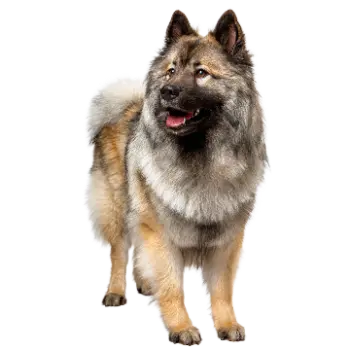
The Eurasian is a medium-sized spitz with a balanced, well-constructed build that reflects all three of its founding breeds without being dominated by any one of them. The Chow Chow's substance and coat density, the Wolfspitz's wedge-shaped head and prick ears, and the Samoyed's lighter bone and amiable expression have been combined into a dog that is distinctly its own type rather than visually resembling any one ancestor.
The head is wedge-shaped and of medium width, tapering cleanly from the broad skull to the moderately pointed muzzle. The stop is moderate - present but not abrupt. The nose is black or self-colored depending on coat color. The lips are tight and dry, without the pendulous jowls of heavier breeds. The eyes are medium-sized, oval to slightly almond in shape, and dark brown in color. They carry an alert, calm expression that experienced Eurasian owners describe as both observant and approachable. The ears are medium-sized, triangular, erect, and covered with short, dense hair. They are carried forward and slightly to the side, giving the dog a watchful, attentive aspect.
The neck is of medium length and well-muscled, set into clean, well-laid-back shoulders. The topline is level. The chest is moderately broad and deep. The body is compact rather than long, with a slight but defined tuck-up at the flank. The tail is set high and carried curled over the back - a defining spitz characteristic - covered with dense, bushy hair. The legs are straight, well-boned, and parallel when viewed from front or rear. The feet are rounded and compact, with well-arched toes and tough pads.
The coat is one of the breed's most immediately striking features. The outer coat is medium-long, loosely lying, and dense without being fluffy or stand-off as in some spitz breeds. The undercoat is thick and soft, providing substantial insulation. Coat texture and length vary across the body: the muzzle, face, ears, and fronts of the legs carry shorter, smoother hair, while the neck, back of the legs, and tail carry the longer guard coat that gives the dog its plush profile. The coat does not form a mane or excessive ruff, distinguishing the Eurasian from the more dramatically coated spitz breeds.
Color ranges include fawn in various shades, red, wolf-grey, solid black, and black and tan. The breed standard permits sable and other combinations. The blue-black or spotted tongue inherited from the Chow Chow appears in some Eurasians and is expected and acceptable. Overall, the Eurasian should present as a naturally balanced, moderately coated, clean-moving dog - attractive without exaggeration, substantial without heaviness.
Movement reflects the breed's balanced construction. The Eurasian should move with good reach in front and strong drive from the hindquarters, covering ground efficiently at a trot. The back should remain level during movement, without excessive rise and fall or rolling. At a walk the tail is typically carried loosely; at a trot and above it curls over the back in the classic spitz position. The breed should move without stiffness or looseness in any joint, and judges evaluate movement as a reflection of the dog's overall structural soundness.
Body condition in the Eurasian can be difficult to assess from the outside because the dense coat obscures the dog's actual weight. Running your hands along the ribs and spine is the reliable check - you should be able to feel the ribs easily without pressing, and the hip bones should be just detectable under a moderate layer of muscle and fat. An overweight Eurasian places additional stress on joints that are already subject to documented orthopedic concerns in the breed, making weight management a practical health priority alongside health testing.
Affectionate With Family
★★★★★
The Eurasian is deeply bonded to its household and shows that bond through constant, quiet proximity. This dog wants to be where its family is, even if it is simply lying nearby.
Good With Young Children
★★★★☆
The Eurasian is patient and tolerant with children who are part of the family. Its calm nature and medium size make it a sensible family companion for households with kids.
Good With Other Dogs
★★★★☆
The Eurasian is generally non-dog-aggressive and coexists peacefully in multi-dog households. Prey drive is low, making introductions to other pets relatively smooth.
Shedding Level
★★★★☆
The dense double coat sheds consistently and blows coat heavily twice a year. Daily brushing during seasonal sheds keeps the volume of loose fur manageable.
Coat Grooming Frequency
★★★☆☆
Brushing once or twice a week handles the Eurasian coat well outside of shedding season. The coat is relatively self-cleaning and does not require frequent bathing.
Drooling Level
★☆☆☆☆
The Eurasian is not a drooler. Its tight-lipped spitz muzzle produces none of the slobber associated with heavy-jowled breeds.
Coat Type
★★★★☆
Medium-long, loosely lying guard hair over a thick, dense undercoat. The coat is longer at the neck and back of the legs, giving the Eurasian its characteristic plush silhouette.
Openness To Strangers
★★☆☆☆
The Eurasian is calm and not aggressive toward strangers, but it does not warm to unfamiliar people quickly. It takes its time deciding how it feels about someone new.
Playfulness Level
★★★☆☆
The Eurasian is lively outdoors and enjoys activity with its family, but it is calm and settled indoors. Play is engaged and genuine without being frenetic.
Watchdog/Protective Nature
★★★☆☆
The Eurasian is alert and will notify its family of arrivals or unusual activity, but it is not a guard dog. Its reserved nature toward strangers makes it observant rather than reactive.
Adaptability Level
★★★☆☆
The Eurasian adapts to varied living situations including apartments when adequately exercised, but it needs to live fully integrated with its family. Isolation and kennel life are genuinely harmful to this breed.
Trainability Level
★★★☆☆
The Eurasian is intelligent and willing to learn, but it has an independent streak that requires patient, consistent training. Positive reinforcement and short sessions work best.