Entlebucher Sennenhund

Entlebucher Mountain Dog

Quick Facts

🐕 Breed Group
Herding Group
📏 Size Category
Medium
📏 Height
Males: 17-21 inches, Females: 16-20 inches
⚖️ Weight
Males: 50-65 pounds, Females: 40-55 pounds
⏱️ Life Expectancy
11-13 years
🧣 Coat Type
Short, dense, tricolor
🎨 Coat Colors
Black, tan, and white
😀 Temperament
Energetic, loyal, confident
🏃 Exercise Needs
High
🎓 Training Difficulty
Moderate
👶 Good with Children
Yes, with supervision
🐾 Good with Other Pets
Good with early socialization

Other Names & Breed Recognition

Entlebucher Sennenhund is the original Swiss-German name for this breed, and it tells you exactly what the dog is and where it comes from. Sennenhund translates literally as the herdsman's dog - Senn being the Swiss term for an alpine dairy farmer who moves cattle between valley pastures and high mountain grazing lands through the seasons. Hund is simply dog. Put them together and you have a working description of a dog whose entire purpose was defined by the alpine agricultural cycle.

The Entlebuch portion of the name identifies the specific valley in the canton of Lucerne where this type of dog developed. There are four Sennenhund breeds, each carrying the name of its home region: the Appenzeller Sennenhund from Appenzell, the Berner Sennenhund (known in English as the Bernese Mountain Dog) from the Bern region, the Grosser Schweizer Sennenhund (Greater Swiss Mountain Dog) from the broader alpine area, and the Entlebucher Sennenhund from the Entlebuch valley. The naming convention is logical, systematic, and rooted in Swiss German agricultural geography.

In English-speaking markets the breed is registered and marketed as the Entlebucher Mountain Dog, a translation that replaces Sennenhund with Mountain Dog to make the name more accessible to audiences unfamiliar with Swiss German. The AKC, the Canadian Kennel Club, and The Kennel Club in the United Kingdom all use the Mountain Dog construction. The FCI, which operates in a multilingual international framework, uses Entlebucher Sennenhund as the breed's official name under FCI Standard No. 47, maintaining the original Swiss designation across its member countries.

People who encounter the breed through European sources, FCI documentation, or Swiss breed literature will most likely see Entlebucher Sennenhund first. Those coming through North American dog fancy will see Entlebucher Mountain Dog. Both names refer to the same dog, the same standard, and the same working history. The Entlebucher Sennenhund designation is the one that connects the breed to its Swiss agricultural roots and to the FCI international framework, and it remains the name used in formal breed documentation across most of Europe. The shortened form Entlebucher, used without any suffix, appears commonly in breed circles and among owners as casual shorthand, and is unambiguous to anyone already familiar with the four Sennenhund breeds.

Entlebucher Sennenhund Organizations & Standards

The governing body for the Entlebucher Sennenhund at the international level is the FCI, which maintains the breed standard under the oversight of the Swiss Kennel Club - the Schweizerische Kynologische Gesellschaft, or SKG. As the country of origin, Switzerland holds custodianship of the standard, which means that when the standard is revised or clarified, it is the Swiss club that initiates and ratifies those changes within the FCI framework. FCI Standard No. 47 describes the Entlebucher Sennenhund as a lively, high-spirited, self-assured, and reliable dog - a working description that emphasizes the breed's utility and character rather than its appearance alone.

The FCI places the Entlebucher Sennenhund in Group 2, Section 3, alongside the other Swiss mountain dogs. This classification acknowledges the shared herding and droving heritage of the four Sennenhund breeds while recognizing each as a separate, independently standardized entity. The breed standard addresses structure, coat, markings, and temperament in specific terms, reflecting decades of organized breeding work to preserve type across the Swiss mountain dog family.

In North America, the Entlebucher Mountain Dog Club of America functions as the AKC parent club. The EMDC maintains the AKC breed standard for North American showing and breeding purposes, which aligns closely with the FCI standard. The club also coordinates health initiatives that are unusually active relative to many breed clubs, with particular attention to the immune-mediated hemolytic anemia documented in the breed and to the OFA health testing program that responsible breeders are expected to participate in.

Key standard points include the breed's rectangular body outline, the precise tricolor markings - black base with specific rust and white placement - and the hard, flat-lying short coat. Eye color should run from hazel to dark brown; light eyes are a fault. The tail is naturally short in many individuals, with naturally bobbed tails equally acceptable to artificially docked ones in countries where docking is restricted. The FCI standard's attention to these details reflects an effort to maintain the breed's original working type rather than allowing drift toward a purely companion-dog conformation.

Breeders in good standing with the EMDC participate in the OFA's CHIC program, which requires hip evaluation, annual CAER eye examination, and DNA testing for progressive retinal atrophy before a CHIC number is issued. Buyers who verify a CHIC number independently through the OFA database can confirm that both parents of a prospective puppy have completed the required health screening with results on public record.

Kennel Club Recognition

  • American Kennel Club (AKC): Recognized in 2011, Herding Group
  • United Kennel Club (UKC): Recognized, Herding Dog Group
  • Canadian Kennel Club (CKC): Recognized, Herding Group
  • FCI: Recognized, Group 2 - Pinscher and Schnauzer
  • The Kennel Club (UK): Recognized, Pastoral Group

Entlebucher Sennenhund Physical Description

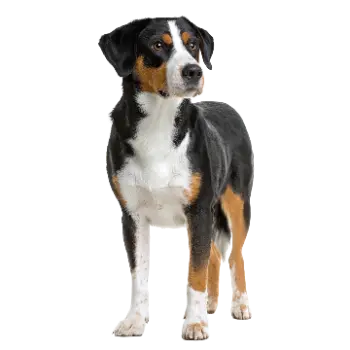
The Entlebucher Sennenhund is a compact, muscular dog with a rectangular outline that immediately communicates purpose. The body is clearly longer from chest to tail than it is tall from withers to ground - a proportion that is not accidental but bred in to allow the agility and low-center-of-gravity movement needed to work cattle on uneven alpine terrain. This is a dog built to move well, absorb contact from livestock, and keep working through a full day in mountain conditions.

The head is clean and proportionate, free of coarseness. The skull is broad and flat on top, with a well-defined but moderate stop. The muzzle is strong and dry, tapering slightly toward a fully pigmented black nose. Lips are tight and clean; the jaw closes in a correct scissors bite. The eyes are small to medium, set well apart, and express an alert, evaluating intelligence. Eye color ranges from hazel to dark brown; the FCI standard considers light-colored eyes a fault, and for good reason - the eye is one of the most expressive elements of the breed's character.

The ears are medium-sized, set high and close to the skull, with a rounded tip and a triangular drop. At rest they hang flat; when the dog is attentive they lift at the base and pull slightly forward. The neck is moderately long, muscular, and blends cleanly into well-laid shoulders that support a free, ground-covering stride.

The chest is broad and reaches to the elbow, with well-sprung ribs that provide genuine lung capacity for working endurance. The topline is level and firm from withers to croup, the loin short and well-muscled, the croup slightly rounded. This is not a dog with a tucked-up belly or a greyhound waist - the depth of body is consistent and reflects a working build.

The coat is the breed's most visually distinctive feature: short, hard, and dense, lying flat against the body with a dense undercoat beneath for insulation. The tricolor pattern is specific and non-negotiable for breed type. The base color is jet black, with rust-colored markings above the eyes, on the cheeks, the inner ear, the chest, and the legs. White appears on the muzzle, typically a blaze or stripe on the skull, the chest, the feet, and the tail tip. The precision of these markings separates dogs of correct type from those that are merely tricolored.

The tail is a variable feature. Some Entlebucher Sennenhund are born with naturally short or bobbed tails; others are born with full-length tails. Both are genetically possible within the breed and both are acceptable under the standard. Historically, tails were docked in Switzerland and elsewhere, but this practice is now restricted or banned in many countries, and natural bobtails are common enough that the breed manages without the practice.

Males stand 17 to 21 inches at the withers and weigh between 50 and 65 pounds. Females are slightly smaller at 16 to 20 inches and 40 to 55 pounds. The breed feels denser than its dimensions suggest because of the tight musculature and solid bone. Movement is brisk and purposeful, with good rear drive and front extension that produces a ground-covering trot without wasted energy.

The overall impression the Entlebucher Sennenhund should give is of a working dog still entirely capable of the work it was bred for. No exaggeration in structure, no softness in expression, no excess in body - just a compact, capable, tricolor dog that looks like it could spend the day on a Swiss hillside and come home satisfied. That is precisely what the breed was built to be, and the standard holds that intention.

Affectionate With Family
The Entlebucher Sennenhund forms tight, lasting bonds with its household and follows its people with genuine devotion. This is a dog that considers itself a full member of the family, not a peripheral presence.
Good With Young Children
Energetic and playful with kids, though its cattle dog drive can be too much for toddlers. Best suited to households with active school-age children who can match the breed's pace.
Good With Other Dogs
Tends to get on well with dogs it has been raised alongside, but can push boundaries with unfamiliar animals. Socialization matters more than it does for more easygoing breeds.
Shedding Level
The short tricolor coat sheds at a moderate steady rate year-round, with two heavier seasonal shedding periods. Regular brushing keeps it under control.
Coat Grooming Frequency
Minimal grooming demands - a weekly brush and occasional bath is all the coat requires. No professional trimming or clipping is needed.
Drooling Level
Essentially drool-free. The Entlebucher Sennenhund has tight-fitting lips and leaves no wet traces on furniture or clothing.
Coat Type
Hard, short, and flat-lying with a dense undercoat that provides weather resistance without the grooming demands of longer alpine breeds.
Openness To Strangers
Reserved with unfamiliar people by nature - not aggressive, but watchful and deliberate. The breed warms up on its own terms once it has assessed the situation.
Playfulness Level
Enthusiastic and game for action. The Entlebucher Sennenhund plays with real energy and enjoys games that challenge both body and mind.
Watchdog/Protective Nature
Alert and vocal when something in the environment changes. The breed takes its role as household watchdog seriously and communicates accordingly.
Adaptability Level
Adaptable when exercise needs are genuinely met, but not a breed that thrives in sedentary or confined environments. Activity is the key variable.
Trainability Level
Highly capable in the hands of a consistent, confident handler. The breed will test vague authority but rewards clear communication with impressive responsiveness.

Entlebucher Sennenhund History & Development

The Entlebucher Sennenhund carries its history in its name. Sennenhund - the herdsman's dog - is a title that describes a working relationship stretching back centuries into the Swiss alpine agricultural tradition. Swiss farmers practiced seasonal transhumance, moving dairy cattle from valley farms to high mountain pastures in summer and back down in autumn. The dogs that worked alongside them needed to be compact enough for mountain terrain, courageous enough to face cattle, and tough enough to work in variable alpine weather. The dogs of the Entlebuch valley developed to fill exactly that role.

For most of their history these dogs existed without formal documentation. Swiss farmers bred for function and kept no pedigree records. The dogs of one valley developed recognizable characteristics that distinguished them from the dogs of neighboring valleys simply through geographic isolation and consistent selection pressure for the same type of work. By the time European dog fancy began cataloging breeds in the late nineteenth century, the Entlebucher Sennenhund was already a distinct and stable type.

The systematic documentation of Switzerland's mountain dogs owes much to Professor Albert Heim, a Swiss geologist who became deeply interested in native dog breeds. Beginning in 1889, Heim cataloged the four Sennenhund types and worked to establish them as recognized breeds worthy of preservation. The Entlebucher was the smallest and perhaps the least celebrated of the four - the Bernese Mountain Dog attracted more attention due to its size and beauty - but Heim recognized the Entlebucher's distinct character and advocated for its documentation alongside the larger breeds.

Organized breeding under club oversight began in Switzerland in 1926 with the founding of a club covering both the Appenzeller and Entlebucher breeds. The Entlebucher Sennenhund's development as a recognized breed moved under this shared administrative structure for several decades. The FCI formally recognized the breed under Standard No. 47, cementing the Swiss name - Entlebucher Sennenhund - as the official international designation.

World War II nearly ended the breed's organized development. Farm populations dropped across Switzerland during the war years, and the breeding programs that had been building for two decades were disrupted. Post-war reconstruction required rebuilding from a reduced gene pool, and the responsible breeders who undertook that work established health and diversity as priorities that remain central to ethical Entlebucher Sennenhund breeding today. The breed's near-disappearance and recovery is part of why those who breed seriously treat genetic health with genuine urgency rather than as a formality.

AKC recognition in 2011 opened the North American show and sport world to the Entlebucher Sennenhund under its English name. The breed remains uncommon in North America, which tends to maintain a culture of seriousness among its breeders and owners - people who have researched carefully and chosen deliberately rather than following a trend. Waiting lists with reputable breeders are common, and that selectivity is a reflection of a breed community that takes its responsibilities seriously. Anyone looking for a shortcut to a puppy is better served by a different breed entirely.

Entlebucher Sennenhund Temperament & Personality

The Entlebucher Sennenhund was developed to move cattle. That single fact explains more about the breed's temperament than any other. Cattle dogs need confidence to work in close contact with animals many times their weight. They need persistence to keep pressure on an animal that resists moving. They need physical toughness to absorb bumps and kicks and keep going. And they need enough independence of judgment to make decisions without waiting for human instruction when the situation demands action. All of those qualities are present in the Entlebucher Sennenhund, and they express themselves in domestic life whether the dog ever sees a cow or not.

With its own family, the Entlebucher Sennenhund is devoted and demonstrably affectionate. The bond runs deep and the attachment is genuine - this is not a breed that keeps comfortable emotional distance from its people. They want to be included, they notice when you leave, and they are visibly pleased when you return. That closeness is one of the breed's most appealing qualities and also the source of one of its challenges: a dog this bonded to its people does not handle prolonged isolation well.

With people outside the household, the response is measured and initially reserved. The Entlebucher Sennenhund does not rush to greet strangers or solicit affection from people it does not know. It watches, assesses, and makes its own determination about whether someone is trustworthy. This is not shyness in the pathological sense - a well-socialized Entlebucher Sennenhund is not anxious around unfamiliar people, just appropriately discerning. The difference between a reserved but stable dog and an anxious one is important, and early socialization is what determines which side of that line a dog falls on.

Herding instinct surfaces in everyday domestic life. Children running, cats moving quickly, visitors moving through the house - these things can activate a herding response in a dog whose ancestors spent generations moving livestock. Nipping at heels, circling, and attempting to move group members are cattle dog behaviors that require management and redirection rather than punishment. The instinct itself is not problematic; the expression of it in a household setting needs to be channeled appropriately through training.

The Entlebucher Sennenhund is vocal. It alerts to changes in its environment, communicates its opinions, and does not quietly accept things it finds wrong with the world. Owners who establish clear expectations about when barking is appropriate end up with a manageable watchdog. Those who allow the dog to self-regulate develop a dog that is noisier than most neighbors will find acceptable. The vocal nature is part of what makes this an excellent alert dog and part of what requires active management in close-quarters living.

For the right owner - someone active, consistent, and genuinely interested in engaging with a smart, driven dog - the Entlebucher Sennenhund is deeply rewarding. The breed gives back in proportion to what is invested. A well-raised, well-trained Entlebucher Sennenhund is a remarkable companion. One that has been left to its own devices is a different animal entirely.

Entlebucher Sennenhund Family Life & Living Requirements

The Entlebucher Sennenhund fits naturally into active family life where the dog can participate rather than observe from the sidelines. Households that hike, run, play in the yard, and maintain an engaged daily routine find the breed to be an enthusiastic partner. The dog's energy and desire to be involved make it a genuinely fun companion when the lifestyle matches what the breed needs.

Children in the household are generally a positive for this breed, provided they are old enough to interact with a dog that plays hard. The Entlebucher Sennenhund's cattle dog energy - the body pressure, the herding instinct, the enthusiasm for movement - can be overwhelming for toddlers without any bad intent behind it. With school-age kids who can run, play fetch, and engage actively with a dog, the match tends to work well. Supervision during initial interactions and clear rules about how the dog is handled set the tone for a positive long-term relationship.

Other dogs in the household are usually manageable when the Entlebucher Sennenhund has been raised with them. The breed can be assertive and bossy with dogs it does not know, particularly same-sex adults meeting for the first time. This is not unusual for herding breeds with strong personalities. Early and ongoing socialization - real exposure to various dogs in controlled settings - produces a dog that can navigate the world without difficulty.

The breed does not do well with chronic isolation. An Entlebucher Sennenhund left alone for most of the workday on a regular basis tends to develop problem behaviors that are really expressions of frustration and under-stimulation. Destructive chewing, persistent barking, and demanding attention are all more likely in dogs whose social and activity needs are chronically unmet. Households where someone is home during the day, or where the dog has access to daycare or regular midday activity, are a better fit than those built around long daily absences.

Housing ideally includes outdoor space. The breed is athletic and benefits from room to move freely. A securely fenced yard - with fencing adequate to contain a strong, agile, motivated dog - adds real quality of life. Apartment living requires a very serious commitment to daily outdoor activity and mental engagement, and it rarely produces a fully settled Entlebucher Sennenhund without considerable effort from a very dedicated owner. The breed is happiest when it has space, purpose, and people to share both with.

Entlebucher Sennenhund Training & Exercise Needs

Training the Entlebucher Sennenhund is a conversation between two opinionated parties. The breed is intelligent, perceptive, and fully capable of reading the difference between a confident handler and a hesitant one. Give it a handler who is clear about expectations, consistent in follow-through, and patient with the process, and you get a dog that is a pleasure to work with. Give it ambiguity and you get a dog that has filled in the blanks with its own judgment - which tends to create situations the owner did not intend.

Positive reinforcement-based training is well-suited to the breed. The Entlebucher Sennenhund responds to reward and is motivated by both food and play, which gives trainers good tools to work with. What it does not respond well to is harsh, coercive, or correction-heavy approaches. Dogs trained with significant physical or aversive pressure tend to become either shut down or reactive, neither of which produces the cooperative, confident partner the breed is capable of being.

Socialization should begin as early as the puppy enters the household. The critical window for exposure to new environments, unfamiliar people, and other animals is early puppyhood, and an Entlebucher Sennenhund that experiences a wide variety of positive exposures during that period develops into a more confident, adaptable adult. Puppies that are under-socialized tend to become dogs that treat the world outside their immediate territory with caution or suspicion that is difficult to reverse later.

The Entlebucher Sennenhund excels at dog sports. Agility, herding trials, obedience, rally, nose work, and tracking all provide the mental challenge and handler-directed activity that satisfy this breed at a deep level. Owners who commit to a sport find that the training time enriches the relationship and produces a dog that is noticeably more settled and cooperative at home than one that only receives physical exercise without mental engagement.

Physical exercise requirements are substantial. An hour or more of genuine aerobic activity daily is the practical baseline - running, hiking, fetch, or off-leash time in a secure environment. Casual walks are not sufficient for this breed's needs. The Entlebucher Sennenhund has real endurance built from generations of alpine work, and meeting that endurance honestly is the most practical behavioral management tool an owner has. A tired Entlebucher Sennenhund is a cooperative and settled one; an under-exercised one is neither. Building exercise into the daily schedule as a non-negotiable commitment rather than an optional extra is the single most impactful thing an owner can do for this breed's quality of life and temperament.

Entlebucher Sennenhund Health Concerns

Hip dysplasia is the primary structural health concern in the Entlebucher Sennenhund. The condition involves malformation of the hip joint that leads to progressive joint laxity, cartilage erosion, and arthritis over time. The severity varies considerably across individuals - some dogs with radiographically confirmed dysplasia function comfortably for years with appropriate management, while others develop significant lameness that requires medical or surgical intervention. OFA or PennHIP radiographic evaluation is required for breeding animals and should be requested by buyers from both parent dogs.

Urinary incontinence is reported at higher than typical rates in spayed females of this breed. It is manageable with veterinary guidance in most cases, but owners should be aware of the possibility and discuss it with their veterinarian at the time of spay rather than waiting for symptoms to appear. Early conversation about management options - including hormonal supplementation where appropriate - is more effective than reactive treatment after the condition is established. Maintaining a healthy body weight throughout life also reduces cumulative stress on the joints, which is relevant given the breed's moderate hip dysplasia risk. Annual wellness exams provide an opportunity to monitor for early signs of any of these conditions before they become difficult to manage.

Common Health Issues

  • Hip dysplasia - Malformation of the hip joint causing progressive laxity and arthritis, with severity variable across individuals; OFA or PennHIP evaluation required for all breeding animals.
  • Progressive retinal atrophy (prcd-PRA) - Hereditary retinal degeneration leading from night blindness to complete vision loss; a DNA test is available to identify carriers and affected individuals.
  • Immune-mediated hemolytic anemia (IMHA) - The immune system attacks red blood cells, documented at elevated frequency in the Entlebucher Sennenhund; can present acutely and requires emergency veterinary care.
  • Urinary incontinence - Reported at elevated rates in spayed females; manageable with veterinary guidance but worth discussing at the time of spay rather than waiting for symptoms.

Preventive Care & Health Monitoring

  • OFA or PennHIP hip radiograph evaluation for both parents before breeding - Buyers should request and verify clearance certificates.
  • Annual CAER ophthalmologic exam by a board-certified veterinary ophthalmologist - Plus DNA testing for prcd-PRA in breeding animals.
  • Owner familiarity with IMHA warning signs - Pale gums, sudden severe lethargy, rapid breathing - given the breed's documented elevated risk for this condition.
  • Routine weight monitoring and body condition assessment to reduce cumulative joint stress in a breed with moderate hip dysplasia risk. - Routine weight monitoring and body condition assessment to reduce cumulative joint stress in a breed with moderate hip dysplasia risk.

Entlebucher Sennenhund Grooming & Maintenance

The Entlebucher Sennenhund's coat is one of the breed's most practical features. Short, hard, and dense, it requires no trimming, no clipping, and no professional grooming appointments. The tricolor pattern stays sharp and clean with minimal intervention. Shedding is the main grooming consideration - the breed sheds at a moderate year-round rate with two heavier seasonal periods in spring and fall when the undercoat releases in greater volume. A rubber curry brush or a firm bristle brush used weekly pulls the loose coat out efficiently and keeps it off furniture and clothing.

Bathing is done as needed based on smell and dirt rather than on a rigid schedule. Dogs that spend significant time outdoors on varied terrain - hiking, swimming, running through brush - will need bathing more frequently than dogs with quieter routines. Use a shampoo formulated for dogs and rinse thoroughly; the dense undercoat traps soap residue if rinsing is rushed, and residual shampoo against the skin causes irritation. The short coat dries relatively quickly, though toweling off thoroughly after water exposure helps in cooler weather.

Nail maintenance is a monthly task for most owners. Active dogs that run on pavement may wear their nails adequately between trims, but dogs exercising primarily on grass and soft ground will accumulate nail length that needs addressing. Long nails change the way the foot loads the ground, which alters gait mechanics and puts cumulative stress on joints over time - something worth taking seriously in a breed monitored for hip dysplasia.

Ear hygiene is a simple monthly maintenance task. Wiping the visible portion of the ear canal with a dog-safe ear cleaner and a cotton ball removes accumulated wax and catches early infection signs before they become established. Dental care rounds out the routine. Regular tooth brushing or quality dental chews reduce tartar buildup and protect long-term oral health. Acclimating the dog to having its mouth handled early makes all future dental care considerably easier and less stressful for both dog and owner. A cooperative dog is easier to groom in every respect, and the Entlebucher Sennenhund's intelligence makes early handling conditioning an investment that pays back across the dog's entire life.