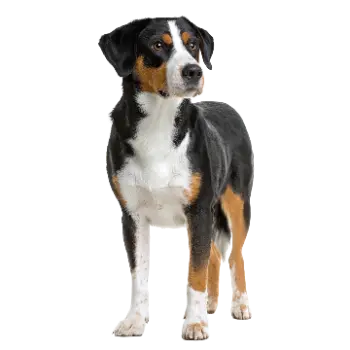
The Entlebucher is a sturdy, muscular dog that carries more substance than its medium size suggests at first glance. Built low and long for alpine agility, the body is noticeably rectangular - longer from chest to tail than from withers to ground. This is not a square-bodied dog and was never meant to be. Every proportion reflects a cattle dog engineered to move quickly across uneven terrain and absorb the occasional kick from livestock without going down.
The head is clean and wedge-shaped without being coarse. The skull is flat on top, the stop well-defined but not dramatic. The muzzle is strong and tapers slightly to a black nose, with lips that fit tightly and jaws that close in a scissors bite. The eyes are one of the breed's most striking features - small to medium in size, set well apart, and ranging in color from hazel to dark brown. The gaze is alert and direct, carrying the confident assessment that characterizes working herding dogs.
Ears are set high and relatively close to the skull, dropping forward when relaxed and lifting at the base when the dog is alert. They are triangular in shape with rounded tips and covered in short, dense fur that matches the rest of the coat. The neck is moderately long and muscular, flowing cleanly into well-laid shoulders that allow for a free, ground-covering stride.
The chest is broad and deep, reaching approximately to the elbows, with well-sprung ribs that provide lung capacity for sustained work. The topline is level and firm, the loin short and powerful, the croup slightly rounded. The tail is naturally short or occasionally born without a tail entirely, a trait that varies within litters. Docked tails are a historical practice now restricted or prohibited in many countries; natural bobtails are equally acceptable under the breed standard.
The coat is the breed's most recognizable feature: short, hard, and dense, lying flat against the body. The tricolor pattern - jet black base with rust and white markings - is fixed and specific. Rust appears above the eyes, on the cheeks, along the legs, and on the chest. White markings appear on the muzzle, a blaze or patch on the head, the chest, feet, and tip of the tail. The placement of these markings matters to judges and breeders alike - haphazard or missing markings are faults. The undercoat is dense enough to provide insulation for outdoor work without requiring the grooming burden of a longer-coated breed.
Females are distinctly feminine in outline while carrying the same fundamental structural qualities as males. The difference in size between sexes is meaningful but not extreme - females run slightly smaller in both height and weight while sharing the same rectangular body outline and tricolor coat pattern. Both sexes should give the impression of a compact, capable working dog rather than a pet with working-dog styling.
Size falls in the medium range, with males standing 17 to 21 inches at the withers and weighing 50 to 65 pounds. Females are slightly smaller at 16 to 20 inches and 40 to 55 pounds. Despite the moderate dimensions, the dog feels heavier and more substantial than the numbers suggest because of the breed's dense musculature and tight, solid build. Owners often describe the Entlebucher as feeling like a "little tank" when they pick one up for the first time.
Movement should be free and ground-covering, with the drive coming from the hindquarters and the front legs reaching forward without paddling or winging. A correct Entlebucher moving toward you shows parallel tracking front and rear - no toeing in, no crabbing. At a trot, the outline remains level, and the dog covers ground efficiently without wasted motion. The overall impression in motion is of a compact, purposeful dog that could work all day without fatigue.
Affectionate With Family
★★★★★
The Entlebucher bonds tightly to its people and rarely leaves their side when given the choice. This is a dog that genuinely wants to be part of whatever you are doing.
Good With Young Children
★★★★☆
Entlebuchers are playful and patient with kids, though their energy and herding instincts can bowl over very small children. A good match for families with active school-age kids.
Good With Other Dogs
★★★☆☆
Generally gets along fine with other dogs when raised with them, but can be assertive or bossy with unfamiliar dogs. Early socialization smooths out most of the rough edges.
Shedding Level
★★★☆☆
The short tricolor coat sheds at a moderate year-round rate, with heavier seasonal blowouts twice a year. Weekly brushing keeps it manageable.
Coat Grooming Frequency
★★☆☆☆
Low maintenance overall - a weekly brush and occasional bath keeps the coat clean and healthy. No trimming or clipping required.
Drooling Level
★☆☆☆☆
Clean-mouthed and dry. Drooling is essentially a non-issue with the Entlebucher.
Coat Type
★★☆☆☆
Short, hard, and dense - built for alpine work in variable weather. The undercoat provides insulation, the outer coat sheds dirt and debris well.
Openness To Strangers
★★☆☆☆
Naturally reserved with people they do not know. Not shy, but not instantly welcoming either - they watch and assess before warming up.
Playfulness Level
★★★★☆
Enthusiastic and game for almost anything, the Entlebucher plays hard and brings real energy to every activity. They love games that give them something to figure out.
Watchdog/Protective Nature
★★★★☆
Alert and vocal when something is off. The Entlebucher takes the watchdog role seriously without tipping into obsessive barking with the right training.
Adaptability Level
★★★☆☆
Can adapt to different living situations if exercise needs are genuinely met, but suffers in sedentary or cramped environments. A tired Entlebucher is a happy one.
Trainability Level
★★★★☆
Smart, willing, and capable of learning complex tasks quickly. They do best with handlers who are consistent and confident - this breed will test limits if they sense ambiguity.