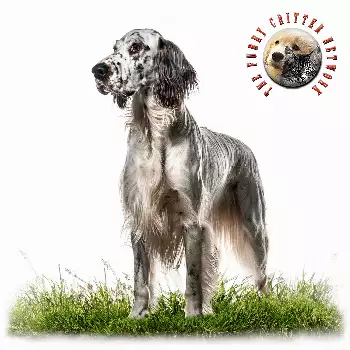
The English Setter is widely considered one of the most beautiful dogs in the world, and it is a beauty that arises from function rather than exaggeration - the breed looks like what it is, a supremely well-constructed bird dog wrapped in one of the most distinctive coats in the sporting dog world. The silhouette is elegant and athletic simultaneously: long-limbed and lean, with the deep chest and well-sprung ribs of a dog built for sustained running.
The head is long, lean, and carried with the particular dignified bearing that knowledgeable observers consider characteristic of the breed. The skull is oval when viewed from above, moderately wide between the ears, and shows a well-defined occipital protuberance at the back. The stop is moderate and well-defined. The muzzle is long and moderately deep and square, with flews that are clean and close rather than pendant. The nose is large, with wide nostrils appropriate to an air-scenting dog that works with its head up, seeking bird scent on the wind rather than tracking ground scent with its nose down.
The eyes are large, round, and very dark brown - as dark as possible is preferred. The expression is one of the most immediately recognizable features of a good English Setter: gentle, intelligent, and dignified, with a particular quality of softness that experienced Setter people call "the look." It is a distinctly gentle expression, absent the keenness of a terrier or the directness of a herding breed. The ears are moderately low-set, hanging in close folds against the head, with well-developed leather and substantial silky feathering.
The neck is long, muscular, and clean at the throat, sweeping in a graceful arch into well-laid-back shoulders. The shoulder blade should be nearly equal in length to the upper arm, with both set at complementary angles that allow the exceptional reach of the breed's characteristic trot. The chest is deep, reaching to the elbows, with moderately sprung ribs that provide good lung capacity without the barrel shape that would impede the dog's smooth gallop. The back is straight and strong, the loins slightly arched, and the hindquarters broad and muscular. The breed's working gait is a free-flowing, elegant trot that covers ground efficiently, with the head carried level or slightly above the topline - the bird dog's pose of a dog ready to wind scent.
The tail is straight or slightly curved, medium length, tapering to a fine point, and carried in line with the back or slightly elevated when the dog is working. In motion, the tail moves with the dog's rhythm - the setter does not carry it high and stiffly like a terrier or low and tucked, but with the natural, relaxed carriage of a dog working confidently. Heavy feathering on the tail is part of the breed's characteristic silhouette.
The legs are straight and strong, with good bone and round, close-knit, well-arched feet. The hind legs are well-angulated through the stifle and hock, providing the driving power for the breed's extending trot and gallop. Movement overall should be free, smooth, and effortless - a correctly built English Setter moving at the trot is a genuinely beautiful sight, covering ground with minimal effort.
The coat is the breed's most visually distinctive feature. The belton pattern - white ground with colored flecking distributed throughout - is unique to this breed among AKC-recognized dogs. Blue belton is black ticking on white, producing a gray-blue overall impression; orange belton is orange ticking; lemon belton is pale yellow ticking, often found on lighter-pigmented dogs; liver belton is brown ticking; and tri-color combines blue belton with tan points on the muzzle, over the eyes, and at other trim points. In heavily marked individuals, the ticking can be so dense that the white ground is nearly obscured.
The coat texture is silky and flat to slightly wavy, never curly or woolly. The silky texture is functional as well as beautiful - it releases burrs and debris more readily than a harsher coat and dries quickly after rain or water work. Feathering is abundant on the ears, chest, abdomen, backs of the legs, and the tail. Show dogs carry maximum feathering; field dogs are typically maintained with shorter, more practical coats. The difference in coat volume between a fully-prepared show English Setter and a working field dog can be substantial.
Sexual dimorphism in the English Setter is meaningful. Males are distinctly larger and more masculine in head and body, carrying the 65 to 80-pound range and 25 to 27-inch height; females are noticeably lighter-boned and more refined in expression and frame, typically 45 to 65 pounds at 23 to 25 inches. A good female Setter should look feminine and elegant without appearing slight or lacking substance. Both sexes share the characteristic gentle expression, but a male Setter has a more commanding physical presence that experienced judges note immediately. When evaluating puppies for sporting or show purposes, understanding typical sex-related differences in development helps set appropriate expectations.
Affectionate With Family
★★★★★
English Setters are deeply bonded to their families and genuinely want to be with their people. They are gentle and affectionate without being needy in a neurotic way - warm, present, and easy to live with when their exercise needs are met.
Good With Young Children
★★★★★
Among the most reliably gentle breeds with children of all ages. Their size requires some supervision with very young children simply because enthusiasm can result in accidental knocks, but the temperament is characteristically patient and tolerant.
Good With Other Dogs
★★★★☆
Generally dog-friendly and sociable. They were bred to hunt alongside other dogs and tend to get along well. Some individuals have a prey drive that needs management around very small dogs.
Shedding Level
★★★★☆
English Setters are significant shedders, particularly during coat blowing periods in spring and fall. The long feathering means the shed hair is visible and does accumulate on furniture and clothing.
Coat Grooming Frequency
★★★★☆
The silky, feathered coat requires brushing several times per week to prevent tangles and matting, particularly behind the ears and in the armpits. Regular professional trimming keeps the coat manageable.
Drooling Level
★☆☆☆☆
Not a drooler. The tight, clean lip of the English Setter's muzzle makes this a dry-mouthed breed that will not leave slobber on guests or furniture.
Coat Type
★★★★☆
Long, silky feathering throughout is beautiful but requires consistent grooming attention. Show-bred dogs carry substantially more coat than field-bred dogs; both need regular brushing to stay tangle-free.
Openness To Strangers
★★★★★
Typically friendly and warm with everyone, including strangers. English Setters do not have an adversarial bone in their body and tend to greet new people with genuine enthusiasm.
Playfulness Level
★★★★☆
Playful and energetic, especially outdoors. They retain an enthusiasm for games and running well into adulthood, though they are perfectly capable of settling quietly indoors after adequate exercise.
Watchdog/Protective Nature
★★☆☆☆
Not a watchdog in any meaningful sense. They may bark at an unfamiliar sound but are too friendly and non-territorial to be relied upon as a deterrent. An intruder is more likely to receive a greeting than a warning.
Adaptability Level
★★★☆☆
Can adapt to suburban life with committed daily exercise, but genuinely thrives with access to open space. Not suited to apartment living. The breed's energy level requires more than a brief yard outing to be manageable indoors.
Trainability Level
★★★☆☆
Responds well to positive, patient training. The English Setter's independent bird-finding instinct means outdoor work competes strongly with trained cues, requiring more reinforcement history than some sporting breeds to achieve reliable outdoor compliance.