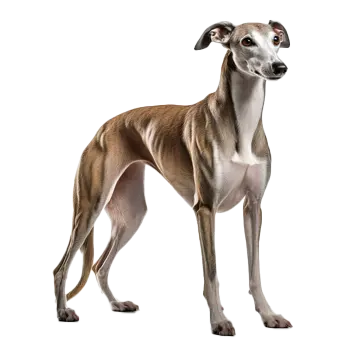
The English Greyhound is built for one thing above all others: speed. Every aspect of the dog's physical structure is an expression of aerodynamic efficiency, and the result is one of the most recognizable and aesthetically striking body forms in the canine world. There is nothing excess about a well-built Greyhound - no coat to catch wind, no heavy bone to carry, no structure that does not contribute to the central purpose of moving very fast.
Males stand 27 to 30 inches at the shoulder and weigh 65 to 70 pounds; females stand 27 to 28 inches and weigh 60 to 65 pounds. The height-to-weight ratio reflects the breed's lean construction - a male at 28 inches and 65 pounds is a very differently built dog from, say, a Labrador at the same height and weight. The Greyhound's weight is concentrated in muscle, with minimal fat and a bone structure that is strong but not heavy.
The head is long and narrow, tapering gradually from the wide skull to the fine muzzle. The skull is relatively flat, the stop barely perceptible. The jaws are powerful and long. The eyes are dark, oval, and set obliquely in the skull - this wide-set placement maximizes peripheral vision and is functionally important for a coursing dog that needs to track prey without turning its head. The ears are small and rose-shaped, folded back along the neck when the dog is relaxed and rising when alert.
The neck is long and strongly arched, blending into well-laid-back, sloping shoulders. The chest is very deep and narrow, reaching well down to the elbows, with a spring of rib that provides lung volume without adding width that would compromise the aerodynamic profile. The back is long and shows the characteristic slight arch over the loin - sometimes described as a "roach" or "wheel back" - that is particular to the breed and provides the flexible spinal extension during the double-suspension gallop that is the Greyhound's fastest gait.
The hindquarters are the engine of the Greyhound. The thighs are long, broad, and massively muscled. The stifles are well bent and the hocks are well let down, providing the power and extension that generate the breed's speed. The feet are compact and hare-footed, with thick, tough pads and well-arched toes.
The coat is short, smooth, and lies flat against the body with no undercoat. It comes in virtually every canine color - black, white, brindle, fawn, red, blue, and combinations of these. The skin is very fine and thin, which contributes to the breed's cold sensitivity and its susceptibility to skin lacerations and pressure sores.
In motion, the English Greyhound is something remarkable to observe. The double-suspension gallop - in which all four feet are off the ground twice in each stride cycle - produces a fluid, reaching movement at top speed that has been documented exceeding 45 miles per hour. Even at a trot, the breed's movement is notably long and reaching, conveying potential energy.
One of the most noted aspects of the English Greyhound's physiology is what is absent. There is essentially no subcutaneous fat. Place your hand on a Greyhound's ribcage and you feel the ribs directly - this is normal for the breed, not a sign of underfeeding. The abdomen tucks dramatically behind the deep chest, producing the characteristic silhouette that makes the breed unmistakable in profile. The skin is extremely fine and thin, almost papery in texture over bony prominences. This physique is both the source of the breed's speed and the reason it requires specific care considerations around cold exposure, sleeping surface quality, and anesthetic management.
Color variation in the English Greyhound is broader than in many breeds. Solid black, white, brindle in various intensities, fawn ranging from cream to dark golden, red, blue (a dilute gray-black), and combinations or patches of these colors are all accepted. No color is disqualifying in the breed standard.
Affectionate With Family
★★★★★
Despite the racing image, the English Greyhound is a deeply affectionate and gentle companion that forms close bonds with its household. The couch, and the people on it, are where this dog most wants to be.
Good With Young Children
★★★★☆
Gentle and patient with children, the English Greyhound is a good family dog provided children understand how to interact calmly. Very rough play should be discouraged as the breed is sensitive.
Good With Other Dogs
★★★★☆
The English Greyhound is typically dog-friendly and coexists well with other dogs. Racing Greyhounds are socialized to other dogs from an early age, and most make smooth transitions to multi-dog households.
Shedding Level
★★☆☆☆
The short, smooth coat sheds minimally and consistently. Grooming requirements are among the lowest of any large breed.
Coat Grooming Frequency
★☆☆☆☆
An occasional wipe-down with a damp cloth or hound glove is all this coat typically needs. Bathing is infrequent and drying is nearly instantaneous.
Drooling Level
★☆☆☆☆
Not a drooling breed. The tight, clean lips of the English Greyhound produce minimal saliva under normal circumstances.
Coat Type
★☆☆☆☆
The coat is short, smooth, and close-lying - one of the most minimal coats of any sighthound. It offers little insulation against cold, and the breed needs a coat in winter climates.
Openness To Strangers
★★★☆☆
Variable - some English Greyhounds are sociable with strangers while others are reserved or shy. Racing dogs that have been properly socialized after adoption usually integrate well.
Playfulness Level
★★★☆☆
Capable of explosive bursts of playful energy, but the English Greyhound's default state is restful. It plays enthusiastically when the mood strikes and naps the rest of the time.
Watchdog/Protective Nature
★☆☆☆☆
Not a watchdog. The English Greyhound is quiet, undemonstrative about arrivals, and too gentle by nature to adopt a guarding role.
Adaptability Level
★★★★☆
Surprisingly adaptable - the English Greyhound does well in apartments and smaller homes provided it has daily access to a safe area for brief, fast exercise. Low indoor energy makes it easy to live with.
Trainability Level
★★★☆☆
Sensitive, intelligent, and capable of learning effectively with patient, positive methods. The English Greyhound does not respond to harsh treatment and is not as handler-focused as herding breeds, but is genuinely trainable with the right approach.