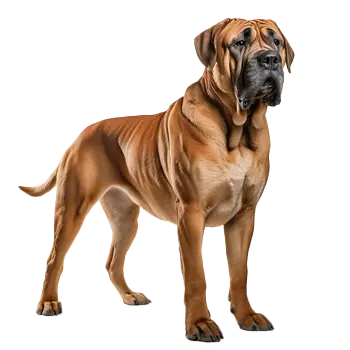
The Dogo Argentino's first impression is one of restrained power - a dog that is obviously built for serious physical work, without any of the exaggeration or bulk that marks breeds developed for appearance rather than function. Males stand 24 to 27 inches at the withers and weigh 88 to 100 pounds; females are slightly smaller at 23.5 to 26 inches and 77 to 88 pounds. Despite that weight, the Dogo reads as athletic rather than heavy, with clearly defined musculature and a body designed for speed, endurance, and the physical demands of hunting dangerous large game. The breed's silhouette is longer than it is tall, with good reach and depth of chest, and the entire structure conveys functional capability rather than mass for its own sake.
The head is one of the most distinctive features and a focal point of the breed standard. It is large, broad, and powerful - the skull is slightly convex when viewed from the side, and the stop is pronounced but not abrupt. The muzzle is deep and strong, nearly equal in length to the skull, with tight, dark lips and a large, wide black nose. The jaw carries considerable force, as a hunting dog designed to hold large prey must. The teeth meet in a scissors bite, with a level bite permitted but undershot or overshot bites being serious faults. The overall head shape conveys strength and determination rather than brutishness, and should be proportionate to the body - a head that appears too small or too massive detracts from the breed's athletic character.
The eyes are dark to amber, set somewhat wide apart, and carry an alert, intelligent expression that is direct without being aggressive. The preferred eye color is dark hazel or dark brown; blue or partially blue eyes are associated with a higher prevalence of congenital deafness and are considered a fault in the show ring. The ears are set high on the skull and in their natural state are pendant, falling close to the cheeks. Historically, the ears were routinely cropped in the working tradition, as natural ears were considered vulnerable to injury when the dog engaged with large prey. While ear cropping is banned in many countries and increasingly discouraged elsewhere, cropped ears remain permissible in the AKC standard and continue to be practiced by some working-dog breeders in Argentina.
The neck is strong, slightly arched, and covered with thick skin that provided protection when the breed worked closely with dangerous animals. It blends smoothly into well-laid-back shoulders. The topline is level and firm, leading to a broad, well-muscled loin and a croup that slopes slightly toward the tail set. The chest is deep and capacious, reaching to the elbows, with well-sprung ribs providing the lung room that hunting endurance demands. The forechest is developed without being excessively prominent. The abdomen is moderately tucked.
The forequarters feature straight, well-boned legs with moderate angulation at the shoulder and elbow. The feet are round and compact, with well-arched toes and thick, tough pads suited to rough terrain. The hindquarters are notably powerful with broad, well-developed thighs and a good degree of angulation at stifle and hock, providing the driving force behind the breed's athletic movement. The tail is thick at the base, tapering to a point, and carried low or level with the back in movement. Tail carriage should not curl over the back.
The coat is the breed's most immediately striking characteristic. It is short, smooth, and uniformly white across the entire body. The skin beneath the white coat is also white, though with a pinkish cast - this distinguishes the Dogo from a true albino, which it is not. The coat is single-layered, which means it provides minimal insulation and the breed is genuinely unsuited to cold climates. In sunlight, the white coat can also make dogs susceptible to sunburn on thinly covered areas like the ear tips and nose, particularly in dogs with inadequately pigmented skin.
Movement in the Dogo Argentino should be ground-covering and athletic - a long, free trot with strong rear drive and good reach in front. At the trot, the feet tend to converge toward a center line without crossing. Any rolling, choppy, or restricted movement is a fault, as it suggests structural compromise that would limit the dog's working ability. Males should be clearly masculine in type; females are noticeably finer-boned and lighter throughout without appearing weak or lacking substance.
Skin pigmentation varies and carries health relevance. Dogs with well-pigmented skin under the white coat tend to have lower rates of congenital deafness than dogs with essentially unpigmented pink skin throughout. The permitted head patch - the "pirata" marking - is associated with pigmented cochlear structures and measurably reduced deafness prevalence according to published research. A Dogo with a patch is not more or less correct than one without it in terms of standard type, but the pigmentation information that patch carries is genuinely meaningful to health-aware breeders.
Affectionate With Family
★★★★☆
Dogos bond deeply with their households and are genuinely warm and physical with people they trust. That affection has a protective edge to it - they love hard, and they take their job of keeping you safe seriously.
Good With Young Children
★★★☆☆
A well-raised Dogo can be patient and gentle with children in their own family, but the breed's size and energy demand supervision around small kids. Their protectiveness can also make them reactive to rough play between children.
Good With Other Dogs
★★☆☆☆
Same-sex aggression is well documented in this breed, and dog-dog tension tends to be physical when it occurs. Multi-dog households require careful management and matching of temperaments.
Shedding Level
★★☆☆☆
The short white coat sheds moderately year-round. Individual hairs are short and fine, so they tend to embed in fabric rather than forming obvious tumbleweeds - a lint roller becomes a household essential.
Coat Grooming Frequency
★☆☆☆☆
The Dogo's smooth coat is genuinely low-maintenance - a weekly wipe-down or rubber curry brush is all it takes. The white coat does show dirt and environmental staining more readily than darker breeds.
Drooling Level
★★☆☆☆
Dogos drool moderately, particularly around mealtimes or when they've been working hard. They're not in the same league as the Mastiff types, but you'll want a hand towel in the kitchen.
Coat Type
★☆☆☆☆
A tight, smooth, single-layered coat that offers very little insulation. This is a working dog built for warm South American terrain, and it shows - they need protection in cold climates.
Openness To Strangers
★★☆☆☆
The Dogo is reserved and alert with unfamiliar people, which is exactly what a guarding breed should be. Well-socialized dogs can be politely neutral with strangers, but this breed rarely warms up fast to newcomers.
Playfulness Level
★★★☆☆
Athletic and enthusiastic with their own family, Dogos enjoy vigorous play sessions and have the physical capacity to keep going long after most owners are ready to stop. Their play can be rough for smaller dogs or children.
Watchdog/Protective Nature
★★★★★
The Dogo was developed to be fearless and to protect its hunting partners from dangerous game. That same courage and territorial instinct translates directly into the household - this is a serious guardian.
Adaptability Level
★★☆☆☆
This breed does best with space, a job, and consistent structure. Apartment life is a poor fit for most Dogos - they need room to move, mental engagement, and a handler who sets clear expectations.
Trainability Level
★★★☆☆
Dogos are intelligent and can learn quickly, but they are also strong-willed and selective about compliance. They respond to confident, consistent handlers - permissive owners get a dog that runs the household.