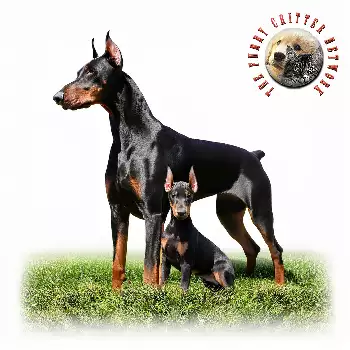
The Dobermann is a dog of elegant athleticism - not massive and not fine, but precisely balanced between power and refinement. The overall impression is of a dog built for sustained work: muscular enough to have genuine physical capability, lean enough to move with efficiency and speed. Side by side with an American Doberman Pinscher, a European Dobermann of working breeding may appear somewhat more substantial and heavier in bone, reflecting the different selection pressures between the two lines over decades of separate development.
The head is long, lean, and refined with a wedge-shaped skull and a muzzle that runs parallel to the topskull. The stop is slight. The skin lies flat throughout the head without wrinkling or looseness - the breed standard term is dry, meaning tight and clean. Eyes are oval, medium-sized, dark in color, and carry an expression of keen alertness that is one of the breed's most characteristic features. The gaze of a Dobermann at attention is direct and evaluating in a way that is distinctly different from breeds with a softer, more diffuse expression.
The neck is long, well-muscled, and cleanly arched, rising from well-laid-back shoulders and contributing substantially to the breed's elegant silhouette. The body is square or very slightly rectangular - the FCI standard specifies that the length from the point of the shoulder to the point of the buttock should not exceed the height at the withers by more than five percent. The chest is broad and deep, reaching to the elbow. The topline is firm and level. The underline shows a slight tuck-up that reinforces the impression of an athletic, working-capable body.
The coat is short, hard, thick, and close-lying. It requires minimal maintenance while effectively showing the musculature and clean body lines underneath. FCI-recognized colors are black with rust-red markings, brown with rust-red markings, blue with rust-red markings, and fawn (Isabella) with rust-red markings. The rust-red markings appear in a specific pattern: above each eye, on the muzzle and throat, on the chest in two parallel stripes, on all four legs, on the feet, and below the tail. Markings that deviate significantly from this pattern are considered faults.
Movement in the Dobermann is ground-covering and elastic, driven from well-angulated hindquarters and reaching well forward with the front. The FCI standard emphasizes that movement should appear effortless and free, with the dog covering ground efficiently at a working trot. Proper movement is not just aesthetically important - it reflects the structural soundness needed for a breed expected to work at sustained pace over varied terrain. Dogs that move short or stilted behind, or that crab or roll excessively, have structural issues that compromise their working capability.
Some observable differences exist between American and European Dobermann lines that are worth knowing for buyers comparing dogs. European working-line Dobermanns tend to be somewhat heavier in bone and substance, reflecting selection toward a dog that can perform physically demanding IGP work. American show-line Dobermans often present as leaner and more elegant. Both expressions fall within the overall standard, and neither is more correct in an absolute sense - the right expression depends on what the buyer intends to do with the dog. The key physical attributes - the dry head, clean neck, level topline, short hard coat, and rust-red marking pattern - are consistent across both lines.
The Dobermann's physical conditioning changes meaningfully with exercise level. A well-conditioned working dog in regular training shows defined musculature and a taut, athletic outline. The same dog in a low-activity period will soften noticeably. This responsiveness to conditioning means that the Dobermann owners see in sport venues typically looks more impressive than the same breed in a less active context - the breed shows its physical best when it is being worked.
Affectionate With Family
★★★★★
The Dobermann bonds with extraordinary intensity to its family unit - this is a breed that defines itself through its relationships with the people it lives with. That devotion is total and unconditional once it is established.
Good With Young Children
★★★★☆
Dobermanns raised alongside children are typically protective and patient with the kids they know. The breed's size and energy level warrant supervision around very young children, but the intelligence and trainability make clear household rules effective.
Good With Other Dogs
★★★☆☆
Manageable with other dogs when properly socialized, though dominant tendencies - particularly between intact same-sex animals - require ongoing attention. Multi-dog households need thoughtful management of resources and introductions.
Shedding Level
★★★☆☆
The short coat sheds year-round at a consistent, moderate level. A weekly once-over with a rubber curry or grooming mitt manages it well. You will find hairs on dark fabric, but nothing unmanageable.
Coat Grooming Frequency
★☆☆☆☆
Minimal coat maintenance is one of the Dobermann's most practical attributes. Weekly brushing and monthly bathing covers the full routine - no trimming, no stripping, no professional appointments required.
Drooling Level
★☆☆☆☆
The Dobermann is a clean, dry-mouthed breed. The tight lip structure that contributes to the breed's refined head profile also means drooling is essentially a non-issue.
Coat Type
★☆☆☆☆
Short, hard, and flat - the coat requires minimal work and showcases the breed's athletic musculature. It is a practical coat for a breed built for work.
Openness To Strangers
★★☆☆☆
Reserved and evaluating with unfamiliar people - a trait that reflects the breed's purpose rather than a socialization failure. A well-socialized Dobermann is controlled and watchful around strangers, not aggressive without cause.
Playfulness Level
★★★★☆
Genuinely playful, particularly with trusted family members. The Dobermann retains an engaged, energetic quality well into adulthood that owners who are looking for an active companion will appreciate.
Watchdog/Protective Nature
★★★★★
Protection is the Dobermann's founding purpose and the instinct runs deep regardless of how the dog is kept. Alert, fast to read a situation, and deeply bonded to its people - these traits combined make the breed a natural guardian.
Adaptability Level
★★★☆☆
Adapts to different housing situations when exercise and mental stimulation needs are genuinely met. The Dobermann needs engagement, not just space - an under-exercised Dobermann in a large house is less settled than a properly exercised one in a smaller home.
Trainability Level
★★★★★
Among the most trainable breeds in existence - fast to learn, eager to work, and possessing the intelligence to retain complex behavioral chains. The Dobermann wants a job and a handler it respects.