Do-ken

Hokkaido

Quick Facts

🐕 Breed Group
Non-Sporting Group
📏 Size Category
Medium
📏 Height
Males: 19-20 inches, Females: 18-19 inches
⚖️ Weight
Males: 44-66 lbs, Females: 44-66 lbs
⏱️ Life Expectancy
12-15 years
🧣 Coat Type
Double coat, dense and harsh outer coat
🎨 Coat Colors
White, red, black and tan, brindle, sesame, wolf gray (rare)
😀 Temperament
Loyal, alert, brave, independent
🏃 Exercise Needs
High
🎓 Training Difficulty
Moderate
👶 Good with Children
Good with older children when socialized
🐾 Good with Other Pets
Moderate - high prey drive toward small animals

Other Names & Breed Recognition

Do-ken - sometimes written Dooken or Do Ken - is one of several Japanese-language names used for the breed most commonly known in English as the Hokkaido. The name translates roughly to "road dog" or "working dog" in certain regional dialects, though its usage has been closely tied to communities in northern Japan who relied on these dogs as hunting partners and guardians. For anyone encountering this name outside of Japan, it refers to the same ancient spitz-type breed developed on Japan's northernmost main island.

The most widely recognized name in Japan today is Hokkaido-ken or Hokkaido-inu, both of which translate to "dog of Hokkaido" and reflect the breed's geographic identity. This designation was officially adopted by Japan's Ministry of Education in 1937 when the breed was placed on the country's protected species list. Prior to that, the breed was commonly referred to as Ainu-ken or Ainu-inu, names honoring the Ainu people who were historically inseparable from the breed's development. The transition from Ainu-ken to Hokkaido reflected a shift in how Japan was framing the breed's identity - less as a cultural artifact of the Ainu indigenous people and more as a symbol of the northern island itself.

Do-ken as a name occupies a more informal, regionally rooted position in the breed's naming history. It has never appeared in formal kennel club registrations and does not carry official standing with the Japan Kennel Club or any international body. The breed is registered with the FCI under the name Hokkaido in Group 5 (Spitz and Primitive Types), and with the AKC under the same name in the Non-Sporting Group since 2013. In Japan, the primary registration body is the Nihon Ken Hozonkai, known as NIPPO, which recognizes the Hokkaido as one of the six native Japanese breeds considered national treasures.

For anyone researching the Do-ken specifically because that is the name they encountered, the most important thing to understand is that the breed has multiple names depending on who is speaking, what era they are from, and what aspect of the breed's heritage they are emphasizing. Ainu-ken points to cultural heritage. Hokkaido-ken points to geography. Do-ken points to function and regional identity. All of these names describe the same remarkable dog - compact and powerful, deeply loyal, and still relatively rare outside of Japan despite growing international interest over the past two decades.

Do-ken Organizations & Standards

The most important organization for anyone serious about the Do-ken in Japan is the Nihon Ken Hozonkai, known by the abbreviation NIPPO. Established in 1928, NIPPO's founding mission was the preservation of Japan's six native dog breeds at a time when foreign breeds were rapidly displacing them. The Hokkaido - registered by NIPPO under that name - holds a place of particular honor as one of the hardiest and most primitive of the six, and NIPPO maintains detailed breed standards that have changed little over decades. The Hokkaido was designated a Natural Monument of Japan in 1937, a status that carries genuine legal and cultural weight.

Internationally, the breed is registered with the Federation Cynologique Internationale under the name Hokkaido in FCI Group 5, Section 5 (Asian Spitz and related breeds), Standard Number 261. The FCI standard describes a medium-sized, well-muscled dog with a bold and loyal character, specifying the correct structural proportions, coat type and acceptable colors, ear set, tail carriage, and movement. This is the standard that guides breeders outside of Japan who are working with the breed under FCI rules.

In North America, the Hokkaido Association of North America, known as HANA, serves as both a breed club and a health advocacy organization. HANA has established a health testing protocol that requires OFA or PennHIP hip evaluations and OFA cardiac examinations for all breeding dogs, along with CAER eye examinations by a board-certified veterinary ophthalmologist. HANA also tracks Collie Eye Anomaly (CEA) within the North American population and maintains a strong stance against breeding dogs that have not completed the required health screenings.

The American Kennel Club officially recognized the Hokkaido in 2013 in the Non-Sporting Group. The AKC standard calls for a dog that is medium in size, well-boned, and capable of enduring cold and rugged terrain. The standard specifies that males should stand 18.5 to 21.5 inches at the withers and females 17 to 19.5 inches. Acceptable colors under the AKC standard include sesame, brindle, red, black and tan, white, and wolf gray. The standard places particular emphasis on the bold and dedicated character of the breed, noting that the Hokkaido is brave and fiercely devoted to its owner.

For anyone considering a Do-ken from a North American breeder, HANA membership is a reasonable indicator that the breeder is engaged with the health and preservation standards the breed community considers essential. Puppies from HANA-affiliated breeders should have parents with documented hip, cardiac, and eye clearances on file with OFA.

Kennel Club Recognition

  • American Kennel Club (AKC): Recognized in 2013, Non-Sporting Group
  • United Kennel Club (UKC): Recognized, Northern Breeds
  • FCI: Recognized, Group 5 - Spitz and Primitive Types

Do-ken Physical Description

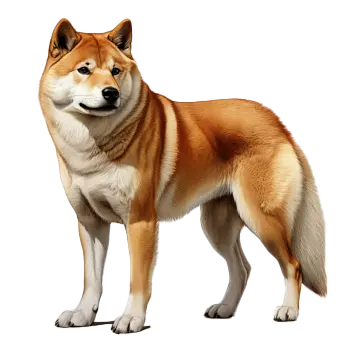
Stand next to a Do-ken and you immediately understand why this dog was trusted to track and bay large game in the mountains of northern Japan. It has the look of a dog that was built for work in rough terrain - compact and dense, with nothing wasted and nothing exaggerated. The overall impression is of controlled power in a medium frame.

The head is the most expressive feature. The skull is broad and slightly rounded, with a well-defined stop that gives the face a determined, alert quality. The muzzle is wedge-shaped and proportionate, tapering to a black nose. The eyes are small, set somewhat triangularly, and dark brown in color - they give the dog a focused, intelligent expression that reads as both watchful and engaged. Blue-black tongue pigmentation, similar to what you see in Chow Chows or Shar-Peis, is seen in some individuals and is considered acceptable. The ears are small and erect, set slightly forward, and always pricked - they swivel independently to catch sound and give the dog a perpetually alert appearance.

The neck is muscular and moderately arched, flowing into strong, well-laid-back shoulders. The chest is deep and moderately broad, giving good lung capacity without the barrel-chested look of some working breeds. The back is straight and firm, the loin well-muscled. The overall body length is slightly longer than the height, giving the dog the rectangular silhouette common to most spitz breeds built for endurance over speed.

The legs are straight and well-boned with the kind of solid construction you'd want in a dog navigating snowy, rocky terrain. The feet are tight and compact, with thick pads and strong, well-arched toes. The hind end provides the push - muscular thighs and well-angled stifles give the Do-ken a powerful rear drive that is evident in its purposeful, elastic trot.

The tail is the classic spitz signature - thick, well-furred, and carried curled over the back. It sits firmly in place during movement and at rest, and its bushy texture matches the density of the rest of the coat.

The coat is a double structure designed for the climate of Hokkaido, where winters are harsh and hunting season does not stop for weather. The outer coat consists of stiff, straight guard hairs that repel moisture and debris. Underneath, the undercoat is dense and soft, providing thermal insulation that allows the dog to work comfortably in deep snow and bitter cold. The coat is medium in length - not as long as an Akita, not as short as a Shiba - and lies flat against the body rather than standing off in the dramatic fashion of some northern breeds.

Accepted colors include sesame (a mix of red and black-tipped hairs), brindle (striped pattern of dark on a lighter base), red, black and tan, white, and the rare wolf gray. White dogs are striking but require the same health attention given to white-coated individuals in other breeds - pigmentation screening, particularly for eye anomalies, is important. Sesame-coated individuals are among the most visually distinctive.

In motion, the Do-ken covers ground with an economical, reaching stride. It does not prance or mince - it moves with the efficiency of a dog that was bred to travel miles in difficult conditions. At a trot, the outline stays level and the topline remains firm. The rear drives cleanly and the front reaches with purpose, the whole picture suggesting endurance rather than flash.

Size falls in the medium range: males stand 18.5 to 21.5 inches and females 17 to 19.5 inches, with weight typically ranging from 44 to 66 pounds. This is a dog whose physical description cannot really be separated from what it was built to do.

Affectionate With Family
The Do-ken bonds deeply with the people who earn its trust, following its owner from room to room and expressing emotion openly. These dogs wear their loyalty on their sleeve - they are genuinely devoted companions.
Good With Young Children
The Do-ken does best with older children who understand how to interact respectfully with a dog. Younger children and toddlers can overwhelm this breed, and supervision is always recommended.
Good With Other Dogs
With proper early socialization, the Do-ken can coexist peacefully with other dogs, particularly those of similar size. Without socialization, same-sex conflicts can arise.
Shedding Level
The Do-ken sheds consistently year-round and blows its undercoat heavily twice a year during seasonal changes. Regular brushing is the only real management strategy.
Coat Grooming Frequency
Weekly brushing keeps the Do-ken's coat in good condition under normal circumstances, with daily attention required during the heavy seasonal shed periods in spring and fall.
Drooling Level
The Do-ken is a dry-mouthed breed with no tendency toward drooling. This is one maintenance concern that does not apply.
Coat Type
The coat is a double structure with a harsh, straight outer layer and a dense, soft undercoat. It is thick enough to insulate against the severe winters of northern Japan.
Openness To Strangers
The Do-ken is reserved with people it does not know, which is a deeply ingrained trait from its history as a watchdog and hunter. Strangers are assessed, not welcomed on sight.
Playfulness Level
With its own family the Do-ken is animated, playful, and enthusiastic about activity. That energy drops off considerably around unfamiliar people or in new environments.
Watchdog/Protective Nature
Alertness is hardwired into the Do-ken. It notices everything and will communicate accordingly. Its protective instinct toward family members is genuine and consistent.
Adaptability Level
The Do-ken adjusts reasonably well to different living situations provided its exercise needs are met. It struggles in prolonged heat and is not well-suited to being home alone for long stretches.
Trainability Level
The Do-ken is intelligent and motivated to work with its owner, though it has an independent streak that requires consistent and confident handling. It learns quickly when training feels like collaboration rather than compliance.

Do-ken History & Development

The name Do-ken is a window into a particular layer of the Hokkaido's history - a layer defined less by dog shows and breed standards and more by the daily realities of hunting and survival in northern Japan. To understand what Do-ken means and why it was used, you have to understand who was using it and where.

The Hokkaido dog traces its roots to ancient dogs brought to the island of Hokkaido - Japan's northernmost large island - by the Ainu people, the indigenous inhabitants of the region. The Ainu began migrating to Hokkaido from the main island of Honshu during the Kamakura period, roughly the 12th and 13th centuries, and they brought their dogs with them. The isolation of Hokkaido and the extreme harshness of its climate shaped those dogs over centuries into something distinct from the breeds developing on Honshu. By the time the outside world took notice, the Hokkaido dog was a fully formed type - adapted to cold, proven against large prey including bear and deer, and deeply bonded to the Ainu way of life.

The Ainu called the dog Ainu-ken, and for much of the breed's documented history, that was its primary identity in the broader Japanese consciousness. The regional names - Do-ken among them - reflected how different communities across Hokkaido and the northern regions referred to these dogs in everyday use, not in formal documents. The name Do-ken captured the functional identity of the dog in certain communities, describing it as a working dog or a dog of the road and trail rather than attaching it to any specific ethnic or geographic identity.

The modern recorded history begins in earnest in 1869 when Thomas W. Blankiston, a British zoologist exploring Hokkaido, formally observed and described the breed. Japanese awareness of the breed as something worth preserving as a cultural treasure grew through the late 19th and early 20th centuries. A pivotal moment came in 1902 when Hokkaido dogs participated in a search and rescue effort during a Japanese army expedition across the Hakkoda Mountains, where soldiers became trapped in a devastating snowstorm. The dogs' performance in those conditions brought national attention to the breed's capabilities.

Formal recognition came in 1937 when the Japanese government designated the Hokkaido as a Natural Monument under the Law for the Protection of Cultural Properties. At that point, the Ministry of Education officially shifted the breed's primary name from Ainu-ken to Hokkaido, the geographic designation that remains standard today. This change was significant - it reframed the dog as a symbol of the island and the nation rather than exclusively of the Ainu people.

Do-ken, along with Ainu-ken, persisted as informal names in regional usage even after the official rename, the way traditional names often do. These names carried cultural memory in communities where the distinction between an official designation and lived language was not particularly meaningful. Today, outside of Japan, the breed is almost exclusively called Hokkaido, and Hokkaido-ken or Hokkaido-inu are the standard Japanese references. Do-ken remains a historical and regional name - a piece of the breed's layered naming history that tells you something real about how these dogs lived alongside people for centuries before anyone was keeping registries.

Do-ken Temperament & Personality

If you've ever been standing next to your aquarium and noticed a dog watching everything in the room the way the fish watch you - steady, focused, fully aware - you've got a sense of what a Do-ken in a home feels like. This is a dog that misses nothing and processes everything. That alertness is not anxiety. It's the instinct of a breed shaped over centuries to track game, assess threats, and stay connected to its handler in difficult conditions.

The bond a Do-ken forms with its family is one of the most distinctive things about the breed. These dogs are described consistently by owners as emotionally transparent - they do not hide what they feel, they seek proximity constantly, and they are likely to follow their person from room to room throughout the day. Rehoming an adult Do-ken can be genuinely difficult because the dog's attachment to its original family is deep and lasting. This is not a breed that transfers easily to new owners after several years of bonding.

With strangers, the Do-ken operates very differently. Reserve is the norm, not the exception. The dog will watch a newcomer carefully before extending any trust, and some individuals will never become fully comfortable with people outside the immediate household. This is not aggression in well-socialized dogs - it is an assessment process. The appropriate response when introducing a Do-ken to new people is patience and zero pressure. Forcing interaction only deepens the suspicion.

The Do-ken's prey drive is real and needs to be acknowledged plainly. This is a breed that hunted bear in the mountains of Hokkaido. The instinct to pursue small, fast-moving animals did not disappear because the breed moved into suburban homes. Small dogs, cats, rabbits, and similar animals are at risk in a Do-ken household unless introductions were made very early and very carefully. Even then, some individuals retain a chase instinct that cannot be fully trained out - management is part of the picture.

When the Do-ken's physical and mental needs are not met consistently, specific problem behaviors emerge that owners report across the breed. Psychogenic polydipsia - the compulsive drinking of large amounts of water followed by vomiting - has been documented in multiple Do-ken owners in North America and appears to be related to stress or understimulation. Pica, the eating of non-food items including rocks, fabric, and sticks, is another documented pattern in the breed. Both behaviors are signals that the dog is bored, anxious, or not getting the engagement it needs - not signs of a broken dog. Address the root cause and the behavior typically resolves.

These are intelligent dogs in the way that makes daily life interesting - they problem-solve, they learn quickly, and they notice patterns in their environment that most dogs miss. That intelligence needs direction. A Do-ken with nothing to think about will find something to think about, and the choice may not align with what you had in mind for your living room.

Do-ken Family Life & Living Requirements

The Do-ken is genuinely a family dog once it decides your family is its family - and that decision, once made, is firm. These dogs extend their protective instinct to everyone in the household, including children, and they are attentive companions who prefer to be where the action is rather than confined to a yard or crate. But the fit between a Do-ken and a given household depends on a few things that are worth thinking through honestly before you commit.

Older children are a much better match than toddlers and very young kids. The Do-ken's patience is real but not unlimited, and a small child who grabs, shrieks, or moves unpredictably can be overwhelming for a dog that processes its environment so carefully. Households with children under five should think carefully about whether the energy level and unpredictability of that age group is a good fit for this breed at this stage. That said, Do-kens raised alongside children from puppyhood and socialized consistently tend to become stable, tolerant family dogs over time.

Space matters for this breed. A home with a securely fenced yard is strongly preferred over apartment living. The Do-ken has enough energy and enough instinct to make apartment confinement a real challenge unless the owner is committed to serious daily exercise. If you live without a yard, every single day needs to include structured exercise - not just a walk around the block, but real physical activity that gives the dog a chance to move at speed and engage its senses.

The Do-ken does not do well in heat. This is a breed built for the cold - its double coat was designed for Hokkaido winters, and in climates with hot summers, owners need to be thoughtful about when and how much exercise happens during warm months. Air conditioning during heat waves is not optional; it's a management necessity.

Long periods of solitude are genuinely problematic for this breed. The Do-ken's deep family attachment means separation anxiety is a real risk for dogs left alone for extended periods on a regular basis. If your household requires a dog that can handle eight or more hours alone routinely, this is probably not the right breed for your situation.

Do-ken Training & Exercise Needs

Training a Do-ken goes best when it feels like a partnership rather than a performance. These are dogs that are motivated by their connection to their owner, which means they respond well to positive reinforcement - play, praise, food rewards - delivered by someone they trust. What they do not respond well to is heavy-handed correction or training that feels adversarial. Push back hard and the Do-ken will disengage, not comply.

The independent streak in this breed is real. The Do-ken was bred to make decisions in the field without constant handler input - a dog tracking a bear through deep snow cannot stop to ask for direction at every fork in the trail. That self-reliance translates in a home setting to a dog that will assess commands rather than execute them automatically. Training a Do-ken requires consistency, patience, and the understanding that the dog is thinking about what you're asking rather than just reacting to it.

Socialization during puppyhood is probably the single most important investment you can make with this breed. The Do-ken's natural wariness of strangers can tip into problematic reactivity if the dog has not been exposed to a wide range of people, places, sounds, and experiences during its critical developmental window. Early, positive, and ongoing socialization doesn't eliminate the breed's natural reserve - it ensures that reserve doesn't become fear or aggression.

Physically, the Do-ken needs more exercise than most people expect from a medium-sized dog. This is a breed that was built for endurance work in mountainous terrain. Plan for at least an hour of vigorous exercise daily, and ideally more than that. Hiking, running, and activities that combine physical exertion with sensory engagement - tracking, scent work - are ideal. Exercise done with the owner is far more effective than exercise done alone in a yard, both because the breed craves that interaction and because unsupervised yard time is when the boredom-related problem behaviors tend to emerge.

Off-leash work requires honest assessment. The Do-ken's prey drive and tendency to follow its nose mean that reliable off-leash recall in an unfenced environment is a serious training goal that takes time and consistency to achieve. Until that reliability is solid, a long line or secure fencing is the practical choice.

Do-ken Health Concerns

The Do-ken is considered a generally healthy breed with a lifespan of 12 to 15 years. But "generally healthy" doesn't mean maintenance-free, and there are specific conditions documented in this breed that every owner should be familiar with.

Two behavioral health conditions - pica and psychogenic polydipsia - also appear specifically in this breed. Pica involves the compulsive ingestion of non-food items. Psychogenic polydipsia involves compulsive water drinking in large quantities followed by vomiting. Both are believed to be connected to understimulation or anxiety and are managed primarily through addressing the underlying cause.

Common Health Issues

  • Collie Eye Anomaly (CEA): A genetic eye condition affecting a large portion of the Hokkaido population - Estimated at roughly two-thirds as carriers - caused by a mutation on canine chromosome 37. Severity ranges from minor depth perception impairment to retinal detachment and blindness, but the condition is non-progressive, so function at eight weeks reflects lifetime function.
  • Hip dysplasia: An inherited abnormality in hip joint formation that can lead to painful arthritis and reduced mobility. Most tested North American Hokkaidos have come back with Good or Excellent OFA ratings - But the condition is documented in the population.
  • Idiopathic seizures: Genetic seizure disorder with no identifiable physical cause - Onset typically occurs between six months and six years of age. The condition is incurable and affected dogs should be removed from breeding programs.
  • Cardiac murmurs: Heart murmurs have been documented in breeding Hokkaidos - And OFA cardiac evaluation by a board-certified cardiologist is mandatory for HANA-member breeders. Dogs with murmurs should not be bred.
  • Psychogenic polydipsia and pica: Both conditions are documented in the breed and believed to be linked to understimulation or anxiety. Psychogenic polydipsia involves compulsive water overconsumption and subsequent vomiting. Pica involves eating non-food items including rocks - Fabric, and sticks.

Preventive Care & Health Monitoring

  • CAER eye examination by a board-certified veterinary ophthalmologist is required for all HANA-member breeding dogs to screen for Collie Eye Anomaly - A DNA test for CEA is also available and recommended for breeding stock.
  • OFA or PennHIP hip evaluation is required for all breeding Hokkaidos in North America under HANA's health protocol - All dogs with failing or borderline evaluations should be removed from breeding consideration.
  • OFA cardiac examination by a board-certified cardiologist is mandatory for HANA breeding dogs - Annual cardiac monitoring is also reasonable for adult pets given the documented prevalence of murmurs in the breed.
  • Monitor for signs of seizure activity - Particularly in dogs between six months and six years. Document frequency and duration and report to your veterinarian for evaluation and management planning.
  • Ensure adequate daily physical and mental stimulation to reduce risk of anxiety-related conditions including pica and psychogenic polydipsia - A Do-ken with insufficient exercise and engagement is a Do-ken at risk for these behavioral health problems.

Do-ken Grooming & Maintenance

The Do-ken's double coat is one of its defining features and, honestly, one of the less demanding aspects of owning this breed once you understand what the coat requires. Under normal circumstances - meaning outside of the two annual shedding blowouts - the coat needs a thorough brushing once a week with a pin brush and a metal comb to work through the undercoat. The outer guard hairs are relatively self-cleaning and resist matting, so routine maintenance is not particularly time-intensive.

Twice a year, spring and fall, the Do-ken blows its undercoat in a process that is genuinely dramatic if you have never owned a double-coated Nordic breed. During these periods, the loose undercoat comes out in large quantities and daily brushing is needed to keep it from accumulating on every surface in your home. An undercoat rake or slicker brush used in the direction of hair growth is effective during these periods. Some owners find that a professional deshedding treatment at a groomer is worth the cost during peak shed season.

Bathing is infrequent - the Do-ken's coat repels dirt and moisture naturally, and over-bathing strips the oils that keep the coat functioning as it should. Every six to eight weeks or when the dog is genuinely dirty is a reasonable schedule. Use a shampoo designed for double coats and ensure the undercoat is fully dried afterward to prevent skin irritation at the skin level.

Nails, ears, and teeth round out the maintenance picture. Nails should be checked monthly and trimmed before they reach the point where they affect the dog's gait or foot structure. Active dogs who walk on pavement regularly will wear their nails down naturally, but it's worth checking anyway. The ears are naturally erect and allow for good air circulation, which reduces infection risk compared to dropped-ear breeds - a gentle cleaning with a vet-approved ear cleaner on a regular schedule is sufficient. Dental care through brushing or dental chews is important for long-term health, as periodontal disease is a common issue across all dog breeds.