Diehard

Scottish Terrier

Quick Facts

🐕 Breed Group
Terrier Group
📏 Size Category
Small
📏 Height
Males: 10 inches, Females: 10 inches
⚖️ Weight
Males: 19-22 pounds, Females: 18-21 pounds
⏱️ Life Expectancy
11-13 years
🧣 Coat Type
Hard, wiry outer coat with dense soft undercoat
🎨 Coat Colors
Black, wheaten, brindle
😀 Temperament
Independent, loyal, spirited, dignified
🏃 Exercise Needs
Moderate
🎓 Training Difficulty
Moderate - independent thinker
👶 Good with Children
Better with older children
🐾 Good with Other Pets
Can be territorial, best with early socialization

Other Names & Breed Recognition

Diehard is one of the most evocative breed nicknames in the terrier world, and it was earned. The name was applied to the Scottish Terrier during the era when the breed was being consolidated and promoted in the Scottish Highlands in the nineteenth century. The dog's legendary refusal to give up underground - its willingness to follow quarry into burrows and hold or flush it regardless of what the quarry did in response - impressed everyone who worked with these dogs. The word Diehard described exactly what the breed did. It did not quit. It earned that name through a very specific kind of courage.

The most frequently cited origin of the Diehard name involves George, the fourth Earl of Dumbarton, whose regiment of Scottish soldiers was nicknamed Dumbarton's Diehards for their tenacity in battle during the eighteenth century. The Earl maintained a pack of Scottish Terriers and reportedly called them Diehards in tribute to his regiment. Whether this origin story is precisely accurate or has been polished over time in the retelling, the association between the breed's temperament and the Diehard nickname is genuine and consistent with the dog's actual character.

Beyond Diehard, the Scottish Terrier carries several other alternate names. Scottie and Scottie Dog are the most widely used informal names in everyday conversation, used affectionately by owners and recognized immediately by anyone familiar with the breed's distinctive silhouette. Aberdeen Terrier is a historical alternate name that reflects the breed's association with the Aberdeen area of Scotland and was used in official documentation and breed club records before the name Scottish Terrier became the standard designation. The name Scottie appears frequently in popular culture, having been attached to the breed by everyone from Monopoly game designers to cartoon animators to American presidents who kept them as companions.

The Scottish Terrier is recognized by every major kennel club. The AKC has recognized the breed since 1885, placing it in the Terrier Group. The FCI classifies it in Group 3, Section 2 among the small terriers. The Kennel Club in the UK and the Canadian Kennel Club both recognize it in their respective terrier categories. The breed's international recognition is consistent, and the Diehard name, while informal, appears in breed histories and enthusiast literature across all of these registry traditions.

Diehard Organizations & Standards

The Scottish Terrier Club of America serves as the AKC parent club for the breed in the United States. Founded in 1900, the STCA is one of the older breed clubs in American purebred dog history and maintains the breed standard, sponsors specialty shows, and provides health and breeder information to the public. The club's health committee has been active in tracking the breed's documented health conditions and supporting research into conditions of concern, particularly the neurological and blood coagulation disorders that affect the Scottish Terrier.

The Scottish Terrier Club in the United Kingdom has an even longer history, with organized breed activity tracing to the 1880s when the breed was being formally standardized. The UK club works under The Kennel Club and maintains its own breed standard documentation. Given that the Scottish Terrier originated in Scotland and Britain, the UK clubs have historically been central to documenting and preserving the breed's character and conformation requirements. The Diehard nickname appears in British breed literature going back to the nineteenth century.

The AKC breed standard for the Scottish Terrier describes a small but substantial dog. The standard emphasizes a sturdily built dog of moderate size that is longer in the body than it is tall, with a large head in proportion to its size, powerful jaws, and the characteristic harsh, wiry coat. The standard is explicit about the quality of the coat - it should be hard and wiry to the touch, not soft or silky. The body is described as remarkably muscular for the breed's size, and the word power appears repeatedly in the standard's language, reflecting the breed's origins as a working dog that needed genuine physical capability underground.

Health testing recommendations from the STCA and the parent club's health committee include evaluation for Scottie cramp, von Willebrand's disease, and bladder cancer screening awareness. The CHIC program for the Scottish Terrier includes DNA testing for von Willebrand's disease as a core requirement. Responsible breeders complete these evaluations before breeding and make results available to puppy buyers who ask.

The STCA also maintains a breeder referral service and publishes a breed health survey that tracks the conditions appearing most frequently in the population. This kind of organized data collection through parent clubs is one of the most valuable tools available to breed communities working to understand and reduce inherited health problems over time.

Kennel Club Recognition

  • American Kennel Club (AKC): Recognized in 1885, Terrier Group
  • United Kennel Club (UKC): Recognized, Terrier Group
  • Canadian Kennel Club (CKC): Recognized, Terriers
  • FCI: Recognized, Group 3 - Terriers
  • The Kennel Club (UK): Recognized, Terrier Group

Diehard Physical Description

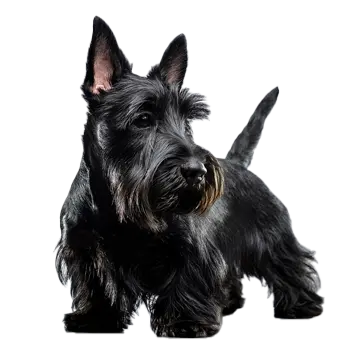
The Diehard presents as a small dog with a personality and physical presence that immediately communicates more substance than its actual size would suggest. Standing approximately 10 inches at the withers and weighing somewhere between 18 and 22 pounds depending on sex, the Scottish Terrier is compact and dense, built with the muscularity of a dog that was designed to work underground in Scottish terrain. Pick one up and you discover how solid it actually is beneath all that coat.

The head is large relative to the body and is one of the most distinctive features of the breed. It is long in proportion, with a flat skull that shows a slight stop. The muzzle is approximately equal in length to the skull. The jaws are powerful and the teeth should meet in a scissors bite. The nose is large and black. This is a head built for working - the jaw power is functional, not ornamental, and the length of muzzle accommodates a grip that terriers relied on underground.

The ears are small, pointed, and carried fully erect. They are set reasonably high on the skull. The texture of the ear leather should be fine, and the ears are covered in short, velvety hair of a finer quality than the body coat. These upright, alert ears contribute significantly to the Scottish Terrier's characteristic expression, which is simultaneously serious and keen.

The eyes are small, almond-shaped, and set wide apart under prominent brow furnishings that are one of the breed's most recognizable features. The brow, when the coat is in proper condition, gives the face a hooded, intense quality that becomes more pronounced with correct coat growth and trimming. Eye color is dark brown.

The neck is moderately short, muscular, and set into well-laid-back shoulders. The topline is level. The chest is moderately broad and the brisket is well let down between the forelegs. The body is compact and well-ribbed up. The back is quite short compared to some other terrier breeds, which contributes to the cobby, substantial look of a well-put-together Scottie. The hindquarters are muscular and well-angulated. The tail is of moderate length, thick at the base, carried upright or with a slight curve forward.

The feet are round and compact with thick pads, built for traction on rough terrain. The forelegs are heavy-boned and straight. The overall impression is of a small dog with genuine structural substance, not a fragile companion but a working terrier in a compact package.

The double coat is the breed's most distinctive physical characteristic. The outer coat is hard, dense, and wiry - not soft, not wavy, not smooth. It provides serious weather resistance. The undercoat is softer and dense. Colors are black, wheaten in various shades from pale cream to golden, and brindle in combinations of black and tan. In show condition, the coat is hand stripped - dead outer coat is plucked by hand or with a stripping knife to maintain the harsh texture. Clipped coats are common in companion dogs but typically produce a softer coat texture over time that lacks the breed-correct hardness.

The overall picture of the Diehard in good condition is of a compact, sturdy dog that looks capable - because it is. There is nothing delicate or ornamental about the correctly built Scottish Terrier. The bone is heavy, the musculature is real, and the coat is functional. The distinctive outline created by the long head, upright ears, well-furnished beard and eyebrows, and level topline is immediately recognizable and unlike any other terrier breed. Judges and longtime breed enthusiasts often describe the correct Scottie as looking like a dog that could actually do its job, which is the highest compliment you can pay a terrier bred for work.

Affectionate With Family
The Diehard is devoted to its household in a dignified, self-possessed way. Affection is offered on the dog's own terms rather than as a constant demand, and that suits many owners just fine.
Good With Young Children
Best matched with older children who respect the Scottish Terrier's space and independent nature. Very young children who grab or startle this confident little dog can provoke a sharp response.
Good With Other Dogs
Same-sex aggression is documented in the breed and same-sex pairing requires careful management. The Scottie's confident nature means it rarely backs down from a confrontation with other dogs.
Shedding Level
The wiry double coat sheds minimally compared to many breeds, making the Scottie a reasonable choice for households that prefer to keep dog hair off furniture and clothing.
Coat Grooming Frequency
The wiry coat requires hand stripping to maintain its correct harsh texture for show purposes, or regular clipping for companion dogs. Either way, the coat needs consistent professional attention.
Drooling Level
Dry-mouthed and tidy. Drool is not something Scottie owners spend any time thinking about.
Coat Type
The wiry, hard outer coat is a defining characteristic of the breed - dense and weather-resistant with a softer undercoat beneath that provides insulation.
Openness To Strangers
The Scottish Terrier is not a dog that warms up instantly to new people. Reserved and watchful on first meeting, it takes time to accept strangers as part of its acceptable circle.
Playfulness Level
Energetic in bursts and genuinely playful when the mood strikes, though the Scottie also has a dignified quality that keeps it from being the most exuberantly playful dog in the room.
Watchdog/Protective Nature
Alert, vocal, and unintimidated by things considerably larger than itself. The Diehard takes its watchdog responsibilities seriously and announces visitors with confidence.
Adaptability Level
Adapts reasonably well to varied living situations given adequate daily exercise and mental stimulation. The Scottish Terrier is more flexible than its stubborn reputation suggests when its basic needs are met.
Trainability Level
Intelligent and fully capable of learning what you are asking, but inclined to evaluate whether compliance is worth its time. Training requires patience, consistency, and a sense of humor.

Diehard History & Development

The name Diehard tells you something essential about what this breed was made to do and how it earned admiration doing it. The Scottish Terrier developed in the Scottish Highlands over centuries as a working earth terrier - a dog specifically bred to go underground after vermin, particularly rats, rabbits, otters, and foxes that threatened livestock and game. The terrain of the Scottish Highlands demanded a dog that was small enough to follow quarry into rocky burrows and dens, bold enough to face whatever it found there, and persistent enough to continue working regardless of what the quarry did in response. The Diehard name captured all of that.

The specific origins of the Scottish Terrier as a distinct type are debated among breed historians, as the terriers of Scotland in the eighteenth and early nineteenth centuries were not clearly differentiated by modern breed standards. Several Scottish terrier varieties existed simultaneously in different regions, including what would become the Cairn Terrier, the West Highland White Terrier, the Dandie Dinmont Terrier, and the Scottish Terrier, all likely sharing common ancestry before selective breeding and geographic isolation pushed them toward distinct types. By the mid-nineteenth century, breeders in the Aberdeen area of Scotland were working specifically toward the type that became the Scottish Terrier, which led to the historical alternate name Aberdeen Terrier.

The first formal breed standard for the Scottish Terrier was written in 1880, and a Scottish Terrier Club was established in Britain in 1882. These organizational steps formalized what breeders in Scotland had been working toward and set the stage for the breed's recognition by major kennel clubs. The AKC recognized the breed in 1885, making it one of the earlier terrier breeds formally registered in the United States.

The Diehard name gained cultural resonance beyond the working dog world when Scottish soldiers known as Dumbarton's Diehards carried their reputations for battlefield tenacity alongside the breed's reputation for terrier toughness. Both earned the same word for the same quality, and the association stuck. By the time breed enthusiasts were writing histories of the Scottish Terrier in the twentieth century, the Diehard nickname was firmly attached to the breed's identity.

American enthusiasm for the Scottish Terrier reached a peak in the 1930s and 1940s, partly driven by the famous Scotties owned by President Franklin D. Roosevelt. His dog Fala became arguably the most famous Scottish Terrier in history, generating enormous public interest in the breed and driving registration numbers higher than the breed has seen since. The Scottie became an American cultural fixture, appearing in advertising, as the iconic Monopoly game token, and as a symbol of a certain kind of dignified, independent charm. The Diehard name is used less commonly today than Scottie in casual conversation, but it appears regularly in breed history discussions and among enthusiasts who appreciate the depth of the breed's working heritage.

The name endures because it is accurate. Anyone who has lived with a Scottish Terrier understands exactly why the breed earned it. These dogs do not give up on things, whether those things are chasing a squirrel, investigating a smell, or insisting on sleeping in a particular spot. That quality that made them invaluable underground is the same quality that makes them such vivid, memorable companions above ground.

Diehard Temperament & Personality

The name Diehard was not applied to this breed ironically. What the Scottish Terrier brought underground in the Scottish Highlands - determination, confidence, and an absolute refusal to be intimidated - it brings into the living room. That is both the great appeal of this breed and the primary challenge of living with one. The same qualities that made this dog exceptional as a working terrier make it opinionated, independent, and occasionally resistant to being told what to do.

The Scottish Terrier is not aloof in the way some breeds are aloof - it is engaged with its household, attentive to its people, and genuinely loyal to those it has accepted as its own. What it is not is automatically compliant. This is a dog that thinks about what it is being asked to do and makes its own assessment of whether compliance is warranted. New owners expecting the eager-to-please responsiveness of a retriever or even a Border Collie are often surprised by the Scottie's evaluative approach to human requests. Experienced terrier people find this quality charming. People with less patience for negotiation find it exhausting.

The breed's confidence with strangers tips toward wariness rather than friendliness. A Scottish Terrier meeting an unfamiliar person does not bounce up looking for attention. It observes, assesses, and decides at its own pace whether the newcomer is worth engaging. This caution is not fear - a fearful Scottie is quite different in its body language from a confident, reserved one - but it is real and consistent across the breed. Puppies exposed broadly to a variety of people during the socialization window develop into adults who handle new introductions with more grace, but the essential reserve remains part of the breed's character.

Same-sex aggression is documented in the breed and is worth honest discussion before someone acquires a second dog. Two male Scotties in the same household, or two females, can develop serious conflict, particularly as they mature. Same-sex pairs are not impossible but require diligent management and are genuinely more work than opposite-sex pairings. Dog-dog interactions with unfamiliar dogs outside the household also require attention, as the Scottie's confidence means it does not read danger signals from larger dogs and is willing to escalate a confrontation that a more socially sophisticated dog would disengage from.

With family members, the Scottie is devoted and affectionate on its own terms. It tends to be a one or two person dog that forms its deepest bonds with the people it sees most consistently. It enjoys being in the room where people are without necessarily demanding constant physical contact. Play sessions are enthusiastic but shorter than with some other terrier breeds. The dignified quality the breed carries even in play makes it seem more adult in its bearing than its small size might suggest.

Owners who appreciate a dog with genuine character, a dog that is not a pushover and has opinions worth respecting, find the Scottie's independence charming rather than frustrating. The relationship that develops with a well-socialized, properly trained Scottish Terrier is one between two personalities that have genuinely negotiated an understanding, and that quality gives the bond a depth that more compliant breeds sometimes do not achieve.

Diehard Family Life & Living Requirements

The Scottish Terrier is a practical size for a variety of living situations. At 10 inches tall and under 22 pounds, it is manageable in apartments, townhouses, and houses with or without yards. The breed's exercise requirements are moderate, and daily walks with some off-leash running in a securely fenced area satisfy its physical needs without requiring the hours of sustained activity that larger working breeds demand. The secure fence is non-negotiable - a Scottie that catches a scent or spots something worth investigating has the determination to follow through on it, and its recall under distraction is not reliable enough to depend on off-leash in open areas.

Children do better with this breed when they are older and have been taught to interact with a dog that has clear limits and communicates them. The Scottish Terrier is not a dog that absorbs rough handling or unpredictable behavior from young children without eventually objecting to it. For families with children under about six or seven, the match works considerably better when adults supervise all interactions and children have been specifically taught how to approach and handle this breed with respect.

The Scottie does best as an only dog or with one compatible companion of the opposite sex. Two males or two females in the same household is a situation that experienced Scottie owners can navigate, but it is not recommended for people new to the breed. Mixed breed households where the Scottie is the only terrier and other dogs are larger, calmer breeds can work well with proper introduction and management.

Digging is a natural terrier behavior, and Scottish Terriers maintain the instinct even when they have never been worked. Gardens with accessible soil are reliably excavated by a Scottie given the opportunity. A dedicated digging area in the yard where the behavior is permitted provides an appropriate outlet. Fencing that extends below ground or has a concrete barrier at the base prevents escape attempts that motivated diggers occasionally pursue.

The Scottish Terrier is an alert, watchful dog that takes its monitoring of the home environment seriously. It announces visitors with confidence and notices changes in its environment reliably. Its bark is surprisingly substantial for a small dog, which makes it an effective deterrent even for people who never intended to have a guard dog.

Diehard Training & Exercise Needs

Training the Diehard requires a realistic approach that accounts for what this breed actually is rather than what you might want it to be. The Scottish Terrier is intelligent - genuinely so. It learns quickly and retains what it learns reliably. The challenge is that learning quickly does not automatically translate to immediate compliance. The Scottie understands what you want, considers whether to cooperate, and makes its own decision. Knowing this going in makes the training process considerably less frustrating.

Positive reinforcement - treats, praise, and play as rewards for correct responses - is the most effective training approach with this breed. Correction-heavy or repetitive drill methods produce resistance, and a Scottish Terrier that has decided to resist training is a remarkably difficult problem to reverse. Keep sessions short, end on a success, and use the dog's natural intelligence by varying exercises enough to keep it engaged. A Scottie that has seen the same exercise repeated for the tenth time in a row is likely to perform it incorrectly out of sheer boredom rather than lack of knowledge.

The foundational training priorities are consistent recall (as reliable as you can possibly make it, given the breed's terrier instincts), walking politely on leash, and manners around strangers and other dogs. A Scottie that responds reliably to its name and a come command is safer in daily life than one that has been taught a hundred tricks but ignores its name when something more interesting appears. Leash manners matter because the breed's confidence can lead to reactive behavior toward other dogs or people on leash if it has not been trained to focus on its handler in those situations.

Exercise needs are moderate for a terrier. Two solid walks per day - real walks with sniffing time, not just a quick trip to the curb - plus some active play time indoors or in a fenced yard satisfy most Scottish Terriers. The breed also benefits from mental engagement through training, puzzle toys, and nose work activities that tap into terrier instincts in a constructive way. A Scottie that is mentally tired from a good training session is often more settled than one that has had only physical exercise.

Diehard Health Concerns

The Scottish Terrier has several documented health conditions that prospective owners and responsible breeders take seriously. Understanding them before ownership is not a reason to avoid the breed but a tool for selecting a well-bred dog and managing its care appropriately over its lifetime.

The documented lifespan for well-bred Scottish Terriers is typically 11 to 13 years. Working with a breeder who conducts appropriate health screening and is transparent about health histories in their lines is the most effective thing a prospective owner can do to start with the healthiest possible dog. The conditions the breed faces are real, but they are not reasons to avoid the breed - they are reasons to be a thoughtful buyer.

Common Health Issues

  • Scottie cramp: A breed-specific movement disorder triggered by excitement or exercise that causes temporary muscle cramping and abnormal gait. Ranges from mild to more disruptive - Has a genetic basis, and can be identified through DNA testing.
  • Von Willebrand's disease: A blood coagulation disorder caused by deficiency of clotting proteins - Resulting in abnormal bleeding from injuries or during surgical procedures. DNA testing identifies clear, carrier, and affected dogs.
  • Transitional cell carcinoma of the bladder: Bladder cancer occurs at substantially elevated rates in Scottish Terriers compared to most other breeds - The CADET BRAF urine test provides screening before clinical signs develop and is increasingly used in the breed.
  • Craniomandibular osteopathy: Abnormal bone growth along the jaw and skull that affects growing puppies and causes pain during development. Typically resolves after skeletal maturity - With pain management during the active phase.
  • Skin allergies: Environmental and food allergies are reported in the breed and can manifest as skin irritation - Recurrent ear issues, and coat quality changes.

Preventive Care & Health Monitoring

  • DNA testing for Scottie cramp: Genetic testing identifies carriers and affected dogs - Responsible breeders test before breeding to reduce prevalence in the population.
  • DNA testing for von Willebrand's disease: A core CHIC requirement for Scottish Terriers - Buyers should confirm both parents have been tested and ask to see the results.
  • CADET BRAF urine screening: An annual urine test that screens for bladder cancer cells before clinical disease develops - Recommended for adult Scottish Terriers as a monitoring tool given the breed's elevated risk.
  • Annual wellness exams: Routine bloodwork and physical evaluation allow early detection of emerging health conditions across all documented areas of concern in this breed. - Annual wellness exams: Routine bloodwork and physical evaluation allow early detection of emerging health conditions across all documented areas of concern in this breed.
  • Dental care: Regular brushing and periodic professional cleanings prevent periodontal disease that - If untreated, can contribute to systemic health problems over time.

Diehard Grooming & Maintenance

The Scottish Terrier's wiry double coat is low-shedding but high-maintenance in a different sense - it requires specific grooming techniques to keep it in correct condition, and it benefits from regular professional attention regardless of whether the dog is shown or kept strictly as a companion.

For show dogs and owners who want to maintain the correct harsh, wiry coat texture, hand stripping is the method of choice. Hand stripping involves pulling dead outer coat by hand or with a stripping knife, which allows the new coat to come in with the correct hard texture. This is a skilled technique that takes practice to do correctly and is generally handled by a professional groomer experienced with terrier coats. The process is not painful when done correctly on a properly maintained coat, but it is time-consuming and not inexpensive. Show conditioning requires stripping on a rolling schedule throughout the year.

Most companion Scotties are maintained through clipping rather than stripping. Clipping is faster, easier, and more widely available at general grooming salons. The tradeoff is that clipped coats tend to soften over time as the hard outer coat grows back with a different texture after being cut rather than pulled. The dog looks like a Scottish Terrier but its coat loses some of the functional harshness of a correctly maintained working coat. For a companion dog whose primary role is being an excellent household member rather than winning in the show ring, this tradeoff is entirely acceptable.

Between professional grooming appointments, regular brushing keeps the coat free of tangles and debris and maintains the furnishings on the face, legs, and belly that give the breed its distinctive outline. Nails need attention every three to four weeks. Ears should be checked regularly and the excess hair around the ear canal trimmed as needed. Teeth require the same consistent care as in any breed.

For owners who want to learn hand stripping themselves, it is a learnable skill with practice and ideally some in-person instruction from an experienced groomer. Terrier breed club members are often generous with this kind of coaching. The reward is a coat that looks and feels exactly right - harsh, weather-resistant, and true to the breed's working heritage. Whether you strip or clip, establishing a consistent grooming routine early in the dog's life produces a dog that accepts the process calmly and cooperatively.