Deutscher Spitz

German Spitz

Quick Facts

🐕 Breed Group
Toy Group
📏 Size Category
Small to Medium
📏 Height
Males: 12-15 inches (Mittel); 9-11 inches (Klein), Females: 12-15 inches (Mittel); 9-11 inches (Klein)
⚖️ Weight
Males: 24-26 pounds (Mittel); 18-22 pounds (Klein), Females: 24-26 pounds (Mittel); 18-22 pounds (Klein)
⏱️ Life Expectancy
13-15 years
🧣 Coat Type
Double coat, profuse and stand-off outer coat
🎨 Coat Colors
White, black, brown, orange, sable, cream
😀 Temperament
Lively, devoted, alert, attentive
🏃 Exercise Needs
Moderate
🎓 Training Difficulty
Moderate - independent thinker but eager to please
👶 Good with Children
Yes, best with older children
🐾 Good with Other Pets
Generally good with proper socialization

Other Names & Breed Recognition

Deutscher Spitz is the German language name for a family of spitz-type dogs that have been bred in Germany for centuries. The English translation, German Spitz, is the name used by English-language registries and is what most people in the United States, the UK, and other English-speaking countries encounter in breed literature. If you have come across the name Deutscher Spitz on a pedigree, a European breed club website, or in conversation with a breeder in Germany or another German-speaking country, you were looking at the same breed family - the name simply reflects the linguistic context of the source.

The German Spitz is not a single size variety but a family of dogs recognized across several size categories. The FCI recognizes five varieties: the Wolfsspitz (also called the Keeshond), the Grossspitz (Giant Spitz), the Mittelspitz (Medium Spitz), the Kleinspitz (Small Spitz), and the Zwergspitz, which is better known internationally by its Italian-derived name, the Pomeranian. The Pomeranian developed from the Kleinspitz and Wolfsspitz lines and has been recognized as a separate breed by most major registries for well over a century. In everyday English-language registry usage, German Spitz typically refers to the Mittel and Klein varieties, as the Wolfsspitz and Pomeranian are handled under their own breed designations.

Beyond Deutscher Spitz and German Spitz, individual variety names function as alternate names in their own right. The Keeshond, for instance, is called the Wolfsspitz under FCI classification. The Pomeranian, as noted, traces directly to the larger German Spitz family. In some European countries the various sizes are not always distinguished and the family name covers all of them under the Deutscher Spitz umbrella. In English-speaking countries there is more separation between the recognized varieties.

The German Spitz as a unified breed category is recognized by the FCI under Group 5, Section 4, which groups European spitz types together. The Kennel Club in the UK recognizes the German Spitz within its Utility Group. The American Kennel Club has not granted full recognition but tracks the breed through its Foundation Stock Service program, meaning breeders can maintain records while working toward full recognition. The United Kennel Club recognizes the breed within its Northern Breeds group.

Deutscher Spitz Organizations & Standards

The Deutscher Spitz Klub, founded in Germany in 1899, is the oldest and most influential organization dedicated to this breed family. The club operates under the Verband fur das Deutsche Hundewesen, the VDH, which is the FCI-affiliated national kennel club for Germany. The Deutscher Spitz Klub sets the breed standard for all five varieties recognized within the FCI framework and maintains the studbook records that document the breed's development in its country of origin. Breeders affiliated with the club must meet health and quality standards to participate in club-sanctioned activities and to have litters registered.

The FCI standard for the Deutscher Spitz is the reference document that governs the breed in member countries worldwide. It specifies the physical requirements for each size variety separately, establishing height ranges, proportions, coat characteristics, and color requirements. The standard describes an overall impression of sturdiness, compactness, and lively alertness. The head is described as wedge-shaped with a flat skull, a clearly defined stop, and a moderately pointed muzzle. The coat requirements are detailed and specific - the stand-off outer coat, the dense undercoat, the mane and ruff around the neck, the bushy tail carried over the back.

In the United Kingdom, the German Spitz Club serves as the primary breed organization under The Kennel Club. British breed enthusiasts have worked to maintain the breed since its importation from the continent, and the UK club has been active in both conformation and companion dog activities. The Kennel Club standard for the German Spitz aligns closely with the FCI document, with the breed placed in the Utility Group rather than the Toy Group where smaller Spitz-type breeds sometimes land.

For American enthusiasts, the German Spitz Club of America works to promote the breed and support owners while the breed works through the Foundation Stock Service toward full AKC recognition. The GSCA collaborates with the broader international community to ensure that American breed standards and health expectations remain consistent with the breed's established European profile. Breeders operating in multiple countries navigate between these organizational frameworks regularly, particularly when importing dogs from German or European lines. Pedigrees from German-registered dogs carry SV or VDH designations and are transferable to the AKC Foundation Stock Service and other affiliated registries when properly documented. Understanding which body issued a pedigree and what health requirements the issuing organization mandates is a practical skill for anyone importing Deutscher Spitz stock from Europe.

Kennel Club Recognition

  • United Kennel Club (UKC): Recognized, Northern Breeds
  • FCI: Recognized, Group 5 - Spitz and Primitive Types
  • The Kennel Club (UK): Recognized, Utility Group

Deutscher Spitz Physical Description

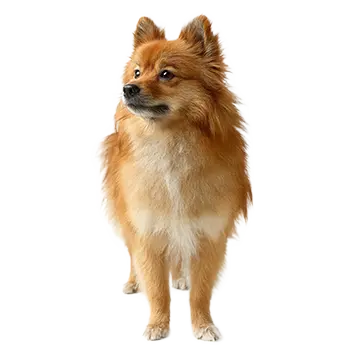
The Deutscher Spitz makes an immediate visual impression thanks to its coat, which frames the dog's body in a cloud of stand-off fur that gives it a distinctly full, rounded silhouette. The breed is compact and well-proportioned beneath all that coat, with a body that is slightly longer than it is tall and a build that suggests both agility and sturdiness. The size varies by variety, with the Mittelspitz standing roughly 12 to 15 inches at the withers and the Kleinspitz running slightly smaller at around 9 to 11 inches. Weights correspond proportionally, with the Mittel averaging in the mid-twenties of pounds and the Klein somewhat lighter.

The head is the focal point of the dog's expression and is fox-like in character. The skull is moderately broad and slightly domed, tapering through a well-defined stop to a muzzle that is moderately long and refined. The muzzle should not be excessively pointed or snipey, but it carries a refined quality that contributes to the alert, intelligent expression the breed is known for. The lips are close-fitting and clean. The nose is typically dark, matching the coat color in self-colored dogs.

The eyes are medium-sized, almond-shaped, and set slightly oblique. They are dark in color, and the expression they create, combined with the pointed muzzle and erect ears, produces the look that owners often describe as bright and foxy. Dark eye rims add definition. The ears are small, triangular, and held fully erect. They are set close together on top of the skull and their upright carriage contributes significantly to the dog's characteristic alert expression. Inside the ears the fur is dense but shorter than the surrounding coat.

The neck is of moderate length and arches slightly. It is set well into the shoulders and is framed by the profuse mane and ruff that gives the Spitz its characteristic lion-like neck appearance, particularly pronounced in the Mittel variety. The chest is moderately deep, reaching to the elbows. The back is short and straight. The belly is moderately tucked up. The overall body impression is compact without being cobby.

The tail is one of the breed's defining features. It is set high, carried curled over the back, and densely furred. The double curl is particularly prized in some varieties. This tail carriage is characteristic of the spitz family broadly and the Deutscher Spitz specifically - a tail that hangs or droops is considered a serious fault.

The coat is the breed's most dramatic physical characteristic and requires detailed description. There are two components: a long, straight, stand-off outer coat and a dense, woolly undercoat. The undercoat is what creates the volume and the characteristic stand-off appearance of the outer coat - without the dense undercoat, the outer coat would lie flatter. The mane and ruff around the neck are especially profuse. The front legs have feathering. The hindquarters are covered in full, dense fur. The tail is plumed. Colors recognized across the varieties include white, black, brown, orange, sable, and cream, with parti-color acceptable in some varieties. The Mittel and Klein are typically shown in solid colors.

Movement in the Deutscher Spitz should be lively and free, reflecting the breed's inherent energy and structural soundness. The gait at a trot shows good reach in the front and strong drive from the rear. There should be no wasted movement, paddling, or rolling. The back remains level and stable during movement. When standing at attention, the overall impression is one of compact readiness - a small but capable dog fully aware of its surroundings and comfortable in its own skin.

Affectionate With Family
The Deutscher Spitz bonds closely with its household and shows consistent warmth and attentiveness toward family members, often following them from room to room throughout the day.
Good With Young Children
Better suited to homes with older, calmer children who understand how to handle a small dog with respect. Very young children and their unpredictable movements can be stressful for this breed.
Good With Other Dogs
Generally sociable with other dogs when raised with them or properly introduced, though some individuals carry a boldness that exceeds their actual size when meeting strange dogs.
Shedding Level
The profuse double coat sheds consistently year-round with heavier seasonal blowouts. Regular brushing manages the volume but this breed is not a light shedder.
Coat Grooming Frequency
The dense, stand-off coat needs brushing several times per week to prevent matting, particularly around the collar area, behind the ears, and in the leg feathering.
Drooling Level
Clean, dry mouthed, and tidy in that regard. Drool is simply not part of life with a Deutscher Spitz.
Coat Type
The stand-off double coat is the breed's most visually striking feature - a dense undercoat pushes the straight outer coat away from the body, creating that characteristic full, cloud-like silhouette.
Openness To Strangers
Typically reserved on first meeting but warms up once an introduction has been made. Not aggressive toward strangers, but not immediately welcoming either.
Playfulness Level
Lively and enthusiastic about play, with good energy for games and activities throughout the day. This is a dog that stays engaged and spirited well into adulthood.
Watchdog/Protective Nature
Historically bred as a farm watch dog and alert to anything that changes in the environment. The Deutscher Spitz announces visitors reliably and has the voice to make its alert known.
Adaptability Level
Adapts well to apartment or house living given moderate daily exercise. The smaller varieties in particular are practical for urban life without large outdoor spaces.
Trainability Level
Intelligent and capable of learning quickly, but also independent-minded enough to decide whether a given exercise is worth its attention. Positive, engaging training methods work considerably better than repetitive or harsh approaches.

Deutscher Spitz History & Development

The name Deutscher Spitz reflects a very long history. Spitz-type dogs - characterized by their pointed muzzles, erect ears, dense double coats, and curled tails - are among the oldest domesticated dog types in the world, with archaeological evidence placing spitz-type dogs in central Europe going back thousands of years. The German varieties were documented in written records by the eighteenth century, where travelers and naturalists noted them as the distinctive dogs of the common people in the German states - alert, vocal, and found on farms throughout the region.

The name Spitz itself is a German word meaning pointed, a reference to the breed's characteristic pointed muzzle and ears. It is a descriptive name rather than a geographic one, though the Deutsch prefix anchors the breed in Germany as its country of standardization. The breed has been called Deutscher Spitz in German-language records consistently over the centuries its development was documented.

The breed's function throughout most of its history was as a watch dog and companion on farms and in small villages. The vocality that Spitz owners today manage as a characteristic trait was genuinely useful historically - these dogs announced strangers, deterred predators, and served as an alarm system for working households. Their size made them economical to feed and their coat made them resilient in Central European winters. They were genuinely useful dogs that also happened to be appealing companions.

The various size varieties emerged through selective breeding within the German-speaking states over generations. The larger Wolfsspitz was particularly associated with barge workers along the Rhine River in the Netherlands, where it became the national dog and acquired the name Keeshond. The smaller varieties were more common as household dogs in towns and farms across Germany. The Zwergspitz, the smallest variety, was exported to the Pomerania region of what is now northern Germany and Poland, where selective breeding for the smallest specimens eventually produced what became the Pomeranian - a dog that grew famous worldwide almost independently of its German Spitz origins.

The Deutscher Spitz Klub's founding in 1899 formalized the breed's management and set the stage for the standardization that brought the various size varieties under a unified framework. The twentieth century brought both challenges and continuity. Post-war periods disrupted breeding programs as they did for most German breeds. Breed numbers declined at various points. Dedicated breeders in Germany and in other European countries, particularly the United Kingdom, maintained the breed through difficult periods and rebuilt populations.

Today the name Deutscher Spitz is maintained primarily in FCI-affiliated documentation and German breeding circles. In the broader English-speaking world, German Spitz is more commonly used. The breed remains more popular in Europe than in North America, though interest in the Mittel and Klein varieties has grown in the United States as enthusiasts seek the look of the Pomeranian in a sturdier, somewhat larger package.

For anyone tracing a German Spitz pedigree back through older European records, the Deutscher Spitz name will appear consistently through the twentieth century and into earlier documented history. The name is not an alias or a marketing term - it is the breed's authentic designation within the tradition that produced it, and recognizing it for what it is helps owners and enthusiasts navigate the broader history of spitz-type dogs across Europe.

Deutscher Spitz Temperament & Personality

The Deutscher Spitz is a lively, engaged dog with a strong attachment to its people and an equally strong opinion about everything happening in its environment. This is not a passive or indifferent dog. It notices things, comments on them, and expects its household to take its reports seriously. That alertness and responsiveness is one of the breed's most consistent traits, traceable directly to its historical function as a farm watch dog.

The attachment the Deutscher Spitz forms with its family is genuine and intense. These dogs follow their people, prefer to be where the action is, and are not well-suited to long hours alone. Separation anxiety is a real risk in the breed if dogs are left isolated for extended periods without adequate preparation and management. The flip side of that attachment is a dog that is genuinely responsive to its people's moods and cues, which makes training and communication more intuitive than with some more independent breeds.

Vocality is a significant behavioral trait that prospective owners must honestly evaluate before choosing this breed. The Deutscher Spitz uses its voice readily and without much inhibition. Strangers, unusual sounds, other animals, and events outside the window are all worth announcing. This is not a nervous barking but a confident, declarative communication style rooted in the dog's history as an alarm dog. It can be managed through training and by not inadvertently reinforcing the behavior, but it cannot be completely eliminated, and owners who need a quiet dog are better served by a different breed.

With family members, the temperament shifts noticeably. The same dog that announces the mail carrier with authority becomes a cheerful, engaged, and affectionate companion once the household is settled. The Deutscher Spitz is playful, enjoys interaction, and tends to be amusing and expressive in a way that endears it strongly to its people. It has a comic quality that owners of the breed often describe as one of its great pleasures.

The breed is not typically aggressive, but it is bold in a way that occasionally outpaces its actual physical capability. Individual Spitze may take on dogs considerably larger than themselves if they perceive a challenge, which makes leash manners and reliable recall important safety considerations. The reserve toward strangers is typical but mild in a well-socialized dog - the Deutscher Spitz warms up to new people once an introduction has been made and the dog has decided the newcomer is acceptable. The process is slower with some individuals than others.

Deutscher Spitz Family Life & Living Requirements

The Deutscher Spitz is well-suited to family life in a home where its voice and energy are understood and managed with patience and consistency. The breed adapts readily to apartments and smaller homes given its size, and the exercise requirements are moderate enough that urban living is genuinely practical for most owners. What the breed asks for in return is company, engagement, and consistent training that addresses the vocality before it becomes a neighborhood problem.

Families with older children who understand how to interact respectfully with a small dog are good matches for this breed. The Deutscher Spitz is not fragile, but it is smaller than a lot of family dogs and does not enjoy rough handling. Young children who grab, chase, or startle a Spitz can produce a dog that becomes defensive or avoidant, which is not good for the child or the dog. Households with children old enough to be taught appropriate interaction and supervised closely with younger kids tend to have much better outcomes.

Multiple pet households can work well if the Deutscher Spitz is properly socialized from an early age. The breed is generally manageable with other dogs and can coexist peacefully with cats it has grown up with. The boldness that occasionally causes friction with larger unfamiliar dogs tends to smooth out in stable household situations where a clear social structure exists. Careful introductions to new animals are always advisable.

Shedding is a fact of life with this breed that should not be underestimated. The profuse double coat sheds substantially year-round and more dramatically during seasonal coat changes in spring and fall. Regular grooming manages the volume, but owners should expect to find Spitz fur on clothing, furniture, and floor surfaces as a standard feature of their daily lives. This is not a breed for households with serious dog allergy concerns.

The Deutscher Spitz generally does well in varied climates, with its double coat providing reasonable insulation in cold weather and - somewhat counter-intuitively - also helping regulate temperature in heat by blocking direct sun from reaching the skin. In very hot and humid conditions, access to shade and fresh water is important, and grooming to remove dead undercoat helps the coat function effectively.

Deutscher Spitz Training & Exercise Needs

Training the Deutscher Spitz works best when you keep it interesting and keep it positive. This is an intelligent dog with an independent streak - it is capable of learning quickly but also capable of deciding that a particular exercise is beneath its interest if the approach becomes repetitive or correction-heavy. Positive reinforcement, variety in training sessions, and short focused lessons rather than long drilling sessions produce the best results with this breed.

The most important things to address early are the behaviors most likely to create conflict with neighbors and daily life. The vocal nature needs gentle but consistent management from the time the puppy arrives. Teaching a quiet cue and reinforcing it reliably is more effective than reactive corrections after the fact. Equally important is teaching the dog not to jump on people, which is a common habit in small breeds that owners inadvertently reinforce by allowing it when the dog is young and cute. Jumping and barking managed early stay manageable. Ignored in puppyhood, they become ingrained habits that are considerably harder to address in an adult dog.

Socialization should be broad and consistent during the puppy period. The Deutscher Spitz's natural reserve with strangers benefits from exposure to a wide variety of people, places, and situations from an early age. Puppy classes offer a useful combination of foundational training and socialization. Regular visits to parks, pet-friendly businesses, and other public spaces build the confidence and familiarity that produce a well-adjusted adult dog.

Exercise needs are moderate for the size. Daily walks and indoor play sessions typically satisfy the Deutscher Spitz without requiring the kind of sustained athletic output that larger working breeds demand. A couple of solid walks per day, some interactive play, and mental engagement through training or puzzle toys are usually sufficient. The breed also does well in canine sports that suit its size and agility - rally obedience, agility, and trick training are all activities that tap into the Spitz's intelligence and enthusiasm without overtaxing its physical capabilities. Mental stimulation is as important as physical exercise for this breed, and a dog that has had a good training session often settles more readily than one that has only had physical exercise.

Deutscher Spitz Health Concerns

The Deutscher Spitz is a generally healthy breed with a lifespan that commonly reaches 13 to 15 years in well-bred dogs. That longevity reflects a breed that has not been subjected to the same degree of extreme physical modification seen in some companion breeds, and it is one of the reasons enthusiasts value the German Spitz family as a practical, hardy choice in the small dog category.

Overall the Deutscher Spitz is a sturdy and long-lived dog when sourced from breeders who conduct appropriate health screening. Asking a breeder for OFA evaluations on patellar luxation and current eye certification on both parents is a reasonable and important step before purchasing a puppy.

Common Health Issues

  • Patellar luxation: A condition where the kneecap slips out of its normal position during movement. Ranges from mild intermittent hopping to persistent lameness requiring surgery - And is one of the most consistently documented orthopedic concerns in small spitz-type breeds.
  • Progressive retinal atrophy: A degenerative eye condition that causes gradual loss of vision progressing to blindness. DNA testing is available for some forms - Allowing breeders to identify and avoid pairing carriers.
  • Cataracts: Cloudiness of the lens that can affect vision - Annual ophthalmologist exams are recommended for breeding dogs and provide useful monitoring for companion animals.
  • Hypothyroidism: Underactive thyroid function affecting metabolism - Energy levels, and coat condition. Manageable with daily medication once diagnosed.
  • Dental disease: Small-jawed breeds are prone to crowding and accelerated tartar accumulation - Consistent dental hygiene and professional cleanings reduce the risk of periodontal disease and associated systemic effects.

Preventive Care & Health Monitoring

  • OFA patellar luxation evaluation: Both parents of any litter should have OFA patellar evaluation on record - Ask for documentation when evaluating a puppy or a breeding dog.
  • Annual ophthalmologist eye examination: CAER eye exams performed by a board-certified veterinary ophthalmologist are recommended for breeding dogs and provide monitoring for progressive retinal atrophy and cataract development. - Annual ophthalmologist eye examination: CAER eye exams performed by a board-certified veterinary ophthalmologist are recommended for breeding dogs and provide monitoring for progressive retinal atrophy and cataract development.
  • DNA testing for progressive retinal atrophy: Genetic testing can identify carriers of certain PRA mutations - Allowing breeders to make pairing decisions that reduce risk in offspring.
  • Thyroid function testing: Periodic thyroid panel evaluation is recommended when clinical signs like weight gain - Coat changes, or lethargy suggest possible hypothyroidism.
  • Dental care: Regular brushing with dog-formulated toothpaste and professional dental cleanings as recommended by your veterinarian are the most effective tools for preventing periodontal disease in this breed. - Dental care: Regular brushing with dog-formulated toothpaste and professional dental cleanings as recommended by your veterinarian are the most effective tools for preventing periodontal disease in this breed.

Deutscher Spitz Grooming & Maintenance

The Deutscher Spitz's signature coat is its most demanding maintenance requirement, and owners need a realistic picture of what keeping it in good condition actually involves before they commit. The stand-off double coat, while visually striking, requires regular attention to prevent matting and manage shedding. Brushing two to three times per week is the minimum for most dogs, with daily brushing preferable during the heavy seasonal shedding periods when the undercoat releases in quantity.

The tools that work best for this coat include a slicker brush for the outer coat and a pin brush or wide-tooth comb for working through the undercoat. An undercoat rake is particularly useful during shedding season to pull out loose undercoat before it mats against the remaining coat. The areas most prone to matting are behind the ears, around the collar area, in the armpit region, and in the feathering on the legs - these spots deserve extra attention during each grooming session.

Bathing every four to six weeks keeps the coat clean and the skin healthy. The dense double coat takes a significant amount of time to dry thoroughly, and a high-velocity dog dryer dramatically speeds the process while helping to separate the coat and reduce matting. Allowing a Spitz coat to air dry while compressed into a towel encourages the undercoat to mat. The coat should never be shaved except for legitimate medical purposes - the double coat insulates and protects the skin, and shaving can permanently alter coat texture and regrowth in some individuals.

Nails should be trimmed every three to four weeks. Ears need weekly checks for signs of irritation or early infection. Dental hygiene through regular brushing or approved dental care products is important for long-term health in a breed that tends toward the smaller jaw structure where tartar accumulates more readily.

For owners new to spitz-type coats, spending time with an experienced groomer who can demonstrate proper brushing technique for the stand-off coat is worth every penny. Done correctly, grooming the Deutscher Spitz is manageable and even relaxing for both dog and owner once a routine is established. Dogs introduced to brushing positively from early puppyhood typically accept it well throughout their lives.