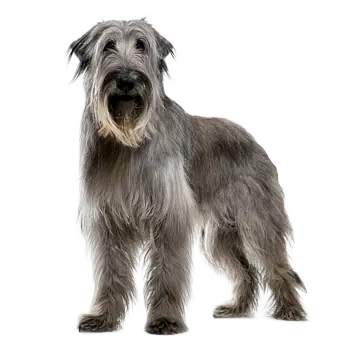
The first time you stand next to a Deerhound, the word that comes to mind is not big - it is tall. These dogs have a verticality about them that makes even people accustomed to large breeds stop and recalibrate. A mature male stands 30 to 32 inches at the shoulder as a minimum, and some run taller. Coupled with a long neck and a naturally upright carriage, these dogs look you in the eye if you are of average height and look right past you if you are not. The overall impression is of height, reach, and power delivered with an almost courtly composure.
The head is long and level - a classic sighthound skull that is broad between the ears and tapers to a strong muzzle without any abrupt drop at the stop. The jaws are powerful, well-muscled, and deep. The nose is typically black or dark blue-black, and the eyes are dark brown or hazel with a gentle, deep expression. The ears are set high, folded back at rest, and small relative to the skull. When the dog is alert or in motion, the ears lift and partially open in a way that changes the whole profile of the head.
The neck is long, strong, and notably well-arched - one of the features that gives the Deerhound its distinctive silhouette and one that carries real function. A dog built to pull down deer at speed needs a neck with both reach and power. The shoulders are well laid back, the chest deep and fairly narrow, and the back arched with a slight rise over the loin - the classic sighthound tuck that provides the coiled-spring power behind the galloping stride. The tail is long, nearly reaching the ground, thick at the root and tapering, and carried low in a graceful curve.
The coat is the feature that most immediately distinguishes the Deerhound from other sighthounds. It is harsh, crisp, and shaggy rather than smooth - wiry enough to provide weather resistance in the wet, wind-scoured Scottish Highlands where the breed developed. The coat is typically three to four inches long on the body with a slight beard and eyebrow fringe on the face. Color ranges from blue-gray and dark gray (the most prized historically) through gray brindle, yellow, sandy red, and red fawn. White markings are permissible but not preferred on the body.
In motion the Deerhound is something to see. The double-suspension gallop - the gait of the cheetah and the greyhound, where all four feet leave the ground twice per stride cycle - covers extraordinary ground with each bound. Even in the garden at moderate pace, these dogs move with a flowing, effortless quality that belies how much ground they are actually covering. The stride is long, the back flexible, the rear drive powerful. This is a dog that was built to run, and every physical detail reflects that fact.
In motion the Deerhound is something to see. The double-suspension gallop - the gait of the cheetah and the greyhound, where all four feet leave the ground twice per stride cycle - covers extraordinary ground with each bound. Even in the garden at moderate pace, these dogs move with a flowing, effortless quality that belies how much ground they are actually covering. The stride is long, the back flexible, the rear drive powerful. This is a dog that was built to run, and every physical detail reflects that fact.
Despite all this size and capability, the resting Deerhound is a study in relaxed elegance. They fold themselves into surprisingly compact positions when lying down, occupy furniture with the practiced ease of long custom, and carry their remarkable physical equipment with a dignity that reads as entirely natural.
Weight runs 85 to 110 pounds for males and 75 to 95 pounds for females, though some individuals run outside these ranges - particularly working or older lines that bred for size. Feet are compact, close-knuckled, and strong, with thick pads suited to rough terrain. The hindquarters are broad, powerful, and well-muscled with good angulation - the engine behind the galloping stride. Taken together, the Deerhound is one of those breeds whose every physical detail makes sense once you understand what it was bred to do.
Affectionate With Family
★★★★★
Deerhounds form deep, quiet bonds with their families and are devoted companions in the home. Despite their imposing size, they are notably gentle and affectionate with the people they love.
Good With Young Children
★★★☆☆
Deerhounds are gentle and patient but are large enough to accidentally knock over small children. They are better suited to homes with older, calmer kids who understand how to be around a big dog.
Good With Other Dogs
★★★★☆
Deerhounds are generally companionable with other dogs and often do well in multi-dog households. They are not typically dominant or aggressive with other dogs.
Shedding Level
★★★☆☆
The harsh wiry coat sheds moderately but the coarse texture means loose hair tends to clump rather than float, making cleanup slightly more manageable than with smooth-coated breeds.
Coat Grooming Frequency
★★☆☆☆
The rough coat needs only weekly brushing and occasional hand-stripping of dead hair. It does not need professional grooming the way many other large breeds do.
Drooling Level
★★☆☆☆
Deerhounds are relatively dry-mouthed for a large breed. Some drooling occurs around meals or water, but they are not heavy droolers by any measure.
Coat Type
★★★☆☆
The coat is harsh, wiry, and shaggy with a slight beard and eyebrow fringe. It provides real weather protection and is far more rugged than it appears.
Openness To Strangers
★★★☆☆
Deerhounds are typically polite rather than effusive with strangers. They are not guard dogs and will rarely bark at visitors, but they are not usually immediately demonstrative with unfamiliar people.
Playfulness Level
★★★☆☆
Deerhounds have bursts of playful energy, particularly as youngsters, but they mature into calm, composed dogs that are content to rest for much of the day.
Watchdog/Protective Nature
★★☆☆☆
Deerhounds are not natural watchdogs. They are gentle and friendly rather than suspicious, and their tendency toward quiet means they are unlikely to raise an alarm.
Adaptability Level
★★★☆☆
Given enough space to move and regular exercise, Deerhounds adapt reasonably well to different living situations. They are surprisingly calm indoors but need room to stretch out comfortably.
Trainability Level
★★★☆☆
Deerhounds are intelligent and gentle in training but retain an independent sighthound streak. They respond well to patient, low-pressure approaches and poorly to harsh or repetitive methods.