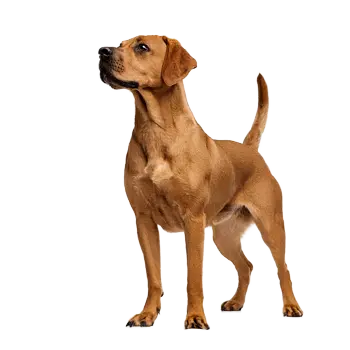
The Danish Mastiff presents the typical Mastiff silhouette - large, rectangular, powerfully constructed, with a head that is massive relative to the body and a bearing that is deliberate rather than agile. But compared to the heaviest Mastiff breeds, the Broholmer has a more athletic build and less extreme proportions. It is a working guardian dog, not a show-ring specialty, and its construction reflects that function.
Males stand approximately 29.5 inches at the withers and weigh 110 to 150 pounds. Females are somewhat smaller, around 27.5 inches and 90 to 130 pounds. These are substantial dogs - not in the range of the largest Mastiff breeds but clearly large. The body is slightly longer than tall, with a broad, deep chest and well-developed musculature throughout. The topline is level and strong. The brisket reaches to approximately the elbow, and the deep-chested conformation is one of the breed's notable health considerations - this depth creates susceptibility to gastric dilatation-volvulus.
The head defines the Danish Mastiff's visual character - broad, powerful, and expressively serious. The skull and muzzle are roughly equal in length, which avoids the foreshortening of brachycephalic breeds and produces a face that is both powerful and functional. The skull is wide and flat across the top. The stop - the transition from skull to muzzle - is clear but not dramatically pronounced. The muzzle is broad and strong, and the nose is always black. The jaws are well-developed and close in a scissors bite. The lips have some looseness but are not heavily pendulous. The eyes are amber to brown and medium in size, forward-facing, and alert. The ears are medium-sized and set at eye level, lying flat and close against the sides of the head.
The neck is strong and muscular, and there is some loose skin around the throat and neck, which is characteristic of the breed without being excessive. The skin folds are not as prominent as in some Mastiff breeds, and the overall impression is powerful but not coarse. The forelegs are straight and strongly boned, and the feet are compact and well-arched. The hindquarters are well-muscled with good angulation. The tail is long and broad at the base, tapering to a point, carried in a natural downward curve at rest and raised toward horizontal when alert.
The coat is short, close-lying, and somewhat harsh in texture, covering a thick undercoat that provided real weather protection for a dog working outdoors in Denmark's variable climate. Three colors are recognized: yellow with black mask, golden red, and black. The yellow-masked dog is the most commonly seen and the most immediately recognizable as a Mastiff-type guardian. Golden red is a warmer, richer variation on the same base. Black Broholmers are historically documented - they worked as night guards at the Tivoli Gardens in Copenhagen - and are less common today but no less correct to the standard. Optional white markings on the chest, feet, and tail tip are permitted.
In motion, the Danish Mastiff shows ground-covering, purposeful movement - not flashy, not labored, but confident and efficient. The FCI standard calls for movement that is composed and powerful, which is exactly the right description. A dog that moves with unnecessary effort or rolls in the hindquarters is showing structural deficiency. At its best, this is a dog that looks completely unhurried while covering ground steadily.
Affectionate With Family
★★★★☆
The Danish Mastiff is warmly bonded to the people it considers its own - steady and affectionate in a quiet, Mastiff-typical way rather than effusively demonstrative.
Good With Young Children
★★★☆☆
Patient with older children who know how to interact with large dogs, but a dog of this size demands supervision with toddlers simply because of the physical size difference.
Good With Other Dogs
★★★☆☆
Can coexist with other dogs when properly socialized, though the breed's independent, dominant character means some individuals need careful introductions with unfamiliar dogs.
Shedding Level
★★★☆☆
The short coat with its dense undercoat sheds moderately year-round with heavier seasonal periods - weekly brushing prevents accumulation on furniture.
Coat Grooming Frequency
★★☆☆☆
Maintenance is simple - weekly brushing with a curry brush or hound glove is all the coat needs under normal circumstances.
Drooling Level
★★☆☆☆
The Danish Mastiff is less drooly than many of its Mastiff relatives - some jowl drool after meals and water is expected, but not the constant situation of heavier Mastiff breeds.
Coat Type
★☆☆☆☆
Short and close-fitting with a practical dense undercoat - no trimming, no professional grooming required, just regular brushing.
Openness To Strangers
★★☆☆☆
The Danish Mastiff is a guardian breed with a naturally watchful, reserved attitude toward strangers - this is built-in breed character and is not a fault when expressed appropriately.
Playfulness Level
★★★☆☆
Serious in demeanor but not humorless - the Danish Mastiff will engage in play with family and can move with surprising ease when motivated.
Watchdog/Protective Nature
★★★★★
Guardian function is central to this breed's identity - the Danish Mastiff watches its property attentively and its bark is a genuinely impressive deterrent.
Adaptability Level
★★★☆☆
Adaptable to different living situations if basic space and exercise needs are met - calmer indoors than some working breeds but needs daily structure.
Trainability Level
★★★☆☆
Capable and intelligent but independently minded - the Danish Mastiff trains well with a calm, consistent handler but will challenge an owner who is uncertain or inconsistent.