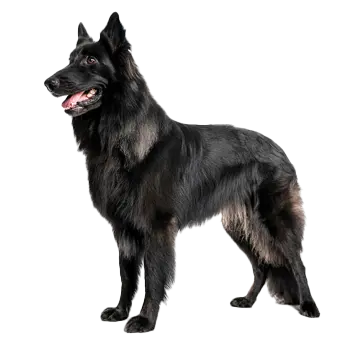

Chien De Berger Belge Groenendael

Belgian Sheepdog

Quick Facts

🐕 Breed Group
Herding Group (AKC) / FCI Group 1 - Sheepdogs and Cattledogs
📏 Size Category
Large
📏 Height
Males: 24-26 inches (61-66 cm), Females: 22-24 inches (56-61 cm)
⚖️ Weight
Males: 55-75 pounds (25-34 kg), Females: 45-60 pounds (20-27 kg)
⏱️ Life Expectancy
12-14 years
🧣 Coat Type
Long double coat - abundant, straight outer coat with dense undercoat
🎨 Coat Colors
Black; small white markings on chest and toe tips permitted
😀 Temperament
Intelligent, alert, devoted, protective, energetic, versatile
🏃 Exercise Needs
High
🎓 Training Difficulty
Moderate - highly intelligent and eager to please but sensitive
👶 Good with Children
Yes, with proper socialization
🐾 Good with Other Pets
Conditional - generally good with household pets; may herd smaller animals

Other Names & Breed Recognition

Chien de Berger Belge Groenendael is the full French-language designation for the black, long-coated variety of the Belgian Shepherd Dog as classified by the Federation Cynologique Internationale. The name translates directly as Belgian Shepherd Dog Groenendael, with Chien de Berger meaning shepherd dog, Belge identifying Belgian nationality, and Groenendael specifying which of the four recognized Belgian Shepherd varieties is being described. This naming convention follows the FCI's treatment of all four Belgian Shepherd varieties, Groenendael, Tervueren, Malinois, and Laekenois, as coat and color variants of a single breed rather than as separate breeds.

The Groenendael designation derives from the village of Groenendael near Brussels, where restaurant owner Nicolas Rose bred the foundation dogs that established the long black coat variety during the 1890s. Rose's breeding program centered on a pair of black dogs named Picard d'Uccle and Petite, whose offspring formed the genetic basis for the entire Groenendael variety. The village name literally means green valley in Dutch, and the Chateau de Groenendael where Rose's restaurant and kennel were located became so strongly associated with the black Belgian Shepherds that the geographic name transferred permanently to the dogs themselves.

In North America, the naming situation takes a distinctly different path. The American Kennel Club and the Canadian Kennel Club treat the four Belgian Shepherd varieties as separate breeds rather than varieties of a single breed. Under this system, the Groenendael is registered simply as the Belgian Sheepdog, a name that can cause confusion because it suggests a breed encompassing all Belgian shepherd types rather than specifically the black long-coated variety. The AKC first recognized the breed in 1912, and it is classified within the Herding Group. This divergence between FCI and North American nomenclature means that the same dog is called Chien de Berger Belge Groenendael in most of the world and Belgian Sheepdog in the United States and Canada.

The breed is recognized by all major kennel clubs worldwide, though the manner of recognition varies. The FCI classifies all four Belgian Shepherd varieties under a single standard in Group 1 (Sheepdogs and Cattledogs), Section 1 (Sheepdogs). The United Kennel Club places the breed in the Herding Dog Group, and the Kennel Club in the United Kingdom classifies it in the Pastoral Group. Regardless of naming convention or organizational structure, all registries describe the same dog: an elegant, intelligent, intensely devoted black-coated herding breed whose beauty and working ability have made it one of the most admired shepherd dogs in the world.

Chien De Berger Belge Groenendael Organizations & Standards

The Belgian Sheepdog Club of America serves as the AKC parent club for the breed in the United States, maintaining the breed standard, promoting responsible breeding practices, and coordinating health research. The club has been active since its founding in organizing specialty shows, supporting rescue efforts, and publishing educational materials about the breed's health, temperament, and care requirements. The BSCA participates in health screening programs through the OFA and has been instrumental in funding research into breed-specific health conditions.

The FCI breed standard, which governs the breed internationally, describes the Chien de Berger Belge as a medium-sized dog of harmonious proportions, combining elegance with power. The standard applies to all four varieties, with the Groenendael specified as the long-coated black variety. The standard calls for a height of 62 centimeters for males and 58 centimeters for females, with a tolerance of plus or minus two centimeters. The body should be square in proportion, with the length from point of shoulder to point of buttock approximately equal to the height at the withers. The standard emphasizes that the breed should convey an impression of elegant robustness.

The AKC standard for the Belgian Sheepdog specifies ideal height at the shoulder of 24 to 26 inches for males and 22 to 24 inches for females. The standard describes a well-balanced, square dog of medium size with an exceedingly proud carriage of the head and neck. The coat is described as abundantly long, straight, and of medium harshness, with a dense undercoat. The color must be black, though small white markings are permitted on the chest, between the pads of the feet, on the tips of the rear toes, and on the chin and muzzle as frosting. The standard explicitly states that the breed should exhibit neither shyness nor viciousness.

Both the FCI and AKC standards emphasize that the Groenendael's temperament is as important as its physical conformation. The ideal dog should be alert, intelligent, and devoted to its handler, with a willingness to work that reflects its herding heritage. The breed should demonstrate confidence without aggression and watchfulness without excessive shyness. The quality of character and the soundness of working temperament are considered as essential to the breed as correct physical type.

Kennel Club Recognition

  • American Kennel Club (AKC): Recognized in 1912, Herding Group
  • United Kennel Club (UKC): Recognized, Herding Dog Group
  • Canadian Kennel Club (CKC): Recognized, Herding Group
  • FCI: Recognized, Group 1 - Sheepdogs and Cattledogs
  • The Kennel Club (UK): Recognized, Pastoral

Chien De Berger Belge Groenendael Physical Description

The Chien de Berger Belge Groenendael is a medium to large-sized dog whose appearance combines athletic functionality with striking elegance. Males stand 24 to 26 inches at the shoulder and typically weigh 55 to 75 pounds, while females measure 22 to 24 inches and weigh 45 to 60 pounds. The body is square in proportion, with a well-balanced structure that supports both the endurance needed for sustained herding work and the agility required for quick, responsive movement. The overall silhouette is one of refined power, with clean lines and an erect, proud carriage that gives the breed an unmistakable presence.

The head is clean-cut, long, and well-chiseled, carried high on a well-muscled neck that flows smoothly into sloping shoulders. The skull is flat rather than rounded, approximately the same length as the muzzle, with a moderate stop. The eyes are medium-sized, slightly almond-shaped, and dark brown, conveying an expression of intelligence, alertness, and inquiry. The ears are triangular, stiff, erect, and set high on the head, adding to the breed's attentive, alert expression. The jaws are strong and well-developed, meeting in a scissors or level bite.

The breed's most visually striking feature is its luxurious black coat. The outer coat is long, straight, and moderately harsh in texture, lying flat against the body and providing protection against weather and brush. The undercoat is dense and thick, providing insulation against both cold and heat. Males display a pronounced collarette of longer hair around the neck and chest, creating a mane-like effect that enhances the breed's regal appearance. Feathering of longer hair appears on the backs of the forelegs, the hindquarters (forming culottes), and the tail. The hair on the head, the outside of the ears, and the lower portions of the legs is shorter and lies close to the body.

The coat is entirely black, creating the breed's dramatic, monochromatic appearance. Small white markings are permissible on the chest and on the tips of the toes, and frosting on the chin and muzzle is common in mature dogs. The tail is strong at the base, medium in length, and carried low at rest with a slight curve at the tip. When the dog is in motion, the tail rises but should not form a hook or deviate to one side. The breed moves with a free, easy, seemingly tireless gait that covers ground efficiently, with good reach in front and strong drive from behind, a hallmark of functional herding structure.

Affectionate With Family
The Chien de Berger Belge Groenendael bonds intensely with its family and demonstrates its devotion through constant engagement, physical proximity, and an almost intuitive attentiveness to its people's emotional states. This breed forms partnerships rather than simple pet-owner relationships, and its need for close connection with its family is a fundamental aspect of its character that should not be underestimated.
Good With Young Children
The Groenendael can be a wonderful companion for children when raised together and properly supervised, showing patience and protective instincts toward the youngest family members. However, the breed's herding instinct may lead it to chase and nip at running children, and its high energy level and sensitivity make it better suited to families with children old enough to interact respectfully with an active, intelligent dog.
Good With Other Dogs
The Groenendael generally coexists well with other dogs, particularly those it has been raised alongside, though some individuals display dominance-related tension with unfamiliar dogs of the same sex. The breed's herding instinct and high drive can sometimes overwhelm more placid companion breeds. Early socialization establishes the foundation for reliable behavior in multi-dog environments.
Shedding Level
The abundant black double coat sheds steadily throughout the year, with substantial seasonal blowouts in spring and fall when the dense undercoat releases in large volumes. The long, dark hair is conspicuous on light-colored clothing and furniture, and regular brushing is essential to manage the continuous flow of loose hair that the breed produces.
Coat Grooming Frequency
The long double coat requires thorough brushing two to three times per week to prevent matting and manage shedding. During seasonal blowouts, daily brushing with an undercoat rake becomes necessary. The coat around the ears, behind the legs, and in the hindquarter feathering is particularly prone to tangling and requires focused attention. Despite the grooming demands, the coat does not require professional trimming or clipping.
Drooling Level
The Groenendael is an exceptionally clean, low-drool breed. Its well-proportioned muzzle and tight lips contain saliva effectively, and owners will not encounter the wet spots on furniture or clothing associated with breeds that have looser flews. This tidiness is one of the breed's practical advantages as a household companion.
Coat Type
The double coat consists of an abundant, straight, moderately harsh outer coat of considerable length and a dense, thick undercoat that provides insulation against both cold and heat. Males develop a pronounced mane and collarette around the neck and chest, and feathering appears on the backs of the forelegs, hindquarters, and tail. The coat is shorter on the head, outside of the ears, and on the lower legs. This luxurious coat is entirely black, creating the breed's striking, elegant silhouette.
Openness To Strangers
The Groenendael is naturally reserved with unfamiliar people, assessing strangers with alert watchfulness before deciding how to engage. This reserve is not fearful but rather a deliberate caution that reflects the breed's protective heritage. With proper socialization, the breed learns to tolerate routine social encounters, but it typically maintains a polite distance from people it does not know rather than seeking their attention.
Playfulness Level
The Groenendael retains a strong playful drive well into adulthood, engaging enthusiastically in games, interactive toys, and structured activities with its handler. Its play style reflects its herding intelligence, often incorporating chasing, problem-solving, and the kind of purposeful engagement that makes it excel in dog sports. The breed's playfulness is one of its most appealing traits for active families.
Watchdog/Protective Nature
The Groenendael is an alert, vigilant guardian that takes its protective role seriously. It monitors its environment constantly, announces approaching visitors or unusual activity with a clear, carrying bark, and positions itself between its family and perceived threats with quiet confidence. The breed's intelligence allows it to discriminate between routine events and genuine concerns, making it an effective household watchdog.
Adaptability Level
The Groenendael adapts to various living situations provided its substantial exercise and mental stimulation needs are met. It can live successfully in suburban homes with adequate yard space and committed owners, though rural settings with more room to move and work are ideal. The breed's high energy level and need for engagement make it poorly suited to sedentary households or situations where it is left alone for extended periods.
Trainability Level
The Groenendael is among the most trainable of all breeds, combining sharp intelligence with a genuine desire to work cooperatively with its handler. It learns new concepts rapidly, retains training reliably, and performs with enthusiasm across a wide range of disciplines including obedience, agility, herding, tracking, and protection work. The breed's sensitivity requires a handler who uses positive methods and avoids harsh corrections, which can produce avoidance behavior or anxiety in this responsive breed.

Chien De Berger Belge Groenendael History & Development

The Chien de Berger Belge Groenendael shares its foundational history with the other three Belgian Shepherd varieties, all of which descend from the diverse population of working herding dogs that existed across Belgium before breed standardization began in the late 19th century. Prior to formal classification, Belgian farms and villages maintained their own strains of herding dogs selected for working ability, temperament, and local conditions rather than any particular coat type or color. These dogs varied considerably in appearance but shared the intelligence, versatility, and dedication to work that would become defining characteristics of all Belgian Shepherd varieties.

The breed's formalization began in earnest in 1891, when Professor Adolphe Reul of the Belgian School of Veterinary Sciences undertook a systematic study of the native herding dogs of Belgium. Reul examined 117 dogs and concluded that they represented a single breed with distinct variety types based primarily on coat characteristics. This finding led to the establishment of the Club du Chien de Berger Belge in 1891 and the drafting of the first breed standard in 1892. The standard identified three coat types, later expanded to four, that would form the basis for the variety classifications still used today.

The Groenendael variety owes its specific identity to Nicolas Rose, a restaurant and kennel owner in the village of Groenendael near Brussels. During the 1890s, Rose focused his breeding program on producing elegant, solidly black, long-coated dogs from existing Belgian herding stock. His foundation pair, Picard d'Uccle and Petite, produced offspring that established the type, and Rose's kennel at the Chateau de Groenendael became the recognized center for the black variety. The dogs bred at Groenendael proved themselves not only in the show ring but as police dogs, messenger dogs during World War I, and versatile working companions, demonstrating the practical abilities that complemented their beauty.

The breed arrived in the United States in the early 1900s and gained AKC recognition in 1912. During the interwar period, Belgian Shepherds of all varieties competed together in American shows. In 1959, the AKC made the consequential decision to separate the Belgian Shepherd varieties into distinct breeds, registering the Groenendael as the Belgian Sheepdog, the Tervueren as the Belgian Tervuren, and the Malinois as the Belgian Malinois. This separation, which contradicted the European standard treating all varieties as a single breed, reflected American breeding practices that emphasized maintaining pure variety lines and has shaped the breed's development in North America ever since.

The Groenendael's 20th century history includes distinguished service in both World Wars, where these dogs served as messenger dogs, ambulance dogs, and sentries, earning recognition for their intelligence, courage, and devotion to duty. In the post-war era, the breed transitioned increasingly from working herder to competitive sport dog and companion, excelling in obedience, agility, tracking, and herding trials. The Groenendael has consistently demonstrated the versatility that is perhaps the Belgian Shepherd's most remarkable trait, performing at the highest levels in virtually every canine discipline.

Chien De Berger Belge Groenendael Temperament & Personality

The Chien de Berger Belge Groenendael's temperament is defined by an intensity of focus, depth of devotion, and breadth of ability that place it among the most rewarding and demanding of all companion breeds. This is a dog that engages with life at full capacity, bringing intelligence, energy, and emotional sensitivity to everything it does. Its bond with its primary handler is exceptionally strong, often approaching what experienced owners describe as an almost symbiotic connection, where the dog reads and responds to its person's moods, movements, and intentions with uncanny accuracy.

The breed's intelligence is evident in every interaction. The Groenendael learns quickly, remembers thoroughly, and applies its knowledge with a creativity that can surprise even experienced dog owners. This mental sharpness makes the breed extraordinarily capable in structured activities like obedience, agility, and herding, but it also means the dog requires consistent mental engagement to prevent the boredom and frustration that lead to behavioral problems. A Groenendael without adequate mental stimulation will find its own entertainment, and the results are rarely what the owner had in mind.

With its family, the Groenendael is warm, affectionate, and deeply attentive. It follows household members with a presence that is companionable rather than clingy, preferring to be in the same room and aware of its people's activities at all times. The breed demonstrates its affection through physical closeness, eye contact, and an eagerness to participate in whatever its family is doing. Its sensitivity to emotional atmosphere makes it a responsive and empathetic companion, though this same sensitivity means the breed can absorb household stress and respond to tension with anxiety or unsettled behavior.

The breed's protective instincts are genuine and well-developed. The Groenendael is naturally alert and watchful, monitoring its environment for anything unusual and positioning itself to respond if its family is threatened. This protectiveness is expressed through confident alertness rather than indiscriminate aggression, and the breed is generally capable of discriminating between routine social encounters and genuine threats. However, its reserve with strangers is real and should be managed through consistent socialization rather than ignored or suppressed.

Chien De Berger Belge Groenendael Family Life & Living Requirements

The Chien de Berger Belge Groenendael thrives in active households that can provide the physical exercise, mental stimulation, and emotional engagement this breed requires. It is not suited to sedentary lifestyles, households where it will be left alone for extended periods, or owners who want a low-maintenance companion that requires only basic care. The Groenendael needs a significant daily investment of time and energy from its owner, and it repays that investment with a depth of partnership and devotion that few breeds can match.

The breed adapts to suburban and rural homes provided adequate exercise is available. A securely fenced yard gives the dog space for free play and patrols, though yard time alone is insufficient as a substitute for structured activity and handler interaction. The Groenendael is not an independent breed that entertains itself in the backyard; it wants to work with its person, and its exercise and enrichment should involve interactive engagement rather than solitary activity. Apartment living is possible for committed, active owners but requires a substantial daily exercise commitment to compensate for limited indoor space.

The breed's compatibility with children depends on the individual dog's temperament, the children's ages and behavior, and the quality of socialization the dog has received. The Groenendael is generally gentle and protective with its own family's children, showing patience and attentiveness that can be remarkable. However, its herding instinct may lead to nipping at running children, and its high energy level can overwhelm very young kids. Families with children do best when the dog is raised with them, when children are taught appropriate interaction, and when all contacts between young children and the dog are supervised.

The breed can coexist successfully with other household pets, particularly when introduced during puppyhood. Its herding instinct may surface as chasing behavior toward cats or smaller animals, but many Groenendaels learn to moderate this response toward established household companions. The breed does best in homes where its role is clear, its exercise needs are met, and its relationship with its handler provides the purposeful engagement it craves.

Chien De Berger Belge Groenendael Training & Exercise Needs

The Chien de Berger Belge Groenendael is one of the most trainable breeds in existence, combining exceptional intelligence with a genuine desire to work cooperatively with its handler. The breed excels across an extraordinary range of disciplines including obedience, agility, herding trials, tracking, protection sports, and search and rescue, demonstrating a versatility that few breeds can match. Its capacity for learning is limited more by the handler's skill and imagination than by the dog's ability, and experienced trainers consistently report that the Groenendael is among the most rewarding breeds to work with.

The breed's sensitivity is the primary factor that distinguishes training a Groenendael from training many other high-ability breeds. This is not a dog that tolerates harsh corrections, raised voices, or forceful physical handling. The Groenendael responds to negative treatment with anxiety, shutdown, or avoidance behavior that can be difficult to reverse. Positive reinforcement methods, particularly those that combine clear communication, enthusiastic praise, and food or toy rewards, produce outstanding results. The handler's emotional state matters enormously; the Groenendael reads its trainer's mood with exceptional accuracy and performs best when the training atmosphere is positive, engaged, and fun.

Early socialization is critical for developing the confident, stable adult temperament the breed standard describes. The Groenendael's natural reserve with strangers and its protective instincts require deliberate, positive exposure to a wide range of people, environments, animals, and situations during the developmental period. Puppy classes, controlled social outings, and ongoing exposure to novel experiences throughout the first year and beyond build the social confidence the breed needs to navigate modern life without excessive wariness or reactivity.

Exercise requirements are substantial. An adult Groenendael needs a minimum of sixty to ninety minutes of vigorous daily exercise, which should include both physical activity and mental engagement. Hiking, running, swimming, agility training, herding practice, and interactive play sessions all provide appropriate outlets for the breed's considerable energy. The Groenendael is not a breed that can be exercised with a quick walk around the block; it needs opportunities to move at speed, use its body and mind together, and engage in activities that satisfy its drive to work. Dogs that do not receive adequate exercise and mental stimulation develop behavioral problems including destructive behavior, excessive barking, hyperactivity, and anxiety.

Chien De Berger Belge Groenendael Health Concerns

The Chien de Berger Belge Groenendael is generally a healthy breed with a lifespan of twelve to fourteen years, benefiting from its working heritage and the functional selection pressures that shaped its development. The breed has not been subjected to the extreme conformational exaggeration that produces structural health problems in some breeds, and its athletic build supports a life of active physical engagement. However, like all purebred dogs, the Groenendael carries predispositions to certain health conditions that responsible owners and breeders should understand and monitor.

Orthopedic conditions represent a common category of concern. Hip and elbow dysplasia are documented in the breed, and OFA evaluation of breeding stock is recommended to reduce incidence in future generations. The breed's active lifestyle can mask early symptoms of joint disease, making radiographic screening important even in dogs that appear clinically sound. Maintaining healthy body weight and providing appropriate exercise that supports rather than stresses joint health help manage orthopedic risk throughout the dog's life.

Eye conditions including progressive retinal atrophy and cataracts have been documented in the breed. PRA causes gradual vision loss that ultimately leads to blindness, and DNA testing is available for some forms affecting the Belgian Shepherds. Regular ophthalmologic examinations by a board-certified veterinary ophthalmologist provide screening for both PRA and cataracts, allowing early detection and informed breeding decisions. Epilepsy has also been reported, with idiopathic seizures typically presenting between one and five years of age and requiring ongoing management with anticonvulsant medication.

Gastric dilatation-volvulus is a concern for any deep-chested breed. Preventive feeding practices, awareness of symptoms, and preparedness for emergency veterinary care are important for all Groenendael owners. Hypothyroidism, while manageable with daily supplementation once diagnosed, can develop insidiously and may present initially as subtle changes in energy level, coat quality, or weight. Regular thyroid screening helps detect this condition before it significantly impacts the dog's wellbeing. The breed's overall health profile is favorable compared to many purebred dogs of similar size, and attentive preventive care supports a long, active life.

Common Health Issues

  • Hip dysplasia - Abnormal development of the hip joint leading to progressive arthritis and mobility loss. OFA hip evaluation is recommended for breeding stock. The breed's active lifestyle can mask early symptoms, making radiographic screening the primary detection tool.
  • Elbow dysplasia - Developmental abnormalities of the elbow joint producing front-limb lameness and arthritis. OFA elbow evaluation is recommended for breeding stock to reduce incidence in future generations.
  • Progressive retinal atrophy (PRA) - A group of inherited degenerative eye diseases that cause gradual vision loss and eventual blindness. DNA testing is available for some forms affecting the breed, and ophthalmologic screening helps identify affected dogs before clinical symptoms appear.
  • Epilepsy - Idiopathic seizures have been documented in the breed, typically presenting between one and five years of age. Management involves daily anticonvulsant medication with ongoing veterinary monitoring. Breeders should be asked about seizure history in their lines.
  • Hypothyroidism - Insufficient production of thyroid hormones causing weight gain, lethargy, coat deterioration, and metabolic slowing. Diagnosed through blood testing and managed effectively with daily thyroid hormone supplementation.
  • Gastric dilatation-volvulus (bloat) - A life-threatening emergency in which the stomach fills with gas and may twist. The breed's deep chest conformation places it at moderate risk. Feeding multiple smaller meals and avoiding exercise around mealtimes are standard preventive measures.
  • Cataracts - Opacity of the eye lens that can develop at various ages and may progress to vision impairment. Regular ophthalmologic examinations allow early detection, and surgical correction is available for cases that significantly affect vision.

Preventive Care & Health Monitoring

  • OFA hip and elbow evaluation for breeding stock - Radiographic evaluation of hip and elbow joints before breeding helps identify affected dogs and reduce incidence of orthopedic disease in subsequent generations.
  • Ophthalmologic examination by a board-certified veterinary ophthalmologist - Annual eye examinations screen for progressive retinal atrophy, cataracts, and other hereditary eye conditions. Results should be registered through the OFA eye certification registry.
  • Thyroid screening - Periodic thyroid panel testing monitors for hypothyroidism, which can develop insidiously. Early detection and supplementation prevent metabolic complications.
  • Bloat prevention feeding protocol - Feed two to three smaller meals daily rather than one large meal. Avoid vigorous exercise for at least one hour before and after feeding. Learn to recognize early signs of gastric distress.
  • Epilepsy pedigree research - No genetic test exists for idiopathic epilepsy in the breed. Prospective owners should discuss seizure history openly with breeders and request information about the incidence of epilepsy in the dog's family lines.
  • Regular dental care - Regular dental brushing, veterinarian-approved dental chews, and professional cleanings as recommended help maintain oral health and prevent secondary complications from periodontal disease.

Chien De Berger Belge Groenendael Grooming & Maintenance

The Chien de Berger Belge Groenendael's luxurious black coat requires regular maintenance to preserve its health, appearance, and the breed's characteristic elegant silhouette. The coat's length, density, and double-layered structure mean that grooming is a consistent commitment rather than an occasional task. Owners who establish a regular grooming routine from puppyhood find the process manageable and even enjoyable, while those who allow the coat to become matted face a significantly more difficult remediation process.

Regular brushing two to three times per week with a pin brush and undercoat rake forms the foundation of coat care. Brushing removes loose hair, prevents mat formation, distributes natural oils, and provides an opportunity to inspect the skin for parasites, irritation, or developing problems. The areas most prone to matting include behind the ears, under the legs, around the neck collarette, in the hindquarter culottes, and along the tail feathering. These zones require focused attention during each grooming session. During seasonal coat blowouts in spring and fall, daily brushing with an undercoat rake becomes necessary to manage the substantial volume of loose undercoat that the breed produces.

Bathing should be performed as needed, typically every six to eight weeks or when the dog becomes noticeably dirty. The coat's natural texture and oils provide some self-cleaning capability, and excessive bathing can strip these protective oils and dry the skin. When bathing, a shampoo formulated for double-coated breeds preserves coat texture, and thorough rinsing is essential to prevent residue from irritating the skin beneath the dense undercoat. Complete drying, particularly of the thick undercoat, prevents moisture retention that can lead to skin problems.

The breed does not require professional trimming or clipping. The coat should be maintained in its natural state, with only minor tidying of stray hairs around the feet, ears, and hocks to maintain a neat appearance. Excessive trimming or shaping alters the breed's natural silhouette and is penalized in the show ring. Beyond coat care, routine maintenance includes nail trimming every two to three weeks, weekly ear inspection and cleaning, dental care through regular brushing, and eye inspection for any discharge or irritation. The breed's erect ears provide good air circulation to the ear canal, reducing but not eliminating the need for regular ear hygiene.