Chi-Chi

Chihuahua

Quick Facts

πŸ• Breed Group
Toy Group
πŸ“ Size Category
Toy
πŸ“ Height
Males: 5-8 inches, Females: 5-8 inches
βš–οΈ Weight
Males: Under 6 pounds, Females: Under 6 pounds
⏱️ Life Expectancy
14-16 years
🧣 Coat Type
Smooth or long coat
🎨 Coat Colors
Any color or combination
πŸ˜€ Temperament
Alert, loyal, bold, confident
πŸƒ Exercise Needs
Low to moderate
πŸŽ“ Training Difficulty
Moderate
πŸ‘Ά Good with Children
Better with older children
🐾 Good with Other Pets
Better with other Chihuahuas

Other Names & Breed Recognition

Chi-Chi is the kind of nickname that feels like it was invented by someone who tried to say "Chihuahua" twice in quick succession and discovered it came out musical. The doubled syllable has an irresistible rhythm, and it captures something real about the breed - there is nothing halfway about a Chihuahua, so why settle for one Chi when two will do? The name is used affectionately in everyday speech, particularly in communities where Chihuahuas are kept in numbers and the dogs develop distinct personalities that seem to demand a name with a little extra personality built in.

Chi-Chi has no formal standing in any registry and appears in no breed standard, but that has never made it any less real in the mouths of the people who use it. It belongs to the living language of dog ownership rather than the official taxonomy of canine organizations. You will encounter it in rescue networks, in online communities, in neighborhoods with active Chihuahua owner populations, and in families where the breed has been kept for multiple generations. In those contexts, Chi-Chi is understood immediately and used without any need for explanation.

The full breed name, Chihuahua, comes from the Mexican state of the same name, which travelers and traders crossed when bringing these small dogs north to the United States in the 19th century. The state name itself derives from a Nahuatl word, the precise translation of which remains disputed, though interpretations have ranged from "dry place" to "place of the sandy waters." What is not disputed is that the city of Chihuahua near the US border was the primary point of contact through which these dogs entered American hands and acquired the name they carry today.

Other informal names for the same breed include Chi (the single-syllable version), the Teacup Chihuahua label (which is not endorsed by legitimate breed organizations and often signals breeders promoting unhealthily small individuals), and in some international contexts, the breed is sometimes simply called the Mexican dog, though this broad description is imprecise. Formal registration everywhere uses the full name Chihuahua. The AKC recognized the breed in 1904, and the Chihuahua Club of America has served as the national parent club since 1923, maintaining the breed standard and governing health programs. Across all registries worldwide, the breed is consistently recognized under its full name, while Chi-Chi lives on as a term of affection used by people who love these dogs deeply enough to have given them a name all their own.

Chi-Chi Organizations & Standards

The Chihuahua Club of America is the national parent organization in the United States and the authority behind every aspect of the Chi-Chi's formal recognition, health program, and breed standard. The CCA was founded in 1923 and has spent over a century working to define what the breed should be and protect it from the health consequences of irresponsible breeding practices. The CCA's health committee administers the breed's participation in OFA's Canine Health Information Center, requiring that all breeding stock receive cardiac, patella, and eye clearances before a CHIC number is issued.

The AKC breed standard describes the Chihuahua as a graceful, alert, and swift-moving dog with an intelligent, saucy expression and erect ears carried in a way that signals constant awareness of the world around it. The weight ceiling established by the standard is six pounds, a figure that the breed community enforces strictly in the show ring while acknowledging that slightly larger individuals are common and healthy in pet homes. The standard is clear that dogs bred extreme small under the banner of "teacup" or "micro" represent a departure from the ideal and often a compromise of health.

Two coat varieties compete in separate classes under the same breed standard. The smooth coat must be soft, glossy, and close-lying with a ruff at the neck, while the long coat should have a soft, flat or slightly wavy texture with feathering on the ears, legs, feet, and tail. Both types carry an undercoat. The standard specifies no color preferences, making the Chi-Chi one of the most varied breeds in the Toy Group in terms of possible coat colors and patterns. Fawn, black, chocolate, cream, white, red, blue, merle, sable, and brindle all appear, alone and in combination with white markings.

The Kennel Club in the United Kingdom recognizes the breed in its Toy group with a comparable standard. The FCI places the Chihuahua in Group 9 within a dedicated section called the ChihuahueΓ±o section, the only section in the FCI classification system named entirely for a single breed. The United Kennel Club recognizes the breed in Companion Breeds. The Canadian Kennel Club also recognizes the Chihuahua in its Toy Group. Across all of these organizations, registration and show participation require the full breed name, while Chi-Chi remains the warmly informal name that owners use when they are talking about their dogs as family members rather than as registered animals.

Kennel Club Recognition

  • American Kennel Club (AKC): Recognized in 1904, Toy Group
  • United Kennel Club (UKC): Recognized, Companion Breeds
  • Canadian Kennel Club (CKC): Recognized, Toy Group
  • FCI: Recognized, Group 9 - Companion and Toy Dogs
  • The Kennel Club (UK): Recognized, Toy

Chi-Chi Physical Description

Look at a Chi-Chi and what strikes you first is the proportion of personality to physical space. Everything about the way this dog carries itself - the upright ears, the steady eyes, the lifted chin - broadcasts a confidence that takes no account of the fact that the entire dog might weigh four pounds soaking wet. The breed standard caps weight at six pounds, and real-world Chis typically fall between three and six pounds, with some individuals running slightly larger without any health consequence. Height at the shoulder is roughly five to eight inches, a range that places the Chi-Chi firmly among the smallest recognized breeds in the world.

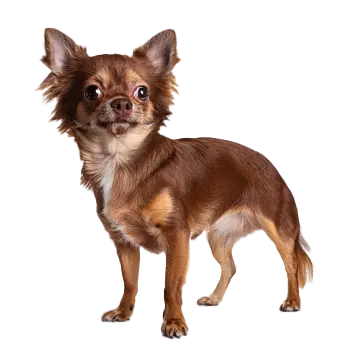
The head is the breed's architectural centerpiece. It is rounded and dome-shaped - what breeders call the apple dome - with a defined stop between the muzzle and the forehead. The muzzle itself is short, moderately pointed, and well-formed with tight lips. The eyes are large, round, dark, and set well apart, giving the face its distinctive alert expression. Very pale dogs may have lighter eyes with a ruby or wine hue that is accepted but not preferred. The ears are large relative to the head, triangular, and naturally erect when the dog is engaged. At rest, they angle outward at roughly 45 degrees from vertical rather than folding down or flying straight out to the sides.

The body is compact and slightly longer than it is tall, measured from the point of the shoulder to the rump. The neck is slightly arched and merges smoothly into the shoulder. The topline is level and the chest is moderately broad with a good spring of rib. The tail is moderately long and held up or in a sickle curve over the back. Fine-boned legs appear delicate but should be straight, properly muscled, and sound. The feet are small and round with well-separated toes.

The smooth coat lies flat against the body and produces the sleek, close-fitting silhouette that makes the Chi-Chi's outline so recognizable in profile. The ruff at the neck is often heavier in males and gives the dog a slightly more imposing look than its size alone would suggest. The long coat changes the silhouette considerably, adding soft feathering at the ears that can fall like small wings, along the backs of the legs, at the chest, and at the tail, which fans out when carried. Neither coat should be harsh, cottony, or excessively thick.

Color in the Chi-Chi is genuinely unlimited. The breed standard in every registry specifies that all colors and combinations are acceptable, and the range that appears in real breeding programs is extraordinary. Solid fawn, black, chocolate, blue, cream, red, and white all occur in pure form. Merle is accepted by some registries and debated by others due to health concerns associated with double-merle breeding. Parti-color patterns with white, sabling, brindle, and spotted combinations all appear regularly. This variety in color contributes to the Chi-Chi's enormous visual diversity despite the fact that every individual shares the same distinctive structure.

One physical feature worth understanding is the molera - a soft spot on the top of the skull that is a documented breed characteristic rather than a defect. Most Chihuahua puppies are born with this fontanel open, and it generally reduces in size as the dog matures. A very large or persistent molera can be associated with hydrocephalus and warrants veterinary monitoring, but the molera itself in reasonable size is a normal feature of the breed.

Affectionate With Family
The Chi-Chi wraps itself around its family with the kind of commitment most dogs reserve for their one special person. Once this dog decides you belong to it, that decision is final and non-negotiable.
Good With Young Children
Older kids who handle dogs gently can form wonderful bonds with a Chi-Chi, but the breed's small size and firm boundaries make it a poor fit for households with toddlers or children who have not learned to respect a dog's space.
Good With Other Dogs
The Chi-Chi can be territorial and reactive around unfamiliar dogs, occasionally challenging animals many times its own size. Steady socialization helps, and many do well with other small dogs they have grown up alongside.
Shedding Level
Both coat varieties shed on a consistent year-round basis. The smooth Chi-Chi leaves fine hairs in fabric, while the long coat drops more visible strands. Expect to brush regularly regardless of which coat your dog has.
Coat Grooming Frequency
The smooth coat needs only a weekly brush and an occasional wipe-down, while the long coat requires two to three brushings per week to stay tangle-free. Neither coat demands professional grooming under normal circumstances.
Drooling Level
The Chi-Chi is a tidy dog with a compact muzzle and no tendency to drool. You will not find wet spots on the couch or slime on your clothes with this breed.
Coat Type
The Chi-Chi is recognized in two coat types. The smooth variety has a close, glossy coat with a ruff at the neck, while the long coat has a soft, flowing texture with feathering on the ears, legs, and tail.
Openness To Strangers
Strangers are received with watchful reserve rather than warmth. The Chi-Chi will size up anyone new to its environment and make up its own mind at its own pace. Socialization from a young age reduces the edge but does not eliminate it.
Playfulness Level
Inside the house the Chi-Chi is an enthusiastic and inventive playmate. It will throw itself into a game of chase, launch itself at a dangling toy, or manufacture entertainment from whatever is available.
Watchdog/Protective Nature
The Chi-Chi takes its watchdog duties seriously and announces anything it deems worth noting, which is often everything. Its hearing is sharp, its awareness of the household perimeter is constant, and its bark is not shy.
Adaptability Level
The Chi-Chi adapts smoothly to apartments, townhouses, and smaller living spaces as long as it has its person nearby and is protected from cold temperatures. What it does not adapt well to is isolation or a chaotic household without routine.
Trainability Level
The Chi-Chi is capable of learning a great deal when training is consistent, reward-based, and presented as something worth the dog's participation. Repetitive drilling or harsh corrections bring progress to an immediate halt.

Chi-Chi History & Development

The name Chi-Chi is informal and modern, but the dog it refers to carries a history that stretches across centuries and two continents. The Chihuahua's origins are tied to pre-Columbian Mexico, where small companion dogs lived alongside both the Toltec and later the Aztec civilizations. The dogs known as Techichi appear in surviving artifacts and written descriptions as small, mute companions kept for both daily company and ceremonial purposes. These were not the refined, lightweight dogs that would eventually be registered as Chihuahuas, but the physical resemblance is clear enough that most breed historians accept a direct lineage.

The modern breed took shape in the 19th century when American and European travelers began finding small dogs near the Mexican border city of Chihuahua. The city and its surrounding state had become a significant trading hub, and the small dogs were sold there to tourists and traders who found them novel and appealing. The name Chihuahua traveled north with the dogs and became established in the American vernacular before any registry had formalized it. By the late 1800s, breeders in the United States were working with these Mexican dogs and beginning to refine and standardize their appearance.

The AKC registered its first Chihuahua, a dog named Midget, in 1904. From that point, the breed's development in the United States accelerated steadily. The Chihuahua Club of America was established in 1923, giving the breed formal organizational support and a community of dedicated breeders working toward consistent standards. The breed climbed steadily in popularity through the 20th century, driven partly by its practicality as an apartment companion and partly by the intensity of the loyalty it inspired in its owners.

Chi-Chi as a specific nickname emerged organically within that community of devoted owners. It has no founding moment and no single point of origin - it is simply the kind of name that people who love a breed develop over time, through the daily intimacy of living with the dogs. The doubling of the syllable is common in affectionate pet naming across many cultures, and Chi-Chi fits both the sound of the original name and the spirit of the breed with an ease that made it stick. Today the name is widely understood within Chihuahua owner communities and in the broader public, where the breed's distinctive look and personality have made it one of the most recognized dogs in popular culture.

Breed rescue organizations, which have been active since the early 2000s in response to the breed's overpopulation in some regions, commonly use both Chi and Chi-Chi in their names and communications. These organizations have done significant work to rehabilitate the breed's image from an accessory dog to a serious companion deserving thoughtful ownership, and the familiarity of the nickname has helped make the breed approachable to people who might otherwise be put off by its sometimes formidable reputation for strong opinions.

Chi-Chi Temperament & Personality

Imagine the most opinionated person you have ever met, compress that personality into a four-pound package, add absolute fearlessness, and cover the whole thing in fur. That is approximately what you are dealing with when you bring a Chi-Chi into your home. The breed has a genuine character - not simply reactivity or anxiety dressed up as personality, but actual preferences, actual opinions, and actual ways of organizing its world that it will make clear to you whether or not you asked.

The Chi-Chi's relationship with its primary person is its emotional anchor. The attachment is intense and exclusive, the kind of bond where the dog simply wants to know where you are at all times. This can feel flattering - and it is, in its way - but it also means that the Chi-Chi does not do well with sudden changes in routine, long separations, or environments where the person it has bonded to is absent for much of the day. A Chi-Chi that experiences chronic loneliness will find ways to express that, typically through barking, house-training accidents, or the creative destruction of whatever is within reach.

With strangers the Chi-Chi maintains its watchdog posture until it has made its own assessment. This is not shyness in the clinical sense - shy dogs tend to withdraw and hide. The Chi-Chi holds its ground, keeps its eyes on the newcomer, and communicates its opinion of the situation with complete clarity. Some Chi-Chis warm up relatively quickly once they decide a person is acceptable. Others maintain a permanent reserve with anyone outside their core household. Socialization from puppyhood shapes how extreme this tendency becomes, but it does not eliminate the underlying wariness that makes this breed an effective household alarm system.

Around other dogs the Chi-Chi exercises a boldness that is impressive and occasionally alarming. It does not appear to calculate size ratios before deciding to express an opinion, which means unsupervised contact with much larger dogs is a genuine safety concern. Many Chi-Chis live peacefully with other small dogs, particularly others of their breed, and some coexist comfortably with cats they have been raised alongside. The key is managed introductions, respect for each animal's comfort level, and realistic expectations about the Chi-Chi's preference for controlling its own social interactions.

The stubbornness that sometimes surfaces during training is not stupidity - Chi-Chis are genuinely intelligent and quick to learn what they are motivated to learn. What they resist is training that feels pointless, harsh, or repetitive without reward. This is a dog that will remember what it has been taught, both the lessons you intended and the ones you accidentally delivered by laughing at a behavior that later became inconvenient. The most effective Chi-Chi owner is someone who finds the dog's strong will interesting rather than frustrating and who approaches the relationship as a genuine partnership rather than a command structure.

Chi-Chi Family Life & Living Requirements

The Chi-Chi is one of the most genuinely adaptable breeds for people living in smaller spaces. It needs far less physical room than its personality suggests, and it can meet a significant portion of its exercise needs through indoor activity. An apartment with a committed owner who takes the dog on regular walks and engages it mentally through play and training is a far better home for a Chi-Chi than a large house where the dog is left alone while the family is away all day. The dog's world is measured in relationships, not square footage.

Cold weather is a real concern. The Chi-Chi has a small body mass that loses heat quickly, and the breed is noticeably uncomfortable in temperatures that would not bother a medium or large-sized dog. Outdoor time in winter requires a properly fitted coat or sweater, and prolonged cold exposure should be avoided. This sensitivity to temperature is worth factoring into housing choices, daily routines, and what you expect the dog to be able to do comfortably during winter months. A Chi-Chi wearing a sweater is not an affectation - it is an owner paying attention to what the breed actually needs.

Families with children need to evaluate the fit honestly. The Chi-Chi is not naturally tolerant of rough handling, sudden movements, or the unpredictable energy of very young children. Its small size creates a physical vulnerability that must be respected, and the breed will defend its personal space with its voice and sometimes its teeth when it feels cornered or mishandled. Older children who have been taught to interact calmly with a small dog can develop genuine and lasting bonds with a Chi-Chi. Households with toddlers are usually better served by a different breed until the children are old enough to be reliable partners for a dog this small.

The Chi-Chi's need for human contact is among the highest of any toy breed. This is a dog that wants to be present for household life, involved in whatever is happening, and in close physical proximity to its people. It is not a dog you keep in a separate room or leave to its own devices for most of the day. Owners who travel frequently, work extremely long hours, or who want a low-maintenance independent pet will find the Chi-Chi's attachment style demanding rather than rewarding. Owners who want a devoted daily companion will find it perfect.

Chi-Chi Training & Exercise Needs

Training a Chi-Chi is a project that rewards patience and a sense of humor more than force or rigid structure. This is a dog that will go along with you enthusiastically when it understands what you want and believes the result is worth its effort. When those conditions are not met, it will demonstrate its opinion with remarkable consistency. The key is to make training feel like the Chi-Chi's idea as much as possible, which sounds like pandering but is actually just good training practice for a breed with this temperament.

Housetraining is the area where most Chi-Chi owners encounter their most persistent challenge. The combination of small bladder, high metabolism, and the breed's documented reputation for selective rule-following means that many Chi-Chis need a longer and more structured housetraining process than owners expect. Crate training paired with a strict schedule of outdoor opportunities is the most reliable approach. Celebrating success consistently and ignoring accidents without punishment - while immediately cleaning them thoroughly - produces better results than any correction-based method. Temperature sensitivity also plays a role: a Chi-Chi that has decided it is too cold to go outside and eliminates on your floor is communicating a real discomfort rather than defiance.

Leash training benefits the Chi-Chi both physically and socially. A well-leashed dog that walks calmly gets taken out more, which means more socialization and exercise. A harness rather than a collar is the recommended tool for Chi-Chis both for tracheal protection and for control, since a small dog with a collar attachment can slip free or injure itself while pulling. Short, consistent sessions work better than long formal training blocks. The Chi-Chi tunes out when it is tired of a lesson, and continuing past that point produces resentment rather than results.

Exercise requirements are manageable relative to most breeds. Two short daily walks plus indoor play time keeps the typical Chi-Chi physically content. What equally matters is mental engagement - training games, rotating toys, and the stimulation of being involved in daily household activity. A bored Chi-Chi is a creative Chi-Chi, and not always in ways that are convenient. Short training sessions spread through the day, even just five minutes of practicing known cues with treats, satisfy the Chi-Chi's need for engagement and reinforce the relationship between the dog and its owner at the same time.

Chi-Chi Health Concerns

For a breed this small, the Chi-Chi lives a remarkably long time. Lifespans of fourteen to sixteen years are typical, with many individuals reaching beyond that. That longevity means health conditions have a longer window to develop, and staying ahead of them through regular veterinary care matters more for this breed than the raw statistics might suggest.

Tracheal collapse, periodontal disease from tooth crowding, hydrocephalus linked to an abnormally large molera, and Legg-Calve-Perthes disease in young dogs round out the primary health concerns specific to this breed. The tracheal risk is the reason harness use is so strongly recommended over collar attachment for leash walking. Dental care demands daily attention given how severely crowding accelerates tartar accumulation in the Chi-Chi's small jaw. Routine veterinary care, appropriate weight management, and adherence to the breed's recommended health screening protocols give the Chi-Chi every advantage for a long and comfortable life.

Common Health Issues

  • Degenerative Mitral Valve Disease: Progressive failure of the mitral heart valve is the leading documented cause of death in older Chi-Chis. The valve thickens and fails to seal - Creating a heart murmur that precedes clinical signs by months or years. Annual cardiac screening catches it early.
  • Patellar Luxation: A hereditary condition in which the kneecap repeatedly slips out of its groove - Causing the characteristic skipping gait seen in affected dogs. Ranges from mild intermittent lameness to severe displacement requiring surgical correction.
  • Tracheal Collapse: Weakening of the cartilage rings that keep the windpipe open causes progressive airflow restriction and a honking cough. More common in middle-aged and older Chi-Chis - And worsened by collar pressure, obesity, and airway irritants.
  • Hydrocephalus: Accumulation of cerebrospinal fluid within the skull - Associated with an abnormally large molera in affected puppies. Produces neurological signs including seizures, disorientation, and abnormal head size. Most apparent in puppies under nine months.
  • Periodontal Disease: Severe and early-onset tooth crowding in the Chi-Chi's small jaw creates ideal conditions for plaque and tartar accumulation - Leading to gum disease and tooth loss. Active daily dental care is essential from puppyhood.
  • Legg-Calve-Perthes Disease: Reduced blood supply to the femoral head causes bone death at the hip joint in puppies typically between six and nine months of age. Produces pain and lameness - With surgical removal of the affected femoral head offering a good prognosis.

Preventive Care & Health Monitoring

  • OFA Cardiac Evaluation - CHIC Required, : Cardiac auscultation by a qualified veterinarian or cardiologist screens for early mitral valve disease. Required by the Chihuahua Club of America for all breeding stock under the CHIC program.
  • OFA Patella Evaluation - CHIC Required, : A graded physical evaluation of kneecap stability conducted at one year of age or older. Required for CHIC certification and identifies hereditary luxation before breeding decisions are made.
  • OFA Eye Examination/CAER - CHIC Required, : Performed by a board-certified veterinary ophthalmologist to screen for inherited eye conditions including progressive retinal atrophy. Valid for twelve months and required annually for continued CHIC certification.
  • Daily Dental Hygiene: Daily toothbrushing combined with scheduled professional cleanings under veterinary supervision is the most effective strategy against the Chi-Chi's documented predisposition to early and severe periodontal disease. - Daily Dental Hygiene: Daily toothbrushing combined with scheduled professional cleanings under veterinary supervision is the most effective strategy against the Chi-Chi's documented predisposition to early and severe periodontal disease.
  • Harness Use for All Leash Walking: Routing the leash through a harness rather than a collar eliminates neck pressure on the trachea - Reducing the risk of triggering or accelerating tracheal collapse in susceptible individuals.
  • Annual Veterinary Cardiac Monitoring: Even Chi-Chis outside of breeding programs benefit from annual heart checks as they age - Allowing early detection of mitral valve changes before congestive heart failure develops.

Chi-Chi Grooming & Maintenance

The Chi-Chi's grooming routine depends largely on which coat variety you have, but both are far simpler than the grooming calendars of many other Toy breeds. The smooth coat can be maintained with a brief weekly brushing and the occasional damp-cloth wipe-down to restore shine. The long coat needs brushing two to three times per week to prevent the tangles that develop behind the ears, in the armpit area, and along the rear feathering where friction is highest. Both coats shed year-round at a moderate level that is manageable with regular brushing but visible if you skip sessions for weeks at a time.

Dental care is the Chi-Chi's most pressing maintenance need, outranking coat care in terms of health impact. The breed's small jaw creates crowding that accelerates tartar and plaque buildup at a rate significantly faster than in larger dogs, and periodontal disease affects the vast majority of Chi-Chis before they reach age two without active intervention. Daily toothbrushing with a dog-specific toothpaste is the most effective tool available. Introducing the Chi-Chi to this routine during puppyhood makes it a matter of normal daily life rather than a battle. Professional dental cleanings under veterinary supervision are typically needed more frequently for this breed than for larger dogs - your veterinarian will advise based on your individual dog's buildup rate.

Nails should be trimmed every three to four weeks. The Chi-Chi's small nails can feel intimidating to trim for first-time owners, but allowing them to grow too long will alter the dog's gait and create discomfort. A grinder or small clipper both work well with patience and proper training of the dog to accept the process calmly. Ears should be checked and cleaned monthly using a veterinarian-recommended solution, wiped gently into the ear canal without pushing debris deeper. The large, upright ears of the Chi-Chi tend to collect less moisture and debris than drop-eared breeds, making ear care relatively straightforward under normal circumstances.