Chi

Chihuahua

Quick Facts

πŸ• Breed Group
Toy Group
πŸ“ Size Category
Toy
πŸ“ Height
Males: 5-8 inches, Females: 5-8 inches
βš–οΈ Weight
Males: Under 6 pounds, Females: Under 6 pounds
⏱️ Life Expectancy
14-16 years
🧣 Coat Type
Smooth or long coat
🎨 Coat Colors
Any color or combination
πŸ˜€ Temperament
Alert, loyal, bold, confident
πŸƒ Exercise Needs
Low to moderate
πŸŽ“ Training Difficulty
Moderate
πŸ‘Ά Good with Children
Better with older children
🐾 Good with Other Pets
Better with other Chihuahuas

Other Names & Breed Recognition

Chi is the casual everyday shorthand that Chihuahua owners, breeders, and enthusiasts have used for generations, and it fits the dog perfectly - short, punchy, and hard to ignore, just like the breed itself. The name condenses the full breed name down to its first syllable, and it carries a warmth that the clinical full name sometimes lacks. If you grew up with one of these dogs, you probably called it your Chi without ever thinking much about it. The shorthand feels earned rather than invented.

The full name, Chihuahua, comes from the Mexican state of the same name, which is itself derived from a Nahuatl word whose meaning is still debated among linguists and historians. Some translate it as "dry place" or "sandy place," others point to interpretations related to elevation and terrain. What everyone agrees on is that the state of Chihuahua, situated in the northern part of Mexico along the border with the United States, is where American and European explorers first encountered and documented the small dogs that would eventually become the modern breed. The dogs were traded and sold near the city of Chihuahua, which gave the breed the name that stuck when it made its way into formal registries.

Beyond Chi and Chihuahua, the breed travels under a handful of other informal names. Teacup Chihuahua is a term you will see advertised by some breeders, but it carries no official standing and legitimate breed organizations actively discourage the label because it promotes breeding for extreme smallness at the expense of health. Chi-Chi is another affectionate doubling that appears in casual conversation and in some regional communities. The breed is occasionally called the Mexican hairless, though that name more accurately belongs to a completely separate breed, the Xoloitzcuintli. The Chihuahua is not hairless, even in its shortest-coated form.

Registries recognize the breed under the full name Chihuahua. The American Kennel Club has recognized the breed since 1904, making it one of the older AKC registrations in the Toy Group. The Chihuahua Club of America serves as the parent club in the United States and maintains the breed standard, oversees health programs, and promotes ethical breeding practices. The Federation Cynologique Internationale classifies the Chihuahua in Group 9 under the ChihuahueΓ±o section, which is the only section dedicated entirely to this breed. Whether you say Chihuahua or Chi, you are talking about exactly the same dog - small in size and enormous in personality, with one of the longest documented histories of any companion breed in the Americas.

Chi Organizations & Standards

The Chihuahua Club of America is the national parent club in the United States and the primary authority on breed standards, health programs, and ethical breeding for the Chi. Founded in 1923, the CCA has worked for over a century to protect the breed from the excesses that come with popularity - extreme size breeding, irresponsible production, and health neglect. The CCA maintains close ties with the AKC and participates actively in the Canine Health Information Center program through OFA, requiring member breeders to health test breeding stock.

The breed standard maintained by the AKC and the CCA describes the Chi as a graceful, alert, swift-moving compact little dog with saucy expression, intelligent eyes, and erect ears. The standard sets the maximum weight at six pounds, with no minimum established, though the breed community recognizes that very tiny individuals - sometimes marketed as teacup or micro - carry heightened health risks. The standard emphasizes a well-rounded, apple-domed skull as the breed's most distinctive structural feature. The eyes should be large, round, not protruding, and set well apart. Ears should be large, held erect when the dog is alert, and flared at the sides at roughly a 45-degree angle to the head when the dog is at rest.

Two distinct coat varieties are recognized within the same breed and shown in separate classes. The smooth coat lies tight to the body with a lustrous finish and a ruff at the neck. The long coat has a soft texture, either flat or slightly wavy, with feathering on the ears, legs, feet, and tail, and a full undercoat. Both varieties come in virtually any color, pattern, or combination of colors, making the Chi one of the most visually diverse breeds in the Toy Group.

The Kennel Club in the United Kingdom recognizes the breed in its Toy group and maintains a comparable standard. The Federation Cynologique Internationale standard, which governs recognition across much of Europe, South America, and Asia, places the breed in its own dedicated section within Group 9. The FCI standard is used in the countries where the Chi competes internationally under its full name but where the nickname Chi is equally common in everyday use among fanciers. The United Kennel Club also recognizes the breed in its Companion Breeds category. Across all registries, the core physical and temperament requirements are consistent: small, balanced, alert, and structurally sound.

Kennel Club Recognition

  • American Kennel Club (AKC): Recognized in 1904, Toy Group
  • United Kennel Club (UKC): Recognized, Companion Breeds
  • Canadian Kennel Club (CKC): Recognized, Toy Group
  • FCI: Recognized, Group 9 - Companion and Toy Dogs
  • The Kennel Club (UK): Recognized, Toy

Chi Physical Description

The Chi occupies less physical space than almost any other recognized dog breed, yet it manages to fill a room with presence. Adult weight tops out at six pounds per the breed standard, and many Chis fall between three and six pounds in everyday life, though slightly larger individuals are not uncommon outside the show ring. Height typically lands somewhere between five and eight inches at the shoulder. Despite the scale of a small paperback book, the Chi is a properly proportioned dog with a square, well-muscled body that gives no sense of fragility when you watch it move.

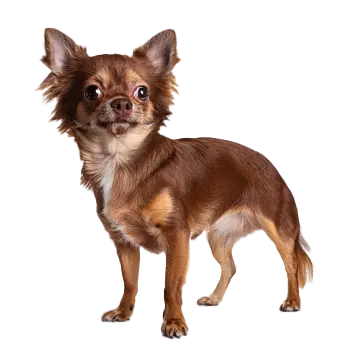
The head is the Chi's most recognizable feature and the element that distinguishes it immediately from other toy breeds. The skull is rounded and dome-like - the apple dome shape that the breed standard specifies - with a well-defined stop and a short, slightly pointed muzzle. The jaw closes cleanly with a scissors or level bite. The eyes are large, round, dark, and luminous, giving the face its famous intensity of expression. Eye color can lean toward ruby in lighter-colored dogs. The ears are large relative to the head, triangular, and erect, angling slightly to the sides when relaxed and standing fully upright when the dog is alert. These ears are the Chi's natural antenna and they miss very little.

The body is compact and slightly longer than it is tall when measured from shoulder to hindquarters. The neck is slightly arched and carries the head with a lifted, confident carriage. The topline is level, the chest is moderately broad and deep, and the ribs are well-sprung without being barrel-shaped. The tail is moderately long, carried up or in a sickle curve over the back, and well-furred in the long-coated variety. The legs are straight and fine-boned but not fragile-looking, and the feet are small with well-split toes and hard pads.

The smooth coat is close-lying with a glossy sheen, often with a visible ruff around the neck that is heavier in males. The long coat is silky and can be flat or slightly wavy. Neither coat should be harsh or cotton-textured. Colors span the entire spectrum - solid fawn, chocolate, black, white, cream, red, blue, and merle are all seen, as are combinations with white markings, sabling, brindle, and spotted patterns. No color is preferred over another in the show ring, making the Chi one of the most visually varied breeds anywhere in the dog world.

Movement reflects the soundness of the structure. The Chi moves with a brisk, quick stride that is deceptively covering for such small legs, with good reach in front and drive from behind. The head stays carried up. A Chi in proper condition moves with self-assurance rather than mincing or scrambling. When you watch a well-built Chi trot across a room, you see a small dog that knows exactly who it is.

One notable structural feature worth understanding is the molera - a soft spot on the top of the skull that is a breed characteristic rather than a health defect in most individuals. Many Chis are born with this fontanel open, and it often closes or reduces significantly as the puppy matures. A very large persistent molera can be associated with hydrocephalus, which is why experienced breeders and veterinarians evaluate it as part of routine early health assessment. The molera alone is not a cause for alarm, but its size and persistence are worth monitoring.

Affectionate With Family
The Chi bonds with ferocious loyalty to the people it calls its own, often choosing one person above all others and following them from room to room. This devotion runs deep and makes the Chi a remarkably warm companion for the right household.
Good With Young Children
The Chi is best suited to homes with older, calm children who understand how to handle a fragile small dog. Very young children can accidentally injure a Chi, and the breed will not hesitate to tell a child when it has had enough.
Good With Other Dogs
Chis often prefer the company of their own kind and can be surprisingly assertive or reactive around unfamiliar dogs of any size. Careful socialization from puppyhood makes a meaningful difference in how they navigate canine company.
Shedding Level
Both smooth and long-coated Chis shed consistently year-round, with the smooth coat dropping fine hairs that embed in fabric and the long coat leaving more visible strands. Neither coat is truly low-shedding.
Coat Grooming Frequency
The smooth Chi needs little more than a weekly once-over with a soft brush, while the long coat benefits from more frequent combing to prevent tangles behind the ears and along the legs. Neither variety requires professional grooming as a rule.
Drooling Level
Drooling is not a characteristic of the Chi. This is a dry-mouthed breed with a tidy, compact muzzle that keeps slobber off your furniture and clothing.
Coat Type
The Chi comes in two distinct coat varieties: the sleek, close-lying smooth coat and the soft, slightly wavy long coat with feathering on the ears, legs, and tail. Both coat types are accepted in the show ring and equally valued by owners.
Openness To Strangers
Chis tend to be reserved with people they do not know and will sometimes make their suspicion unmistakably clear with a bark or a stare. Early and ongoing exposure to different people helps, but this breed's wariness is deeply rooted.
Playfulness Level
Inside the house the Chi is a surprisingly spirited playmate, willing to chase toys, climb furniture, and invent its own games with whatever is available. That big personality produces big play energy in a very small body.
Watchdog/Protective Nature
The Chi takes its role as household sentinel with absolute seriousness. It hears everything, misses nothing, and will alert with full conviction regardless of whether the threat is a delivery driver or a leaf hitting the window.
Adaptability Level
As long as the Chi has its person nearby, it adjusts to apartments, houses, cities, and rural areas with equal ease. What it cannot adapt to is being left alone for long stretches or exposed to extreme cold without protection.
Trainability Level
The Chi is smart and motivated by its person's approval, but it is also capable of developing firm opinions about what it wants to do and when. Consistent, reward-based training works well; harsh corrections make this breed shut down or dig in.

Chi History & Development

The name Chi comes late in a story that stretches back centuries, but the dog itself predates the shorthand by a very long time. The Chihuahua's origins are genuinely ancient, though the full picture involves both documented history and reasonable inference. Small dogs resembling the modern Chihuahua appear in artwork and artifacts connected to the Toltec civilization of central Mexico, and later the Aztecs, who kept small dogs called Techichi that were companions, spiritual animals, and in some documented contexts, sacrificial animals used in burial rituals. These Techichi were likely heavier and less refined than the modern breed, but the physical resemblance is clear enough that most historians accept a direct ancestral connection.

Spanish explorers arriving in Mexico in the 16th century documented the small companion dogs kept by indigenous peoples, but the breed as we know it today did not emerge fully formed from those observations. The modern Chihuahua was shaped significantly in the 19th century, when American travelers and traders began finding small dogs near the Mexican border city of Chihuahua and purchasing them as novelties and companions. The city and state lent their name to the dogs being sold there, and the name Chihuahua traveled north with the dogs.

Formal registration began in the United States in 1904 when the AKC accepted its first Chihuahua, a dog named Midget. The Chihuahua Club of America was established in 1923, and from that point the breed's development in the United States was guided by breeders who were actively shaping the standards and popularizing the breed at shows. By the mid-20th century the Chi had become one of the most recognizable toy breeds in North America, and the nickname Chi was already in common informal use among the community of owners and enthusiasts who had built their lives around these small dogs.

The nickname Chi carries the breed's personality in its brevity. Chihuahua fanciers are famously devoted, often becoming advocates for the breed in a way that owners of more mainstream breeds rarely match. Chi rescue organizations proliferated through the late 20th and early 21st centuries, driven by the same passionate community that uses the shorthand. Today the Chi is consistently among the most recognized dog breeds in the world, appearing in popular culture, advertising, and on the laps of people from every walk of life. The shorthand is universal enough that most people who have never owned a Chihuahua know exactly what a Chi is.

Chi Temperament & Personality

Stand next to the Chi's aquarium - well, in this case, stand next to the Chi itself - and you will immediately understand why these dogs inspire such fierce loyalty in their owners. The Chi is not a passive companion. It has opinions, it expresses them, and it expects to be taken seriously despite weighing somewhere around the same as a bag of sugar. That combination of strong will and physical smallness is the central tension of owning a Chi, and how you manage it determines whether life with one of these dogs is a delight or an ongoing negotiation.

The bond the Chi forms with its primary person is among the most intense in the dog world. This is not a dog that is friendly to everyone in a casual, equally distributed way. It picks its person and commits completely, following them through the house, sleeping against them, and sometimes becoming visibly unsettled when that person leaves the room. This level of attachment is endearing but it also sets the stage for separation anxiety, which can manifest as barking, destructiveness, or house-training regression when the dog is regularly left alone for long periods. If you work long hours and live alone, the Chi's attachment style is something to think carefully about before bringing one home.

With strangers the Chi is naturally cautious. This is not aggression in the traditional sense - it is a working watchdog instinct compressed into a very small package. The Chi is designed by its nature to notice things and sound the alarm. It will bark at unfamiliar people, unfamiliar sounds, and unfamiliar situations until it has decided for itself that the situation is safe. Socialization from puppyhood helps considerably. A Chi that has been exposed to many different people, environments, and experiences from an early age is far less reactive than one that has been kept in a bubble. But even a well-socialized Chi will maintain a healthy skepticism toward newcomers that no amount of training will fully eliminate.

Around other dogs, the Chi can be surprisingly assertive. It does not seem to register that it is small, and it will challenge dogs many times its size if it feels threatened or if it decides to claim something worth defending. This is not unusual for the breed and it is not a defect, but it does mean that introductions to other dogs need to be managed carefully and that unsupervised contact with large dogs carries genuine risk. Many Chis do well with other Chis or with small dogs they have been raised alongside, but the expectation that any dog will immediately be welcomed is unrealistic for this breed.

The Chi's intelligence is real but comes with a strong independent streak. These dogs figure out routines quickly, read their owners well, and can learn a surprising number of cues when training is consistent and positive. What they resist is repetition without purpose and any form of harshness. Raise your voice at a Chi and it will either bark back or shut down entirely - neither is productive. The most successful approach treats training as a cooperative game rather than a compliance exercise, which is honestly how the Chi prefers to experience everything in its life.

Chi Family Life & Living Requirements

The Chi is genuinely one of the best apartment dogs in existence, and that is not simply because of its size. It is because the Chi's exercise needs are manageable indoors, it does not require a yard, and it is content to spend large portions of the day in close proximity to its person without demanding constant entertainment. A Chi can get meaningful exercise just from exploring a reasonably sized apartment, playing indoor fetch, and accompanying you on walks around the block. This flexibility makes the breed accessible to people living in cities, in small homes, or without outdoor space.

The trade-off is that the Chi does not tolerate being alone well. It is a breed that was developed to be a companion in the most literal sense, and long daily absences work against its temperament. A Chi left alone for eight or more hours regularly will find ways to communicate its dissatisfaction. If your lifestyle involves being away from home for most of the day, either a different breed or a second Chi for company is worth considering seriously.

Families with young children should think carefully about whether a Chi is the right fit. The dogs are physically fragile - a fall from a child's arms or an accidental step can cause serious injury. Very young children do not yet have the coordination or impulse control to interact safely with a dog this size. The Chi also has clear boundaries and will use its voice, and sometimes its teeth, to enforce them when it feels cornered or mishandled. Families with older children who have been taught to respect small dogs can do well with a Chi, but households with toddlers are often not ideal.

Temperature is something Chi owners have to stay on top of. The breed is sensitive to cold because of its small body mass and limited ability to retain heat. A Chi should never be expected to spend extended time outdoors in winter temperatures without protection - a properly fitted coat or sweater is not just a fashion accessory for this breed, it is a reasonable precaution. Indoor temperatures should remain comfortable. Summer heat is also a concern, particularly in humid conditions where the short muzzle can make breathing slightly more labored during hard exercise.

Chi Training & Exercise Needs

Training the Chi requires patience, consistency, and a genuine sense of humor. This is a dog that will absolutely cooperate with you when it sees the point, and will absolutely decide it has better things to do when it does not. The good news is that Chis are food-motivated, attuned to their owner's emotions, and clever enough to learn quickly. The less good news is that they are also prone to a phenomenon sometimes called Small Dog Syndrome, which is less a breed defect and more a description of what happens when small dogs are allowed to set their own rules because their owners find their bossiness charming rather than problematic.

Start training early. The Chi puppy that learns basic house manners from eight weeks forward is the Chi that grows into a confident, manageable adult. Housetraining is the area where most owners hit the biggest wall. Chis have small bladders, high metabolisms, and a well-documented reputation for being difficult to fully housetrain. Crate training, strict schedules, and genuine celebration of outdoor success are the tools that work. Expecting reliability too early, or punishing accidents after the fact, sets the process back significantly.

Leash manners matter even for a dog this small. A Chi that pulls, barks at everything it passes, or charges other dogs on a walk is unpleasant company and reflects on the owner's commitment to training. The harness is strongly recommended over a collar for leash walking, both because it avoids pressure on the Chi's sometimes vulnerable trachea and because it gives better control for a small but determined dog. Short, positive training sessions work best. The Chi has a relatively short attention span for formal work but can sustain focus remarkably well when the session feels more like a game than a lesson.

Exercise for the Chi does not need to be intense. Two short walks per day, plus indoor play, keeps most Chis physically satisfied. What they need in equal measure is mental engagement - puzzles, training games, and the social stimulation of being involved in household life. A Chi that is physically tired but mentally bored is still a Chi looking for trouble. Rotating toys, teaching new tricks, and simply including the dog in whatever you are doing goes a long way toward keeping the Chi content and out of mischief.

Chi Health Concerns

The Chi is one of the longer-lived dog breeds, with lifespans regularly reaching the mid-to-late teens and some individuals documented past twenty years. That longevity is genuinely good news, but it also means that health issues have more time to develop and that some conditions you might not encounter in a shorter-lived breed become relevant. Knowing what to watch for gives you the best chance of catching problems early.

Tracheal collapse is a structural weakness of the cartilage rings that support the windpipe. It produces a characteristic honking cough that tends to worsen with excitement, exertion, or pressure on the neck. Using a harness instead of a collar for leash attachment reduces mechanical stress on the trachea and is strongly recommended for all Chis regardless of whether collapse has been diagnosed. Hydrocephalus, or fluid accumulation on the brain, can occur in puppies with an unusually large molera and produces neurological signs including seizures and coordination problems. Periodontal disease affects the vast majority of Chis before age two due to tooth crowding in their small jaws, making regular dental home care and professional cleanings essential from the start.

Common Health Issues

  • Degenerative Mitral Valve Disease: The mitral valve progressively thickens and fails to seal properly - Causing blood to flow backward through the heart. This is the leading documented cause of death in older Chis and is detectable early through cardiac auscultation during routine exams.
  • Patellar Luxation: The kneecap slips out of its normal groove in the femur - Causing an intermittent skipping gait in mild cases and persistent lameness in severe cases. Heritable in the Chi and part of the CCA-recommended CHIC screening protocol.
  • Tracheal Collapse: The cartilage rings supporting the windpipe weaken and flatten - Restricting airflow and producing a characteristic honking cough triggered by excitement, exertion, or collar pressure. Progressive and more common in middle-aged to senior Chis.
  • Hydrocephalus: Cerebrospinal fluid accumulates within the skull - Causing neurological symptoms including seizures, disorientation, and abnormal gait. Associated with an unusually large or persistent molera and typically manifests before nine months of age.
  • Periodontal Disease: Overcrowding of teeth in the Chi's small jaw creates ideal conditions for plaque and tartar accumulation - Leading to gum disease, tooth loss, and systemic inflammation. Affects the vast majority of Chis before age two without proactive dental care.
  • Legg-Calve-Perthes Disease: Reduced blood supply to the femoral head causes bone deterioration at the hip joint - Producing pain and lameness in puppies between six and nine months. Surgical removal of the affected femoral head typically produces a good outcome.

Preventive Care & Health Monitoring

  • OFA Cardiac Evaluation - CHIC Required, : Annual cardiac auscultation by a veterinary cardiologist screens for early mitral valve murmurs before clinical signs of heart disease develop. The CCA requires this test for all breeding stock through the CHIC program.
  • OFA Patella Evaluation - CHIC Required, : A physical examination grading the kneecap's stability from 1 to 4. Required for CHIC certification at one year of age or older. Identifies heritable luxation before breeding decisions are made.
  • OFA Eye Examination - CHIC Required, : A CAER exam performed by a board-certified veterinary ophthalmologist screens for inherited ocular conditions including progressive retinal atrophy. Valid for twelve months and required annually for CHIC certification.
  • Daily Dental Home Care: Toothbrushing with dog-safe toothpaste daily - Combined with scheduled professional cleanings, is essential for the Chi given its documented predisposition to severe early-onset periodontal disease.
  • Harness Use for Leash Walking: Avoiding collar attachment reduces pressure on the Chi's trachea and is recommended by veterinarians to slow the progression of tracheal collapse in affected dogs and as a preventive measure in all Chis. - Harness Use for Leash Walking: Avoiding collar attachment reduces pressure on the Chi's trachea and is recommended by veterinarians to slow the progression of tracheal collapse in affected dogs and as a preventive measure in all Chis.
  • Annual Cardiac Monitoring in Adults: Even Chis not destined for breeding benefit from annual heart checks as they age - Since early detection of mitral valve changes allows treatment to begin before congestive heart failure develops.

Chi Grooming & Maintenance

The Chi's grooming demands fall on the lighter end of the toy breed spectrum, but lighter does not mean nonexistent, and a few specific care needs are more pressing for this breed than for larger dogs. The coat variety you live with determines most of the routine, while dental care is the one area every Chi owner must prioritize regardless of coat type.

The smooth-coated Chi needs a brief weekly brush with a soft bristle brush or grooming mitt to remove loose hair and keep the coat looking clean. It sheds year-round with slightly heavier periods in spring and fall, and the fine short hairs have a particular talent for embedding in upholstery and dark clothing. A damp cloth wipe-down between brushings keeps the coat gleaming. The long-coated Chi requires more frequent attention - brushing two to three times per week prevents tangles from forming behind the ears, in the armpits, and along the rear feathering. A fine-toothed comb works well for catching developing mats before they become serious.

Dental care is non-negotiable for the Chi. The breed's small jaw creates crowding that traps food and accelerates tartar buildup dramatically. Daily tooth brushing with dog-safe toothpaste is the gold standard, and the Chi that is introduced to toothbrushing as a young puppy will accept it as normal routine by adulthood. Professional dental cleanings under anesthesia are typically needed more frequently for Chis than for larger breeds - your veterinarian will guide the schedule based on your individual dog's rate of buildup. Dental chews and water additives help between brushings but do not replace them.

Nail trimming is needed every three to four weeks on average. The Chi's nails grow relatively quickly and small nails that are allowed to get long will begin to affect the dog's gait and can cause discomfort. Ear cleaning once or twice monthly with a veterinarian-approved solution keeps the large, upright ears clear of debris. Eyes should be checked regularly for any discharge, and the area around the eyes wiped with a damp cloth as needed.