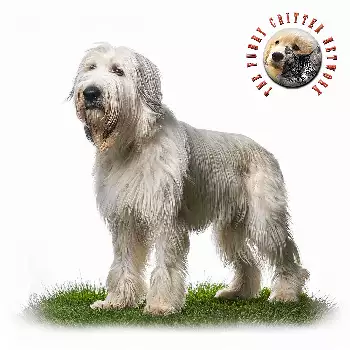
The first thing you notice about a Caucasian Mountain Dog is its sheer scale. Males regularly exceed 150 pounds and stand over 28 inches at the shoulder. The head alone is massive - broad and wide, with a strong stop transitioning to a broad, slightly tapered muzzle. The skull is large enough that the face appears flattened when viewed from the front. Small, deep-set eyes give the dog an alert, penetrating expression that many people find simultaneously impressive and sobering. Ear cropping was traditional in working dogs of this type to reduce injury risk in confrontations with predators; in countries where cropping is legal, it is still practiced by some working dog breeders. In show dogs and pet dogs in countries where cropping is prohibited, the natural ears are medium-sized, high-set, and triangular.
The neck is short and powerfully muscled, running into a broad, deep chest and a straight, level topline with a slightly sloping croup. The body is rectangular and heavily built - slightly longer than tall, with massive bone throughout. The hindquarters are well-angulated and heavily muscled, providing the power needed for a dog that historically needed to physically overpower large predators. This is not a lithe or agile dog; it is a dog built for overwhelming physical presence and raw power.
The coat comes in two varieties. The long-coated mountain type is more common and more visually striking: a profuse, coarse outer coat with a dense, woolly undercoat that provided insulation against severe mountain winters. The coat forms a pronounced mane around the neck and shoulders, feathering on the legs, and a heavily furnished tail. The short-coated steppe type has a more moderate coat with less furnishing - still a double coat with significant undercoat, but without the mane and heavy leg feathering of the mountain type. Both types are accepted in the breed standard.
Colors range widely across the breed: gray, fawn, red, cream, tan, white, brindle, and piebald patterns are all found. Most dogs carry a darker mask on the muzzle and forehead, and many have white markings. Solid white dogs exist within the breed. Color is not a selection priority in working dogs - function drives breeding decisions - which accounts for the broad color range.
The feet are large, round, and compact with substantial bone and tough pads. The tail is set high and carried curved over the back in a sickle or ring shape when the dog is alert. At rest it hangs lower. Movement should be powerful and fluid despite the dog's size - a ground-covering trot that expresses the breed's working capability. Dogs that appear clumsy or structurally unsound in movement are not correct for the breed regardless of how impressive they look standing still.
The size difference between a correctly built Caucasian Mountain Dog and an oversized or poorly conditioned specimen is significant, and buyers should understand what correct looks like before acquiring one. A correctly built dog carries its weight in muscle and bone, not fat. It moves with purpose and relative ease despite its mass. A dog that struggles to move comfortably, that is visibly overweight, or that lacks the muscling to support its frame is not a correctly built specimen regardless of what the scale says. Giant breed conformation requires more than simply being large.
The mane around the neck and shoulders in long-coated dogs is a distinctive feature that adds considerable visual mass to the front of the dog. Seen from the front or from a slight angle, the mane gives the dog a lion-like or bear-like silhouette that contributes significantly to its intimidating presence. This visual effect is functional in working dogs - a large, impressively coated guardian is more deterrent to predators and intruders than a less visually imposing one, and the Caucasian Mountain Dog's appearance has been shaped in part by that selective pressure over generations.
Affectionate With Family
★★★★☆
Deeply devoted to the household they claim as their own - the Caucasian Mountain Dog's loyalty is absolute once trust is established.
Good With Young Children
★★☆☆☆
Protective of family children but size and protective instinct make this breed inappropriate around unfamiliar children or in unpredictable situations.
Good With Other Dogs
★★☆☆☆
Territorial and dominant by nature. Multi-dog households require careful management; same-sex pairings are particularly risky.
Shedding Level
★★★★☆
Heavy seasonal shedding from the dense double coat. The long-coated variety is particularly demanding during seasonal blowouts.
Coat Grooming Frequency
★★★★☆
The long-coated variety requires frequent brushing to prevent matting. The short-coated variety is more manageable but still sheds significantly.
Drooling Level
★★★☆☆
Moderate drooling, particularly after drinking. Not extreme, but owners of lighter-colored furniture should be aware.
Coat Type
★★★★★
The long-coated variety has a striking, heavily furnished double coat built for mountain winters. The short-coated variant is less common.
Openness To Strangers
★☆☆☆☆
This is a guardian breed. Strangers are not welcomed, and introductions must be carefully managed to prevent territorial responses.
Playfulness Level
★★☆☆☆
More serious than playful by nature. These dogs were not selected for eagerness to play; they were selected for vigilance and protection.
Watchdog/Protective Nature
★★★★★
One of the most formidable natural guardians in the dog world. Courage and protective instinct are the core of this breed.
Adaptability Level
★★☆☆☆
Needs space, a secure environment, and experienced handling. Does not adapt easily to apartment life or passive ownership.
Trainability Level
★★☆☆☆
Independent and strong-willed. Responds to consistent, confident leadership but will not comply simply to please an uncertain handler.