Catalonian Sheepdog

Catalan Sheepdog

Quick Facts

🐕 Breed Group
Herding / Pastoral (FCI Group 1 - Sheepdogs)
📏 Size Category
Medium
📏 Height
Males: 18.5-21.5 inches, Females: 17.5-21 inches
⚖️ Weight
Males: 44-55 pounds, Females: 37-46 pounds
⏱️ Life Expectancy
12-14 years
🧣 Coat Type
Long, flat or slightly wavy double coat with dense undercoat
🎨 Coat Colors
Fawn, sable, grey, brown-red, black mixtures - appears unicolored from a distance
😀 Temperament
Intelligent, loyal, cheerful, brave, watchful, active
🏃 Exercise Needs
High
🎓 Training Difficulty
Easy to moderate - intelligent and willing but independent
👶 Good with Children
Yes
🐾 Good with Other Pets
Yes - with socialization

Other Names & Breed Recognition

Catalonian Sheepdog is the English translation used in the FCI breed standard (Standard No. 87) for the Gos d'Atura Catala, a herding breed native to the Pyrenean valleys and foothills of Catalonia in northeastern Spain. The FCI document's header reads "Gos d'Atura Catala (Catalonian Sheepdog)," making this the officially sanctioned English rendering for international purposes. In practice, however, the shorter form "Catalan Sheepdog" has become the dominant English-language name, used by The Kennel Club in the UK, the UKC in the United States, and the vast majority of English-language breed references and publications.

The breed's original Catalan name, Gos d'Atura Catala, breaks down linguistically in a way that illuminates the dog's function: gos means dog, atura derives from the verb aturar meaning to stop or control - a precise description of the herding action of gathering and directing livestock - and Catala identifies the breed's Catalonian origin. The Spanish-language name, Perro de Pastor Catalan or simply Pastor Catalan, translates as Catalan Shepherd Dog. In France, where the breed has a small but dedicated following, it is known as the Berger Catalan. The shortened form Gos d'Atura is used informally when the Catalonian context is understood.

The FCI definitively accepted the breed in 1954, classifying it in Group 1 (Sheepdogs and Cattle Dogs, except Swiss Cattle Dogs), Section 1 (Sheepdogs), without a working trial requirement. The first breed standard had been drawn up in 1929, following the breed's initial recognition by the Real Sociedad Central para el Fomento de las Razas Caninas en Espana in 1911. The UKC recognized the breed in 2006, placing it in the Herding Dog Group. The Kennel Club in the United Kingdom added the breed to its import register in 2009 under the Pastoral Group. The AKC and CKC do not currently recognize the breed.

The breed achieved its greatest international visibility when a stylized Catalan Sheepdog designed by the artist Javier Mariscal became Cobi, the official mascot of the 1992 Summer Olympic Games in Barcelona. Cobi became one of the most commercially successful Olympic mascots in history and introduced millions of viewers worldwide to a breed that had previously been known almost exclusively within Spain. Despite that moment of global exposure, the Catalonian Sheepdog remains a genuinely rare breed outside its homeland, with growing but still modest populations in Germany, Finland, Sweden, France, the Netherlands, and the United Kingdom.

Catalonian Sheepdog Organizations & Standards

The Club del Gos d'Atura Catala, founded in 1984 in Catalonia, serves as the breed's parent club and the custodian of the breed standard within Spain. This organization coordinates breeding programs, maintains registrations, organizes breed-specific events and working trials, and works to preserve the breed's functional herding characteristics alongside its development as a companion animal. The Real Sociedad Canina de Espana, Spain's national kennel club and FCI member organization, oversees the breed at the national level and maintains the formal connection to FCI international recognition.

The FCI standard describes the Catalonian Sheepdog as a dog of pleasant appearance whose driving of flocks reveals the true essence of the breed. The standard emphasizes that the dog not only obeys the shepherd but in numerous cases shows its own initiative, directing the flock with ease and preventing any animal from separating from the others. The standard also notes the breed's great bravery and courage for guarding missions, and praises its intelligence and loyalty as qualities that make it an excellent companion. Height specifications call for males between 47 and 55 centimeters (approximately 18.5 to 21.5 inches) at the withers, and females between 45 and 53 centimeters (approximately 17.5 to 21 inches).

In the United Kingdom, the Catalan Sheepdog Club of Great Britain coordinates breed activities, maintains a rescue network, and promotes the breed through education and organized events. The club serves as the primary resource for prospective owners in the UK and works closely with Spanish breed authorities to ensure that British breeding programs maintain connection to the breed's original type and function. The Kennel Club lists hip dysplasia screening as a priority health scheme for the breed.

Breed societies in Germany, Finland, Sweden, France, and the Netherlands each maintain their own organizational structures while cooperating internationally to share breeding information, health data, and genetic diversity management strategies. The breed's small global population outside Spain makes this international cooperation particularly important for avoiding the genetic bottlenecks that can affect rare breeds when breeding programs operate in isolation.

Kennel Club Recognition

  • FCI: Recognized in 1954, Group 1 - Sheepdogs and Cattle Dogs (except Swiss Cattle Dogs)
  • United Kennel Club (UKC): Recognized in 2006, Herding Dog Group
  • The Kennel Club (UK): Recognized in 2009, Pastoral

Catalonian Sheepdog Physical Description

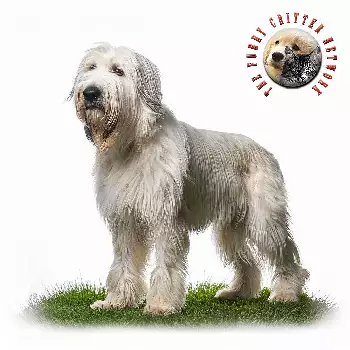
The Catalonian Sheepdog is a medium-sized, well-proportioned herding dog whose athletic build is somewhat obscured by its long, rough coat. Males stand 47 to 55 centimeters (18.5 to 21.5 inches) at the withers and weigh approximately 20 to 25 kilograms (44 to 55 pounds), while females measure 45 to 53 centimeters (17.5 to 21 inches) and weigh 17 to 21 kilograms (37 to 46 pounds). The body is slightly longer than tall, creating the rectangular proportions that facilitate the agile, ground-covering movement required for effective herding work across the uneven terrain of the Pyrenean foothills.

The head is strong and wedge-shaped, with a slightly domed skull and a well-defined but not exaggerated stop. The most immediately striking facial feature is the abundant facial furnishings: thick eyebrows that arch over the eyes without obscuring vision, a prominent moustache, and a full beard that give the breed its characteristically expressive and endearing appearance. The eyes are round, dark amber to brown, and convey an intelligent, alert gaze. The ears are set high, triangular, pointed, and carried hanging close to the head, covered with long hair that ends in mobile fringes.

The coat is the breed's defining physical attribute. Long, flat or slightly wavy, and rough in texture, it covers the body with a dense undercoat that is particularly well developed on the posterior third of the body. The color pattern is complex and distinctive: from a distance, the dog appears to be a single solid color - typically fawn, sable, or grey - but close inspection reveals that the apparent uniform color is actually created by a mixture of hairs in different shades of fawn, brown, reddish-brown, grey, black, and sometimes white. This multi-tonal effect produces a visual richness that changes subtly with lighting conditions.

The breed's most unusual physical characteristic is its sequential shedding pattern. When the Catalonian Sheepdog blows its coat, the process occurs in two distinct phases: first the front half of the body sheds its coat, then the back half follows. During the transition period between these phases, the dog has visibly different coat lengths on its front and rear, creating a striking two-toned appearance that is unique among dog breeds. This distinctive shedding pattern is so well known among breed enthusiasts that it serves as an informal identification marker for the breed.

Affectionate With Family
The Catalonian Sheepdog forms deep, demonstrative bonds with every member of its household, expressing devotion through constant companionship, physical closeness, and an attentive watchfulness that reflects both affection and the breed's herding instinct to keep its flock together. These dogs genuinely want to be involved in family activities and become visibly unhappy when excluded.
Good With Young Children
The Catalonian Sheepdog is generally excellent with children, approaching young family members with patience and gentle enthusiasm. The breed's herding instinct may occasionally manifest as an attempt to gather running children by circling or gentle nudging, a behavior that should be redirected through training rather than punished. Its medium size makes it sturdy enough for active play without the overwhelming physicality of giant breeds.
Good With Other Dogs
The Catalonian Sheepdog typically gets along well with other dogs, reflecting its heritage of working cooperatively in rural settings where multiple dogs and various livestock shared the same environment. Early socialization reinforces the breed's natural inclination toward friendly canine interactions. The breed is not typically prone to same-sex aggression and generally integrates smoothly into multi-dog households.
Shedding Level
The Catalonian Sheepdog sheds substantially, with a distinctive shedding pattern in which the coat blows in two separate phases - first the front half of the body, then the back half, creating a brief period where the dog appears to have two different coats. This unusual sequential shedding makes the breed instantly recognizable to anyone who has witnessed it. Year-round shedding is moderate but continuous.
Coat Grooming Frequency
The long, rough coat benefits from combing two to three times per week to prevent matting and remove debris, with particular attention to the areas behind the ears, under the legs, and along the belly where tangles form most readily. The coat is naturally weather-resistant and somewhat self-maintaining, but neglected grooming leads to matted clumps that require cutting rather than combing. Professional grooming for trimming may be helpful periodically.
Drooling Level
The Catalonian Sheepdog is a clean, dry-mouthed breed that produces minimal drool under normal circumstances. The breed's tight lip structure and medium-length muzzle do not create the conditions for heavy saliva accumulation. Owners will not find wet spots on furniture or clothing as a consequence of living with this breed.
Coat Type
The double coat is long, flat or slightly wavy, and rough in texture with a dense undercoat that is particularly well developed on the back half of the body. The head features distinctive facial furnishings including a beard, moustache, bushy eyebrows, and a topknot that frame the breed's expressive face without obscuring its vision. A short-haired variety exists but is nearly extinct.
Openness To Strangers
The Catalonian Sheepdog approaches unfamiliar people with a measured wariness that reflects its guardian heritage, assessing newcomers before deciding whether to engage. The breed is not aggressive toward strangers but maintains a watchful reserve that makes it an effective alert dog. With time and positive experience, most individuals warm to regular visitors, though the breed rarely becomes indiscriminately friendly.
Playfulness Level
The Catalonian Sheepdog possesses a cheerful, energetic disposition that sustains genuine playfulness well into adulthood. The breed delights in interactive games, chase activities, and any pursuit that engages its quick mind and athletic body. Its playful nature is one of the breed's most appealing qualities and contributes to its success as a family companion in addition to its working capabilities.
Watchdog/Protective Nature
The Catalonian Sheepdog is naturally vigilant, using its voice readily to announce the approach of strangers or the detection of anything unusual in its environment. The breed's dual heritage as both herder and farm guardian has produced a dog that monitors its surroundings with constant attention and responds to perceived intrusions with alert barking. Its protective instinct is proportionate and generally non-aggressive in well-socialized individuals.
Adaptability Level
The Catalonian Sheepdog adapts reasonably well to various living situations provided its substantial exercise needs are met, though it is best suited to homes with outdoor space and active owners. The breed's weather-resistant coat allows it to thrive in a wide range of climates, and its hardy constitution reflects generations of working in the variable conditions of the Pyrenean foothills. Apartment living is possible but not ideal for this active herding breed.
Trainability Level
The Catalonian Sheepdog is highly intelligent and generally eager to learn, absorbing new concepts quickly and retaining them reliably. The breed's herding heritage has instilled a capacity for independent decision-making that can occasionally manifest as a tendency to test boundaries or improvise solutions rather than follow instructions precisely. Positive, varied training methods that engage the dog's problem-solving abilities produce excellent results.

Catalonian Sheepdog History & Development

The Catalonian Sheepdog descends from the ancient population of long-haired herding dogs that worked throughout the Pyrenees mountain range, the natural border between Spain and France. This broader ancestral population also gave rise to the Pyrenean Shepherd on the French side and the Euskal Artzain Txakurra (Basque Shepherd Dog) in the Basque Country. The Catalonian branch developed its distinct type in the valleys and foothills of northeastern Spain, where Catalonian shepherds selected for dogs that combined effective herding ability with the hardiness, intelligence, and independent judgment needed to manage livestock across the region's demanding terrain and variable climate.

The breed's history is poorly documented before the twentieth century, having developed organically in a rural agricultural context where working performance mattered more than written pedigrees. What is certain is that these dogs were integral to the pastoral economy of Catalonia for centuries, managing flocks of sheep and herds of horses across seasonal grazing circuits that moved livestock between lowland winter pastures and highland summer ranges. The dogs worked both as herders - moving and directing livestock with their characteristic gathering and stopping technique - and as guardians, protecting the animals and the farmstead from predators and intruders.

Formal breed recognition began in 1911, when the Real Sociedad Central para el Fomento de las Razas Caninas en Espana acknowledged the breed. The first written standard came in 1929, and FCI acceptance followed in 1954. The breed's wartime service during the Spanish Civil War, when Catalonian Sheepdogs served as messenger and sentry dogs alongside republican forces, added another chapter to its history but also contributed to population losses during a period of devastating conflict. The Second World War and the subsequent decades of agricultural modernization further reduced numbers, as rural depopulation emptied the mountain valleys where the breed had worked for generations.

By the 1950s and 1960s, the Catalonian Sheepdog was approaching critical population decline. The breed's recovery is credited to dedicated breed enthusiasts who began systematic efforts in the 1970s to locate surviving dogs, establish breeding programs, and rebuild the population. The formation of the Club del Gos d'Atura Catala in 1984 provided organizational structure for these preservation efforts. The breed's selection as the basis for Cobi, the 1992 Barcelona Olympics mascot, generated public interest that supported the recovery. Today the breed is well-established in Spain, with growing but still modest populations in several European countries and the beginnings of a presence in North America.

Catalonian Sheepdog Temperament & Personality

The Catalonian Sheepdog possesses a temperament that blends the intelligence and drive of a working herder with the warmth and sociability of a devoted family companion. The FCI standard captures this duality when it describes a dog that is very vigilant and resistant, capable of working independently, yet characterized by great loyalty to its masters. The breed approaches life with a cheerful energy that breed enthusiasts consistently identify as one of its most appealing qualities - a brightness of spirit that distinguishes it from the more serious, reserved temperament found in some other herding breeds.

The breed's intelligence is practically oriented and highly adaptive. Catalonian Sheepdogs are quick to learn, responsive to training, and capable of the independent problem-solving that effective herding demands. Shepherds in Catalonia have long noted these dogs' ability to direct flocks home along familiar routes, keep groups together, and respond appropriately to developing situations without constant human direction. In a domestic context, this intelligence manifests as an engaging responsiveness to training, a capacity for learning household routines quickly, and an occasional tendency to improvise solutions to perceived problems - including problems the owner may not have recognized existed.

With its family, the Catalonian Sheepdog is deeply affectionate, attentive, and participatory. These dogs want to be part of household activities and maintain an awareness of family members' locations and movements that reflects the herding instinct to keep the flock together. They are generally excellent with children, approaching young family members with patience and gentle playfulness. The breed's medium size makes it physically manageable for families while still being substantial enough for active outdoor companionship.

The breed's relationship with strangers is characterized by an initial reserve that relaxes as the dog evaluates the newcomer and reads its family's cues. This watchfulness makes the Catalonian Sheepdog an effective alert dog - it will bark to announce arrivals and anything it perceives as unusual. The breed is not typically aggressive toward people, but its guardian heritage produces a vigilance that requires socialization to channel appropriately. Under-socialized individuals can develop reactivity toward unfamiliar people and situations that creates management challenges.

Catalonian Sheepdog Family Life & Living Requirements

The Catalonian Sheepdog makes an outstanding family companion for active households that can provide the exercise, mental stimulation, and companionship this breed requires. Its cheerful temperament, moderate size, and genuine affection for family members make it well suited to the role of all-around household dog - one that participates in family activities, accompanies outdoor adventures, and settles contentedly at the end of a well-exercised day. The breed's tolerance for children is generally excellent, and its playful disposition makes it a natural companion for older children who can participate in interactive games and training activities.

Space requirements favor homes with yards or ready access to outdoor areas where the dog can move freely. The breed's herding heritage means it is most fulfilled when it has room to run, patrol, and engage with its environment. Rural and suburban settings are ideal, though the breed can adapt to more confined living situations if the owner compensates with structured daily exercise and mental engagement. The Catalonian Sheepdog is not a suitable choice for households where it will spend long hours alone in a small space with minimal activity - boredom and under-exercise produce destructive behavior and excessive barking.

The breed's weather-resistant coat allows it to thrive across a wide range of climates, from the cold mountain winters of its Pyrenean homeland to temperate lowland conditions. The coat provides effective insulation against cold and rain, and the breed is described by the FCI standard as very resistant to heat, cold, and all atmospheric conditions. This climatic adaptability is one of the breed's practical advantages as a companion dog, as it does not require the climate management that some breeds demand.

The Catalonian Sheepdog generally coexists well with other household animals, including cats and other dogs, particularly when raised alongside them from puppyhood. The breed's herding instinct may produce attempts to gather or direct other animals' movements, a behavior that should be managed through training. The breed's generally friendly disposition toward other dogs makes it a reasonable candidate for multi-dog households, though individual temperament and proper introductions remain important factors.

Catalonian Sheepdog Training & Exercise Needs

The Catalonian Sheepdog's intelligence and willing temperament make it one of the more trainable herding breeds, responding enthusiastically to positive, varied training methods that engage its problem-solving capabilities. The breed absorbs new concepts quickly, retains learned behaviors reliably, and shows genuine pleasure in collaborative work with its handler. Like most herding breeds, it responds best to training that provides mental challenge and purposeful engagement rather than repetitive drill work, which tends to bore these intelligent dogs and reduce their motivation.

The breed's herding instinct requires early channeling through training. Without appropriate direction, the Catalonian Sheepdog may attempt to herd running children, bicycles, joggers, or other moving objects, using the circling, gathering, and sometimes nipping techniques that constitute its natural herding repertoire. Teaching appropriate alternatives and establishing clear boundaries around herding behavior is a foundational training priority. Positive redirection - offering acceptable outlets for the instinct rather than attempting to suppress it entirely - produces better results than punitive correction.

Exercise requirements are substantial. The breed needs at minimum one hour of vigorous daily activity, with most individuals thriving on considerably more. Long walks, hiking, off-leash running in secure areas, and interactive play sessions all serve as effective outlets. The breed excels at organized dog sports that combine physical exertion with mental engagement: agility, herding trials, flyball, obedience competition, and canine freestyle (doggy dance) are all activities at which the Catalonian Sheepdog performs with natural aptitude and visible enjoyment.

Mental stimulation is as important as physical exercise for this intelligent breed. Puzzle feeders, scent-based games, training sessions that introduce new skills, and interactive toys that require problem-solving all help keep the dog's mind engaged. A Catalonian Sheepdog that receives both adequate physical exercise and meaningful mental stimulation is a calm, contented household companion. One that receives neither becomes a restless, vocal, potentially destructive presence through no fault of its own - the behavior problems are a symptom of unmet needs, not a deficiency in the dog's character.

Catalonian Sheepdog Health Concerns

The Catalonian Sheepdog is generally regarded as a healthy, hardy breed with good longevity for its size - a lifespan of 12 to 14 years is typical, and many individuals remain active and vital well into their senior years. The breed's development as a working dog in a demanding environment, combined with its relatively small and geographically concentrated breeding population, has preserved a degree of genetic health that some more popular breeds have lost through intensive selection for appearance at the expense of functional soundness.

Hip dysplasia is the most consistently cited heritable health concern in the breed. The condition involves abnormal development of the hip joint, leading to progressive cartilage wear, pain, and reduced mobility. The Kennel Club in the UK lists hip dysplasia screening as a priority health scheme for the breed, and responsible breeders should have breeding stock evaluated through an appropriate radiographic screening program. The breed's moderate weight means that hip dysplasia, when it occurs, may produce less severe clinical consequences than it would in a heavier breed, but it remains a condition that warrants attention in breeding decisions.

Eye conditions including progressive retinal atrophy and glaucoma have been reported in the breed. PRA causes gradual vision loss and eventual blindness through degeneration of the retinal photoreceptors. Regular ophthalmologic examinations allow early detection and inform breeding decisions aimed at reducing the condition's incidence in future generations. Epilepsy has also been documented, presenting as recurring seizures that may require lifelong anticonvulsant medication management.

The breed's rarity means that comprehensive health data across large populations is limited compared to more common breeds with extensive OFA databases and CHIC testing protocols. Individual breeders bear particular responsibility for tracking health outcomes in their breeding lines, sharing information with breed clubs, and making breeding decisions based on the best available evidence. Prospective buyers should ask breeders about health testing, request documentation of hip evaluations, inquire about the longevity and health history of related dogs, and look for breeders who participate in breed club health data collection initiatives.

Common Health Issues

  • Hip dysplasia - Abnormal development of the hip joint leading to progressive cartilage deterioration, pain, and reduced mobility. While the breed's moderate weight reduces the severity of joint stress compared to larger breeds, hip dysplasia remains the most consistently cited heritable health concern in the Catalan Sheepdog. Hip scoring of breeding stock is recommended.
  • Progressive retinal atrophy (PRA) - A group of inherited degenerative eye diseases that cause gradual vision loss and eventual blindness. The condition has been documented in the breed, and annual ophthalmologic examinations help detect early changes before significant vision loss occurs.
  • Epilepsy - A neurological condition characterized by recurring seizures that may be idiopathic (of unknown cause) or secondary to an identifiable brain lesion. The condition has been reported in the breed and can usually be managed effectively with anticonvulsant medications under veterinary supervision.
  • Patellar luxation - Displacement of the kneecap from its normal position in the femoral groove, ranging from mild intermittent slipping to chronic dislocation requiring surgical correction. Medium-sized active breeds that engage in agile turning and jumping movements may be particularly susceptible.
  • Dental disease - The breed's facial furnishings can trap food particles and moisture around the mouth, contributing to periodontal disease if dental hygiene is neglected. Regular tooth brushing and periodic veterinary dental assessments help prevent tartar accumulation and gum inflammation.

Preventive Care & Health Monitoring

  • Hip radiographic evaluation for breeding dogs - Both parents should have hip radiographs evaluated through an appropriate screening scheme. The Kennel Club in the UK lists hip dysplasia screening as a priority health test for the breed.
  • Annual ophthalmologic examination - Have the dog's eyes examined periodically by a veterinary ophthalmologist to screen for progressive retinal atrophy and other hereditary eye conditions. Early detection allows for management planning even when the condition is not curable.
  • Regular dental care - Brush the dog's teeth several times weekly with canine toothpaste, paying particular attention to the areas around the facial furnishings where food and moisture can accumulate. Periodic veterinary dental assessments and professional cleanings help prevent periodontal disease.
  • Consistent daily exercise - Provide at minimum one hour of vigorous daily activity to maintain the breed's physical health and mental equilibrium. Under-exercised Catalonian Sheepdogs develop destructive behaviors, excessive barking, and anxiety that are consequences of unmet needs rather than temperament defects.
  • Early and comprehensive socialization - Begin socialization before 16 weeks of age and continue throughout the first two years. Expose the puppy to diverse people, animals, environments, and situations in positive, controlled contexts. The breed's natural wariness toward strangers can escalate to problematic reactivity without adequate socialization.
  • Coat and skin health monitoring - During regular grooming sessions, inspect the skin beneath the dense coat for hot spots, parasites, skin irritation, and lumps that may be hidden by the abundant hair. The thick coat can conceal developing skin conditions that would be immediately visible on a short-coated breed.

Catalonian Sheepdog Grooming & Maintenance

The Catalonian Sheepdog's long, rough coat requires regular grooming to remain healthy and functional, though the coat's naturally weather-resistant texture makes it somewhat easier to maintain than the softer, more tangle-prone coats found on some long-haired breeds. Combing two to three times weekly with a wide-toothed comb and a slicker brush prevents matting, removes debris and dead hair, and preserves the coat's natural texture. The areas most prone to matting are behind the ears, in the armpits, along the belly, and on the inner thighs, where friction and moisture create conditions for tangles to form.

The breed's distinctive sequential shedding pattern presents a unique grooming challenge. When the coat blows - first the front half, then the back half - the volume of loose hair produced during each phase is substantial and requires increased grooming frequency to manage. During these shedding periods, daily brushing with an undercoat rake helps remove the detaching hair before it mats against the remaining coat. The entire shedding cycle may take several weeks to complete, and owners should anticipate significant hair on clothing, furniture, and household surfaces during this period.

Bathing should be done as needed rather than on a rigid schedule, as the coat's natural oils contribute to its weather-resistant quality. Over-bathing strips these oils and can make the coat dry, brittle, and more prone to tangling. When bathing is necessary, a mild dog-specific shampoo and thorough rinsing are important, and the dense coat requires extended drying time. The facial furnishings - beard, moustache, and eyebrows - may need more frequent cleaning than the body coat, as they can trap food particles and moisture.

The breed's facial hair deserves particular grooming attention. The beard and moustache should be wiped after meals to prevent food residue from hardening in the hair, and the eyebrows should be kept trimmed enough that they do not obstruct the dog's vision while still preserving the breed's characteristic expressive face. Nails should be trimmed every two to three weeks, and the ears should be checked weekly for debris, redness, or odor, with particular attention to the long hair that covers them and can trap moisture. Regular dental care, including tooth brushing with canine toothpaste, helps prevent the periodontal disease to which the breed's facial structure and hair can contribute.