Ca Eivissenc

Ibizan Hound

Quick Facts

🐕 Breed Group
Hound Group
📏 Size Category
Medium
📏 Height
Males: 23.5-27.5 inches, Females: 22.5-26 inches
⚖️ Weight
Males: 45-50 lbs, Females: 40-45 lbs
⏱️ Life Expectancy
11-14 years
🧣 Coat Type
Smooth or wire
🎨 Coat Colors
Red, white, or red and white
😀 Temperament
Energetic, alert, independent, affectionate with family
🏃 Exercise Needs
High
🎓 Training Difficulty
Moderate - independent thinker
👶 Good with Children
Yes, with supervision
🐾 Good with Other Pets
Good with dogs, caution with small animals

Other Names & Breed Recognition

Ca Eivissenc is the name this hound carries in its homeland. In the Catalan language spoken across the Balearic Islands, "ca" simply means dog, and "eivissenc" means from Eivissa - the Catalan name for the island the wider world calls Ibiza. If you grew up on those islands or have spent time there, this is the name you know. The English-speaking world mostly calls this dog the Ibizan Hound, which is just the same thing said differently: Ibizan refers to Ibiza, the Italianized version of what locals call Eivissa. Same dog, same place, different language.

The breed also goes by Podenco Ibicenco in Spanish, reflecting the broader family of primitive hunting dogs known as podencos across Spain and its island territories. In Catalan contexts you will sometimes see it abbreviated simply as Ca Eivissenc or referred to as the Eivissenc among people familiar with the breed. Outside Spain, the FCI classification places it alongside other primitive types under the label of hunting dogs with ancient origins, and various registries have used slightly different spellings over the years, though the animal itself is universally the same.

The breed holds AKC recognition since 1978 in the Hound Group. The FCI places it in Group 5 among primitive hunting dogs. The Kennel Club in the UK recognizes it as well, and the Ibizan Hound Club of the United States serves as the parent club in America. Regardless of which registry you consult, the physical standard and the breed identity remain the same: a lean, elegant, deep-chested sighthound built for hunting rabbits across rocky Mediterranean terrain.

Understanding that Ca Eivissenc and Ibizan Hound refer to the same dog also helps make sense of the breed's history. The name anchors the animal to Eivissa specifically - not Spain in general, not the Mediterranean broadly, but that one particular island where generations of hunters depended on this dog's speed, agility, and keen senses to put food on the table. The Ca Eivissenc is essentially a living piece of Balearic cultural heritage, and using the Catalan name connects you to that context in a way the anglicized version does not.

Ca Eivissenc Organizations & Standards

The Ibizan Hound Club of the United States, the AKC parent club for this breed in America, sets the framework that American breeders work within. The IHCUS maintains breeding standards, promotes responsible ownership, and administers the CHIC health testing program in cooperation with the Orthopedic Foundation for Animals. For a dog competing in AKC events or being bred under American registry, the IHCUS is the primary point of contact for standards and breeder referrals.

In Spain and the Balearic Islands, the Real Sociedad Canina de Espana oversees breed standards for native breeds including the Podenco Ibicenco. The FCI, which coordinates breed standards internationally across most of the world outside the United States and United Kingdom, classifies this dog in Group 5 among Spitz and Primitive Types, Section 7 covering Primitive Hunting Dogs. This classification reflects the breed's ancient origins and its functional purpose as a hunter rather than a herder or guardian.

The AKC breed standard describes a dog of racy, lean construction - fine-boned and yet athletic, built for sustained speed over rough ground rather than raw power. The head is long and narrow with a prominent occipital peak, and the large upright ears are a defining feature, set high and carried erect when alert. The chest is deep and somewhat narrow, the abdomen well tucked, and the overall outline suggests a dog built to float across terrain rather than bulldoze through it. Males stand between 23.5 and 27.5 inches at the shoulder; females run slightly smaller. Both sexes carry weight appropriate to their lean frame.

Health testing requirements through CHIC involve four specific evaluations that responsible breeders are expected to complete before breeding. These are OFA or PennHIP evaluation for hip conformation, an OFA thyroid evaluation using the standard blood panel, BAER hearing testing to confirm bilateral hearing function, and an OFA Eye Certification examination performed by a board-certified veterinary ophthalmologist. All results are made publicly available through the OFA database, which is a resource prospective puppy buyers can and should use when evaluating breeders.

The breed standard also addresses coat, color, and gait in meaningful detail. Colors are restricted to white, red in its various shades, and combinations of the two - no other colors are acceptable under any recognized standard. The smooth and wire coat varieties are equally recognized and neither is considered more correct than the other. Gait assessment is emphasized in the standard because how this dog moves is a window into how well its structure serves its function: the ideal is light, fluid, and ground-covering, with the topline remaining level and the limbs moving in efficient parallel planes. Faults that impede this mechanical efficiency - steep shoulders, east-west feet, excessive angulation or lack of it - are treated as genuinely important rather than cosmetic concerns, because they have real consequences for a working sighthound covering miles of rough terrain.

Kennel Club Recognition

  • American Kennel Club (AKC): Recognized in 1978, Hound Group
  • United Kennel Club (UKC): Recognized, Sighthound and Pariah Group
  • Canadian Kennel Club (CKC): Recognized, Hounds
  • FCI: Recognized, Group 5 - Spitz and Primitive Types
  • The Kennel Club (UK): Recognized, Hound

Ca Eivissenc Physical Description

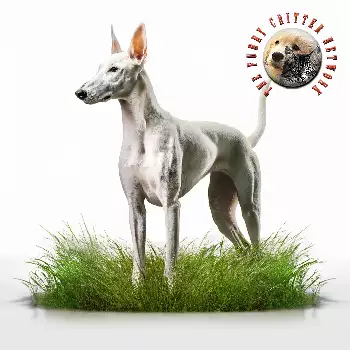
Stand next to a Ca Eivissenc and the first word that comes to mind is fine - fine-boned, fine-featured, and fine in the sense of refined. This is not a coarse dog. Every line on this animal seems drawn with a narrow pen, from the long chiseled head to the lean legs to the whip-thin tail that curves gently downward at rest. And yet there is real muscle underneath all that elegance. These dogs ran rabbits over rocky terrain for centuries; they had to be tough to do it.

The head is arguably this breed's most striking feature after those ears. Long, slender, and almost deer-like, with a flat skull, very little stop, and a long dry muzzle that tapers to a fine point. The nose is flesh-colored or rosy, which gives the face an unusual, almost otherworldly quality. The eyes are small, oblique, and amber in color - ranging from pale honey to a deeper caramel - and their expression is bright and intelligent rather than soft. Nothing about this face is rounded or soft; it is all angles and alertness.

Those ears are large, stiffly erect, and set high on the skull. When the dog is relaxed they may drop slightly, but when attention is engaged they rise and pivot independently toward sound, giving the dog an almost radar-like quality. The ears are a key diagnostic feature distinguishing this breed from superficially similar primitive types.

The neck is long and lean, flowing without excess musculature into clean, well-laid-back shoulders. The chest is notably deep - dropping well below the elbows - but narrow, which contributes to the breed's ability to turn quickly. The back is level and the loin has a gentle arch. The abdomen is well tucked, continuing the lean silhouette from chest to flank. The whole body is built along sighthound lines: maximum coverage of ground per stride, minimum resistance to air, sustained speed over distance.

The legs are long and straight with clean, dry bone. Feet are hare-shaped, with well-arched toes and hard pads built for rough ground. The hindquarters are well-muscled with moderate angulation - enough to generate power without sacrificing the effortless, floating quality of the gait. Movement should be light and ground-covering, with the head carried level or slightly below the topline when the dog is at speed.

Coat options come in smooth and wire varieties. The smooth coat lies flat and close, from very short to medium length. The wire coat is harder in texture, slightly longer, and may carry a small beard and eyebrows. Both are equally correct. Colors run through white, red, and combinations of the two. Red ranges from a pale, golden-chestnut to a rich liver-red. Pied patterns with both colors are common and attractive. No other colors appear in the standard.

The overall impression when watching a Ca Eivissenc move is one of controlled energy - a coiled spring at rest, a flowing line in motion. The breed does not lumber or plod. Even at a walk there is lift in the step and awareness in the expression. The tail, low and slightly curved in repose, rises when the dog is engaged and active but does not curl over the back like a spitz. Size and substance are always evaluated in the context of the working purpose: a dog too heavy to sustain speed over rocky ground or too light to have genuine durability fails the standard regardless of how well-constructed its individual parts may be. This is a breed where form truly follows function, and the function was demanding. A dog that looks the part but cannot perform the work it was bred for fails the standard in the most fundamental sense.

Affectionate With Family
The Ca Eivissenc bonds closely with its household and shows genuine warmth with the people it considers its own, though it maintains the independent streak common to sighthounds.
Good With Young Children
Generally patient and gentle, though the breed's high energy and size call for supervision around very young children who may not understand a sighthound's need for space.
Good With Other Dogs
These hounds historically worked in packs on the islands and typically get along well with other dogs, especially when raised alongside them.
Shedding Level
Smooth-coated dogs shed minimally, making the Ca Eivissenc one of the tidier breeds in the hound group when it comes to managing loose hair around the house.
Coat Grooming Frequency
Whether smooth or wire coated, this breed requires little in the way of regular grooming - an occasional wipe-down or brief brushing keeps the coat in good shape.
Drooling Level
Not a drooler. The fine, dry muzzle of the sighthound type means you won't find strings of saliva on the furniture or on your clothes.
Coat Type
The breed comes in both smooth and rough wire varieties. Both are short to medium in length and close-lying, giving the dog its clean, athletic silhouette.
Openness To Strangers
Cautious rather than fearful with new people, this breed takes a moment to assess before warming up. Proper socialization makes a noticeable difference in how readily they accept newcomers.
Playfulness Level
Athletic and light on their feet, these hounds enjoy a good romp and can be quite playful with family, though they settle nicely indoors once exercised.
Watchdog/Protective Nature
Alert and observant, the Ca Eivissenc will notice and announce anything unusual. They are watchful rather than aggressive, serving more as an alarm than a guard.
Adaptability Level
Adapts reasonably well to different living situations as long as daily exercise needs are met and the environment is safely fenced. They are not suited to off-leash freedom in open areas.
Trainability Level
Intelligent and willing, but the independent nature of a hunting sighthound means training requires patience and positive reinforcement rather than repetitive drilling.

Ca Eivissenc History & Development

The name Ca Eivissenc ties this dog directly to Eivissa, and the island's isolation is arguably what preserved the breed across millennia. Eivissa sits in the western Mediterranean, part of the Balearic archipelago off Spain's eastern coast. Trade routes passed through these islands for thousands of years, and somewhere in the ancient past, lean hunting dogs arrived - possibly with Phoenician traders, possibly with other Mediterranean seafarers - and settled in. Cut off from continental breeding trends by surrounding water, the island's hunting dogs developed along their own path.

The breed's connection to ancient Egypt has fascinated enthusiasts for decades. Pharaoh hound-type dogs appear on Egyptian artifacts dating back over 5,000 years, depicted with the same large upright ears, narrow heads, and light build that characterize today's Ca Eivissenc. Whether these ancient Egyptian hounds are actual ancestors of the breed or simply the product of parallel development for similar hunting purposes remains debated among cynologists. What is clear is that by the time Spanish explorers and colonizers were documenting the Balearics in detail, the Ca Eivissenc was already an established, distinct type long valued by island hunters.

For generations these dogs hunted rabbits in teams, often working alongside ferrets and nets on the rocky hillsides of Eivissa, Formentera, and the other Balearic islands. The hunting technique was and in some places still is distinctly traditional: dogs flush and course the rabbit, using sight, hearing, and scent in combination, which is unusual among sighthound types that typically rely on sight alone. This versatility was bred in because island terrain demanded it.

The name Ca Eivissenc remained the dog's primary identifier in its homeland while the rest of the world, particularly the English-speaking world, came to know the breed under anglicized versions of the place name. The breed arrived in the United States in 1956, introduced by Colonel and Mrs. Seoane who brought dogs from the island of Eivissa. Those early American imports formed the foundation of the breeding population, which remained small and tightly knit for decades. The breed gained AKC recognition in 1978.

The breed's rarity outside its homeland has been a defining characteristic of its history in the wider world. It never experienced the surge in popularity that transformed other Mediterranean breeds into mainstream pets, and that scarcity has both protected the gene pool from some of the pressures that damage popular breeds and made finding a well-bred puppy a real commitment of research and patience. Breeders outside Spain tend to be small in number and serious in their dedication to the breed's original type and working character.

On Eivissa and the other Balearic islands, working dogs that match the Ca Eivissenc type are still kept by traditional hunters. The relationship between the living dog and the terrain it was shaped by remains intact there in ways that feel genuinely ancient - a sighthound pursuing rabbits across Mediterranean scrub using the same combination of senses its ancestors employed thousands of years ago. Today the breed carries both its name and its history with equal authenticity.

Ca Eivissenc Temperament & Personality

Living with a Ca Eivissenc is a bit like living with a very athletic, very observant houseguest who occasionally decides your authority is optional. These are hunting dogs, and hunting dogs that worked independently in rough terrain developed a certain self-directedness that does not simply disappear because the dog is now living on a sofa. That independent streak is not stubbornness for its own sake; it is the residue of a breed that had to problem-solve on the fly without instruction from a human standing fifty yards away.

Inside the house, these dogs tend to be calm and affectionate with family. They form genuine bonds with their people and enjoy close physical contact in a way that surprises owners expecting a more aloof sighthound experience. With the family they know well, the Ca Eivissenc is warm, engaged, and often entertaining. They have a playful side that can catch you off guard, and they are notably gentle with people they trust.

With strangers it is a different calculation. This breed does not automatically assume a new person is safe. They will observe, assess, and take their time before deciding someone is worth greeting. Push the interaction and you may get a polite but firm withdrawal. Give the dog space to make its own decision and you will usually get a curious, friendly response within a reasonable timeframe. This caution is not fear-based in well-socialized dogs; it is simply the watchfulness of a breed that takes its own counsel seriously.

Prey drive is real and significant. These dogs notice small animals, and they do not fight that instinct easily. Cats in the household can coexist with the Ca Eivissenc if raised together from puppyhood, but even then the relationship should be supervised rather than assumed. Outside the home, a squirrel or rabbit crossing the path will get the dog's full and immediate attention. A reliable recall around high-value distractions requires dedicated training - and even then, an off-leash Ca Eivissenc in an unfenced area is a risk you should think carefully about.

They tend to be vocal in the way of watchdogs, alerting to unusual sounds or sights around the property, but they are not chronic barkers when their needs are met. Mental and physical exercise are both necessary. A tired Ca Eivissenc is a settled one; an under-exercised dog may channel its energy into behaviors you would rather it did not.

What distinguishes this breed's temperament from many other sighthounds is the quality of its attention. A Ca Eivissenc that has bonded with you is genuinely tuned into you - watching your movements, reading your mood, and responding to your cues in ways that can feel almost telepathic. This sensitivity is an asset in training when leveraged well, and it is part of what makes the breed so rewarding to own for people who take the time to develop a real relationship with their dog. They are not push-button animals and they are not lap dogs in the passive sense. They are engaged, alert companions who offer a lot to those who meet them on their own terms.

Ca Eivissenc Family Life & Living Requirements

The Ca Eivissenc can fit into many kinds of households, but the non-negotiables are pretty clear: you need a securely fenced yard, or a reliable daily exercise plan that substitutes for one. These dogs are built to run and they will. A gap in a fence is an invitation, and once they are running with a scent or sight in mind, recall becomes aspirational. The fence question is not optional - this is one of those situations where the breed's history and instincts simply override most training.

Given that basic requirement, the Ca Eivissenc is actually a fairly adaptable companion. They are lean and relatively compact for a sighthound, and they do not need a massive house to be comfortable. They tend to settle well indoors once exercised, often choosing a comfortable spot and spending several quiet hours there. Some owners describe them as surprisingly good apartment dogs, provided the exercise needs are genuinely met through daily running or active outings.

With children they are generally patient and gentle, though the combination of energy and lean frame means younger children may be knocked over accidentally during enthusiastic greetings. Older children who can respect a dog's space and engage in appropriate play will get along well with this breed. The Ca Eivissenc does not enjoy being cornered or harassed, and it will communicate its discomfort clearly before escalating - but early socialization and household rules that protect the dog's space from small children are worth establishing.

The breed's pack origins make it generally sociable with other dogs. They tend to enjoy canine company and do well in multi-dog households. Small animals like rabbits, guinea pigs, and cats that the dog does not know from puppyhood are a genuine management challenge given the prey drive involved. Plan your household composition accordingly before bringing one home.

One practical consideration often overlooked is this dog's sensitivity to cold. With very little body fat and a short coat, the Ca Eivissenc genuinely feels the cold in ways that northern or double-coated breeds do not. A sweater or jacket for cold-weather outings is not an affectation; it is a real necessity in climates with hard winters. These dogs originated in a Mediterranean climate and their constitution reflects that. Providing soft bedding, indoor sleeping arrangements, and protection from drafts and extreme cold is a genuine quality-of-life issue for this breed. This is not a dog that lives happily in a drafty garage or unheated kennel - it belongs inside with the family that owns it.

Ca Eivissenc Training & Exercise Needs

Training a Ca Eivissenc rewards patience and positive reinforcement more than any other approach. These are intelligent dogs, and they learn quickly - but they also notice quickly when training becomes repetitive and mechanical, and at that point their interest wanders. Keeping sessions varied, short, and rewarding holds their attention in a way that drilling the same command twenty times does not. Think of it as a conversation rather than an instruction session.

Harsh corrections do not work with this breed and tend to produce avoidance rather than compliance. The Ca Eivissenc is sensitive enough that a sharp tone or a bad session can create a reluctance to engage in future training. Positive reinforcement with high-value food rewards and genuine enthusiasm from the handler produces the best results. These dogs want to work with you - they just need good reasons to do so.

Recall training deserves serious attention from day one, because the alternative is a dog that runs when it wants to and comes back when it feels like it. Building a strong recall requires beginning in low-distraction environments and raising the difficulty gradually, always keeping the return to you more rewarding than whatever the dog was investigating. Sighthound-specific recall training techniques, which account for the fact that a running dog in pursuit mode is genuinely not processing verbal commands, are worth researching before you need them.

Exercise needs are substantial. A daily run in a safely fenced area, or vigorous off-leash exercise through lure coursing or other sighthound sports, is ideal. Lure coursing is a natural fit for this breed, engaging the prey drive in a controlled way that most Ca Eivissencs find enormously satisfying. Leash walks alone are not enough; the dog needs the opportunity to extend its stride and run. Without adequate running, energy accumulates and surfaces as restlessness or unwanted behavior indoors.

Beyond physical exercise, this breed benefits from mental engagement. Puzzle feeders, nose work, and new environments to explore all satisfy the curious, problem-solving mind that made these dogs effective hunters. The combination of physical running and mental challenge produces a dog that is genuinely content rather than just tired. An owner who can provide both - regular running in a safe space and activities that engage the brain - will have a remarkably easy dog to live with the rest of the time. The Ca Eivissenc's indoor manners when properly exercised are genuinely good; its indoor manners when under-exercised are considerably less so.

Ca Eivissenc Health Concerns

The Ca Eivissenc is generally considered a healthy breed, and the Ibizan Hound Club of the United States describes the overall incidence of serious hereditary problems as low compared to many popular breeds. That said, four areas have been identified as worth monitoring, and responsible breeders test for all of them.

Allergies, both environmental and food-based, appear in the breed at a rate that owners should be aware of. Manifestations include recurrent skin irritation, ear infections, and digestive upset. Because this is a lean breed with relatively little padding, skin issues are visible early and should be addressed rather than ignored. A veterinary workup to identify specific triggers is the most effective path to management. Dietary elimination trials and environmental allergen testing are both tools worth discussing with your veterinarian if skin or digestive symptoms persist without an obvious explanation.

Common Health Issues

  • Autoimmune hypothyroidism: The thyroid glands fail to produce adequate hormone - Resulting in weight gain, coat changes, lethargy, and cold intolerance. Manageable with daily oral medication and regular monitoring of blood levels.
  • Congenital deafness: Documented in the breed, with higher incidence in heavily white-marked dogs. BAER testing identifies unilateral or bilateral deafness accurately - Affected dogs should not be bred.
  • Hip dysplasia: Abnormal hip joint development leading to varying degrees of laxity and eventual arthritic change. Incidence is lower than in many breeds but documented - OFA or PennHIP evaluation screens breeding stock.
  • Inherited ocular conditions: Both cataracts and retinal dysplasia have been identified in the breed - Annual OFA Eye Certification examinations by a board-certified veterinary ophthalmologist detect these early.
  • Environmental and food allergies: Manifesting as skin irritation - Recurrent ear infections, or digestive upset. Identifying the specific allergen with veterinary guidance is the foundation of effective management.

Preventive Care & Health Monitoring

  • CHIC health testing: Complete the four required evaluations - OFA/PennHIP hip evaluation, OFA thyroid panel, BAER hearing test, and OFA Eye Certification examination - for any dog being considered for breeding.
  • Annual OFA Eye Certification: Even cleared dogs should have annual ophthalmology exams - As some inherited eye conditions develop progressively and may not appear on initial evaluation.
  • Thyroid panel monitoring: Dogs with a family history of hypothyroidism - Or those showing clinical signs such as weight gain or coat changes, should have a complete thyroid panel performed rather than a single T4 test.
  • Weight management: The lean build of this breed means weight gain is immediately apparent and should be addressed early - Maintaining proper condition supports joint health and overall longevity.
  • Secure fencing and leash discipline: Not a health test, but a practical safety measure - The sighthound's prey drive and speed make containment a genuine health issue in terms of preventing injury from traffic or getting lost.

Ca Eivissenc Grooming & Maintenance

The Ca Eivissenc is one of the easier breeds to maintain in terms of coat care, and that simplicity is a genuine quality-of-life benefit for owners. The smooth coat needs little more than a wipe-down with a damp cloth or a brisk rub with a soft grooming mitt to remove loose hairs and keep the skin in good condition. Weekly attention keeps the coat healthy and shiny with minimal effort. The wire coat variety needs occasional hand-stripping to maintain texture and remove dead hair, but it is still far less demanding than many other wire-coated breeds.

Bathing can be infrequent - every six to eight weeks is typically sufficient for a dog that is not getting into mud regularly. Because these dogs have very little body fat and a thin coat, they dry quickly and tolerate bathing well. Use a mild shampoo appropriate for dogs with sensitive skin.

Nail trimming is important and needs to be done regularly - roughly every three to four weeks depending on how much the dog runs on hard surfaces. Long nails affect the foot structure and gait, and a sighthound's feet are important to maintain properly given the athletic demands placed on them. Ear cleaning every couple of weeks, particularly important in a dog with large upright ears that collect debris, prevents the buildup that can lead to infection. Dental care including regular tooth brushing completes the maintenance routine.

Skin inspection during grooming sessions is especially worthwhile for this breed. Because the coat is so short, any skin reaction, irritation, or early insect bite is immediately visible. Running your hands over the entire body during grooming gives you a weekly check on overall physical condition in addition to skin and coat health. Given that allergic skin reactions are documented in the breed, catching and addressing anything unusual early is practical and valuable. Overall, grooming the Ca Eivissenc is a quick, satisfying task that doubles as a bonding ritual - these dogs typically enjoy the focused attention, and the time spent handling them from puppyhood builds the cooperative relationship that makes all aspects of care easier as they mature.