Bully

American Bully

Quick Facts

🐕 Breed Group
Working Group
📏 Size Category
Medium to Large (varies by class)
📏 Height
Males: 17-20 inches (Standard); varies by class, Females: 16-19 inches (Standard); varies by class
⚖️ Weight
Males: 65-85 lbs (Standard); varies by class, Females: 50-65 lbs (Standard); varies by class
⏱️ Life Expectancy
10-12 years
🧣 Coat Type
Short, smooth, close-lying
🎨 Coat Colors
All colors and patterns accepted
😀 Temperament
Loyal, affectionate, confident, gentle with family, outgoing
🏃 Exercise Needs
Moderate - 45 to 60 minutes daily
🎓 Training Difficulty
Moderate - eager to please but can be stubborn
👶 Good with Children
Yes - bred specifically for family life
🐾 Good with Other Pets
Variable - better with dogs raised together; some dog-selectivity noted

Other Names & Breed Recognition

"Bully" is the shorthand name that the American Bully community settled on almost from the start. Among breeders, owners, and enthusiasts, the breed rarely gets called by its full name in casual conversation - it is simply the Bully. The name carries warmth in the bully breed community rather than any edge, which is somewhat ironic given how much work advocates have done to separate the breed from the aggressive connotations that word carries in other contexts.

The official registered name is American Bully, which is how the breed appears in the UKC stud book (recognized 2013) and in the American Bully Kennel Club (ABKC) registry, the breed's most prominent dedicated organization. The ABKC divided the breed into four official size classes - Pocket, Standard, Classic, and XL - and those designations layer on top of the base name. So you will hear people say "Pocket Bully," "XL Bully," or just "Bully" depending on context. The Extreme class exists in some registries as well, though it is more controversial within the community due to conformation concerns.

Other names float through the culture around this breed. Some owners use "Bully breed" generically, though that term encompasses multiple breeds including the American Pit Bull Terrier, American Staffordshire Terrier, and Staffordshire Bull Terrier, among others. The American Bully is a distinct breed from all of these, with its own breed standard and its own documented history, but the umbrella term persists. Some people use "Bully dog" in the same broad way. In the UK, XL Bullies became a recognized size category with its own social profile in recent years, and legislation introduced in 2023 specifically named the XL Bully as a type requiring registration and neutering for existing dogs.

The AKC has not yet granted full recognition to the American Bully, though the breed is listed in the Foundation Stock Service, which is the pathway breeds follow toward full recognition. The breed is fully recognized by the UKC in the Companion Breeds group. Internationally, the FCI does not recognize the American Bully as a separate breed. Given how recently the breed was developed - primarily the 1980s and 1990s - its recognition history is still actively unfolding compared to breeds with centuries of documented existence behind them.

Bully Organizations & Standards

The American Bully Kennel Club (ABKC) is the most prominent registry and breed organization specifically dedicated to the American Bully. Founded in 2004, the ABKC defined the four official size categories - Pocket (under 17 inches for males), Standard (17-20 inches), Classic (same height as Standard, leaner build), and XL (over 20 inches) - and maintains the breed standard that defines what an American Bully is supposed to look like and how it should carry itself. The ABKC organizes shows and has a code of ethics for its members, though as a dedicated breed registry it functions somewhat differently from established AKC parent clubs.

The United Kennel Club recognized the American Bully in 2013 and places it in the Companion Breeds group. The UKC standard emphasizes breed character, sound movement, and correct structure, and includes explicit language stating that extreme shyness and dog aggression are equally disqualifying faults. That language matters - it signals that the UKC standard is trying to protect the companion temperament that defines the breed from extremes in either direction. The UKC recognition gave the breed a path into organized performance events and conformation shows under an established registry.

The United American Bully Association (UABA) is a more recently formed national breed club that has worked with OFA to establish CHIC health testing requirements for the breed. As of the early 2020s, American Bullies had a dedicated CHIC program with required tests covering hips, elbows, and cardiac evaluation. This is significant because OFA data on American Bullies showed concerning statistics: roughly 44 percent of OFA-submitted American Bullies failing hip evaluations and similar numbers for elbows, placing the breed among the worst-performing in the OFA database for joint health. The CHIC program exists to make health testing results publicly available so breeders and buyers can make informed decisions.

The breed standard across all registries describes a dog of heavy bone and muscle, with a blocky head, deep chest, and substantial frame that conveys strength without compromising movement. The standard distinguishes the American Bully from American Pit Bull Terriers and American Staffordshire Terriers not just by build but explicitly by temperament - the Bully's standard calls for a confident, outgoing, stable character rather than high working drive. Breeders who prioritize temperament testing alongside health clearances represent the standard that the breed community should be measured against.

Kennel Club Recognition

  • United Kennel Club (UKC): Recognized, Companion Breeds

Bully Physical Description

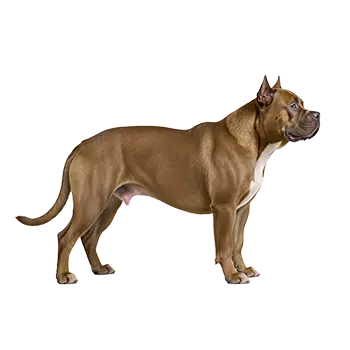
The American Bully's physical presence is hard to miss. This is a dog that carries significant muscle mass on a compact to medium frame, and the overall impression is one of controlled power. The blocky head, wide chest, and heavy bone structure give the breed a distinctive silhouette that sets it apart immediately from the leaner profile of the American Pit Bull Terrier or American Staffordshire Terrier that contributed to its founding.

The head is large in proportion to the body, broad across the skull, with prominent cheek muscles and a well-defined stop. The muzzle is of medium length and broad throughout its length, with a wide jaw. The depth of muzzle varies by line and size class. Eyes are medium to large, set low, and can be any color. Ears are typically high-set and can be natural or cropped depending on owner preference and local regulations. The overall head impression should be one of substantial strength rather than exaggeration - excessive shortening of the muzzle that causes visible breathing difficulty is a structural fault that responsible breeders work against.

The neck is heavy, slightly arched, and tapers from shoulders to head. The shoulders are well-muscled and wide. The chest is deep and broad, one of the most visually defining features of the breed - the Bully's chest width significantly exceeds what you see in most other medium-sized dogs. The topline is level or has a very slight downward slope from withers to rump. The body is compact - shorter than it is tall, or approximately square depending on the size class. The ribs are well-sprung, contributing to that round-barreled body shape that gives the breed such a solid visual presence even in smaller size classes.

Forearms are straight and heavy-boned. The breed's wide front can create a distinctive rolling gait if the chest is too wide relative to the dog's overall structure - the standard expects clean, efficient movement, not the rolling waddle that indicates exaggeration. Rear angulation should be moderate, with well-developed thighs providing drive. Feet are round, compact, and well-arched.

The coat is short, close, hard to the touch, and glossy. It lies flat against the body and requires minimal grooming to maintain its appearance. All colors and color combinations are acceptable in the breed standard with one exception: merle patterns carry health risks when bred irresponsibly and are a topic of ongoing debate in the Bully community. The skin under the coat should be tight; excessive wrinkling or loose skin folds, particularly around the face, create grooming obligations and predispose the dog to skin fold dermatitis if not kept clean and dry.

Skin and muscle condition on a well-bred Bully are notable. The muscle definition visible even through the short coat reflects the breed's genuine athleticism - this is not a soft, sedentary dog in a stocky frame. When you watch a well-conditioned Bully move at a confident trot, the muscle engagement through the hindquarters and the drive off the rear is clear. Movement faults like crabbing, paddling, or crossing over in front are all signs that the structure is compromised despite the breed's visual mass.

Size varies considerably across the four recognized classes. The Standard male stands 17 to 20 inches at the shoulder; Pocket males are under 17 inches; XL males exceed 20 inches. Weight is not the defining measure - it is height and proportion. A well-built Standard Bully might weigh 65 to 85 pounds on a frame that carries it well; an XL Bully may exceed 100 pounds. The key is that the dog should move soundly, breathe without distress, and carry its mass without structural compromise.

Affectionate With Family
The American Bully was specifically designed to be a companion dog and it shows. These dogs are devoted to their families in a way that is central to the breed's identity.
Good With Young Children
Gentle and tolerant with children, which is a direct result of deliberate temperament selection. Their patience with kids is a documented strength of the breed.
Good With Other Dogs
Sociable when properly introduced, but some individuals show dog-selectivity, particularly same-sex. Raising with other dogs from puppyhood significantly improves outcomes.
Shedding Level
The short coat sheds moderately year-round. Weekly brushing keeps the coat gleaming and manages loose hair without much effort.
Coat Grooming Frequency
About as low-maintenance as a coat gets. A rubber mitt or soft brush once a week is all this breed needs to look its best.
Drooling Level
Varies by individual and head structure. Dogs with looser lips and broader muzzles tend to drool more than those with tighter facial structure.
Coat Type
Short, smooth, and flat to the body. The glossy sheen of a well-maintained Bully coat is one of the breed's visual calling cards.
Openness To Strangers
Generally friendly and outgoing with unfamiliar people. Bullies do not tend toward suspicion or shyness - they were bred to be confident and social.
Playfulness Level
Enthusiastic, good-natured, and always ready for a game. Their playfulness is genuine and makes them great companions for active families.
Watchdog/Protective Nature
Will alert to unusual activity, and their physical presence is a deterrent in itself, but the American Bully was not bred as a guard dog and should not be treated as one.
Adaptability Level
Adapts well to various living situations provided exercise needs are met. More heat-sensitive than many breeds due to shorter muzzle structure in some lines.
Trainability Level
Smart and eager to please, especially when food rewards are involved. Positive reinforcement training brings out the best in this breed reliably.

Bully History & Development

The American Bully is one of the few modern breeds whose development is documented well enough that you can actually trace the decisions that created it. The breed emerged primarily in the United States during the 1980s and 1990s, developed by breeders who wanted to create a companion dog that carried the visual presence of bully-type breeds while deliberately moving away from the working dog drives and dog aggression that characterized some of the lineages they were drawing from.

The foundation breeds most consistently cited include the American Pit Bull Terrier and American Staffordshire Terrier as primary contributors, with various Bulldog breeds - American Bulldog, English Bulldog, Olde English Bulldogge - introduced to add mass, bone, and the broader skull profile that became central to the type. Some breeders contributed other breeds to various bloodlines. The goal was to select for extreme human-friendliness, a stable and unflappable temperament around children and strangers, and the heavy, muscular build that appealed to people who loved the look of bully breeds.

The nickname "Bully" attached naturally - the dogs were bred to exemplify the bully breed type in its most companion-focused form. The name traveled with the dogs from the breeding programs of the 1990s through the internet era of the 2000s, where American Bullies became one of the most searched and discussed breeds online. That digital presence accelerated the breed's spread rapidly - probably faster than formal registry recognition could keep pace with.

The American Bully Kennel Club was founded in 2004 and brought organizational structure to a breed that had been developing largely through informal community consensus. The ABKC defined the size classes, wrote the breed standard, and began organizing the show circuit that gave breeders a formal framework for evaluating dogs against the standard. The UKC's recognition in 2013 marked the breed's entry into an established major registry. The AKC's Foundation Stock Service listing indicates that full recognition remains a future possibility.

In the UK, the breed's XL variety gained notoriety in the early 2020s following a series of serious bite incidents, leading to legislation under the Dangerous Dogs Act effective February 2024 that required existing XL Bullies to be registered, neutered, microchipped, and kept on lead and muzzled in public. New acquisitions were banned. This represented a significant regulatory moment for the breed internationally and prompted ongoing debate about the relationship between breeding practices, owner responsibility, and breed-specific legislation.

Bully Temperament & Personality

The American Bully was purpose-bred for a specific temperament, and when the breeding is done right, that temperament is genuinely one of the breed's greatest strengths. These dogs were selected generation after generation for being gentle with children, easy to handle, friendly toward strangers, and devoted to their families. That intentional temperament selection is the core reason the Bully exists as a separate breed from the working-line pit bull terrier types it descended from.

A well-bred Bully is the kind of dog that greets your guests with enthusiasm rather than suspicion, tolerates the chaos of children without losing its calm, and settles comfortably on the couch at the end of the day with equal contentment. The confidence is real - these dogs carry themselves without anxiety or skittishness - but the confidence expresses itself through ease and stability rather than aggression. The breed standard explicitly disqualifies extreme shyness and dog aggression as temperament faults, which reflects a genuine community investment in protecting what makes the Bully a good companion.

Human aggression is not a characteristic of correctly bred American Bullies and should not be tolerated or normalized. Any dog showing unprovoked aggression toward people is a serious concern regardless of breed, but in the Bully context it also represents a failure of the breeding program - the entire point of the breed is to produce dogs that are safe and pleasant to be around.

Dog-dog interactions are more nuanced. The breed has some heritage from dogs that were historically selected for dog-directedness, and while deliberate selection toward lower dog aggression has been a priority for responsible Bully breeders, individual variation exists. Some Bullies are genuinely dog-friendly and do well in multi-dog households; others show same-sex selectivity or a preference for dogs they know well. Early socialization is important, but it is not a guarantee. Prospective owners should be honest with themselves about whether they can manage a dog that may need careful introduction to new canine companions.

The breed's temperament under-performance typically shows up when dogs are bored, under-exercised, or poorly socialized. A Bully that does not get adequate physical activity and human interaction can develop attention-seeking behaviors, destructive habits, or excessive vocalization. These are not aggression problems - they are boredom problems - and they respond well to structured daily exercise and engagement. The stress removal principle applies directly here: a Bully with its needs met is a calm, cooperative, and genuinely enjoyable family dog.

Bully Family Life & Living Requirements

The American Bully was designed for the life most people actually want with a dog: calm and affectionate at home, reliable around children, manageable on a walk, and loyal to the household. For families that match their lifestyle to what the breed needs, it delivers on that promise consistently.

Children are a genuine strength. The breed's patience and tolerance were specifically cultivated through decades of selection, and well-socialized Bullies typically handle the noise and unpredictability of children better than many more temperamentally sensitive breeds. That said, supervision between dogs and young children is basic responsible ownership regardless of breed - a Bully's size and muscle mean that even accidental contact can knock a small child over. Teaching children how to interact respectfully with the dog matters as much as teaching the dog how to behave around children.

Housing flexibility is one of the Bully's practical advantages. The breed can adapt to apartment living if daily exercise commitments are met. They are not high-endurance athletes - 45 to 60 minutes of genuine exercise per day is sufficient for most individuals - and their moderate energy level makes them easier to manage in smaller spaces than working breeds with higher drive. A yard is useful but not mandatory. What is mandatory is actual daily exercise, not just access to a yard the dog mostly ignores.

Heat is a real consideration. Short-muzzled individuals in particular are susceptible to overheating, and this is more pronounced in summer months or in warm climates. Air conditioning, access to shade and fresh water, and avoiding exercise during the hottest parts of the day are practical necessities, not luxuries. Dogs with broader, shorter muzzles should be monitored during any physical activity in warm weather, and swimming should be supervised since many heavily-built Bullies are not natural swimmers.

With other pets, the picture depends heavily on the individual dog and its socialization history. Bullies raised with other dogs generally do well; introducing an adult Bully to an existing pet household requires careful management and patient introduction over multiple sessions. Some individuals are quite dog-friendly; others are selective, particularly with same-sex dogs. Honest evaluation of your specific dog's temperament is more useful than relying on breed generalizations. For small animals like cats, early introduction and supervision during the establishment period is a reasonable precaution regardless of how relaxed the individual dog seems.

Bully Training & Exercise Needs

Training an American Bully goes well when you make it worth the dog's while. This breed is food-motivated in a very sincere way - a high-value treat in your hand and a clear training signal will get a Bully's full attention reliably. Positive reinforcement is not just recommended for this breed; it genuinely outperforms other methods in producing reliable, consistent behavior. Bully owners who rely on corrections or punishment-based techniques tend to produce dogs that are less responsive and less trusting than those trained with rewards.

The Bully's intelligence is practical rather than flashy. They learn what benefits them, they remember it, and they apply it. Basic obedience comes readily - sit, down, stay, come, heel - and more advanced work is achievable with motivated training. The breed's physical strength makes leash manners a genuine priority. A Bully that has not been taught to walk politely on a lead is a significant management problem simply because of its mass. Start leash training early, be consistent, and reward good walking behavior the same way you would any other skill. A front-clip harness during the training phase gives you more mechanical advantage while the dog learns.

Adolescence, typically from 6 to 18 months, is the period where Bullies most commonly test established rules. Maintaining consistent expectations through this phase is important - the dog that got away with jumping on people at 15 pounds will do it at 70 pounds as well, and the math changes significantly. Treat adolescence as a critical training window rather than a problem to endure. Enrolling in a group obedience class during this period provides structured socialization alongside the training foundation.

For organized activities, Bullies do well in weight pull competition, where the breed's genuine strength finds a constructive outlet. Obedience, rally, and trick dog titles are accessible and practical goals that build the dog-handler relationship while keeping the dog mentally engaged. Dock diving suits dogs that enjoy water. The breed is not designed for high-endurance working events but does well in activities that combine moderate physical effort with handler interaction.

Exercise needs are moderate. Thirty to sixty minutes of daily physical activity - walks, yard play, tug, fetch - keeps a Bully physically comfortable and mentally settled. Mental engagement through training sessions and interactive toys contributes meaningfully to their overall satisfaction and is a useful supplement on days when conditions limit outdoor time.

Bully Health Concerns

The American Bully's health picture is directly connected to the speed at which the breed was developed and the wide variation in breeding practices across a large, relatively unregulated community. OFA data paints a picture that responsible breeders and buyers need to take seriously: American Bullies rank among the worst-performing breeds in the OFA database for hip pass/fail ratios, with roughly 44 percent of submitted dogs failing hip evaluation. Elbow scores are similarly poor. Cardiac statistics are the most concerning - American Bullies have the worst basic cardiac pass/fail ratio in the entire OFA database. These numbers reflect the breed's current state, not a verdict on what is possible when health testing is prioritized systematically.

Skin allergies and atopic dermatitis affect a meaningful portion of the Bully population, often presenting as recurrent ear infections, foot licking, or facial fold irritation. Environmental and food triggers both occur. Brachycephalic obstructive airway syndrome (BOAS) is a concern in dogs with shorter, broader muzzles - breathing difficulty during exertion, heat intolerance, and sleep apnea are the main expressions. Dogs showing significant breathing distress should be evaluated by a veterinarian familiar with brachycephalic breeds.

Common Health Issues

  • Hip dysplasia: Among the highest failure rates of any breed in the OFA database - Heavy muscle mass compounds joint stress throughout the dog's life, with outcomes ranging from mild discomfort to severe mobility limitation.
  • Elbow dysplasia: Second worst elbow pass/fail ratio in the OFA database - Affects front limb function and can develop into significant lameness if unmanaged.
  • Cardiac conditions: American Bullies have the worst basic cardiac pass/fail statistics in the OFA database - Congenital heart defects and aortic stenosis are documented concerns requiring cardiologist evaluation.
  • Brachycephalic obstructive airway syndrome - BOAS, : Affects dogs with shorter, broader muzzle structure; symptoms include labored breathing during exertion, heat intolerance, and snoring; severity varies by individual.
  • Skin allergies and atopic dermatitis: Environmental and food-related allergies present as recurrent ear infections - Foot licking, facial fold irritation, and generalized skin inflammation.

Preventive Care & Health Monitoring

  • OFA hip and elbow evaluation on both parents before breeding - Buyers should request documentation of passing scores and verify on the OFA public database.
  • OFA cardiac evaluation by a board-certified cardiologist - Not a general practitioner cardiac exam - given the breed's documented cardiac statistics.
  • CHIC certification - Hips, elbows, cardiac, provides public record of health testing completion; verify at ofa.org before purchasing a puppy.
  • Weight management is critical throughout life given the breed's joint health challenges - Keeping a Bully lean reduces daily stress on hips, elbows, and spine.
  • Regular skin fold cleaning for dogs with facial folds - Weekly ear checks and cleaning; routine nail trimming every two to three weeks.

Bully Grooming & Maintenance

The American Bully's short, smooth coat is one of the most practical coats in dogdom. A weekly going-over with a rubber curry brush or grooming mitt removes loose hair, distributes skin oils, and gives the coat that characteristic high-gloss finish that makes a well-maintained Bully look striking. The entire process takes five minutes. There is no scissoring, no trimming, no stripping. If you want a low-maintenance coat, the Bully delivers.

Bathing is needed every four to six weeks or when the dog gets genuinely dirty. The short coat rinses out quickly and dries fast, which makes bath time considerably less of a production than with longer-coated breeds. Use a gentle dog shampoo suited for sensitive or short-coated dogs, rinse thoroughly to remove all residue, and the job is done in short order.

Facial folds deserve specific attention for dogs that have them. Moisture and debris accumulate in skin folds around the muzzle and face, creating conditions where yeast and bacterial infections develop if the folds are not kept clean and dry. Wiping fold creases with a dry cloth or gentle grooming wipe every few days prevents the odor and irritation that results from neglect. This is not optional maintenance for wrinkly-faced individuals - it is a regular health task. Dogs that develop chronic fold dermatitis may need more frequent cleaning and occasional veterinary management.

Ears should be checked weekly and cleaned as needed - Bullies with looser ear carriage may accumulate more debris than dogs with tighter, more upright ears. Use a veterinarian-approved ear cleaner on a cotton pad; never push material deeper into the ear canal. Persistent odor, redness, or head shaking indicates an infection requiring veterinary attention.

Nails should be trimmed or ground every two to three weeks. Many Bullies dislike nail handling if they were not conditioned to it as puppies - introducing nail care gradually with positive reinforcement from an early age prevents a battle that is much harder to win once the dog is full-grown. Dental brushing several times a week is the most impactful preventive health habit most owners can establish, reducing the risk of periodontal disease that affects the majority of adult dogs regardless of breed.