Black and Tan

Black and Tan Coonhound

Quick Facts

🐕 Breed Group
Hound Group
📏 Size Category
Large
📏 Height
Males: 25-27 inches, Females: 23-25 inches
⚖️ Weight
Males: 55-75 pounds, Females: 40-65 pounds
⏱️ Life Expectancy
10-12 years
🧣 Coat Type
Short, dense, glossy
🎨 Coat Colors
Coal black with rich tan markings
😀 Temperament
Friendly, gentle, mellow, loyal
🏃 Exercise Needs
Moderate to high
🎓 Training Difficulty
Moderate - intelligent but follows nose over commands
👶 Good with Children
Good with children
🐾 Good with Other Pets
Good with dogs; small animals may trigger prey drive

Other Names & Breed Recognition

The Black and Tan is what hunters and working dog people across the American South and Appalachian regions have always called their Black and Tan Coonhounds. It is a name born from practical brevity - in a field setting, when you are tracking through dense forest at night listening for your dog's baying voice, four syllables saves time over eleven. The shortened name stuck because the breed's coloring is so distinctive that no further description was ever needed. A Black and Tan is a Black and Tan.

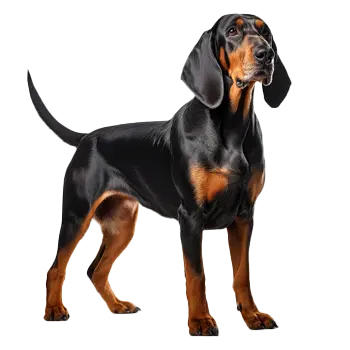
The name describes the dog exactly as it appears: a coal-black base coat with rich tan markings over the eyes, on the muzzle, chest, legs, and the breeching. The tan markings above the eyes are sometimes described as "pumpkin seed" marks - small, seed-shaped accents that give the face its expressive, slightly concerned look. The color pattern is consistent enough that the shortened name has never caused confusion among people who work with hounds. Everyone who has spent time around working dogs in the southern United States knows precisely what dog is meant when someone says "my old Black and Tan."

The full formal name - Black and Tan Coonhound - came with official recognition. The United Kennel Club recognized the breed in 1900, making it the first Coonhound to receive formal registry. The AKC followed in 1945, and again the Black and Tan was first among the six Coonhound breeds to achieve recognition. The AKC places it in the Hound Group. The FCI recognizes the breed in Group 6, Scent Hounds. The Black and Tan Coonhound Club serves as the AKC parent club and is the organization responsible for maintaining the breed standard and health programs.

The breed has also appeared in historical texts as the "Old Virginia Black and Tan," a reference to the Black and Tan Virginia Foxhound that was a primary ancestor. Some older breed documents refer to it simply as the "B&T," which remains common in field trial and coonhound hunting circles today.

For people searching specifically for this breed, the shorthand Black and Tan is one of the most common search terms - far more natural for the average person than the complete four-word formal name. If you grew up in the rural South or spent time around coon hunters, Black and Tan is simply what this dog is called, the way a Labrador Retriever becomes just a Lab in everyday speech. The name carries the weight of genuine American working dog heritage.

Black and Tan Organizations & Standards

The American Black and Tan Coonhound Club serves as the AKC parent club for the breed and participates in the Canine Health Information Center (CHIC) program. For a Black and Tan Coonhound to receive a CHIC number, the dog must have an OFA or PennHip hip evaluation, a CAER ophthalmologist certification that the eyes are healthy, and an OFA cardiac evaluation. Results of all three must be publicly available in the database. Optional CHIC clearances include OFA elbow evaluation and thyroid testing, both of which responsible breeders include beyond the minimum requirements.

The AKC breed standard describes the Black and Tan as a large, working scenthound with an athletic, moderate build - either square or slightly longer than tall. The overall impression should suggest power, agility, and the alertness of a dog bred to work. The head is well proportioned, with an oval outline and a long muzzle that accommodates the olfactory system that makes this breed's nose exceptional. The flews - the pendulous upper lips - are well developed, as is the neck skin, which hangs in loose folds. These features were inherited from Bloodhound ancestry and contribute both to the dog's scenting ability and to its characteristic expression.

The ears are one of the breed's most recognizable features. They are long, velvety, set low, and hang well down the neck - the standard calls for them to extend to the end of the nose when pulled forward. This conformation may help by stirring up ground scent as the dog works a trail, an elegant functional explanation for what appears at first to be an impractical physical extreme.

The United Kennel Club recognized the Black and Tan Coonhound in 1900, forty-five years before AKC recognition. The UKC's working dog culture and field trial program have historically been as important to the breed as the conformation show circuit, and many Black and Tan enthusiasts participate in both traditions. The UKC's nite hunt format specifically tests the breed's ability to locate, trail, and tree quarry - the work these dogs were built to do.

Buyers should look for breeders who can provide documentation of all three required CHIC tests for both parents, who are willing to discuss health history in their lines, and who have agreed to the breed club's code of ethics. A CHIC number alone does not guarantee a healthy dog, but it confirms that required testing was completed and that results are publicly accessible for verification.

Kennel Club Recognition

  • American Kennel Club (AKC): Recognized in 1945, Hound Group
  • United Kennel Club (UKC): Recognized, Scenthound Breeds
  • Canadian Kennel Club (CKC): Recognized, Hounds
  • FCI: Recognized, Group 6 Scent Hounds

Black and Tan Physical Description

The Black and Tan is a large, athletic hound built for sustained work over difficult terrain. Males stand twenty-five to twenty-seven inches at the shoulder and weigh fifty-five to seventy-five pounds. Females are proportionally smaller. The body is square to slightly longer than tall, with a deep chest that provides the lung capacity needed for hours of trailing. The overall impression is of power without heaviness - this is a dog that needs to cover ground efficiently, not one bred for bulk.

The head is distinctive and carries the influence of its Bloodhound ancestry clearly. It is long and oval in profile, with a moderately defined stop. The muzzle is deep and long, accommodating the exceptional olfactory apparatus that makes this breed's tracking ability legendary. The flews - the pendulous upper lips - hang well below the lower jaw, contributing to the dog's ability to hold scent around the muzzle and giving it the characteristic melancholy expression that appeals to so many of its admirers. The neck has loose skin and may show folds, another Bloodhound inheritance.

The ears are among the most distinctive in the entire canine world. Long, velvety, set very low and far back on the skull, they hang in deep folds that extend past the nose when pulled forward. When the dog works a trail with its head down and nose close to the ground, these ears fall alongside the muzzle and may help funnel ground scent toward the nose. The eyes are hazel to dark brown, expressive, and carry the earnest look of a dog focused entirely on the task at hand. The haw - the inner eyelid tissue - is visible and gives the eyes a slightly drooping appearance.

The coat is short, dense, and carries a slight gloss. There is a very slightly oily quality to the texture that provides some weather resistance during field work. The color is coal black over the body with clearly defined rich tan markings on the muzzle, throat, chest, legs, and breeching. The characteristic pumpkin seed marks above each eye are a consistent feature of the correct Black and Tan color pattern. Black pencil markings on the toes are specified in the standard.

The tail is strong at the base and tapers to a point, carried free and nearly perpendicular to the back when the dog is alert or working. Movement is an effortless, ground-covering stride - reach in front matched by strong drive from the rear, with the topline holding steady. At a trot on a trail, this dog moves with the smooth, tireless efficiency of a dog that was built to keep going long after less capable animals would have given up.

The feet are compact and well-padded, built for varied terrain. The toes are well-arched with thick pads that handle rough mountain terrain, wet creek bottoms, and dense undergrowth without complaint. This is a dog designed for the working conditions of the Appalachian backcountry, and every physical detail reflects that origin.

Size is worth noting for prospective owners. Males at up to seventy-five pounds with significant height are genuinely large dogs. When a Black and Tan puts its head on a kitchen counter or leans its full weight against a standing person, the mass is unmistakable. The breed combines that size with a loose-jointed, somewhat gangly movement at slow speeds that contributes to a characteristic look that many owners describe as endearing - a big dog that has not quite decided what to do with all its limbs at a walk, but becomes graceful and purposeful the moment a trail engages its attention.

Affectionate With Family
The Black and Tan bonds warmly with its household and expresses genuine, uncomplicated affection - this is a dog that wants to be near its people when work is done.
Good With Young Children
Gentle and patient by nature, the Black and Tan is generally good with children, though its size and exuberance calls for supervision around very small kids.
Good With Other Dogs
A pack-oriented breed by heritage - the Black and Tan was bred to hunt in groups and is typically sociable and non-confrontational with other dogs.
Shedding Level
The short, dense coat sheds moderately throughout the year. Weekly brushing keeps loose hair under control and maintains the coat's healthy shine.
Coat Grooming Frequency
Low maintenance beyond weekly brushing and regular ear care - the short coat does not mat or require professional trimming.
Drooling Level
The pendulous flews and loose lips inherited from Bloodhound ancestry produce real drool - this is a breed where having a drool cloth on hand is a practical household item.
Coat Type
A short, sleek, dense coat with a slightly oily quality that provides basic weather resistance during field work.
Openness To Strangers
Friendly but not effusively so with people it doesn't know - the Black and Tan tends to be reserved initially and warms up as it becomes comfortable.
Playfulness Level
Playful and goofy enough to be fun company, with a puppy-like quality that persists into adulthood, though it is less continuously manic than some other working breeds.
Watchdog/Protective Nature
Alert and will announce arrivals loudly, but the Black and Tan is too friendly by nature to serve as a serious guard dog.
Adaptability Level
Can adapt to various living situations given adequate exercise, though the voice alone makes dense urban apartment living a challenge for the neighbors.
Trainability Level
Intelligent but independent - when a scent catches its attention, training commands become suggestions. Positive reinforcement and high-value food rewards are essential.

Black and Tan History & Development

The Black and Tan is as American as any breed in existence - not a breed imported from Europe or selectively refined through centuries of aristocratic kennel records, but a working dog bred by working people for a specific and practical purpose. The raccoon became a critical resource for frontier families moving through the Appalachian, Blue Ridge, Ozark, and Smoky Mountains in the eighteenth century - a source of meat, fat for cooking, and thick fur for clothing. Tracking a nocturnal, tree-climbing animal through dense forest at night required a very particular kind of dog.

The crossings that produced the Black and Tan began with European Bloodhounds and various Foxhound strains, particularly the Black and Tan Virginia Foxhound. The Bloodhound contributed its famous cold nose - the ability to follow a faint, hours-old scent trail - along with the long ears, pendulous flews, and heavy bone structure that remain characteristic of the breed. The Foxhounds contributed speed relative to the Bloodhound and the vocal baying that serves as the working hound's communication system with its handler. The Talbot Hound, an ancestor of the Bloodhound that appeared in medieval England, appears further back in the lineage.

George Washington was a significant figure in the early development of American hound breeding. He maintained a kennel at Mount Vernon that included Black and Tan-type hounds, some with names that have achieved a kind of historical notoriety: Drunkard, Taster, Tippler, and Tipsy. Lafayette sent Washington additional hound stock after the Revolution, and Washington's breeding program helped shape the direction of American hound development in the young republic. Thomas Jefferson was also documented as a Black and Tan enthusiast.

The United Kennel Club recognized the Black and Tan Coonhound in 1900, establishing it as the first formally recognized Coonhound breed in any registry. The breed appeared in AKC records beginning in 1945, again as the first Coonhound to achieve that recognition - ahead of the Bluetick, Redbone, Plott, Treeing Walker Coonhound, and American English Coonhound. Disney's 1981 film "The Fox and the Hound" brought the breed to wide popular attention through the character of Copper, a Black and Tan mix, cementing an image of the breed that generations of children grew up with.

The breed has remained relatively unchanged from the hounds that settlers took over the Alleghenies in the early nineteenth century. Never a high-registration breed in AKC terms, the Black and Tan has largely avoided the exaggerating effects of popularity on conformation - it still looks like the working dog it is, built for function rather than fashion.

Black and Tan Temperament & Personality

The Black and Tan has a temperament that divides neatly between its two modes: indoors, it is one of the more relaxed and mellow large breeds you will encounter. Outdoors, or wherever a scent catches its attention, it becomes a single-minded tracking machine that operates on nose-brain bypass with minimal input from its handler. Understanding both modes and what triggers the transition between them is the foundation of a successful relationship with this breed.

The indoor version is genuinely easy company. The Black and Tan is affectionate, good-natured, gentle with children, sociable with other dogs, and happy to occupy the couch for extended periods. It does not have the high-strung edge of some working breeds - it was bred for long hours of trail work with real stamina but not for constant arousal. Given adequate daily exercise, it settles into household routines without drama.

The outdoor version is governed by its nose, which is genuinely exceptional. The breed can follow a cold trail - a scent that is hours or even days old - and once it has committed to a trail it enters a state of focused intensity that makes most training commands temporarily inaudible. This is not stubbornness in the defiant sense; it is the dog doing exactly what it was designed to do. The behavior makes perfect sense for a hound that was bred to work independently through miles of dense forest at night. The management implication is straightforward: a Black and Tan must be on leash or in a secure area whenever it is outside, without exception. It will not check in when a scent is interesting.

Vocalization is a defining characteristic. The Black and Tan's baying voice is deep, melodic, and carries for considerable distances - intentionally so, since its purpose on a hunt was to alert the hunter to its location. In a household context, this voice needs management. It is not a nuisance barker in the anxious sense, but it will express itself loudly when a scent is interesting, when a stranger approaches, or when it is bored and under-stimulated. The neighbor factor is real and should be part of any honest assessment of whether this breed fits a particular living situation.

With strangers, the Black and Tan tends to be reserved initially and then friendly once it has had a moment to assess. It is not aggressive toward people. It is not fearful. It simply takes its time before extending enthusiasm to someone it does not know, which reads as dignity rather than anxiety in an adult dog.

Black and Tan Family Life & Living Requirements

The Black and Tan fits naturally into family life in the right setting. It is gentle, patient with children, sociable with other dogs, and genuinely affectionate with its people. The traits that make it challenging - the voice, the nose, the independence on a trail - are all manageable with honest preparation and appropriate infrastructure. The breed does not require extraordinary skill; it requires appropriate containment and a realistic exercise commitment.

Fencing is not negotiable. A Black and Tan in an unfenced yard is a Black and Tan that will eventually follow its nose somewhere inconvenient and probably not come back when called. The fence needs to address both jumping and digging - these dogs are not acrobats, but they will test a perimeter with their noses and may find gaps that a less scent-driven dog would ignore. A reliable six-foot fence with attention to the base is the right standard.

The breed's Bloodhound-inherited tendency to drool is a household consideration. The pendulous flews and loose lips produce genuine drool, particularly after drinking, eating, or during exercise. Wiping the face after meals and having easy-clean surfaces in the areas where the dog spends most of its time makes the management more comfortable. The breed also carries a characteristic hound odor that regular bathing helps but does not eliminate entirely - honest owners mention both things to prospective owners because surprises in either direction are unhelpful.

With other pets, the picture varies. Other dogs are generally fine - the Black and Tan is a pack breed and handles canine company naturally. Small animals like rabbits, guinea pigs, or ferrets represent prey in the Black and Tan's mental map, regardless of how long it has lived alongside them. Cat introductions require care and supervision, particularly with adult dogs that have not been raised with cats.

Counter surfing is a documented breed tendency worth mentioning before it catches a new owner off guard. The Black and Tan's nose finds food instantly, and its height combined with long neck reach means countertops and tables are accessible. Securing food and developing good kitchen habits when the dog is present prevents a problem that is considerably harder to undo once it is established.

Black and Tan Training & Exercise Needs

Training the Black and Tan requires accepting a fundamental truth about scent hounds: the nose is connected to its own decision-making system, and that system has been in charge for a very long time. Training can shape behavior, establish routines, and build a relationship of genuine mutual engagement - but it cannot convert this dog into a breed that reliably prioritizes commands over interesting scent information in the field. Working with that reality rather than against it defines the difference between a training experience that feels productive and one that feels like repeated futility.

Positive reinforcement with high-value food rewards is the most effective approach. The Black and Tan responds well to food-motivated training and will engage enthusiastically in short sessions with meaningful rewards. Long drilling sessions with the same commands repeated until compliance emerge is exactly wrong for this breed - it will check out and find the session uninteresting. Short, varied, reward-rich sessions that end before the dog loses engagement produce much better results over time.

Basic household manners - house training, not jumping on people, a solid sit and stay - are entirely achievable and worth establishing early. The recall is the most important investment: a Black and Tan with a reliable recall in a training context is safer in the world. Practice it constantly, always make it positive, never call the dog to discipline it. Even a trained recall will have limits when a truly compelling scent is involved, which is why leash and containment remain the primary management tools regardless of training level.

Exercise needs are substantial. A long daily walk at minimum - not a ten-minute stroll but a genuine walk - is the baseline for an adult Black and Tan. Running, field time in a safe enclosed area, and active play sessions keep the dog physically satisfied and mentally engaged. An under-exercised Black and Tan will make use of its voice and its nose to find its own entertainment, and its version of entertainment will not align with the household's preferences. The breed also does well in AKC tracking events and UKC nite hunts, which channel its working ability into structured competition.

Black and Tan Health Concerns

Hip dysplasia is the primary orthopedic concern in the breed, involving abnormal hip joint development that leads to joint laxity, cartilage wear, and progressive osteoarthritis. OFA or PennHip hip evaluation is required for CHIC certification and should be confirmed in both parents before purchasing a puppy. The condition ranges from mild, requiring management with anti-inflammatories and weight control, to severe, requiring surgical intervention.

Coonhound paralysis - technically polyradiculoneuritis - is a nerve inflammation condition associated in some cases with exposure to raccoons, though the exact mechanism is not fully understood. Affected dogs develop progressive weakness beginning in the hindquarters. Most dogs recover with supportive care over several weeks, though severe cases can be more involved. Owners who hunt their dogs with raccoons should be aware of this condition and consult their veterinarian promptly if a dog develops unexplained weakness after a hunt.

Common Health Issues

  • Hip dysplasia - Abnormal hip joint development causing joint laxity, cartilage wear, and progressive osteoarthritis; OFA or PennHip evaluation required for CHIC certification.
  • Ectropion - Heritable eyelid condition in which the lower lid rolls outward, exposing the inner eyelid and predisposing to chronic eye irritation and secondary infections; moderate to severe cases are surgically correctable.
  • Autoimmune hypothyroidism - Immune-mediated destruction of thyroid tissue reduces hormone production, causing weight gain, lethargy, skin changes, and hair loss; managed with daily hormone replacement.
  • Gastric dilatation-volvulus (GDV) - Deep-chested conformation places the breed at elevated risk; the stomach fills with gas and twists on itself in a life-threatening emergency requiring immediate surgery.
  • Progressive Retinal Atrophy - Inherited retinal degeneration documented in the breed; begins with night blindness and may progress to complete vision loss.
  • Hemophilia B (Factor IX deficiency) - Clotting disorder documented in the breed that can cause serious bleeding after injury or surgery; should be identified before any surgical procedure.
  • Ear infections - Chronic risk given the long, pendulous, low-airflow ear structure; requires weekly inspection and regular cleaning to prevent established infections.

Preventive Care & Health Monitoring

  • OFA or PennHip hip evaluation - Required for CHIC certification; screens breeding stock for hip dysplasia.
  • CAER ophthalmologist certification - Required for CHIC certification; screens for ectropion, PRA, and other heritable eye conditions.
  • OFA cardiac evaluation - Required for CHIC certification.
  • OFA thyroid evaluation - Optional CHIC component but recommended given documented autoimmune hypothyroidism incidence in the breed.
  • Weekly ear inspection and regular cleaning - Essential ongoing maintenance given the breed's ear structure and elevated infection risk; use veterinarian-approved ear cleaner and keep ears dry after bathing or swimming.
  • GDV prevention - Feed multiple smaller meals rather than one large daily meal, use slow-feeder bowls, and avoid vigorous exercise for one hour before and after meals; discuss preventive gastropexy with your veterinarian.
  • Pre-surgical clotting assessment - Given the documented Hemophilia B incidence in the breed, blood clotting testing before any planned surgical procedure is advisable.

Black and Tan Grooming & Maintenance

The Black and Tan's short, dense coat is one of the most low-maintenance in the working dog world. Weekly brushing with a rubber curry mitt or bristle brush removes loose hair, distributes skin oils, and keeps the coat looking healthy. The breed sheds moderately throughout the year, and the short black and tan hairs are visible on dark furniture and clothing, but the volume is manageable with regular brushing. Bathing every four to six weeks, or when the dog is noticeably dirty or odorous from field work, keeps the coat clean.

The ears require the most consistent grooming attention of any area on the body. The long, pendulous ears create a warm, moist, low-airflow environment inside the ear canal that is ideal for yeast and bacterial growth. Weekly ear inspection is not optional for this breed - it is how you catch developing infections before they become painful and established. Cleaning with a veterinarian-approved ear cleaner removes accumulated wax and debris. Keeping the ears dry after swimming or bathing is important. Signs of infection include redness, odor, excessive scratching at the ears, or head shaking.

Nail trimming every three to four weeks prevents the nails from affecting the dog's gait and comfort. Dental care - regular brushing with dog-safe toothpaste and periodic professional cleanings - is worthwhile for all dogs and the Black and Tan is no exception. The facial folds and flews collect moisture after drinking and eating and should be wiped clean regularly to prevent skin irritation and bacterial growth in the skin folds. This is a two-minute task that prevents a recurring problem if done consistently.

Overall, the Black and Tan is one of the most straightforward dogs to maintain from a grooming standpoint. There are no coats to trim, no hand-stripping, no professional appointments required for basic maintenance. What the breed does require is consistent ear attention, regular nail care, and the face wipe routine. None of these are difficult; they simply need to become part of the regular schedule.