Bichon a Poil Frise

Bichon Frise

Quick Facts

🐕 Breed Group
Non-Sporting Group
📏 Size Category
Small
📏 Height
Males: 9.5-11.5 inches, Females: 9.5-11.5 inches
⚖️ Weight
Males: 12-18 pounds, Females: 12-18 pounds
⏱️ Life Expectancy
14-15 years
🧣 Coat Type
Double coat, dense curly outer coat with soft undercoat
🎨 Coat Colors
White
😀 Temperament
Cheerful, playful, gentle, sociable
🏃 Exercise Needs
Moderate
🎓 Training Difficulty
Easy to moderate
👶 Good with Children
Yes
🐾 Good with Other Pets
Yes

Other Names & Breed Recognition

Bichon a Poil Frise is the original French name for the dog most English speakers simply call the Bichon Frise. In French, the full name translates roughly to "curly-coated small dog" - "bichon" being the French word for a type of small, fluffy companion dog, and "a poil frise" meaning "with curly hair." The name describes the breed's most defining physical characteristic with practical precision. When the FCI formalized breed classifications in the twentieth century, the full French name was retained in official documentation, though everyday usage in France and elsewhere had already shortened it to Bichon Frise.

The FCI places the Bichon a Poil Frise in Group 9, Section 1, alongside its Bichon relatives including the Bolognese, Maltese, Havanese, and Coton de Tulear. The country of origin recognized by the FCI is Belgium and France jointly, which reflects the breed's development history. The Bichon a Poil Frise as a modern, standardized breed was largely developed in France and Belgium during the early twentieth century, though its ancestral type has Mediterranean origins.

In the United States the breed is known as the Bichon Frise and was recognized by the AKC in 1972, placed in the Non-Sporting Group. The American placement in Non-Sporting reflects the group's role as a catchall for breeds that do not fit neatly into working, sporting, herding, or terrier categories. The Kennel Club in the United Kingdom places the Bichon Frise in the Toy Group, which aligns with its size and companion function. Neither placement reflects any formal difference in the dog - it is the same breed under both standards.

Common informal names for the breed include the Bichon, which abbreviates both the French full name and the English name to the same root word. Some enthusiasts use the shorthand Bichon to distinguish the breed from other Bichon family members in multi-breed conversations. Whether you encounter the name Bichon a Poil Frise in a French breed registry, a Belgian show catalog, or an FCI document, you are looking at the same cheerful, curly, white companion dog found in living rooms worldwide.

Bichon a Poil Frise Organizations & Standards

The FCI standard for the Bichon a Poil Frise defines a small, well-proportioned dog with a distinctive double coat where the outer layer consists of fine, springy curls forming a rounded, powder-puff silhouette. The standard describes a height of 23 to 30 centimeters at the withers, which translates to approximately 9 to 12 inches. Weight is not specified by the standard but typically ranges from 12 to 18 pounds in practice. Color is always white. The head is well-proportioned with a slightly rounded skull, a well-defined stop, and large, round dark eyes with black pigment on the rims. The overall expression is alert, curious, and notably cheerful.

In the United States, the Bichon Frise Club of America is the AKC parent club and maintains the breed standard used in American competition. The BFCA is the primary source of health guidance for American breeders and has been an active participant in researching and documenting breed-specific health conditions, particularly the well-established predisposition to calcium oxalate bladder stones that the club has formally addressed in health guidance literature. The AKC standard for the Bichon Frise describes an ideal height of 9.5 to 11.5 inches, with heights above 12 inches or under 9 inches disqualifying in the show ring. The BFCA code of ethics requires that breeding dogs have appropriate health clearances and that member breeders provide buyers with honest information about the breed's known health tendencies.

The Bichon Frise Club of Great Britain and affiliated clubs operate under Kennel Club guidelines. In the UK the breed competes in the Toy Group and has an active show and health community. The KC health scheme for the Bichon Frise includes eye testing and patellar assessment.

The OFA recommends health testing for the Bichon Frise covering eye certification through annual CAER examination, patellar evaluation, and hip evaluation. The Bichon Frise Club of America additionally recommends that breeders ask for OFA Legg-Calve-Perthes and cardiac evaluations given the breed's documented risk. The BFCA's formal acknowledgment of bladder stone predisposition makes it one of the more proactive breed clubs in addressing a non-orthopedic condition. Responsible breeders discuss the breed's urinary health tendencies openly with buyers and provide guidance on dietary management and monitoring. Breeders who participate in the OFA CHIC program submit health test results to a public database, allowing buyers to verify the health background of their puppy's parents before making a purchase decision.

Kennel Club Recognition

  • American Kennel Club (AKC): Recognized in 1972, Non-Sporting Group
  • United Kennel Club (UKC): Recognized, Companion Breeds
  • Canadian Kennel Club (CKC): Recognized, Non-Sporting Group
  • FCI: Recognized, Group 9 - Companion and Toy Dogs
  • The Kennel Club (UK): Recognized, Toy Group

Bichon a Poil Frise Physical Description

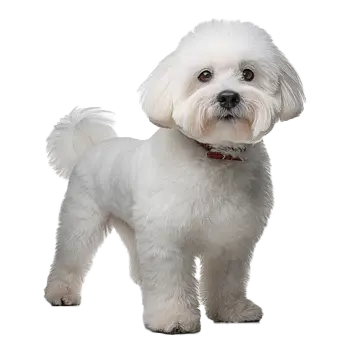
The Bichon a Poil Frise's appearance is defined by its coat in a way that is true of very few breeds. The double coat - a soft, dense undercoat beneath a curly, springy outer layer - is groomed into a rounded shape that gives the dog its characteristic powder-puff silhouette. The coat does not hang, drape, or lie flat. It stands away from the body in tight, springy curls that hold a rounded scissored shape with precision when properly prepared for the show ring. On a well-presented specimen the dog appears almost perfectly spherical from the head backward, with the head similarly rounded by the coat.

Beneath the coat, the Bichon a Poil Frise is a moderately built small dog with proportionate structure and solid bone for its size. The body is nearly square, with the length from shoulder to buttock closely matching the height at the withers. The chest is adequately deep, the back level, and the topline straight. The neck is long and carries the head high, contributing to the alert, upright carriage that characterizes the breed in motion.

The head is proportionate and moderately broad, with a slightly rounded skull and a defined stop. The eyes are among the breed's most expressive features - round, dark brown, and large relative to the skull, framed by black pigment on the rims and set with black halos of skin. The combination of the dark eyes against the white coat and the surrounding black pigmentation gives the face a bright, engaging, almost impish quality. The nose is black, round, and well-defined. Ears are drop ears, set high, covered by the curly coat and carried close to the head.

Height ranges from 9.5 to 11.5 inches and weight typically falls between 12 and 18 pounds. This makes the Bichon a Poil Frise somewhat larger and more substantial than its Maltese and Bolognese cousins, though it remains well within the small dog category. Both sexes are similar in size.

Color is white. Cream or apricot shadings are acceptable on puppies and young dogs and may appear faintly on adult dogs as well. Any buff coloring should be less than 10 percent of the coat in competition. The coat's texture - the springy curls and the underlying softness - is an essential breed characteristic and not merely a grooming style. Dogs with straight or wavy coats do not conform to standard regardless of color or structure.

Movement in the Bichon a Poil Frise is balanced, easy, and free with good reach and rear drive. The head is carried high and the tail, which is carried curved over the back, contributes to the breed's characteristic upright, lively impression. A Bichon a Poil Frise that moves with a stilted or shuffling gait is failing to express the breed's natural athleticism, which despite the pampered appearance is entirely genuine.

The Bichon a Poil Frise is more substantial in build than many people expect given the breed's toy-adjacent reputation. The bones are moderate rather than fine, the muscles adequate for normal activity, and the overall construction sound. This makes the breed genuinely appropriate for families with active children and households that want a small dog without the fragility concerns that come with the lightest toy breeds. The powder-puff exterior contains a sturdy, functional small dog built to live fully.

Affectionate With Family
The Bichon a Poil Frise is genuinely warm and physically demonstrative with the people it lives with. Closeness to family is central to this breed's sense of wellbeing.
Good With Young Children
One of the better small breeds for families with children, the Bichon a Poil Frise is patient, playful, and durable enough to handle the energy of an active household.
Good With Other Dogs
The Bichon a Poil Frise is notably sociable with other dogs and rarely initiates conflict. This breed typically enjoys multi-dog households and dog park visits.
Shedding Level
The double coat sheds minimally. Loose hairs tend to remain caught in the curly outer coat rather than releasing onto furniture and floors.
Coat Grooming Frequency
The dense curly coat requires frequent professional grooming and regular brushing between appointments to prevent mats. This is a high-grooming breed by any measure.
Drooling Level
The Bichon a Poil Frise does not drool meaningfully. It is among the cleanest small breeds from a saliva standpoint.
Coat Type
The outer coat is dense, springy, and curly, creating the characteristic rounded powder-puff silhouette that defines the breed's show appearance.
Openness To Strangers
Few breeds greet new people as readily as the Bichon a Poil Frise. This dog typically approaches strangers with tail wagging and interest rather than caution.
Playfulness Level
Playful and enthusiastic throughout its life, the Bichon a Poil Frise maintains a puppy-like energy and enthusiasm for games well into adulthood.
Watchdog/Protective Nature
Alert enough to notice and announce intruders, but so friendly with strangers that it is not a reliable deterrent. More notice-giver than guardian.
Adaptability Level
Comfortable in apartments and houses alike, the Bichon a Poil Frise adapts to varied living situations as long as companionship and daily activity are consistent.
Trainability Level
Eager to please and responsive to positive reinforcement, the Bichon a Poil Frise learns quickly and performs well in basic obedience. Stubbornness is mild and easily managed.

Bichon a Poil Frise History & Development

The name Bichon a Poil Frise belongs to a breed whose ancestors were sailing around the Mediterranean long before anyone thought to write it down formally. The Bichon family of dogs - small, white, curly or fluffy-coated companions - has roots in the Mediterranean basin reaching back to at least the fourteenth century. Spanish sailors are credited with carrying these small dogs across trade routes, introducing them to the Canary Islands and then throughout Europe. This maritime dispersal eventually produced regional variations: the Bolognese in Italy, the Bichon Maltais in Malta, the Havanais in Cuba, and the Bichon a Poil Frise in the French and Belgian courts where the breed became most fashionable.

The dog we call the Bichon a Poil Frise today was developed primarily in France and Belgium during the nineteenth and early twentieth centuries, where breeders standardized the curly coat and refined the structure toward the compact, rounded type the breed is known for today. The breed enjoyed aristocratic popularity during the reign of Henry III of France in the sixteenth century and continued to be associated with royal households through the seventeenth and eighteenth centuries. The French name reflects this cultural positioning - it is a formal, Gallic name that positions the breed as a product of French refinement.

The breed experienced a significant decline following World War I and World War II, when the disruptions of war reduced breeding populations and made non-working dogs a luxury few could maintain. The Bichon a Poil Frise survived largely through the efforts of Belgian and French breeders who maintained small populations through the mid-twentieth century. By the 1950s and 1960s, the breed was being exported to the United States, where it found enthusiastic support. The FCI officially recognized the Bichon a Poil Frise under French and Belgian joint patronage in 1933, and the AKC admitted the breed to its studbook in 1972.

The name Bichon Frise became the standard English designation during the breed's American development, as the abbreviated form was simply more practical for everyday use. Breed clubs in the United States adopted Bichon Frise as the official name while acknowledging the full French name Bichon a Poil Frise in FCI correspondence and international documentation. Today the two names are treated as fully equivalent across international registries.

The Bichon a Poil Frise has grown considerably in popularity since its American introduction and now ranks consistently among the top fifty to eighty breeds in AKC registration statistics. Its temperament - sociable, playful, gentle, and adaptable - combined with its low-shedding coat have made it a popular choice for urban households, families with children, and allergy-sensitive owners. The formal name Bichon a Poil Frise remains the breed's official FCI designation, a reminder that beneath the accessible, joyful companion dog familiar to millions of households is a breed with centuries of documented history and a carefully standardized type that has been maintained with intention across multiple generations of dedicated breeders.

Bichon a Poil Frise Temperament & Personality

If you want to describe the Bichon a Poil Frise in three words, the best choices are cheerful, social, and resilient. This is not a breed that holds grudges, sulks in corners, or needs convincing before engaging with the world. The Bichon a Poil Frise greets each morning like something worth celebrating. The enthusiasm is genuine, not performative, and it does not fade with age the way it does in some breeds. A well-kept ten-year-old Bichon a Poil Frise often plays with the same energy as a two-year-old.

Sociability is perhaps the defining behavioral trait. The Bichon a Poil Frise approaches strangers, other dogs, cats, and children with the assumption that everyone is either a friend or a potential friend. This is not naive; it is temperamental. These dogs were bred entirely for human company and have no residual wariness of unfamiliar people built into their working heritage. A Bichon a Poil Frise in a room full of new people is typically in the middle of it all - circulating, engaging, making itself available for affection. This quality makes the breed genuinely excellent for therapy work, where calm acceptance of unfamiliar people and environments is more valuable than loyalty to a single handler.

The bond with family is deep. The Bichon a Poil Frise is not a breed that forms an exclusive attachment to one person and tolerates everyone else. It tends to embrace the whole household equally and is genuinely distressed when left without company for extended periods. Separation anxiety is a documented behavioral challenge in this breed and should be addressed through graduated alone-time training beginning in puppyhood rather than simply hoping the dog adjusts. A Bichon a Poil Frise that is never taught to be calm alone will bark, chew, and pace when left - not to be difficult, but because the absence of company is genuinely stressful for this temperamentally social dog.

Training goes well with the Bichon a Poil Frise because the breed is both intelligent and motivated to please. It learns quickly, retains training reliably, and performs enthusiastically when sessions are positive and engaging. Housetraining is the exception - this is one of the breeds most commonly cited as slow to fully housetrain, a combination of small bladder size and a mild preference for indoor convenience that takes consistent management to overcome.

Vocalization is present but manageable. The Bichon a Poil Frise will alert bark but typically does not have the persistent, high-pitched barking that makes some small breeds difficult neighbors. Training and enrichment keep the vocalization appropriate, and a well-exercised, socially satisfied Bichon a Poil Frise is generally quiet in the home.

What sets the Bichon a Poil Frise temperament apart within the Bichon family is the degree of outward sociability. Where the Bolognese is reserved with strangers and the Maltese is warm but selective, the Bichon a Poil Frise appears to have no default suspicion whatsoever. This makes the breed an accessible, stress-free companion for people whose lives involve frequent visitors, social settings, or varied environments. The dog's consistent, cheerful engagement with new people and situations is one of its most practically useful qualities.

Bichon a Poil Frise Family Life & Living Requirements

The Bichon a Poil Frise is one of the most genuinely family-compatible small breeds. It has the size and gentleness to live safely with children without the fragility that makes some toy breeds unsuitable for active households. It is playful enough to engage with children's games and patient enough not to snap when play becomes energetic. Supervision is still appropriate with very young children who do not yet understand gentle handling, but the Bichon a Poil Frise is far more forgiving of boisterous households than smaller or more sensitive breeds.

Apartment living works well for the Bichon a Poil Frise as long as daily exercise is consistent and the dog is not routinely left alone for long hours. The breed's moderate exercise needs are manageable in an apartment - two walks daily plus indoor play satisfies the typical adult - and the low-shedding coat is practical in small spaces. The dog's sociability means it tends to be quiet in the home when its exercise and companionship needs are met.

Other pets rarely cause conflict. The Bichon a Poil Frise is consistently sociable with other dogs and manages introductions to cats and other small animals peacefully when socialized appropriately. Multi-pet households often suit this breed well since the presence of other animals helps manage the breed's separation-related tendencies.

Seniors and work-from-home adults are excellent matches. The Bichon a Poil Frise thrives with consistent human presence and brings daily playfulness and warmth to households that would benefit from an engaged, cheerful companion. The primary commitment beyond companionship is grooming - the curly coat requires professional attention every four to six weeks and consistent home brushing between appointments. Families and individuals who build this grooming schedule into their routine find the Bichon a Poil Frise a highly manageable, deeply rewarding companion. The rare combination of genuine family-friendliness, low shedding, and consistent cheerfulness makes this breed one of the more complete companion options available in the small dog category.

One practical consideration worth naming: the Bichon a Poil Frise is not a breed that tolerates being ignored. A dog in a busy household where no one makes time for daily interaction and play will develop behavioral problems regardless of how well it is fed and housed. The breed's social nature is its greatest strength, but it requires reciprocation to work well. Owners who engage with this dog consistently - walks, training, play, and simple proximity - will find the Bichon a Poil Frise one of the most enjoyable small dogs available. The investment in daily attention pays back in a companion that is reliably cheerful, gentle, and engaged from puppyhood through old age.

Bichon a Poil Frise Training & Exercise Needs

The Bichon a Poil Frise needs daily exercise, but not intense or lengthy sessions. Two walks of moderate duration daily, supplemented with indoor play or backyard access, meets the breed's physical requirements. The dog is athletic enough to enjoy longer hikes or active play when offered, but does not require this level of activity to be settled and well-behaved at home. Pent-up energy in the Bichon a Poil Frise tends to express as the breed's characteristic "Bichon blitz" - a spontaneous burst of running and spinning that dissipates quickly and is more amusing than problematic.

Training is one of the Bichon a Poil Frise's genuine strengths. The breed is intelligent, attentive, and motivated by reward, and it picks up new behaviors quickly with positive reinforcement. Basic obedience comes easily, and many Bichon a Poil Frises excel in agility, rally, and trick training that challenges them to learn sequences and perform with precision. The breed enjoys the interaction that training provides and works with enthusiasm when the relationship with the handler is built on consistency and positive experience.

Housetraining remains the traditional stumbling block. The Bichon a Poil Frise tends to resist the cold, rain, and inconvenience of going outside when the alternative seems perfectly acceptable. Crate training from puppyhood is essential - it prevents unsupervised accidents and builds the dog's understanding of appropriate timing. Scheduled outdoor access every two to three hours for puppies, with consistent positive reinforcement for outdoor elimination, produces reliable results over time. Owners should expect six to twelve months before reliability is established, and some individuals need ongoing management.

Mental stimulation supplements physical exercise effectively. Puzzle feeders, training games, and varied walking routes keep the Bichon a Poil Frise engaged and prevent the restless, attention-seeking behavior that can develop when a clever dog is under-stimulated mentally. The combination of daily physical activity and regular mental challenge produces a calm, settled companion that is genuinely easy to live with.

Socialization should begin as early as possible. The Bichon a Poil Frise's outgoing nature makes this process easy - puppies typically embrace new people and environments with curiosity rather than alarm - but consistent exposure to different situations builds the confidence and resilience that distinguishes a well-adjusted adult from one that becomes anxious when routine is disrupted. Puppy classes serve double duty as both a training foundation and a socialization opportunity, and this breed typically thrives in the group class environment.

Bichon a Poil Frise Health Concerns

The Bichon a Poil Frise has a documented lifespan of 14 to 15 years, one of the better life expectancies among small breeds. Several specific conditions are well-established in the breed and deserve attention from both prospective owners and breeders.

The testing protocol for responsible breeding centers on OFA CAER annual eye examination, OFA patellar evaluation, and OFA hip evaluation, with cardiac and Legg-Calve-Perthes evaluations recommended by the parent club. From the owner's practical standpoint: ensure the puppy's parents have current health clearances, ask the breeder specifically about urinary stone history in their lines, watch for signs of skin allergies from an early age, and establish a regular urinalysis schedule for the dog once it reaches middle age. Early awareness of this breed's specific health tendencies gives owners the tools to catch problems before they become serious.

Common Health Issues

  • Urolithiasis (calcium oxalate bladder stones) - The Bichon a Poil Frise is overrepresented for calcium oxalate stone formation in the bladder. Stones cause bloody urine, painful or frequent urination, and straining. Surgical removal is required for established stones; dietary management and increased water intake reduce recurrence risk.
  • Hyperadrenocorticism (Cushing's disease) - Overproduction of cortisol by the adrenal glands causes gradual onset of increased thirst and urination, hair loss, pot-bellied appearance, and muscle wasting in older dogs. Managed long-term with medication and regular monitoring.
  • Patellar luxation - Kneecap displacement causing intermittent rear limb skipping or lameness. Common in small breeds; most cases in the Bichon are mild to moderate with surgical correction reserved for more severe grades.
  • Legg-Calve-Perthes disease - Reduced blood supply to the femoral head causes bone degeneration in young dogs. Surgical removal of the affected femoral head produces good outcomes in small breeds.
  • Hereditary cataracts - Lens clouding that may develop at a young age in this breed. Annual CAER ophthalmic examinations allow early detection; surgical correction is available for cataracts affecting vision.
  • Atopic dermatitis and food allergies - Chronic skin inflammation, itching, and recurrent ear and skin infections are common in this breed. Management requires identifying and avoiding allergens, with ongoing medical support in affected individuals.

Preventive Care & Health Monitoring

  • Annual OFA CAER ophthalmic examination by a board-certified ACVO ophthalmologist for all breeding dogs to screen for hereditary cataracts. - Annual OFA CAER ophthalmic examination by a board-certified ACVO ophthalmologist for all breeding dogs to screen for hereditary cataracts.
  • OFA patellar evaluation for all breeding dogs. - OFA patellar evaluation for all breeding dogs.
  • OFA hip evaluation and OFA Legg-Calve-Perthes evaluation as recommended by the Bichon Frise Club of America. - OFA hip evaluation and OFA Legg-Calve-Perthes evaluation as recommended by the Bichon Frise Club of America.
  • Urinary health monitoring with annual urinalysis in middle-aged and older dogs to detect early stone formation or infection before clinical signs develop. - Urinary health monitoring with annual urinalysis in middle-aged and older dogs to detect early stone formation or infection before clinical signs develop.
  • Regular dental care including daily brushing and professional cleanings every one to two years to prevent periodontal disease. - Regular dental care including daily brushing and professional cleanings every one to two years to prevent periodontal disease.

Bichon a Poil Frise Grooming & Maintenance

The Bichon a Poil Frise has high grooming requirements relative to most companion breeds, and prospective owners should factor this honestly into their decision. The double coat - a soft dense undercoat beneath tightly curled outer hair - does not shed significantly, which is a practical benefit, but it does mat readily if not brushed regularly and requires professional grooming to maintain its characteristic shape and cleanliness.

Professional grooming every four to six weeks is standard for most pet owners. The groomer scissor-trims the coat into the rounded silhouette the breed is known for, cleans the ear canal, and trims nails. Between professional appointments, daily or every-other-day brushing prevents the mats that develop fastest in friction areas - behind the ears, under the collar, in the armpits, and at the groin. A slicker brush followed by a metal comb works well for routine brushing. Mats that are caught early can be worked out gently; mats that are allowed to tighten against the skin require clipping.

Bathing frequency of every one to two weeks maintains the white coat's brightness and the curly texture. The coat can yellow or dull with infrequent bathing, particularly around the mouth and eyes where food and tear staining accumulate. Dog-specific whitening shampoos are commonly used by both show exhibitors and pet owners to maintain coat color.

Dental care is critical for this breed. The Bichon a Poil Frise is susceptible to periodontal disease, and daily tooth brushing with enzymatic toothpaste is the most effective prevention. Professional dental cleanings under anesthesia are typically needed every one to two years. Regular ear cleaning with a veterinarian-recommended product prevents the yeast and bacterial infections to which drop-eared dogs are prone. Nails should be trimmed every three to four weeks. Eye discharge around the large round eyes should be cleaned daily to prevent staining and skin irritation.