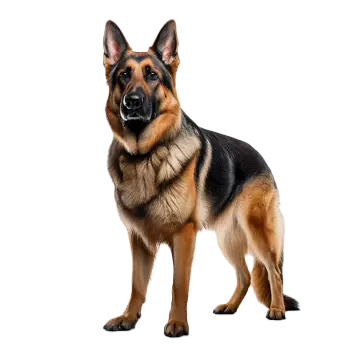
The Berger Allemand presents as a large, athletic dog whose proportions communicate both power and agility. The body is slightly longer than it is tall, with the ideal ratio of height to length approximating 10:8.5, producing the rectangular outline that distinguishes the breed from the square proportions of many other working breeds. Males stand twenty-four to twenty-six inches at the withers and weigh sixty-five to ninety pounds, while females stand twenty-two to twenty-four inches and weigh fifty to seventy pounds. Sexual dimorphism is pronounced, and a well-bred German Shepherd should be immediately identifiable as male or female at a glance. The overall impression should be one of balanced strength, with no single feature appearing exaggerated at the expense of the whole.
The head is clean-cut, strong without coarseness, and proportionate to the body. The skull and muzzle are approximately equal in length, joined at a moderate stop. The muzzle is long and wedge-shaped, ending in a large black nose with well-opened nostrils. The jaws are powerfully developed with a complete scissor bite of forty-two teeth. The eyes are medium-sized, almond-shaped, and dark brown, set slightly obliquely in the skull and conveying an expression of intelligence and alertness. The ears are moderately pointed, open toward the front, and carried erect when the dog is attentive, a feature that becomes one of the breed's most recognizable characteristics. Soft or tipped ears constitute a fault in the show ring.
The neck is strong, well-muscled, and relatively long, carried at approximately a forty-five degree angle when the dog is standing at attention and extending forward and lower during the breed's characteristic flowing trot. The chest is deep, reaching to the elbow, and moderately broad, providing ample lung and heart capacity for sustained physical effort. The back should be firm and straight, flowing without interruption into a long, gradually sloping croup. The tail is bushy, reaches at least to the hock, and is carried in a gentle curve when the dog is at rest, rising slightly when the dog is in motion or excited but never curling over the back.
The double coat is the breed's insulation system, consisting of a medium-length outer coat of dense, straight to slightly wavy hair that lies close to the body, and a thick, plush undercoat that provides thermal protection. The coat is shorter on the head, inner ears, and front surfaces of the legs, and longer and thicker around the neck, forming a moderate ruff, and on the rear of the thighs. A long-coated variety exists in which the outer coat is noticeably longer, sometimes forming ear tufts, feathering on the legs, and a fuller tail plume. This variety was historically penalized in the show ring but has gained acceptance in many registries, including the FCI, which now recognizes it as a separate variety within the breed standard.
The breed's movement is its defining physical characteristic. The German Shepherd Dog was specifically engineered to cover maximum ground with minimum effort, and the correct trot is a long, reaching, ground-covering stride in which the rear foot lands in or beyond the print left by the front foot on the same side. This efficient gait allows the dog to work for extended periods without fatigue and is the primary movement evaluated in conformation competition. The characteristic flying trot, in which the dog appears to float effortlessly across the ground, is one of the most beautiful and distinctive movements in the canine world.
Affectionate With Family
★★★★★
The Berger Allemand bonds profoundly with its family and demonstrates a level of devotion that few breeds can match. This is a dog that wants to be near its people at all times, following them from room to room and positioning itself where it can observe and protect. The depth of attachment the German Shepherd forms with its household extends to genuine emotional sensitivity, as the breed reads and responds to its family's moods with remarkable perceptiveness.
Good With Young Children
★★★★☆
The Berger Allemand typically develops a strong protective bond with children in its family, often assuming a guardian role that includes patient tolerance of the noise and unpredictability that young children bring. The breed's size and energy require supervision during interactions with very small children to prevent accidental knockdowns, but a well-socialized German Shepherd is generally gentle and attentive with kids. Many families find that the breed becomes especially devoted to the youngest household members.
Good With Other Dogs
★★★☆☆
The Berger Allemand's response to other dogs varies considerably depending on socialization history, individual temperament, and the specific context of the encounter. Well-socialized individuals coexist comfortably with other dogs, particularly when raised together. However, some German Shepherds, especially intact males, can display same-sex aggression or assertive behavior toward unfamiliar dogs. Early, extensive socialization with a range of dogs builds the social confidence that produces a well-adjusted adult.
Shedding Level
★★★★★
The Berger Allemand is one of the heaviest shedding breeds in existence, earning the affectionate nickname 'German Shedder' among devotees. The dense double coat sheds continuously throughout the year, depositing hair on every surface in the home. Twice annually, during the seasonal coat blow in spring and fall, shedding escalates dramatically as the undercoat releases in large clumps. Owners who are not prepared for a permanent relationship with lint rollers and vacuum cleaners should reconsider this breed.
Coat Grooming Frequency
★★★☆☆
The Berger Allemand's coat is relatively low-maintenance in terms of professional grooming needs, requiring no trimming, clipping, or special styling. However, regular brushing several times per week is essential to manage the constant shedding and prevent the undercoat from becoming compacted. During the biannual coat blow, daily brushing with an undercoat rake becomes necessary. The coat is naturally weather-resistant and self-cleaning to a degree, so bathing should be infrequent to preserve the coat's protective oils.
Drooling Level
★★☆☆☆
The Berger Allemand is not a heavy drooler under normal circumstances, though some individuals may produce noticeable saliva when anticipating food, after vigorous exercise, or when stressed. The breed's tight lip structure keeps drooling minimal compared to breeds with loose flews. Owners can expect a generally clean, dry-mouthed companion, with occasional situational drooling that does not require special management.
Coat Type
★★★☆☆
The Berger Allemand carries a dense double coat consisting of a medium-length outer coat that lies close to the body and a thick, plush undercoat that provides insulation against temperature extremes. The standard coat variety is the most common, though a longer-coated variety also exists and is now accepted in many registries. The coat's texture is ideally straight and harsh, though slight waviness is acceptable. This functional coat reflects the breed's working origins in the variable German climate.
Openness To Strangers
★★☆☆☆
The Berger Allemand is naturally reserved and discerning with unfamiliar people, maintaining a watchful distance while assessing a stranger's intentions before offering any warmth. This measured response to newcomers is a core breed characteristic rather than a socialization failure, reflecting centuries of selection for guarding and protective work. Well-socialized German Shepherds can distinguish between genuine threats and harmless visitors, but they rarely become the kind of dog that greets every stranger with unbridled enthusiasm.
Playfulness Level
★★★★☆
The Berger Allemand retains a strong play drive well into adulthood, particularly when play involves mental challenge or physical activity that engages its working instincts. Retrieving games, tug-of-war, and structured play that mimics aspects of its working heritage provide the breed with both exercise and mental satisfaction. The German Shepherd's play style tends to be vigorous and purposeful rather than frivolous, and its enthusiasm for interactive games with its handler makes it an engaging companion for active families.
Watchdog/Protective Nature
★★★★★
The Berger Allemand is among the premier watchdog and protection breeds in the world, combining exceptional alertness, physical capability, and the courage to act when it perceives a genuine threat to its family or territory. The breed's protective instincts are deeply embedded and require responsible management through training and socialization to ensure that the dog can distinguish between real threats and normal social interactions. An untrained German Shepherd's protective drive can manifest as inappropriate aggression, while a well-trained one represents one of the most capable and reliable personal protection dogs available.
Adaptability Level
★★★☆☆
The Berger Allemand can adapt to a range of living situations provided its substantial exercise, mental stimulation, and companionship needs are consistently met. The breed can live in an apartment if given sufficient daily activity, but it thrives with access to outdoor space. It handles changes in routine and environment reasonably well when it has a stable relationship with its handler, though prolonged isolation or understimulation produces anxiety-driven behavioral problems including destructive chewing, excessive barking, and pacing.
Trainability Level
★★★★★
The Berger Allemand is one of the most trainable breeds in existence, combining high intelligence, strong work ethic, and a desire to collaborate with its handler that makes it excel across an extraordinary range of disciplines. From basic obedience through advanced competition work, police and military service, search and rescue, disability assistance, and detection work, the breed's trainability has made it the default choice for more professional working roles than any other breed. It responds best to clear, consistent, reward-based training that builds on the natural partnership between dog and handler.